
Short Important Questions
- How brandy is served in a bar? (1 Mark, 2025)
- What are the three grapes varieties used to produce cognac?
- How long you need to aged to grade VVSOP in Cognac brandy? (Board 2022)
Long Important Questions
- Why are aged whiskies and brandies considered better than younger ones, and why are they more expensive? (10 Marks, 2017)
- What are different categories of Brandy? List down the four popular brands of cognac? (5 Marks, 2018)
- Compare the Cognac brandy with other brandies and differentiate it. (5 Marks, 2023)
- Highlight the differences between Rum and Brandy. (5 Marks, 2025)
Introduction
Brandy is a distilled spirit made from fermented fruit juice, most commonly from grapes. It’s standard alcohol content typically ranges from 35% to 60% ABV.
The name comes from the Dutch word “Brandewijn”, meaning “burnt wine,” which refers to the distillation process. While grape brandy is the most common, other fruits such as apples, pears, cherries, and apricots can also be used.
Brandy is generally taken as an after-dinner drink and is used in cooking, cocktails, and desserts to enhance flavor.
Manufacturing Process
- Fermentation
Fermentation is the process where crushed fruits (usually grapes) are converted into a low-alcohol wine by the action of yeast. This base wine forms the starting point for brandy production.- Yeast consumes the sugars in the fruit juice, producing alcohol, carbon dioxide, and flavor compounds.
- The resulting wine has 8–12% ABV and high acidity.
- Fermentation is usually done at a controlled temperature of 20–25°C for up to 5 weeks, depending on the fruit and style of brandy.
- Distillation
After fermentation, the low-alcohol wine is heated in a still to separate alcohol from water and other components. The alcohol vapors rise, are collected, and condensed back into a clear, high-proof liquid called eaux-de-vie.- Pot Stills are commonly used for Cognac, usually involving double distillation for a refined taste.
- Column Stills are used for Armagnac or some American brandies, allowing continuous distillation for larger-scale production.
- The distilled spirit has a much higher alcohol content than the original wine, often around up to 70% ABV.
- Premium brandies are often distilled in small batches to carefully preserve aroma and flavor.
- Ageing / Maturation
Once distilled, the clear brandy (eaux-de-vie) is transferred into oak barrels for aging. This stage is crucial as it:- Color: The brandy slowly turns golden or amber from the wood.
- Flavor: It picks up vanilla, caramel, spice, and oak tastes, while the strong alcohol taste becomes smoother.
- Texture: The drink becomes softer and easier to sip.
- Evaporation: About 1% of alcohol evaporates each year, called the “angels’ share.”
The aging duration varies by type:
- Cognac and most grape brandies: typically aged at least 2 years.
- Armagnac and some premium brandies: may age much longer for richer complexity.
- Blending
Different barrels, ages, or batches of brandy are mixed together by the master blender to create a consistent flavor and style. Sometimes water is added to reach the desired bottling strength (usually around 40% ABV). - Bottling and Labelling
Once blended, the brandy is filtered if needed and then bottled with labelling for sale.
Types on the basis of Grapes
- Cognac
Cognac is often called the “King of Brandies.” It is a protected spirit, meaning it can only be labeled “Cognac” if it is produced according to strict AOC (Appellation d’Origine Contrôlée) laws in France.
Geographic Region
Cognac must be made in the Charente and Charente-Maritime regions of Western France, around the town of Cognac. The area is divided into six crus (i.e. growing zones) based on soil quality, with Grande Champagne and Petite Champagne being the most famous.
Here are the names of six regions:
| Grande Champagne | Petite Champagne | Borderies |
| Fins Bois | Bons Bois | Bois Ordinaires |
Permitted Grapes Variety
Authentic Cognac is made from at least 90% Ugni Blanc, Folle Blanche, or Colombard grapes.
Distillation Process and Ageing
Cognac must be double-distilled in a Charentais copper pot still. It must be aged in French Oak barrels (typically from the Limousin or Tronçais forests) with minimum aging period of 2 years.
Cognac Aging Standard
| Label | Meaning | Legal Minimum Age | |
|---|---|---|---|
| V.S. (or ***) | Very Special (3 Stars) | 2 Years | Fresh, fruity, best for cocktails |
| V.S.O.P. | Very Superior Old Pale | 4 Years | Smoother, with flavor of oak and spice |
| Napoléon | – | 6 Years | Intermediate grade between VSOP and XO |
| X.O. | Extra Old | 10 Years | – |
| X.X.O. | Extra Extra Old | 14 Years | – |
- Armagnac
Armagnac is a premium French brandy, produced in southwest France. It is considered the oldest distilled spirit in France and is known for its rich, fruity, and nutty flavor profile.
Geographic Region
Armagnac is made in three main regions:
a. Haut-Armagnac
b. Bas-Armagnac
c. Ténarèze.
The black oak barrels used for aging often come from the Monlezun forest which imparts a very dark color and strong tannins.
Permitted Grapes
Armagnac is made from a blend of four main grape varieties:
| Ugni Blanc | Baco Blanc | Folle Blanche | Colombard |
Distillation Process
Armagnac is usually distilled only once using a special column still called an Alambic Armagnacais.
Age of Armagnac
The label and grades is similar to the cognac bottle but maturation year is different.
| Label | Meaning | Legal Minimum Age |
|---|---|---|
| V.S. (or ***) | Very Special (3 Stars) | 1 Year |
| V.S.O.P. | Very Superior Old Pale | 4 Years |
| Napoléon | – | 6 Years |
| X.O. | Extra Old | 10 Years |
- Pomace brandy
It is a type of brandy made from the solid remains of grapes left after the juice has been pressed for winemaking. These leftover solids—called pomace—include grape skins, seeds, and sometimes stems. Instead of discarding this material, distillers ferment it and then distill it to produce a spirit.
Characteristics:- Appearance: Usually clear or lightly colored, though some aged varieties may take on a golden hue if matured in wood.
- Flavor: Strong, robust, and often slightly earthy or fruity, reflecting the concentrated flavors of the grape skins and seeds.
Pomace brandies are usually sipped neat as a digestif but can also be used in cocktails or for culinary purposes, such as flavoring desserts.
This type of brandy is distinct from grape juice brandies like Cognac or Armagnac because it is made from grape solids rather than the fermented juice, giving it a more intense and sometimes rustic flavor.
A well-known example is Grappa from Italy, Marc (France) and Orujo (Spain).
Types on Basis of Fruits
- AppleJack Brandy
Applejack is a type of fruit brandy made from apples. It is produced by fermenting apple juice (like making cider) and then distilling it to concentrate the alcohol and flavors.
Manufacturing Process
Fresh apples are crushed to extract juice, which is fermented into apple cider. This cider is then distilled in stills to produce apple brandy. Some traditional Applejack was made by freezing cider and removing ice (a method called freeze distillation), but modern Applejack is usually distilled in pot or column stills.
Characteristics
Applejack has a smooth, fruity apple aroma with warm, slightly spicy notes when aged in oak barrels. It may be clear when unaged or golden when aged in wood.
Alcohol Content
Applejack generally contains 35%–50% ABV.
Applejack is most closely associated with the United States, especially New Jersey, where it is a traditional American apple brandy. It is enjoyed neat, on the rocks, or in classic cocktails such as the Jack Rose. - Marpha Brandy
Marpha is a traditional apple brandy of Nepal, made mainly in the village of Marpha in the Mustang region. It is one of the most famous local fruit brandies of the country.
Often called the ‘Apple Capital of Nepal,’ this high-altitude area (about 2,670 meters above sea level) has the ideal climate for growing the apples used to make Marpha brandy.
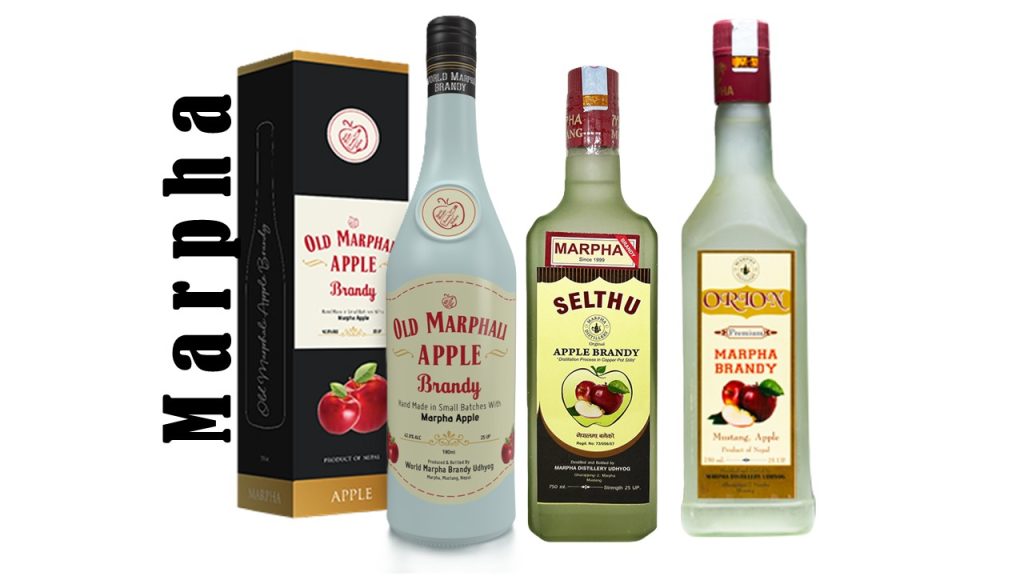
Marpha is made from local Himalayan apples, which grow in the cold and dry climate of Mustang. However, sometimes apricots and Pears (locally known as Naspati) are also used.
Characteristics
Marpha has a fresh apple aroma, a dry and slightly smoky taste, and a strong, warming character. In color, it is usually clear or pale (transparent), similar to an Italian Grappa.
It is unaged fruit brandy with alcohol strength of 40-50 % ABV. It is commonly served neat or warm, especially in cold mountain regions, and is popular with both locals and tourists.
Popular Brands
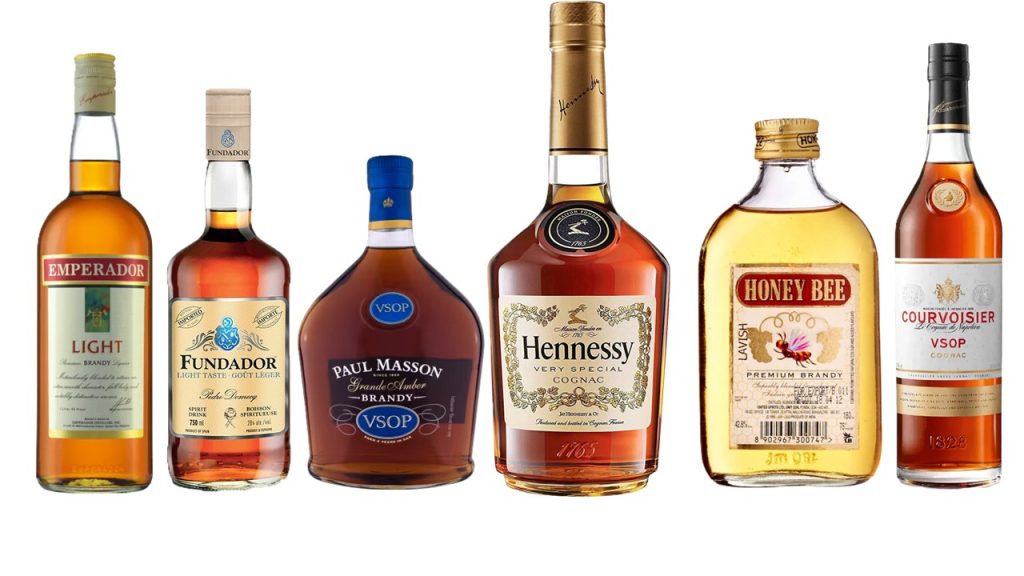
| Hennessy (France) | E&J Gallo (USA) | Metaxa (Greece) |
| Courvoisier (France) | Martell (France) | Rémy Martin (France) |
| St-Rémy (France) | Christian Brothers (USA) | Darroze (France) |
| Emperador (Philippines) | Paul Masson (USA) | Old Admiral (India) |
| Fundador Light (Spain) | Janneau (France) | Mansion House (India) |
| Marpha Brandy (Nepal) | Camus (France) | Honey Bee (India) |
| Torres (Spain) | Lepanto (Spain) | Fundador (Spain) |
Service of Brandy
Brandy is traditionally served neat at room temperature in Western countries, usually in a snifter (brandy balloon) or tulip-shaped glass. The wide bowl allows the aroma to collect, and the narrow top concentrates the fragrance. The glass is often gently warmed by holding it in the palm, which helps release the rich aromas.
In many Asian countries, brandy is also commonly served on the rocks (with ice).
Standard Measure: The standard measure for brandy is 30 ml.
Glassware:
• Brandy snifter (Brandy balloon)
• Tulip glass / Brandy inhaler
Accompaniments:
• Ice cubes
• Cola
• Dry ginger ale
• Soda water
• Plain or warm water
Difference between Cognac and Armagnac
| Cognac | Armagnac |
|---|---|
| It is double distilled. | It is single distilled. |
| It is the most famous and highest-selling brandy in the world. | It is less produced and more artisanal than Cognac. |
| Distillation is done in Charentais copper pot stills. | Distillation is done in a special Armagnac column still (Alambic Armagnacais). |
| Alcohol after distillation is about 70% ABV. | Alcohol after distillation is about 52–60% ABV. |
| Aging is usually longer and more controlled. | Aging is often shorter but more intense because of stronger spirit. |
| Aged in French oak barrels (Limousin or Tronçais). Caramel may be added for color consistency. | Aged in Gascony or Limousin oak barrels, which naturally give a darker color. |
| Ugni Blanc, Folle Blanche, Colombard are grape variety used. | Ugni Blanc, Folle Blanche, Baco Blanc, Colombard are grape variety used. |
| Produced in Grande Champagne, Petite Champagne, Borderies, Fins Bois, Bons Bois, Bois Ordinaires. | Produced in Bas Armagnac, Ténarèze, Haut-Armagnac |
| Brands Example: Hennessy, Martell, Rémy Martin, Courvoisier | Brands Example: Janneau, De Montal, Darroze, Castarède |