
| Dear Students, If you find any question paper missing from any year, please contact us through our email address “bhmaims@gmail.com“ Also, if you have any missing past-year board question papers, kindly forward them to us so that we can update in our website. |

In the previous curriculum, “Nepalese Society and Politics” was included in the 8th semester. However, after the syllabus update in 2025, the subject was shifted to the 4th semester.
Below are the questions that were asked in the 8th semester under the old syllabus.
Nepalese Society and Politics Question Paper Year 2018
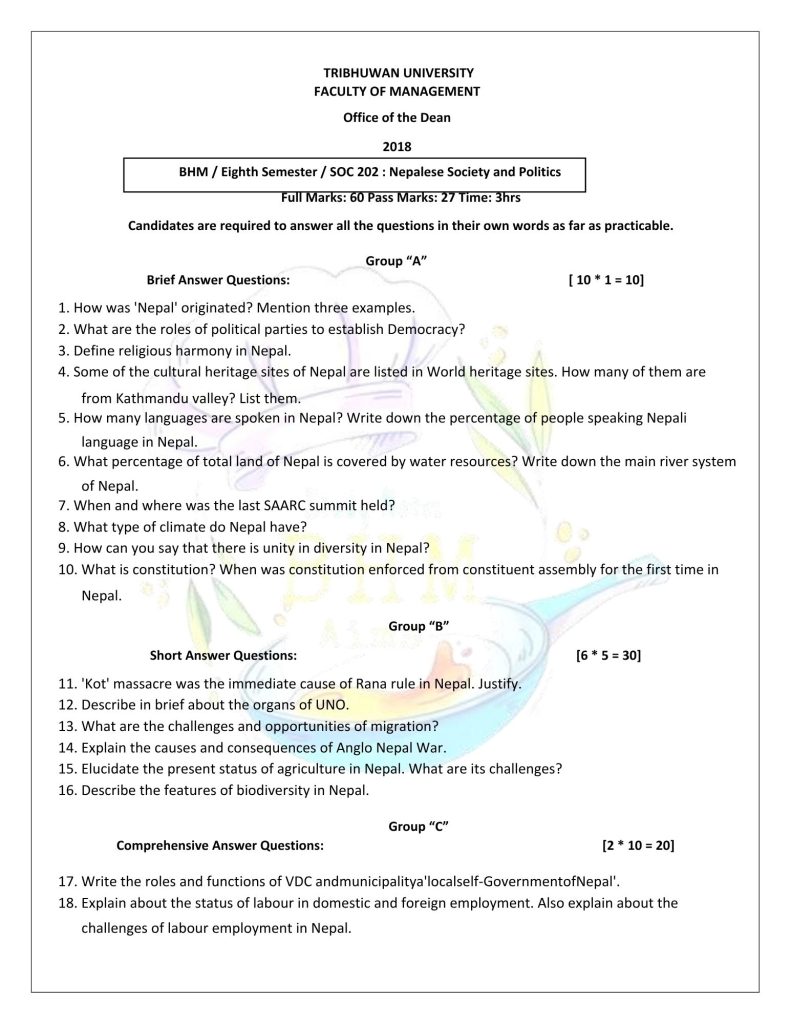
Nepalese Society and Politics Question Paper Year 2019

Nepalese Society and Politics Question Paper Year 2021

Nepalese Society and Politics Question Paper Year 2022

Nepalese Society and Politics Question Paper Year 2023

Nepalese Society and Politics Question Paper Year 2024 (Old Syllabus)
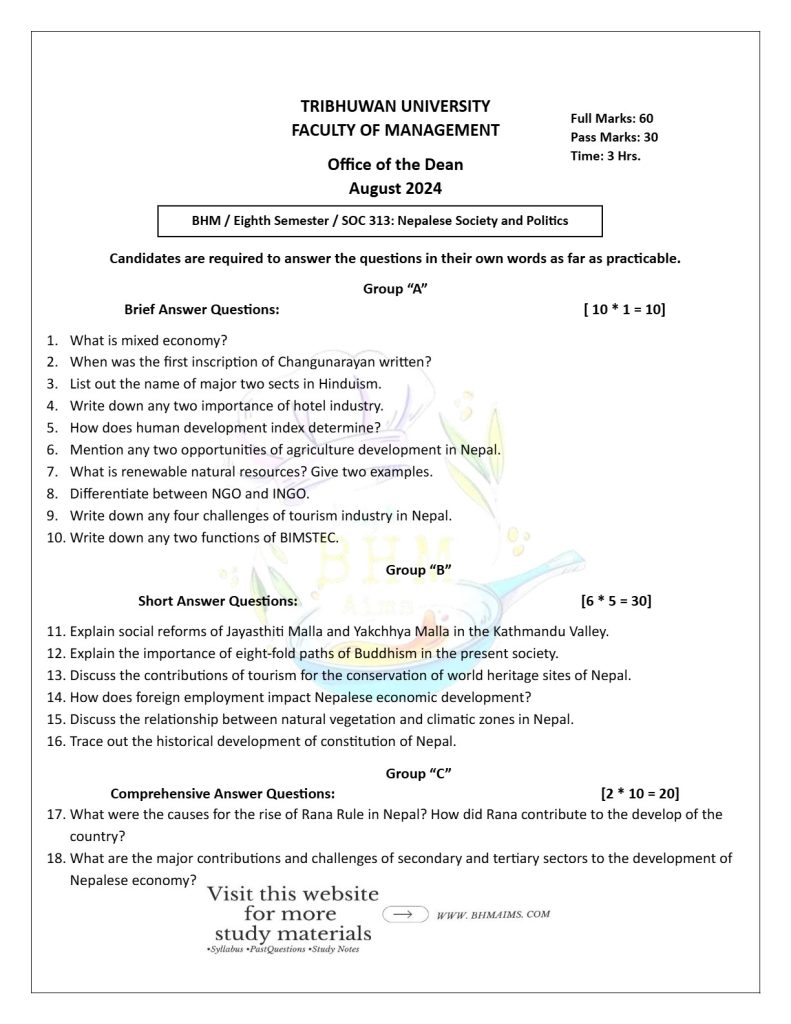
Nepalese Society and Politics Question Paper Year 2025 (Old Syllabus)
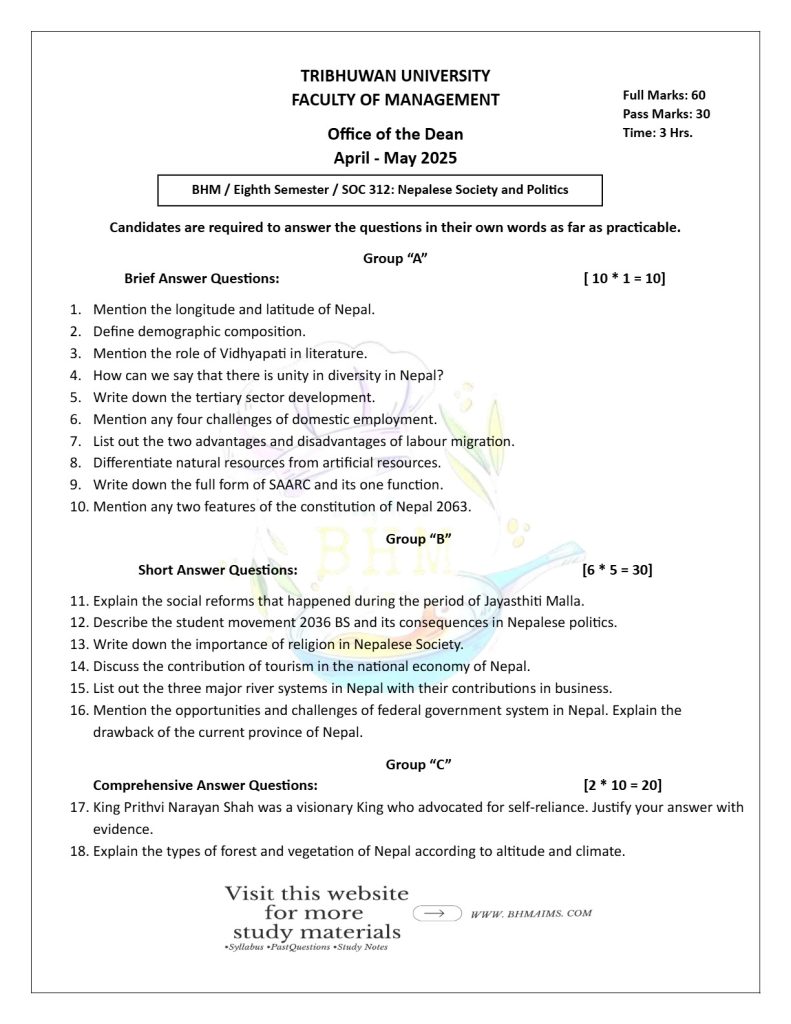
Nepalese Society and Politics Question Paper Year 2026 (Old Syllabus)
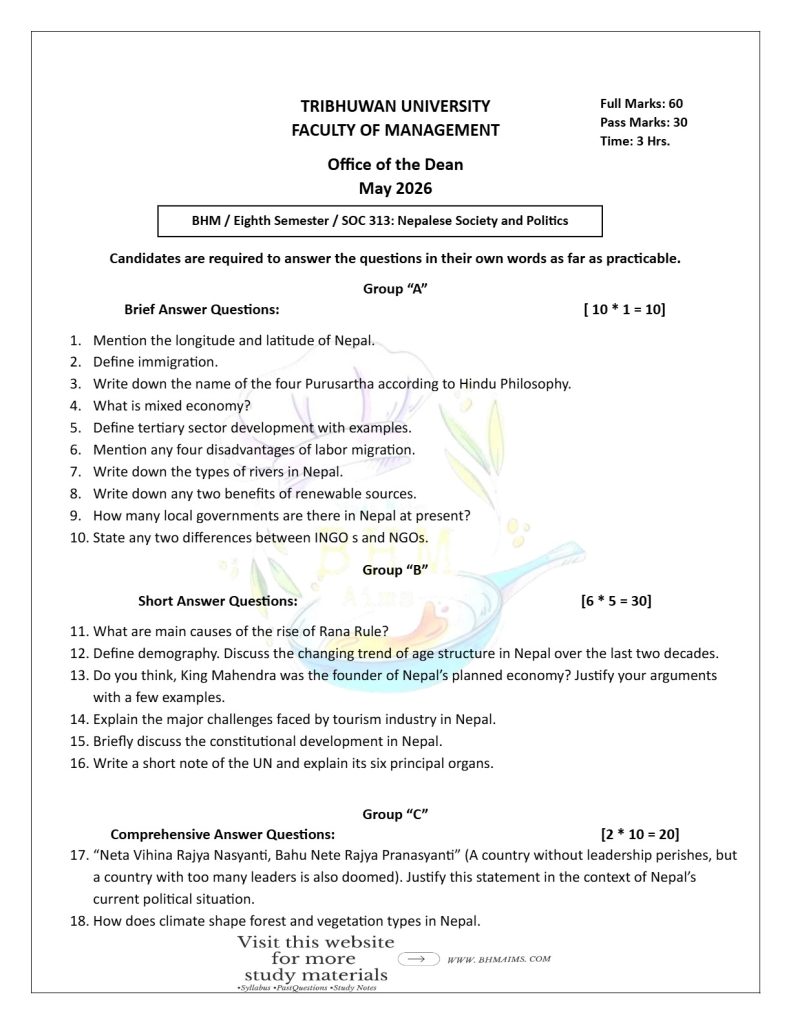
Solved Answers of Year 2025 (4th Semester)
- Define natural resources in a sentence. (Unit 3: Resources in Nepal)
↪
Natural resources are the materials and elements provided by nature that are used by humans for survival and economic development. - Write two features of Nepali society. (Unit 2: Modern Nepal and Contemporary Issues in Politics)
↪
Any two features of Nepali Society are:- Multicultural and multi-ethnic society
- Religious and cultural diversity with social harmony
- Distinguish autocracy from democracy. (Unit 2: Modern Nepal and Contemporary Issues in Politics)
↪
| Basis | Autocracy | Democracy |
|---|---|---|
| Power | Controlled by one ruler or a small group | Power lies with the people |
| Participation | No or very limited public participation | Citizens participate in decision-making |
- Why is sovereignty important for a nation? (Unit 1: Ancient Nepal)
↪
Sovereignty is important because it ensures a nation’s full independence to make its own laws, decisions, and govern without external interference. - Why is the Delhi Agreement called the ‘Tripartite Agreement’? (Unit 2: Modern Nepal and Contemporary Issues in Politics)
↪
It is called the Tripartite Agreement because it was signed among three parties: King Tribhuvan, Nepali Congress, and the Government of India. - What were the objectives of the 1990 Movement? (Unit 2: Modern Nepal and Contemporary Issues in Politics)
↪ The objectives of the 1990 Movement are:- To restore democracy in Nepal
- To end the Panchayat system
- To establish constitutional monarchy and multiparty system
- To guarantee fundamental rights of citizens
- What is political diversity? (Unit 4: Diverity in Present Nepal)
↪
Political diversity refers to the existence of different political ideas, ideologies, parties, and beliefs within a society. - Define political stability. (Unit 2: Modern Nepal and Contemporary Issues in Politics)
↪
Political stability is a condition where a country has a stable government, peaceful environment, and consistent political system without frequent conflicts or changes. - Differentiate between immigration and emigration. (Unit 5: Contemporary Major Issues and their Challenges in Nepal)
↪
| Basis | Immigration | Emigration |
|---|---|---|
| Meaning | Entering a country to live / work | Leaving one’s country to live / work elsewhere |
| Perspective | From receiving country | From sending country |
| Direction | Inward movement | Outward movement |
| Effect on Country | Increases population of the destination country | Decreases population of the home country |
| Example | A person coming to Nepal from India | A person going to Qatar for work |
- Write two effects of climate change on business activity. (Unit 3: Resouce in Nepal)
↪
The two effects of climate change on business activity are:- Disruption in agriculture and tourism industries
- Increased cost of production due to environmental damage and disasters
- What are the roots of Nepalization process? (Unit 1: Ancient Nepal)
- “Corruption is not limited to immoral behaviour; it also leads to the underdevelopment of a country”. Explain it with an example. (Unit 2: Modern Nepal and Contemporary Issues in Politics)
- Discuss the impacts of international migration on business in Nepal. (Unit 5: Contemporary Major Issues and their Challenges in Nepal)
- “Nepal is a country of religious coexistence and harmony”. Explain it. (Unit 4: Diversity in Present Nepal)
- Discuss the major opportunities and challenges of globalization to the hospitality business in Nepal. (Unit 5: Contemporary Major Issues and their Challenges in Nepal)
- How does climate change impacts on the tourism business in Nepal? (Unit 3: Resources in Nepal)
- Describe Lichhavi civilization of the Kathmandu valley. (Unit 1: Ancient Nepal)
- How does political instability affect the development of the hotel industry? Illustrate it with example. (Unit 2: Modern Nepal and Contemporary Issues in Politics)
- Write the major types of rivers in Nepal. Discuss how Nepal’s hospitality sector can gain benefits from the river system in Nepal. (Unit 3: Resource in Nepal)
- Discuss the importance of cultural and religious diversity to promote hotel industry. Justify your answer with suitable illustration. (Unit 4: Diversity in Present Nepal)
Solved Answers of Year 2018
- How was ‘Nepal’ originated? Mention three examples. (Unit 1: Introduction)
↪
The origin of the name “Nepal” is explained by different theories:- From Ne Muni (sage) who protected the valley
- From Newar/Nepal Bhasa people
- From Tibetan word ‘Ney-Pal’ meaning holy land
- What are the roles of political parties to establish Democracy? (Unit 5: Political Development and Governance in Nepal)
↪
The roles of political parties to establish Democracy are:- Promote democratic values and awareness
- Represent people’s interests
- Conduct free and fair elections
- Form government and ensure accountability
- Define religious harmony in Nepal. (Unit 2: People, Society and Culture in Nepal)
↪
Religious harmony is the peaceful coexistence and mutual respect among people of different religions in Nepal. - Some of the cultural heritage sites of Nepal are listed in World heritage sites. How many of them are from Kathmandu valley? List them. (Unit 2: People, Society and Culture in Nepal)
↪
All seven cultural heritage sites of Kathmandu Valley were jointly listed as one UNESCO World Heritage Site in 1979 A.D. They are:- Kathmandu Durbar Square
- Patan Durbar Square
- Bhaktapur Durbar Square
- Swayambhunath Stupa
- Boudhanath Stupa
- Pashupatinath Temple
- Changu Narayan Temple
- How many languages are spoken in Nepal? Write down the percentage of people speaking Nepali language in Nepal.(Unit 2: People, Society and Culture in Nepal)
↪
| Report Name | Number of language spoken in Nepal | % of people speaking Nepali Language |
|---|---|---|
| CBS Census 2011 | 123 | ~44.6% |
| CBS Census 2021 | 124 | ~44.9% |
FYI: According to the Central Bureau of Statistics Nepal Census 2021 (2078 B.S.), the least spoken language in Nepal is Kusunda language.
| Language | Spoken by % of people | Rank |
|---|---|---|
| Nepali Maithili Bhojpuri Tharu Tamang Raute Kusunda | about 44.9% about 11–12% about 6–7% about 5–6% about 5% | 1st 2nd 3rd 4th 5th 2nd last Last |
- What percentage of total land of Nepal is covered by water resources? Write down the main river system of Nepal. (Unit 4: Resources in Nepal)
↪
About 2.6% of Nepal’s total land is covered by water resources
Nepal has three main river system of Nepal are:- Koshi River System
- Gandaki River System
- Karnali River System
- When and where was the last SAARC summit held? (Unit 5: Political Development and Governance in Nepal)
↪
The last SAARC summit (18th) was held in Nov 26-27, 2014 in Kathmandu, Nepal.
Then after, summits have been indefinitely postponed due to ongoing political tensions between India and Pakistan. - What type of climate do Nepal have? (Unit 4: Resources in Nepal)
↪
Nepal has a monsoon type climate, varying from tropical in the south to alpine in the north. - How can you say that there is unity in diversity in Nepal? (Unit 2: People, Society and Culture in Nepal)
↪
Nepal shows unity in diversity because it has 124 languages and 142 ethnic groups, yet people of different cultures and religions live together peacefully with mutual respect and national unity. - What is constitution? When was constitution enforced from constituent assembly for the first time in Nepal. (Unit 5: Political Development and Governance in Nepal)
↪
Constitution is the supreme law of a country that defines the structure of government, rights of citizens, and rules of governance.
The constitution was first enforced from the Constituent Assembly on 3rd Ashwin 2072 B.S. (20th September 2015 A.D.), known as the Constitution of Nepal 2072 B.S. - ‘Kot’ massacre was the immediate cause of Rana rule in Nepal. Justify. (Unit 1: Introduction)
↪
The Kot Massacre is considered the immediate cause of the establishment of Rana rule in Nepal because it directly led to the rise of Jung Bahadur Rana and the end of effective Shah rule.
Before the massacre, Nepal was facing political instability and power struggle among different groups such as the King, Queen, and noble families like Thapas and Pandes. There was no strong central authority, and conspiracies and rivalries were common in the royal court.
The Kot Massacre took place on 14 September 1846 at the Kot (armory courtyard) in Kathmandu. Queen Rajya Laxmi had called a meeting to find out who killed her close supporter, Gagan Singh. During the meeting, tension increased, and suddenly violence broke out. Taking advantage of the situation, Jung Bahadur Kunwar and his supporters killed many powerful nobles and rivals.
As a result of massacre:- Most of the important political leaders were killed
- Jung Bahadur became the most powerful person in Nepal
- He was appointed Prime Minister and Commander-in-Chief
- He later made the Prime Minister post hereditary, starting the Rana dynasty
This event is called the immediate cause because it instantly removed all opposition and allowed Jung Bahadur to take control of the government. After this, the Shah kings remained only nominal rulers, while real power was held by the Rana rulers for about 104 years (1846–1951).
- Describe in brief about the organs of UNO. (Unit 5: Political Development and Governance in Nepal)
↪
The United Nations (UNO) has six main organs that work together to maintain international peace, security, and cooperation.- General Assembly
– Main deliberative body of the UN
– All member countries are represented (one country = one vote)
– Discusses global issues and makes recommendations - Security Council
– Responsible for maintaining international peace and security
– Has 15 members (5 permanent + 10 non-permanent)
– Can impose sanctions and authorize military action - Economic and Social Council (ECOSOC)
– Deals with economic, social, and environmental issues
– Promotes development, education, health, and cooperation - International Court of Justice (ICJ)
– Main judicial organ of the UN
– Settles legal disputes between countries
– Located in The Hague, Netherlands - Secretariat
– Administrative body of the UN
– Headed by the Secretary-General
– Carries out day-to-day operations - Trusteeship Council
– Supervised trust territories after World War II
– Now largely inactive as all trust territories have gained independence
- General Assembly
The six organs of the UNO work together to ensure peace, justice, development, and cooperation among nations.
- What are the challenges and opportunities of migration? (Unit 2: People, Society and Culture in Nepal)
↪
The opportunities of migration are:
a. Employment opportunities
b. Remittance income
c. Skill and knowledge transfer
d. Poverty reduction
e. Economic growth
F. Better education and global exposure
g. Improvement in living standards
The challenges of migration are:- Brain drain
- Family separation and social problems
- Exploitation and unsafe working conditions
- Dependency on remittance
- Labor shortage in home country
- Cultural adjustment problems
- Psychological stress and insecurity
- Explain the causes and consequences of Anglo Nepal War. (Unit 1: Introduction)
↪
The Anglo-Nepal War was fought between Nepal and the British East India Company from 1814 to 1816. It was a significant event that shaped Nepal’s modern political and geographical structure.
The causes of Anglo Nepal War were:- Territorial Expansion of Nepal:
Nepal was expanding rapidly under the Shah rulers, extending its territory towards the east, west, and south. This expansion brought Nepal into conflict with British-controlled areas. - Border Disputes:
There were continuous disputes over border regions like Butwal, Syuraj, and areas in the Terai. Both Nepal and the British claimed these lands. - British Imperial Policy:
The British East India Company wanted to expand its empire and control trade routes, especially between India and Tibet/China. - Trade and Economic Interests:
The British were interested in Nepal’s trade routes and natural resources, which increased tensions between the two sides. - Diplomatic Failure:
Several attempts to resolve disputes through negotiation failed, leading to war as the final option.
- Territorial Expansion of Nepal:
The results / consequences of Anglo Nepal War were:
- Treaty of Sugauli (1816)
The war ended with the Treaty of Sugauli, which had major impacts on Nepal. - Loss of Territory
Nepal lost about one-third of its territory, including Kumaon, Garhwal, and parts of the Terai. - Fixed Boundaries
The modern boundaries of Nepal were largely defined, with the Mechi River in the east and Mahakali River in the west. - British Influence in Nepal
A British Resident was placed in Kathmandu, increasing British political influence in Nepal. - End of Expansion Policy
Nepal stopped its expansion and adopted a defensive foreign policy. - Beginning of Gurkha Recruitment
The British started recruiting Nepali soldiers (Gurkhas) into their army.
- Elucidate the present status of agriculture in Nepal. What are its challenges? (Unit 3: Nepalese Economy)
↪
Agriculture is the main occupation and backbone of Nepal’s economy, but its condition is still traditional and developing.
According to the World Bank (2024, latest available annual data), agriculture contributes about 21.87% of Nepal’s GDP, showing that it remains an important but gradually declining sector in the national economy.
Similarly, the Food and Agriculture Organization (FAO, Nepal at a Glance, updated 2025) reports that around 60–66% of the population still depends on agriculture for livelihood, making it the largest employment sector in the country.
However, recent economic updates from the World Bank Nepal Development Update (2025–2026) indicate that agriculture is facing pressure from climate change and structural weaknesses, although it still plays a key role in supporting rural income and food security.
Most agriculture in Nepal is subsistence-based, meaning farmers produce mainly for their own consumption rather than commercial sale. Major crops include rice, maize, wheat, millet, and potatoes, while cash crops like tea, cardamom, ginger, and coffee are slowly increasing. However, productivity remains low due to traditional farming practices, limited irrigation, and weak mechanization. As a result, Nepal is increasingly dependent on food imports for several agricultural products.
Challenges of agriculture in Nepal:- Traditional Farming System : Agriculture is still dominated by manual labor and traditional tools, resulting in low productivity.
- Climate Change and Natural Disasters: According to the World Bank (2025 Nepal Development Update), agriculture is highly affected by irregular rainfall, floods, droughts, and landslides, which reduce crop output.
- Labor Migration : Large-scale migration of youth for foreign employment has created a serious shortage of agricultural labor in rural areas.
- Weak Irrigation System : A large portion of farmland depends on monsoon rainfall due to insufficient irrigation facilities.
- Fragmented Landholding : Land division through inheritance has created very small and scattered land plots, making commercial farming difficult.
- Poor Market System : Farmers face problems such as lack of storage, transport facilities, and unfair pricing due to middlemen, leading to post-harvest losses.
- Low Use of Technology and Investment : Limited access to modern seeds, fertilizers, machinery, and agricultural finance reduces productivity and modernization.
- Describe the features of biodiversity in Nepal. (Unit 4: Resources in Nepal)
↪
Biodiversity means the variety of plants, animals, and microorganisms found in a place. Nepal is very rich in biodiversity because of its different climates, altitudes, and geographical conditions.- Wide Range of Climate : Nepal has tropical, subtropical, temperate, and alpine climates. Different climates support different kinds of plants and animals.
- Variation in Altitude : Altitude ranges from about 60 meters in the Terai to 8,848.86 meters at Mount Everest which creates many ecosystems and habitats.
- Rich Flora and Fauna : Nepal has thousands of species of flowering plants, birds, mammals, reptiles, and insects. Rare animals like the one-horned rhinoceros, Bengal tiger, red panda, and snow leopard are found here.
- Different Ecosystems : Forests, grasslands, wetlands, rivers, lakes, and Himalayan regions are major ecosystems of Nepal.
- Large Forest Coverage : A significant portion of Nepal is covered by forests, which help protect wildlife and the environment.
- Presence of Protected Areas : Nepal has national parks, wildlife reserves, conservation areas, and buffer zones to conserve biodiversity. Examples include Chitwan National Park and Sagarmatha National Park.
- High Endemic Species : Some plants and animals found in Nepal are unique and not found elsewhere.
- Cultural Importance : Many communities in Nepal protect forests, animals, and plants through religious and traditional practices.
- Write the roles and functions of VDC and municipality a ‘local self-Government of Nepal’. (Unit 5: Political Development and Governance in Nepal)
↪
Local self-government bodies like Village Development Committees (VDCs) (now replaced by rural municipalities) and municipalities play a vital role in local development, service delivery, and governance in Nepal.
Their roles and functions are:- Prepare and implement local development plans
- Construct infrastructure (roads, drinking water, irrigation, sanitation)
- Provide basic services (education, health, water supply)
- Collect local taxes and manage budget
- Maintain local peace and help resolve disputes
- Promote social welfare (women, children, marginalized groups)
- Protect environment and natural resources
- Encourage people’s participation in decision-making
- Support local economic activities (agriculture, small industries)
- Waste Management : Collection, disposal, and recycling systems to maintain cleanliness and address environmental concerns
- Explain about the status of labour in domestic and foreign employment. Also explain about the challenges of labour employment in Nepal. (Unit 3: Nepalese Economy)
Solved Answers of Year 2019
- List out four major social reforms made during Ranarchy. (Unit 1: Introduction)
↪
During the Rana period in Nepal, some major social reforms were introduced:- Abolition of Sati system (widow burning practice was stopped)
- Ban on slavery system (Das Pratha)
- Introduction of formal education system (opening of Durbar High School)
- Legal reforms to improve social order and administration
- Mention the conditions of the Sugauli Treaty. (Unit 1: Introduction)
↪
The conditions of the Sugauli Treay are:- Nepal had to cede (surrender or hand over) all territories west of the Mahakali River, including Kumaon and Garhwal.
- Nepal had to give up all lands between the Mechi and Tista Rivers, which were occupied during unification.
- Nepal was required to surrender a large portion of the Terai region, although some parts were later returned.
- A British Resident was established in Kathmandu, ending Nepal’s isolation policy.
- Nepal was not allowed to employ Europeans or Americans without British permission.
- Nepal had to withdraw its claims over Sikkim permanently.
- Any disputes with neighboring states were to be decided by the British Government (British arbitration).
- The treaty fixed Nepal’s boundary roughly to its present shape, with the Mechi River in the east and Mahakali River in the west.
- Specify three sects of Buddhism. (Unit 2: People, Society and Culture in Nepal)
↪ Any three sects of Buddhism are:- Mahayana Buddhism
- Hinayana (Theravada) Buddhism
- Vajrayana (Tantric) Buddhism
- Define language in a sentence. (Unit 2: People, Society and Culture in Nepal)
↪
Language is a system of communication used by humans to express thoughts, ideas, and emotions through spoken, written, or symbolic forms. - Enlist the main contributions to national economy from secondary sectors. (Unit 3: Nepalese Economy)
↪
The main contributions to national economy from secondary sectors are:- Industrial production and manufacturing
- Job creation in factories and industries
- Contribution to GDP through goods production
- Export of manufactured products
- Classify natural resources with one proper example from each. (Unit 4: Resources in Nepal)
↪- Renewable resources: Resources that can be renewed or replenished quickly by nature (E.g. solar energy, wind, and water)
- Non-renewable resources: Minerals (e.g., iron, copper, fossil fuels like petroleum and coal)
- What are the three levels of rivers in Nepal? Write down with proper examples. (Unit 4: Resources in Nepal)
↪
The three levels of rivers in Nepal are:- First Grade (Himalayan) Rivers: These rivers originate from glaciers and snow-covered Himalayan mountains. They are perennial (flow throughout the year). Examples: Koshi, Gandaki (Narayani), Karnali
- Second Grade (Mid-hill) Rivers: These rivers originate from the Mahabharat range and middle hills. They are partly perennial and mainly fed by monsoon rain. Examples: Bagmati, Kamala, Rapti, Mechi, Kankai
- Third Grade (Siwalik/Chure) Rivers: These rivers originate from the Siwalik (Chure) hills. They are mostly seasonal and depend on rainfall. Examples: Tinau, Banganga, Sirsia, Manusmara
- Write down four objectives of SAARC. (Unit 5: Political Development and Governance in Nepal)
↪
Any four objectives of SAARC are:- Promote economic growth and regional cooperation
- Improve living standards of people in South Asia
- Strengthen mutual trust and friendship among member countries
- Promote social, cultural, and scientific cooperation
- Define tourism. (Unit 3: Nepalese Economy)
↪
Tourism is the activity of traveling to places outside one’s usual environment for leisure, recreation, business, or other purposes for a limited time period. - Mention the number of parts, articles and schedule of interim constitution of Nepal 2063. (Unit 5: Poltical Development and Governance in Nepal)
↪
The Interim Constitution of Nepal 2063 B.S. has:- Parts: 25
- Articles: 167
- Schedules: 4
- The Lichhavi period is known as the ‘golden age’ in the history of Nepal. Justify. (Unit 1: Introduction)
The Lichhavi Period (approximately 400–750 A.D.) is regarded as the golden age of Nepal because it witnessed remarkable progress in political stability, economy, art, culture, religion, and administration.
- Political Stability and Good Governance : During this period, Nepal had a strong and stable government under capable rulers like Manadeva and Amshuvarma.
- Well-organized administration system
- Rule of law and justice
- Efficient taxation and governance
- Economic Prosperity : The Lichhavi period experienced economic growth and prosperity:
- Development of agriculture and irrigation systems
- Flourishing trade with India and Tibet
- Use of coins and organized taxation system
- Development of Art and Architecture : This period is famous for its artistic and architectural achievements:
- Construction of temples, palaces, and sculptures
- Fine stone carvings and inscriptions
- Beginning of pagoda-style architecture
- Cultural and Religious Harmony : There was religious tolerance and harmony:
- Coexistence of Hinduism and Buddhism
- Development of festivals, traditions, and cultural practices
- Advancement in Literature and Education
– Use of Sanskrit language in inscriptions and literature
– Development of education and knowledge
– Historical records through inscriptions - Social Development
– Organized social structure
– Improvement in lifestyle and social practices
– Development of laws and customs
- Political Stability and Good Governance : During this period, Nepal had a strong and stable government under capable rulers like Manadeva and Amshuvarma.
- There is religious harmony in Nepal. Justify it with suitable examples. (Unit 2: People, Society and Culture in Nepal)
↪
Nepal is a multi-religious country where people of different religions live together with mutual respect, tolerance, and cooperation. This shows strong religious harmony in Nepalese society.
Justification with examples:- Hindus, Buddhists, Muslims, Christians, and Kirats live peacefully together.
- People often participate in each other’s religious festivals and celebrations.
- Hindus and Buddhists jointly worship at places like Pashupatinath Temple and Swayambhunath.
- Festivals such as Dashain, Tihar, Eid, Christmas, and Buddha Jayanti are respected by people of different communities.
- Inter-religious tolerance and social cooperation are common in Nepalese society.
- The Constitution of Nepal recognizes secularism and guarantees religious freedom.
- Evaluate the contributions and challenges of foreign employment in Nepal. (Unit 3: Nepalese Economy)
- What is mixed economy? Discuss its features. (Unit 3: Nepalese Economy)
↪
A mixed economy is an economic system in which both the private sector and the public (government) sector work together to carry out economic activities such as production, distribution, and consumption of goods and services.
In a mixed economy, some industries are owned and controlled by the government, while others are owned by private individuals or companies.
The features of mixed economy are:- Co-existence of Public and Private Sector : Both government and private sectors operate side by side. Example: Government runs electricity projects, while private companies run hotels and industries.
- Economic Freedom with Regulation : Private businesses have freedom to operate, where government regulates to protect public interest.
- Profit Motive and Social Welfare
– Private sector focuses on profit.
– Government focuses on social welfare like health, education, and infrastructure. - Price Mechanism with Control
– Prices are mainly determined by market forces.
– Government may control prices of essential goods when needed. - Economic Planning
– Government prepares plans and policies for balanced development. Example: Five-year development plans in Nepal. - Reduction of Economic Inequality
Government tries to reduce income gaps through taxation and welfare programs. - Co-operation Between Sectors
Both sectors cooperate in development projects such as tourism, transport, and industry.
- Define natural resources. Highlight its importance in the promotion of hospitality sector. (Unit 4: Resources in Nepal)
↪
Natural resources are the materials and elements provided by nature that are useful for humans. These resources are used to fulfill human needs and support economic activities. Examples include water, forests, land, minerals, wildlife, mountains, and sunlight.
Natural resources play a vital role in the growth and development of the hospitality and tourism industry. Their importance includes:- Attract Tourists : Mountains, rivers, forests, lakes, and wildlife attract domestic and international tourists.
- Development of Tourism : Natural beauty helps in promoting trekking, mountaineering, rafting, jungle safari, and eco-tourism activities.
- Support Hotel and Resort Business : Hotels and resorts are often established near natural attractions such as lakes, hills, and national parks.
- Employment Opportunities : Hospitality activities based on natural resources create jobs for guides, hotel staff, transport operators, and local people.
- Source of Recreation : Natural environments provide peace, relaxation, and entertainment for visitors.
- Economic Growth : Tourism and hospitality generate foreign currency and increase national income.
- Promotion of Local Culture : Natural destinations also help promote local culture, traditions, foods, and handicrafts.
- Encourages Sustainable Tourism : Proper use and conservation of natural resources support eco-friendly and sustainable hospitality development.
- Define constitution and highlight the feature of a ‘good’ constitution. (Unit 5: Political Development and Governance in Nepal)
↪ Constitution is a fundamental and supreme legal document that serves as the backbone of a country’s governance system.
The features of a good constitution are:- Clarity and simplicity – clearly written and easy to understand
- Supremacy of constitution – highest law of the country
- Guarantee of fundamental rights – protects citizens’ rights and freedoms
- Separation of powers – divides power among legislature, executive, and judiciary
- Rule of law – all are equal before the law
- Independent judiciary – ensures justice and interprets the constitution
- Flexibility with rigidity – can be amended when needed but not easily misused
- Democratic principles – based on people’s sovereignty and participation
- Protection of minority rights – ensures inclusion and equality
- Directive principles/state policies – guides the government in governance
- “Agriculture development and skilled human resources are equally essential for the promotion of hospitality sector”. Assess this view with proper examples. (Unit 3: Nepalese Economy)
- Elaborate upon the functions, duties and rights of rural municipality as mentioned in schedule-8 of constitution of Nepal-2072 B.S. (Unit 5: Political Development and Governance in Nepal)
↪
The functions, duties and rights of rural municoality are:- Legislative and Administrative Functions
– Formulate local laws, policies, and regulations
– Implement and monitor development programs
– Maintain local records and administration - Financial Powers
– Levy and collect local taxes (house tax, land tax, business tax, etc.)
– Prepare and manage local budget and expenditures
– Mobilize local resources - Local Development and Infrastructure
– Plan and construct roads, bridges, irrigation, drinking water
– Promote rural development projects
– Manage local markets and public utilities - Education and Health Services
– Operate and manage basic schools and health centers
– Promote literacy, sanitation, and public health - Agriculture and Livestock Development
– Support farmers, irrigation, and modern agriculture
– Promote livestock and local industries - Natural Resource Management
– Protect and manage forests, water sources, land, and environment
– Control pollution and ensure sustainable use of resources - Social Welfare and Inclusion
– Work for women, children, elderly, and marginalized groups
– Promote social justice and inclusion - Local Justice System
– Settle minor disputes through judicial committees
– Ensure access to justice at the local level - Disaster Management
– Prepare for and respond to natural disasters (flood, landslide, etc.)
– Conduct relief and rehabilitation activities - Cultural and Heritage Preservation
– Protect local culture, traditions, and heritage sites
- Legislative and Administrative Functions
Solved Answers of Year 2021
- Mention four reforms made by Ram shah. (Unit 1: Introduction)
↪
King Ram Shah introduced several important reforms in Nepal. Four major reforms are:
- Establishment of a fair justice system (popularly known as “Nyaya Napaye Gorkha Janu”)
- Introduction of uniform laws and rules for administration
- Reform in taxation system to make it more systematic
- Promotion of good governance and control of corruption
- Why did the East India Company want to capture? List out. (Unit 1: Introduction)
↪
The East India Company want to capture because:- To expand its territory in the Indian subcontinent
- To control trade routes between India and Tibet
- To exploit Nepal’s natural resources
- To establish political dominance in the Himalayan region
- To secure strategic military advantage against other powers
- Specify any three sects of Hinduism. (Unit 2: People, Society and Culture in Nepal)
↪
Any three sects of Hinduism are:- Shaivism (worship of Lord Shiva)
- Vaishnavism (worship of Lord Vishnu)
- Shaktism (worship of Goddess Shakti)
- Define literature in a sentence. (Unit 2: People, Society and Culture in Nepal)
↪
Literature is the written artistic expression of human thoughts, emotions, and experiences through language. - What are the main contributions to national economy of tertiary sectors? (Unit 3: Nepalese Economy)
↪
The main contributions to national economy of tertiary sectors are:- Contribution to GDP through services
- Employment generation in tourism, transport, banking, etc.
- Foreign currency earnings from tourism and remittance services
- Development of trade and communication systems
- Classify bio-diversity with its proper examples. (Unit 4: Resources in Nepal)
↪
Here is the classification of bio-diversity:- Genetic diversity: Variation within species (e.g., different varieties of rice)
- Species diversity: Variety of species (e.g., tiger, elephant, rhino)
- Ecosystem diversity: Variety of ecosystems (e.g., forests, grasslands, wetlands)
- What are the three levels of lakes in Nepal? Write down with proper examples. (Unit 4: Resources in Nepal)
↪
The three levels of lakes in Nepal are:- High Himalayan lakes: Rara Lake (Mugu), Tilicho Lake (Manang), Gokyo Lake (Solukhumbu)
- Mid-hill lakes: Phewa Lake (Pokhara), Begnas Lake (Kaski), Rupa Lake (Kaski), Indra Sarovar (Makwanpur)
- Lowland/Terai lakes: Ghodaghodi Lake (Kailali)
- Define labour. (Unit 3: Nepalese Economy)
↪
Labour refers to the physical and mental effort used in the production of goods and services in exchange for wages or income. - Write down any four objectives of UN. (Unit 5: Political Development and Governance in Nepal)
↪
Any four objectives of UN are:- Maintain international peace and security
- Develop friendly relations among nations
- Promote human rights and freedom
- Encourage social and economic development
- How many parts, articles and schedule does the constitution of Nepal 2072 B.S have? (Unit 5: Political Development and Governance in Nepal)
↪
The Constitution of Nepal 2072 B.S. has:- 35 parts
- 308 articles
- 9 schedules
- Discuss causes of the rise of Rana rule in Nepal. (Unit 1: Introduction)
↪
Repeated Question (Please refer back to Year 2018, Qn No. 11) - Assess opportunities and challenges of migration in the context of Nepalese society. (Unit 2: People, Society and Culture in Nepal)
↪
Repeated question – Please refer back to previous year for answers - Evaluate the contribution and challenges of Nepalese agriculture in present context. (Unit 3: Nepalese Economy)
- What is planned economy? Discuss its features. (Unit 3: Nepalese Economy)
- Define bio-diversity. Highlight its importance for the promotion of hospitality sector. (Unit 4: Resources in Nepal)
Biodiversity refers to the variety of living organisms found in a particular area, including plants, animals, birds, insects, and microorganisms, along with their ecosystems.
The importance for the promotion of bio-diversity for the protmotion of hospitality sector are:- Attracts Tourists : Diverse wildlife, forests, birds, and natural beauty attract both domestic and international tourists.
- Promotes Eco-tourism : Biodiversity supports activities such as jungle safari, bird watching, nature walks, and wildlife tourism.
- Development of Hotels and Resorts : Hotels, lodges, and resorts are established near areas rich in biodiversity to attract visitors.
- Creates Employment Opportunities : Tourism related to biodiversity creates jobs for guides, hotel employees, conservation workers, and local communities.
- Supports Recreation and Adventure : National parks, conservation areas, and forests provide opportunities for adventure and recreation.
- Increases National Income : Biodiversity-based tourism helps earn foreign currency and contributes to the country’s economy.
- Preserves Local Culture and Environment : Conservation of biodiversity also helps protect local traditions, culture, and natural heritage.
- Encourages Sustainable Tourism : Proper conservation of biodiversity promotes environmentally friendly and sustainable hospitality practices
- Examine the history of constitutional development in Nepal. (Unit 5: Political Development and Governance in Nepal)
- “Peace, Security and Infrastructure for tourism sector are a prime requirement for the promotion of hospitality industry”. Present your opinion with proper examples. (Unit 3: Nepalese Economy)
- Discuss functions, duties and rights of district assembly as mentioned in the article 220 (7) of the constitution of Nepal-2072 B.S. (Unit 5: Political Development and Governance in Nepal)
Solved Answers of Year 2022
- What are the longitude and latitude of Nepal? (Unit 1: Introduction)
↪
Nepal lies between:- Latitude: 26°22′N to 30°27′N
- Longitude: 80°04′E to 88°12′E
- Who was the last Malla King of Bhaktapur? (Unit 1: Introduction)
↪
The last Malla King of Bhaktapur was Ranajit Malla. - Who was Vidhyapati? (Unit 2: People, Society and Culture in Nepal)
↪
Vidhyapati was a famous Maithili poet and scholar known for his devotional and love poetry. He is also called मैथिली साहित्यका महाकवि । - Distinguish Secondary sector development from tertiary sector development in a sentence. (Unit 3: Nepalese Economy)
↪
Secondary sector development involves manufacturing and industrial activities, whereas tertiary sector development involves services like trade, transport, and tourism.
| Basis | Secondary Sector | Tertiary Sector |
|---|---|---|
| Meaning | Involves transformation of raw materials into finished goods | Involves provision of services to people and businesses |
| Nature | Production-based (manufacturing, industries) | Service-based (trade, transport, tourism, banking) |
| Output | Physical Goods | Intangible services |
| Examples | Factories, construction, industries | Hotels, education, healthcare, tourism |
- Mention any three advantages labor migration. (Unit 3: Nepalese Economy)
↪
Any three advantages of labor migrations are:- Remittance income for the country
- Reduction of unemployment
- Skill and knowledge transfer
- Write down the full form of HDI and mention the current HDI value of Nepal. (Unit 3: Nepalese Economy)
↪
Full form of HDI: Human Development Index
According to the UNDP Human Development Report 2023–24, Nepal’s HDI value is approximately 0.601.
| Year | Report | HDI Value | Rank |
|---|---|---|---|
| 2023-24 | UNDP HDR 2023/24 | ~0.601 | 146 |
| 2021-22 | UNDP HDR 2021/22 | ~0.602 | 143 |
| 2019-20 | UNDP HDR 2019/20 | ~0.587 | 142 |
- Mention the types of natural resources according to renewability. (Unit 4: Resources in Nepal)
↪
The types of natural resources according to renewability are:- Renewable resources
- Non-renewable resources
- Write the full form of POSDCoRB in administrative management? (Unit 5: Political Development and Governance in Nepal)
↪
The full form of POSDCoRB in administratrative management is:
P – Planning
O – Organizing
S – Staffing
D – Directing
Co – Coordinating
R – Reporting
B – Budgeting - What is the full form of SAFTA and its one function. (Unit 5: Political Development and Governance in Nepal)
↪ SAFTA stands for “South Asian Free Trade Area”
Function: It promotes free trade among South Asian countries by reducing trade barriers and tariffs - Mention any two features of the constitution of Nepal 2063 B.S. (Unit 5: Political Development and Governance in Nepal)
↪ Any two features of the constitution of Nepal 2063 B.S. are:- It was an interim constitution
- It established Nepal as a federal democratic republic (transition phase toward federalism and democracy)
- “King Mahendra was the real communist in the context of Nepal”. Explain this statement according to his administrative and developmental visions on his period. (Unit 1: Introduction)
↪
The statement suggests that although King Mahendra did not officially adopt communism, many of his policies and governance style reflected communist-like ideas, especially in terms of centralized control, equality, and state-led development.- Centralized Power (Similar to Communist Rule)
– King Mahendra dissolved the democratic government in 1960 and introduced the Panchayat system
– All power was concentrated in the hands of the King
– Political parties were banned, similar to one-party or no-party systems in communist countries - State Control over Resources
– The government had strong control over land and resources
– Policies were introduced to reduce exploitation by elites
– Focus on reducing economic inequality - Land Reform Policy
– Introduction of Land Reform Act (1964)
– Aimed to abolish feudal land system and reduce land concentration
– Tried to promote equality among farmers (a key communist principle) - Focus on Rural Development
– Emphasis on village development and self-reliance
– Launch of programs like “Back to the Village National Campaign”
– Priority to agriculture and rural upliftment - Planned Economy and Development
Introduction of periodic plans for national development
State played a major role in economic planning
Focus on infrastructure, education, and health - Nationalism and Self-Reliance
– Promoted strong nationalism and independence
– Reduced dependency on foreign influence
– Encouraged domestic production and development
- Centralized Power (Similar to Communist Rule)
Although King Mahendra was not a communist leader in ideology, his administrative control, land reforms, planned economy, and focus on equality and rural development reflect many features of communist systems. Therefore, he is often described as a “real communist” in the context of Nepal.
- Discuss the importance of religions in Nepal for tourism development. (Unit 2: People, Society and Culture in Nepal)
↪
Religion plays a very important role in promoting tourism in Nepal because the country is rich in religious diversity, sacred sites, temples, monasteries, and pilgrimage traditions.- One major importance is the promotion of religious tourism, where Nepal is a famous destination for Hindu and Buddhist pilgrims, and sites such as Pashupatinath Temple and Lumbini attract large numbers of visitors every year for worship and pilgrimage.
- Religion also contributes to foreign exchange earnings because religious tourists spend money on accommodation, transportation, food, guides, and other services, which helps to increase national income and supports the overall economy.
- It further generates employment opportunities as many people are engaged in tourism-related jobs such as hotel services, travel agencies, guiding, transport services, and pilgrimage management, thereby improving the livelihood of local communities.
- Religious importance also supports infrastructure development, as roads, airports, communication systems, and hotel facilities are developed around major religious sites to improve accessibility and promote tourism growth.
- In addition, religion promotes cultural exchange and harmony by encouraging participation in religious festivals and events, which enhances mutual understanding among different communities and attracts cultural tourists from different parts of the world.
- Lastly, religious significance helps in the preservation of cultural heritage, as temples, stupas, monasteries, and historical monuments are maintained and protected due to their spiritual and cultural value.
In conclusion, religion is a key driving force for tourism development in Nepal as it supports economic growth, employment generation, cultural preservation, and overall development of the tourism sector.
- Briefly explain the importance of planned economy for national development. (Unit 3: Nepalese Economy)
↪
A planned economy is a system in which the government sets goals and policies for the economic development of a country by using resources in a systematic and balanced way.
The importance of planned economy for national development are :- Proper Utilization of Resources : Helps in using natural and human resources in a systematic way without wastage.
- Balanced Regional Development : Ensures development in all regions (hills, Terai, mountains), reducing regional inequality.
- Economic Growth : Promotes industries, agriculture, tourism, and infrastructure development.
- Employment Generation : Creates job opportunities through development projects.
- Poverty Reduction : Helps improve living standards by increasing income and reducing poverty.
- Infrastructure Development : Supports construction of roads, schools, hospitals, hydropower, and communication systems.
- Social Welfare : Encourages development of health, education, and basic services for people.
- What is bio-diversity? Describe the roles of local people to conserve the bio diversity. (Unit 4: Resources in Nepal)
↪
Definition already written in previous question : refer back
Local people play an important role in the protection and conservation of biodiversity. Their major roles are:- Protection of Forests and Wildlife : Local communities help protect forests, animals, and birds from illegal hunting and deforestation.
- Participation in Conservation Programs : People participate in community forestry, conservation campaigns, and environmental awareness programs.
- Sustainable Use of Resources : Local people use natural resources carefully to avoid overexploitation and environmental damage.
- Control of Pollution : Communities help keep rivers, forests, and surroundings clean by reducing pollution and waste.
- Plantation and Afforestation : Planting trees and protecting green areas help maintain ecological balance and biodiversity.
- Promotion of Eco-tourism : Local communities support eco-tourism activities that encourage conservation and provide income opportunities.
- Preservation of Traditional Knowledge : Indigenous and local people preserve traditional practices related to nature conservation and sustainable living.
- Awareness Creation : People educate others about the importance of biodiversity and environmental protection.
- What are the challenges of agricultural development in Nepal? (Unit 3: Nepalese Economy)
↪
Repeated questions from previous Year – please refer back for 2018 Qn no 18 for answer - Briefly discuss the contribution of NGOs and INGOs for development in the context of Nepal. (Unit 5: Political Development and Governance in Nepal)
- Define Democracy. Give your suggestions for our political leader and political parties to reform governance system in Nepal. (Unit 5: Political Development and Governance in Nepal)
- Mention the types of forest and vegetation of Nepal according to altitude and climate. (Unit 4: Resources in Nepal)
↪
The forests and vegetation of Nepal vary greatly according to altitude and climate, ranging from hot tropical plains to cold alpine regions.- Tropical Forest (Up to 1000 m – Terai region)
Climate: Hot and humid
Vegetation:
a. Sal (Shorea robusta)
b. Khair, Sissoo, bamboo, and grasslands
Features:
a. Dense forest in the lowlands
b. Rich in wildlife - Subtropical Forest (1000 m – 2000
Climate: Warm but slightly cooler than Terai
Vegetation:
a. Chilaune, Katus, pine (lower belt)
b. Mixed forests and shrubs
Features:
a. Found in lower hills
b. Good for agriculture and settlements - Temperate Forest (2000 m – 3000 m)
Climate: Moderate and cool
Vegetation:
a. Oak, rhododendron, maple, pine
Features:
a. Dense mountain forests
b. Rich in biodiversity and medicinal plants - Subalpine Forest (3000 m – 4000 m)
Climate: Cold and harsh
Vegetation:
a. Fir, juniper, birch
b. Rhdodendron shrubs
Features:
a. Trees become shorter and sparse
b. Transition zone to alpine region - Alpine Vegetation (4000 m – 5000 m)
Climate: Very cold
Vegetation:
a. Grasses, mosses, lichens
b. No large trees
Features:
a. Used as seasonal grazing land
b. Very limited plant life - Nival Zone (Above 5000 m)
Climate: Extremely cold, snow-covered
Vegetation:
a. Almost no vegetation
Features:
a. Permanent snow and glaciers
b. Very harsh environment
- Tropical Forest (Up to 1000 m – Terai region)
Solved Answers of Year 2023
- Differentiate between inscription and manuscript in a sentence. (Unit 1: Introduction)
↪
An inscription is writing engraved on hard materials like stone or metal, while a manuscript is a handwritten document written on paper, bark, or leaf.
| Basis | Inscription | Manuscript |
|---|---|---|
| Meaning | Writing engraved on hard surfaces like stone, metal, or wood | Handwritten document written on paper, bark, or palm leaf |
| Materials Used | Hard materials (stone, metal, rock) | Soft materials (paper, palm leaf, bark) |
| Durability | Very durable and long-lasting | Less durable, can be damaged easily |
| Purpose | Used for historical records, royal orders, and important announcements | Used for preserving literature, religious texts, and knowledge |
- List out geographical classification of Nepal. (Unit 1: Introduction)
↪
Nepal is geographically classified into three main regions:- Himalayan Region: above 3,000 meters
- Hilly Region: 600 to 3,000 meters
- Terai Region: 60 to 600 meters
- What are four goals of human life as mentioned in the Hindu system? (Unit 2: People, Society and Culture in Nepal)
↪
The four goals of human life in Hinduism are:- Dharma (duty/righteousness)
- Artha (wealth)
- Kama (desire)
- Moksha (salvation)
- Name three Lhochhar festivals celebrated by Gurung, Tamang and Sherpa community respectively in Nepal. (Unit 2: People, Society and Culture in Nepal)
↪
The three Lhochhar festivals celebrated by Gurung, Tamang and Sherpa community respectively in Nepal are:- Gurung: Tamu Lhochhar
- Tamang: Sonam Lhochhar
- Sherpa: Gyalpo Lhochhar
- Specify current challenges of business in Nepal. (Unit 3: Nepalese Economy)
↪
Current challenges of business in Nepal are:- Lack of infrastructure
- Political Instability and Policy Unpredictability
- Limited access to finance
- Corruption and bureaucracy
- Energy shortage
- Labor Shortage and braindrain
- List out any four features of capitalistic economy. (Unit 3: Nepalese Economy)
↪
Any four features of capitalistic economy are:- Private ownership of property
- Profit motive
- Free market competition
- Minimal government intervention
- At what altitude is sub-tropical evergreen forest found in Nepal? (Unit 4: Resources in Nepal)
↪
Sub-tropical evergreen forest is found at an altitude of approximately 1,000 to 2,000 meters above sea level in Nepal. - Which is the best season to visit for tourists in Nepal? (Unit 3: Nepalese Economy)
↪
The best season for tourism in Nepal is autumn (September to November) due to clear weather and good mountain visibility. Also, spring (March to May) can be considered bcz of due to clear weather, moderate temperature, and beautiful blooming flowers, especially rhododendrons. - Mention four contributions of NGOs in economic development. (Unit 5: Political Development and governance in Nepal)
↪
Any four contributions of NGOs in economic development are:- Poverty reduction programs
- Health and education services
- Rural development support
- Awareness and empowerment programs
- What does BIMSTEC stand for? (Unit 5: Political Development and governance in Nepal)
↪
Bay of Bengal Initiative for Multi-Sectoral Technical and Economic Cooperation - Discuss social reforms of Rana period. (Unit 1: Introduction)
↪
The Rana Period is generally known for autocratic rule, but it also witnessed some important social reforms, especially in its later phase. These reforms helped in gradually modernizing Nepali society.- Abolition of Sati System : The practice of Sati (burning of widow) was abolished by Chandra Shumsher Rana in 1920, which was a major step towards improving the status of women.
- Abolition of Slavery
– Slavery system was abolished in 1924 A.D.
– Thousands of slaves were freed, promoting human dignity and equality - Efforts Against Social Evils
– Steps were taken to reduce harmful practices like child marriage and caste discrimination (though limited)
– Some awareness was created regarding social reform - Development of Education
– Establishment of Durbar High School (1854) for modern education
– Opening of Tri-Chandra College (1918), the first college in Nepal
– Education was limited but marked the beginning of modern learning - Legal Reforms (Muluki Ain 1854)
– Introduction of a legal code to systematize laws and social conduct
– It tried to regulate caste system and social behavior (though it also institutionalized caste hierarchy) - Health and Social Services
– Establishment of hospitals like Bir Hospital (1889)
– Beginning of modern healthcare services in Nepal
- “Nepalese history is the history of religious co-existence and harmony”. Furnish your idea with suitable examples. (Unit 2: People, Society and Culture in Nepal)
↪
Nepal has a long history of religious diversity where people of different faiths such as Hinduism, Buddhism, Islam, Christianity, and Kirat have lived together peacefully. This coexistence shows strong religious harmony in Nepalese society from ancient times to the present.
One major example of religious harmony is the shared respect between Hinduism and Buddhism. Many religious sites are worshipped by both communities, such as Pashupatinath Temple, where both Hindus and Buddhists show respect, and Swayambhunath, which is sacred for both religions.
Another example is the celebration of festivals across communities. Festivals like Dashain, Tihar, Eid, Buddha Jayanti, and Christmas are celebrated or respected by people of different religions, showing mutual understanding and cultural acceptance.
Similarly, during social and cultural events, people of different religions participate together, such as in marriages, community gatherings, and local festivals, which strengthens unity and social bonding.
The Constitution of Nepal also supports religious freedom and declares Nepal as a secular state, ensuring that every citizen has the right to follow their own religion without discrimination.
In conclusion, the history of Nepal clearly reflects religious co-existence and harmony through shared religious sites, mutual celebration of festivals, and long-standing cultural tolerance among diverse communities - What are the challenges for commercialization of agricultural sectors in Nepal? Give reasons. (Unit 3: Nepalese Economy)
↪
The challenges for commercialization of agricultural sectors in Nepal are:- Traditional farming system
- Small and fragmented landholding
- Lack of modern technology and mechanization
- Poor irrigation facilities
- Lack of capital and easy credit access
- Weak transportation and market system
- Labor shortage due to foreign migration
- Climate change and natural disasters
- Lack of training and agricultural education
- Post-harvest losses and lack of storage facilities
- Highlight significance of bio diversity in hospitality sectors. (Unit 4: Resources in Nepal)
↪ Repeated Question ; already answer – please refer back - Discuss the roles of political parties to promote economy and business sector in Nepal. (Unit 5: Political Development and governance in Nepal)
- Discuss social importance of festivals in Nepalese Society. (Unit 2: People, Society and Culture in Nepal)
- “Both land diversity and cultural diversity can be a boon for the promotion of hospitality sectors in Nepal”. Justify it with suitable examples. (Unit 4: Resources in Nepal)
↪
A. Land (Geographical) Diversity as a Boon
Nepal has a unique geographical structure ranging from Terai plains to the Himalayas, which creates many tourism opportunities.
For example:
i. Mountains and Himalayas : Trekking and mountaineering in Mount Everest attract thousands of tourists.
ii. National Parks : Wildlife tourism in Chitwan National Park offers jungle safari and elephant rides
iii. Rivers and Lake : Rafting in Trishuli River and boating in Pokhara lakes promote adventure tourism.
iv. Hills and Valleys : Scenic destinations like Pokhara Valley attract nature lovers and photographers.
This geographical diversity supports hotels, resorts, trekking agencies, and transport services.
B. Cultural Diversity as a Boon
Nepal has many ethnic groups, languages, religions, festivals, and traditions, which make tourism more attractive.
For example:
i. Festivals : Dashain, Tihar, Lhosar, and Eid attract cultural tourists
ii. Ethnic Diversity : Gurung, Sherpa, Newar, Tharu, and many other communities offer unique cultural experiences.
iii. Cultural Heritage Sites : UNESCO World Heritage Sites like Pashupatinath, Boudhanath, and Bhaktapur Durbar Square attract religious and cultural tourists.
iv. Traditional Food and Lifestyle : Local cuisines like momo, dal-bhat, and Newari food enhance tourist experience.
The combination of land diversity and cultural diversity makes Nepal one of the most attractive tourism destinations in the world. This directly promotes the hospitality sector by increasing tourist arrivals, creating employment, and supporting economic growth. - How can regional and international organizations contribute to promote hospitality sector and economy in Nepal? Furnish your answer with suitable examples. (Unit 5: Political Development and governance in Nepal)
Solved Answers of Year August 2024
- What is mixed economy? (Unit 3: Nepalese Economy)
↪
A mixed economy is an economic system in which both the government (public sector) and private individuals or businesses (private sector) work together in the production, distribution, and management of goods and services. - When was the first inscription of Changunarayan written? (Unit 1: Political History – Ancient Period)
↪
The first inscription of Changu Narayan Temple was written in Lichchhavi period in 464 AD (Manadeva I’s reign). It is considered the oldest stone inscription of Nepal, written by King Manadeva I in honor of his mother, Queen Rajyavati. - List out the name of major two sects in Hinduism. (Unit 2: People, Society and Culture in Nepal)
↪ The name of major two sects in Hinduism are:- Shaivism (Shaiva sect) – Worshippers of Lord Shiva
- Vaishnavism (Vaishnava sect) – Worshippers of Lord Vishnu
- Write down any two importance of hotel industry. (Unit 3: Nepalese Economy – Tourism)
↪ The two importances of hotel industry are:- Creates employment opportunities in various departments
- Promotes tourism by providing accommodation and services to tourists
- Increases foreign currency earnings and supports the national economy
- Encourages development of local businesses like transport, handicrafts, and food supply
- How does Human Development Index determine? (Unit 3: Nepalese Economy)
↪
HDI is determined by using three factors:- Life expectancy (health)
- Education level (schooling years)
- Income per capita (standard of living)
- Mention any two opportunities of agriculture development in Nepal. (Unit 3: Nepalese Economy)
↪
Any two opportunities of agriculture development in Nepal are:- Abundant fertile land and diverse climate – suitable for different types of crops from Terai to Himalayan regions.
- High potential for cash crops and organic farming – opportunities for tea, coffee, cardamom, ginger, and organic products for export markets.
- Increasing use of modern technology and improved seeds
- What is renewable natural resources? Give two examples. (Unit 4: Resources in Nepal)
↪
Renewable natural resources are those resources that can be replaced or regenerated naturally within a short period of time after use. These resources do not get exhausted easily if used properly and sustainably.
Example: Forest, Water resources, Solar energy, Wind - Differentiate between NGO and INGO. (Unit 5: Political Development and Governance in Nepal)
↪
The difference between NGO and INGO are:
| Basis | NGO | INGO |
|---|---|---|
| Meaning | Organization operating within a country | Organization operating in multiple countries |
| Area of Operation | National level | International level |
| Funding | Mostly local or national funding | International funding and donors |
| Objective | Social welfare at national level | Global development and humanitarian support |
| Example | Local NGOs in Nepal | Red Cross, UNICEF (INGO) |
- Write down any four challenges of tourism industry in Nepal. (Unit 3: Nepalese Economy – Tourism)
↪
Any four challenges of tourism industry in Nepal are:- Poor infrastructure (roads, airports, transportation, and accommodation facilities)
- Lack of effective promotion and international marketing
- Political instability and security concerns
- Seasonal tourism and over-dependence on limited tourist destinations
- Write down any two functions of BIMSTEC. (Unit 5: Political Development and Governance in Nepal)
↪
The two functions of BIMSTEC are:- Promotes regional cooperation among member countries in areas like trade, transport, and communication.
- Enhances economic development and connectivity between South and Southeast Asian countries.
- Explain social reforms of Jayasthithi Malla and Yakshya Malla in the Kathmandu Valley. (Unit 1: Political History – Medieval Period)
- Explain the importance of right fold paths of Buddhism in the present society. (Unit 2: People, Society and Culture in Nepal)
The Noble Eightfold Path (Right Path) is a core teaching of Buddhism that guides people toward ethical living, mental discipline, and wisdom. In today’s modern society, it is very important for building a peaceful and disciplined life.
Eight righfold includes:
a. Right View (Samma Ditthi)
b. Right Intention (Samma Sankappa)
c. Right Speech (Samma Vaca)
d. Right Action (Samma Kammanta)
e. Right Livelihood (Samma Ajiva)
f. Right Effort (Samma Vayama)
g. Right Mindfulness (Samma Sati)
h. Right Concentration (Samma Samadhi)- Promotes Ethical Living : Following right speech, right action, and right livelihood helps people live honestly, avoid violence, and maintain moral behavior in society.
- Reduces Violence and Conflict : Practicing non-violence and right understanding helps reduce anger, hatred, and social conflicts, promoting peace in communities.
- Develops Mental Peace : Right mindfulness and right concentration help individuals reduce stress, anxiety, and depression, which are common problems in modern life.
- Encourages Discipline : The path teaches self-control and proper conduct, helping individuals become responsible and disciplined citizens.
- Improves Decision Making : Right view and right intention guide people to think wisely and make correct decisions in personal and professional life.
- Promotes Social Harmony : By following ethical principles, people respect others, which helps in building harmony, tolerance, and cooperation in society.
- Supports Sustainable Lifestyle : Right livelihood encourages people to choose professions that do not harm others or the environment, supporting sustainability.
- Discuss the contributions of tourism for the conservation of world heritage sites of Nepal. (Unit 3: Nepalese Economy – Tourism)
- How does foreign employment impact Nepalese economic development? (Unit 3: Nepalese Economy – Labour)
- Discuss the relationship between natural vegetation and climatic zones in Nepal. (Unit 4: Resources in Nepal)
↪
The relationship between natural vegetation and climatic zones in Nepal is very close. Vegetation changes according to climate because temperature, rainfall, and humidity determine what types of plants can grow in a particular area.
Answer already answered in Previous question – Please refer back to Year 2022, Qn number 18 - Trace out the historical development of constitution of Nepal. (Unit 5: Political Development and Governance in Nepal)
- What were the causes for the rise of Rana Rule in Nepal? How did Rana contribute to the development of the country? (Unit 1: Political History – Rana Period)
- What are the major contribution and challenges of secondary and tertiary sectors to the development of Nepalese economy? (Unit 3: Nepalese Economy)
Solved Answers of Year April – May 2025 (8th Semester)
- Mention the longitude and latitude of Nepal. (Unit 1: Geography – Location)
↪
Latitude: 26° 22′ N to 30° 27′ N and
Longitude: 80° 04′ E to 88° 12′ E - Define demographic composition. (Unit 2: People, Society and Culture in Nepal)
- Mention the role of Vidhyapati in literature. (Unit 2: Languages and Literature of Nepal)
- How can we say that there is unity in diversity in Nepal? (Unit 2: People, Society and Culture in Nepal)
- Write down the tertiary sector development. (Unit 3: Nepalese Economy)
↪
The development of the tertiary sector in Nepal refers to the growth of service-based activities like tourism, banking, transportation, education, and health services. - Mention any four challenges of domestic employment. (Unit 3: Nepalese Economy – Labour)
↪
Any four challenges of domestic employment are:- Lack of job opportunities in the country
- Low salary and poor working conditions
- High unemployment and underemployment
- Skill mismatch between education and job market requirements
- List out the two advantages and disadvantages of labour migration. (Unit 3: Nepalese Economy – Labour)
The two advantages and disadvantages of labour migration are:- Increases remittance income for families and the national economy
- Reduces unemployment pressure in Nepal
The two disadvantages of labour migration are:
a. Brain drain and loss of skilled manpower in the country
b. Social problems in families such as separation and emotional stress
- Differentiate natural resources from artificial resources. (Unit 4: Resources in Nepal)
↪
a. Natural Resources: Resources that come from nature without human effort. Examples: water, air, soil, forest.
b. Artificial Resources: Resources made by humans using natural resources Examples: roads, buildings, machines. - Write down the full form of SAARC and its one function. (Unit 5: Political Development and Governance in Nepal)
↪
SAARC stands for South Asian Association for Regional Cooperation.
It promotes regional cooperation among South Asian countries in areas like economic development, trade, and cultural exchange. - Mention any two features of the Constitution of Nepal 2063. (Unit 5: Political Development and Governance in Nepal)
- Explain the social reforms that happened during the period of Jayasthithi Malla. (Unit 1: Political History – Medieval Period)
- Describe the student movement 2036 BS and its consequences in Nepalese politics. (Unit 5: Political Development and Governance in Nepal)
- Write down the importance of religion in Nepalese society. (Unit 2: People, Society and Culture in Nepal)
↪
Repeated question – Please refer back for answer - Discuss the contribution of tourism to the national economy of Nepal. (Unit 3: Nepalese Economy – Tourism)
- List out the three major river systems in Nepal with their contributions in business. (Unit 4: Resources in Nepal)
↪
The three major river systems in Nepal with their contributions in business are:- Koshi River System:
Rivers: Arun, Tamor, Sun Koshi
Contributions in business:
a. Hydropower development
b. Irrigation for agriculture
c. Fishing and local livelihood
d. Supports tourism activities like rafting in some areas - Gandaki (Narayani) River System
Rivers: Kali Gandaki, Trishuli, Marsyangdi
Contributions in business:
a. Major hub for rafting and adventure tourism
b. Hydropower projects
c. Supports hotels, resorts, and travel agencies
d. Irrigation for farming - Karnali River System
Rivers: Bheri, Seti, Humla Karnali
Contributions in business:
a. Hydropower potential development
b. Eco-tourism and rafting activities
c. Fishing and agriculture support
d. Employment generation in remote areas
Overall, these three river systems are very important for business in Nepal as they support hydropower, tourism, agriculture, and local employment, helping economic development of the country.
- Koshi River System:
- Mention the opportunities and challenges of federal government system in Nepal. Explain the drawback of the current province system of Nepal. (Unit 5: Political Development and Governance in Nepal)
- King Prithvi Narayan Shah was a visionary king who advocated for self-reliance. Justify your answer with evidence. (Unit 1: Political History – Shah Period)
- Explain the types of forest and vegetation of Nepal according to altitude and climate. (Unit 4: Resources in Nepal)
↪
Repeated questions from Previous Year – Please refer back for answer