
| Dear Students, If you find any question paper missing from any year, please contact us through our email address “bhmaims@gmail.com“ Also, if you have any pending past-year board question papers, kindly forward them to us so that we can update in our website. |
Bar and Beverage Service Question Paper Year 2025

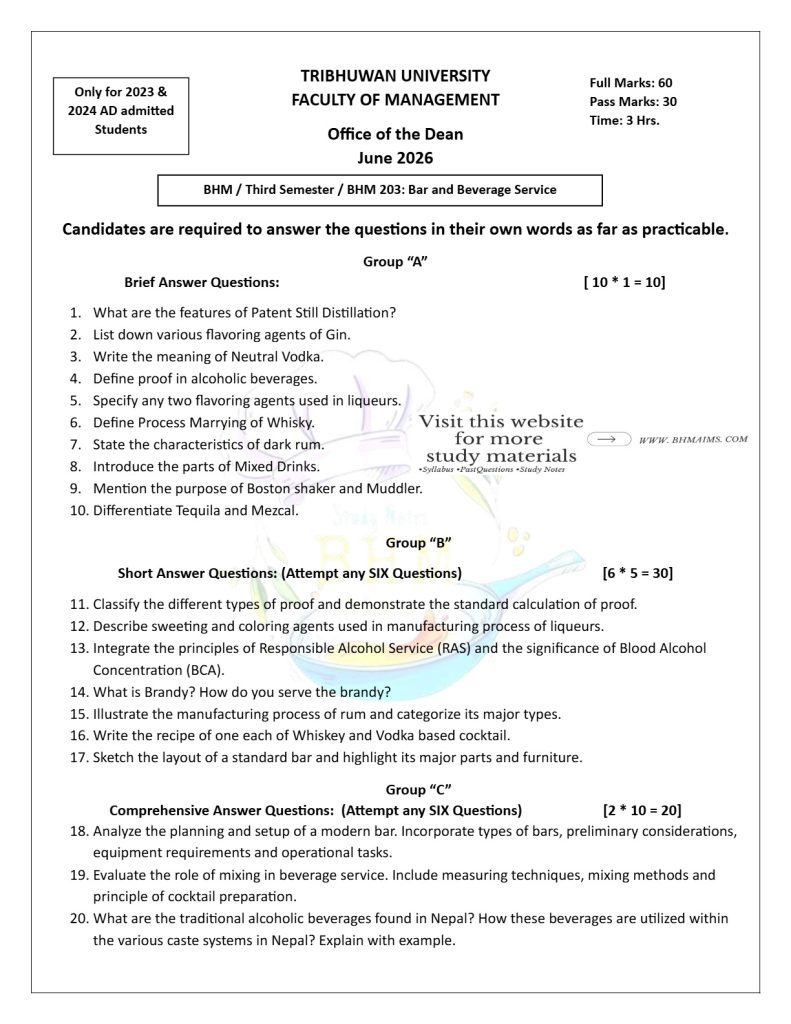
Bar and Beverage Service Question Paper Year 2026
Solution of 2025
- Mention the features of neutral vodka. (Unit 3: Vodka)
⇒ The features of neutral vodka are:- Odorless and colorless spirit
- Clean and smooth taste
- High purity due to multiple distillation
- Neutral flavor with no strong character
- Convert 40 ABV in US Proof. (Unit 1: Alcoholic Beverages & Proof)
⇒
We know,
US Proof = ABV × 2
Now, given:
ABV = 40%
So,
Proof = 40 × 2 = 80 Proof
Hence, 40% ABV is equal to 80 US Proof.
| Meaning: If a drink has 40% alcohol, it means it is 80 proof in the US system. The proof value is always double the ABV in the American system. |
- Define the term distillation. (Unit 1: Alcoholic Beverages & Proof)
⇒ Distillation is the process of separating alcohol from fermented liquid by heating and cooling based on different boiling points. - What do you understand by flavored vodka? (Unit 3: Vodka)
⇒ Flavored vodka is vodka infused with natural or artificial flavors like fruits, herbs, or spices after or during distillation. - How brandy is served in a bar? (Unit 5: Brandy)
⇒ Brandy is usually served neat in a snifter glass at room temperature or slightly warmed to enhance aroma and flavor. - Write down the gin flavoring agent. (Unit 6: Gin)
⇒ The gin flavoring agent are:- Juniper berries (main flavoring agent)
- Coriander seeds
- Citrus peel
- Angelica root
- Brief the term Mezcal. (Unit 7: Tequila & Mezcal)
⇒ Mezcal is a traditional Mexican spirit made from agave plant, known for its smoky flavor due to underground roasting of agave. - Write down parts of Mixed drinks. (Unit 10: Mixology & Cocktails)
⇒ The parts of Mixed drinks are:- Base spirit
- Modifier (juice, soda, syrup)
- Flavoring agents
- Garnish
- What is the purpose of speed rail? (Unit 9: Bar and its Setup)
⇒ Speed rail is used to keep frequently used bottles within easy reach of bartenders for fast and efficient service. - Provide a definition of liqueurs. (Unit 8: Liqueurs)
⇒ Liqueurs are sweetened alcoholic beverages flavored with fruits, herbs, spices, or cream. - What is Proof? Write down its types with standard calculation. (Unit 1: Alcoholic Beverages & Proof)
⇒ Proof is a system used to measure the alcoholic strength (alcohol content) in alcoholic beverages. It shows how strong a drink is in terms of alcohol present in it.
There are two types of proof. It includes:- US Proof System
- Most commonly used system
- Formula: Proof = ABV × 2
- Example: 40% ABV = 80 US Proof
- UK (British) Proof System
- Older system, now rarely used
- Formula: 100 Proof = 57.1% ABV
- Conversion: UK Proof = ABV × 1.75 (approx.)
- US Proof System
- Explain the various types of whisky on the basis of region. (Unit 2: Whisky)
⇒ Whisky is classified into different types based on the country or region where it is produced. Each region has its own style, ingredients, and production method, which gives whisky a unique taste and character.- Scotch Whisky (Scotland)
Scotch whisky is produced in Scotland and is one of the most famous whiskies in the world. It is mainly made from malted barley and aged in oak barrels for at least three years. It has a strong, smoky flavor, especially in single malt Scotch. - Irish Whiskey (Ireland)
Irish whiskey is produced in Ireland and is usually triple distilled, which makes it smoother and lighter in taste compared to Scotch. It is less smoky and easy to drink. - American Whiskey (USA)
American whiskey includes varieties like bourbon, rye, and Tennessee whiskey. Bourbon is made mainly from corn and has a sweet taste, while rye whiskey is spicier. It is aged in new charred oak barrels. - Canadian Whisky (Canada)
Canadian whisky is generally lighter and smoother in taste. It is often made from a blend of grains and is commonly used in cocktails. It is sometimes called “rye whisky” in Canada.
- Scotch Whisky (Scotland)
- Highlight the differences between Rum and Brandy. (Unit 4: Rum & Unit 5: Brandy)
⇒ The differences between Rum and Brandy are:
| Basis | Rum | Brandy |
|---|---|---|
| Raw Material | Made from sugarcane juice or molasses | Made from fermented grape juice or other fruits |
| Production Process | Fermentation and distillation of sugarcane products | Distillation of wine or fruit juice |
| Taste and Flavor | Sweet with caramel-like flavor | Fruity, rich, and aromatic |
| Aging | Aged in wooden barrels, varies from light to dark rum | Usually aged longer in oak barrels for deeper flavor |
| Origin | Mainly Caribbean countries | Mainly France and other European countries |
- Discuss about flavoring, sweetening and colouring agent of liquor. (Unit 8: Liqueurs)
⇒ Liqueurs are flavored and sweetened alcoholic beverages. Various flavoring, sweetening, and colouring agents are added during production to give them their distinctive taste, aroma, sweetness, and appearance.- Flavoring Agents
Flavoring agents provide the characteristic aroma and taste of the liqueur. They may be obtained from:- Fruits: Orange, lemon, cherry, peach, blackberry
- Herbs: Mint, basil, rosemary
- Spices: Cinnamon, cloves, nutmeg, cardamom
- Nuts and Seeds: Almonds, coffee beans, cocoa beans
- Flowers: Rose, lavender
- Sweetening Agents
Sweetening agents are added to balance the alcohol content and improve palatability. Common sweetening agents include:- Sugar
- Sugar syrup
- Honey
- Glucose syrup
- Colouring Agents
Colouring agents enhance the appearance and attractiveness of liqueurs. They may be:- Natural colours: Fruit extracts, caramel, herbal extracts
- Artificial colours: Approved food-grade colourings used to achieve specific shades
- Flavoring Agents
- Define a bar. List duties and responsibilities that a bartender should perform. (Unit 9: Bar and its Setup)
⇒ A bar is a licensed area or establishment where alcoholic and non-alcoholic beverages are prepared, served, and sold to customers for consumption. It may operate independently or as a part of a hotel, restaurant, club, or resort.
A bartender is responsible for preparing and serving drinks while ensuring efficient bar operations and customer satisfaction. The major duties and responsibilities include:- Preparing and serving alcoholic and non-alcoholic beverages according to standard recipes.
- Greeting customers and providing friendly and professional service.
- Taking drink orders and recommending beverages when required.
- Maintaining cleanliness and hygiene of the bar area, equipment, and glassware.
- Checking and maintaining stock levels of beverages and bar supplies.
- Preparing garnishes, mixers, and ingredients required for drink preparation.
- Handling cash, bills, and payment transactions accurately.
- Ensuring responsible alcohol service and refusing service to intoxicated or underage guests.
- Maintaining bar records and assisting in inventory control.
- Following safety, health, and legal regulations related to alcohol service.
- Write the recipe of one each of Gin and Tequila based cocktail. (Unit 10: Mixology & Cocktails)
⇒ The recipe of one each of Gin and Tequila based cocktail- Gin-Based Cocktail:
a. Gin and Tonic Cocktail
Ingredients:
a. 45 ml Gin
b. 120 ml Tonic Water
c. 1 Lemon/Lime wedge
d. Ice cubes
Method:
a. Fill a highball glass with ice cubes.
b. Pour gin into the glass.
c. Add tonic water.
d. Stir gently.
e. Garnish with a lemon or lime wedge and serve.
b. Tom Collins Cocktail
Ingredients:
a. 45 ml Gin
b. 30 ml Fresh Lemon Juice
c. 15 ml Sugar Syrup
d. Soda Water
e. Ice Cubes
Method:
a. Fill a Collins or highball glass with ice cubes.
b. Add gin, lemon juice, and sugar syrup
c. Stir well.
d. Top up with soda water.
e. Garnish with a lemon slice and cherry.
f. Serve chilled.
Glassware: Collins Glass
Garnish: Lemon slice and cherry - Tequila-Based Cocktail:
a. Margarita
Ingredients:
a. 45 ml Tequila
b. 15 ml Triple Sec
c. 30 ml Fresh Lime Juice
d. Salt for rim
e. Ice cubes
Method:
a. Rim a cocktail glass with salt.
b.Add tequila, triple sec, lime juice, and ice into a shaker.
c. Shake well.
d. Strain into the prepared glass.
e. Garnish with a lime slice and serve.
- Gin-Based Cocktail:
- Give brief notes on ‘traditional beverage in Nepal’. (Unit 11: Alcoholic Beverage in Nepal)
⇒ The traditional beverage in Nepal are:- Thon – fermented rice beer of Newar community
- Aaila – strong distilled alcoholic drink made from rice or grains
- Tongba – fermented millet drink served with hot water (Limbu community)
- Chhyang (Raksi base beer) – traditional fermented millet or rice beer
- Raksi – locally distilled spirit made from grains like millet, rice, or maize
- Jaand (Rice beer) – mildly alcoholic fermented rice drink, common in rural areas
- Sehro / Local homemade wines – fruit-based traditional drinks in some regions
- Highlight on the history of spirits. Elaborate on international understanding and measurement of alcoholic strength. (Unit 1: Alcoholic Beverages & Proof)
⇒ Check our notes for its answer - Discuss Tequila. Mention step-by-step manufacturing process of Tequila. (Unit 7: Tequila & Mezcal)
⇒ Tequila is a distilled alcoholic beverage made from the fermented juice of the blue agave plant, mainly produced in specific regions of Mexico. It is known for its strong, earthy flavor and is widely used both as a straight spirit and in cocktails. Tequila is usually categorized into Blanco (white), Reposado (rested), and Añejo (aged), depending on the aging period.
The step-by-step manufacturing process of Tequila are:- Harvesting (Jima)
- Cooking (Baking the Pinas)
- Crushing / Extraction
- Fermentation
- Distillation
- Aging, Bottling and Labelling
- Make a comprehensive discussion on Blood alcohol concentration and Responsible alcohol service. (Unit 9: Bar and its Setup)
⇒ Blood Alcohol Concentration (BAC) refers to the percentage of alcohol present in a person’s bloodstream after consuming alcoholic beverages. It is used to measure the level of intoxication and impairment of an individual.
BAC increases when alcohol is consumed faster than the body can metabolize it. A higher BAC level affects the brain and body functions, leading to reduced judgment, poor coordination, slow reaction time, and loss of control. At very high levels, BAC can become dangerous and even life-threatening.
BAC is influenced by several factors such as body weight, gender, amount of alcohol consumed, drinking speed, and food intake. It is an important concept in bar management and legal regulations to ensure safe alcohol consumption.
Responsible Alcohol Service (RAS) refers to the practices followed by bartenders and bar staff to serve alcohol in a safe, legal, and controlled manner. The main goal is to prevent overconsumption and protect customers from alcohol-related harm.
Key practices of responsible alcohol service include:- Checking legal age before serving alcohol
- Monitoring customers for signs of intoxication
- Refusing service to intoxicated or aggressive guests
- Encouraging slow and moderate drinking
- Offering food and non-alcoholic beverages
- Following local laws and bar policies strictly
- Preventing drunk driving by suggesting safe transport options