
Hello learners, warm welcome to website page with collection of past and old question papers for the BHM third semester Food Production and Patisserie III in Tribhuwan University’s Bachelor of Hotel Management program. Our website also provides a past question of others, covering other subjects such as Food Production, Front Office, Cost and Management Accountancy and F&B Service.
| Dear Students, If you find any question paper missing from any year, please contact us through our email address “bhmaims@gmail.com“ Also, if you have any pending past-year board question papers, kindly forward them to us so that we can update in our website. |
Food Production Operations Year 2024 Question Paper
Pending
Food Production Operations Year 2025 Question Paper (New Course)

Food Production Operations Year 2026 Question Paper (New Course)

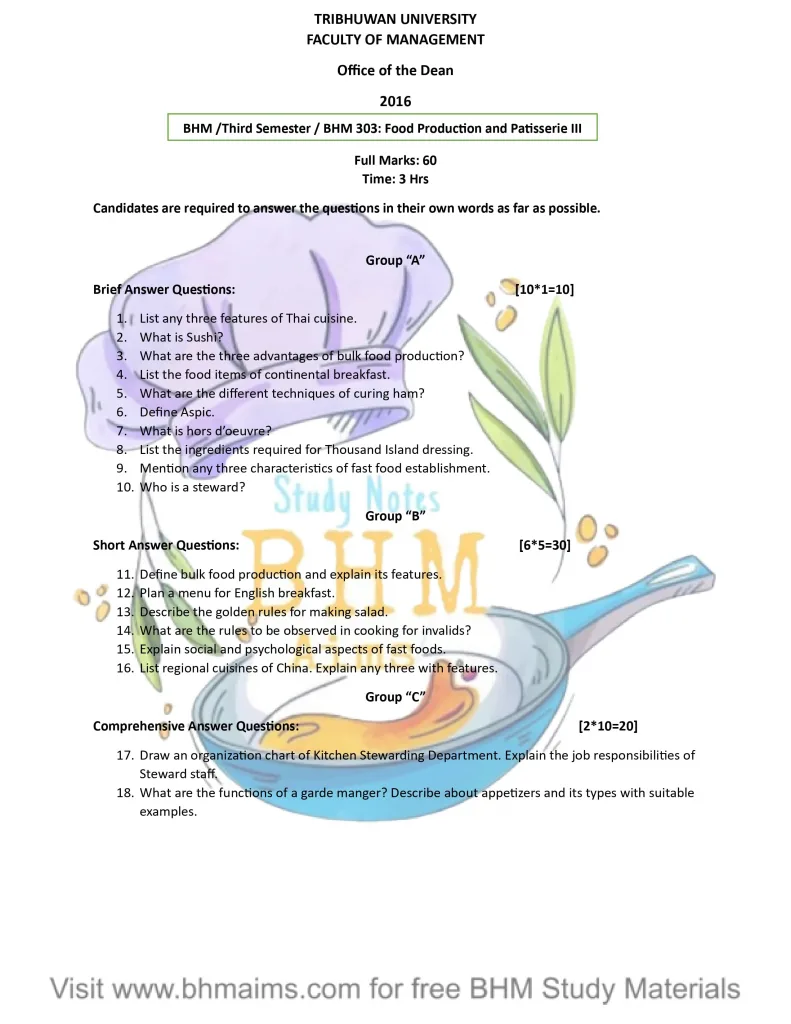
Food Production and Patisserie III Year 2016 Question Paper (Old Course)
Food Production and Patisserie III Year 2017 Question Paper (Old Course)

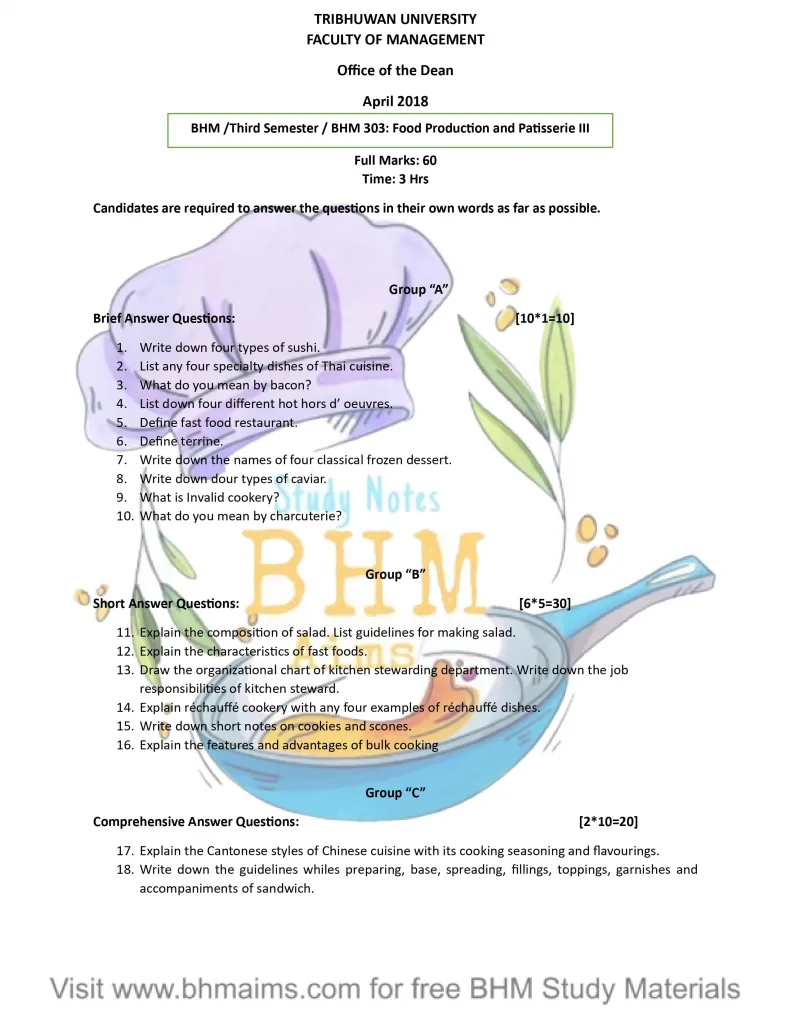
Food Production and Patisserie III Year 2018 Question Paper (Old Course)
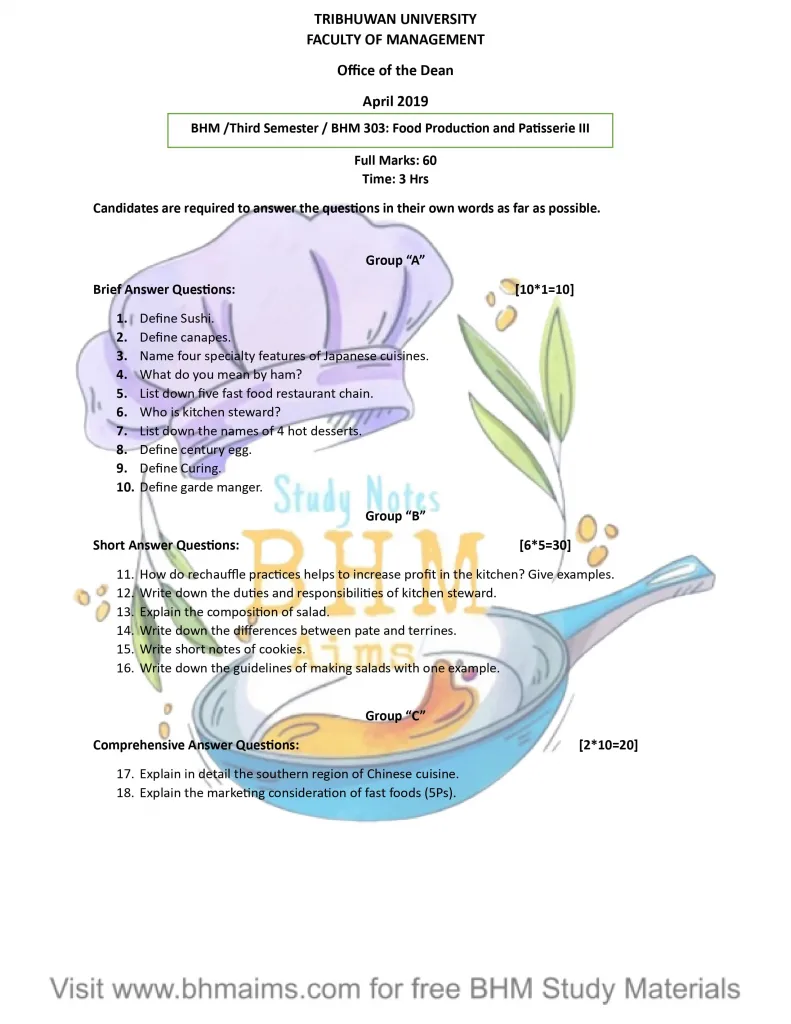
Food Production and Patisserie III Year 2019 Question Paper (Old Course)
Food Production and Patisserie III Year 2021 Question Paper (Old Course)

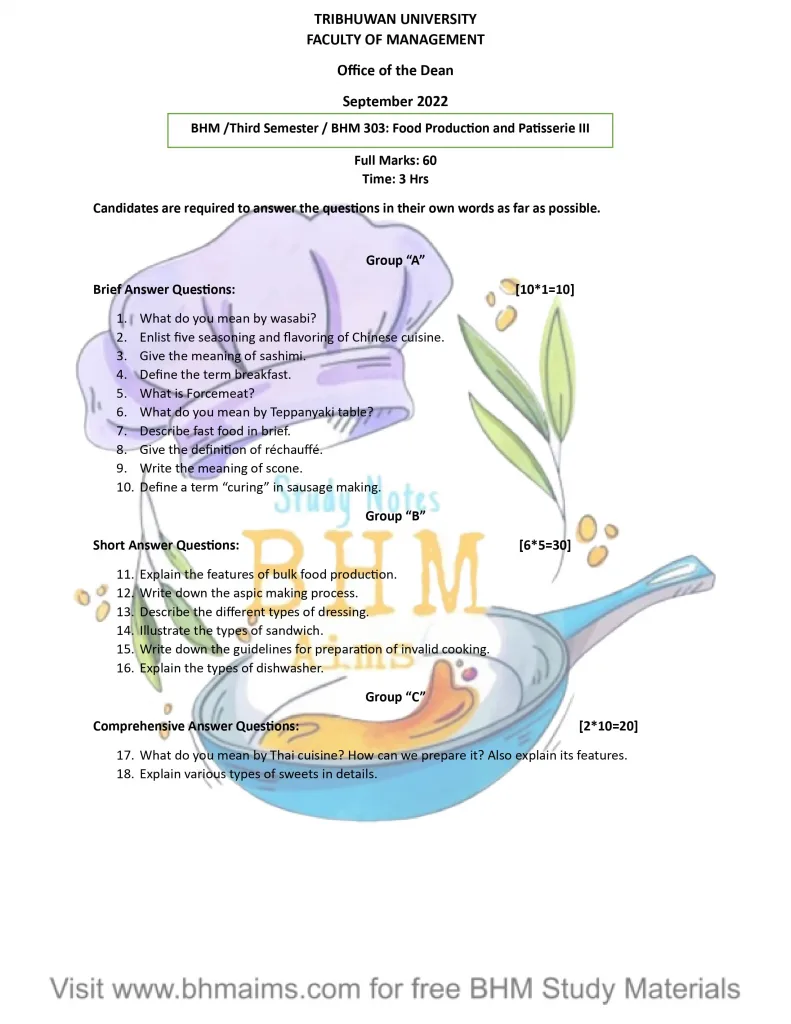
Food Production and Patisserie III Year 2022 Question Paper (Old Course)
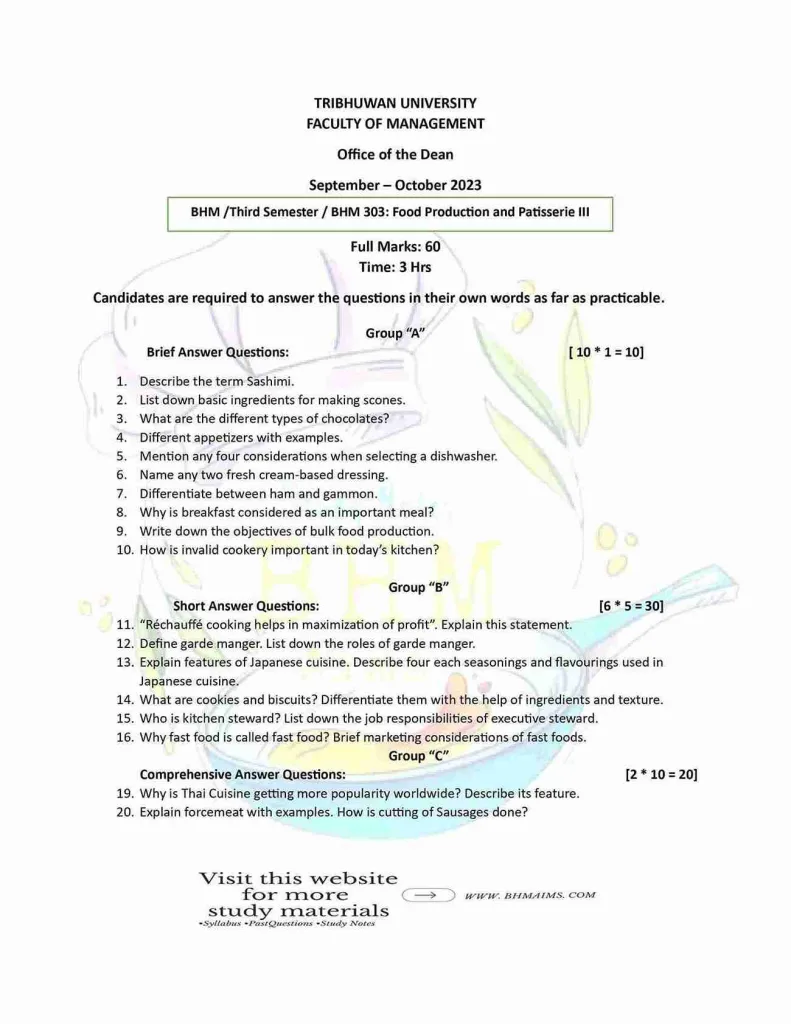
Food Production and Patisserie III Year 2023 Question Paper (Old Course)
Year-2025
- What do you understand by ‘paupiette’? (Unit 1: Garde Manger)
⇒
A paupiette is a thin slice of meat or fish that is flattened, filled with a stuffing such as vegetables, herbs, or forcemeat, then rolled, secured, and cooked by braising, baking, or poaching. - Define the term terrine. (Unit 1: Garde Manger)
⇒
A terrine is a rustic, textured preparation of seasoned meat, seafood, or vegetables that is layered or mixed, pressed into a rectangular mold, slowly cooked, and typically served chilled in slices. - How do you differentiate appetizer and hors d’oeuvre? (Unit 1: Garde Manger)
⇒
| Basis | Appetizer | Hors d’oeuvre |
|---|---|---|
| Meaning | A dish served before the main course to stimulate appetite | Small bite-sized food served before a meal, usually with drinks |
| Serving Time | Served at the dining table before the main course | Served before guests are seated or during a reception/cocktail hour |
| Portion Size | Usually larger than hors d’oeuvres | Very small, often one or two bites |
| Eating Method | Usually eaten with cutlery | Generally eaten with fingers or a cocktail pick |
| Purpose | Prepares guests for the main meal | Entertains guests and stimulates appetite before the meal begins |
| Examples | Soup, salad, shrimp cocktail, stuffed mushrooms | Canapés, cheese cubes, mini sandwiches, olives, crackers |
- Define ‘Game’ with examples. (Unit 2: Meat Fabrication)
⇒ Game refers to the flesh of wild animals and birds that are hunted for food, rather than being raised on farms.
Example: Venison (deer), rabbit, pheasant, quail, and wild duck - Provide a definition of ‘Rigor Mortis’. (Unit 2: Meat Fabrication)
⇒ Rigor mortis is the natural stiffening and hardening of the muscles of an animal after death / slaughtering due to chemical changes in the muscle tissues. - What do you understand by ‘Aspic’? (Unit 1: Garde Manger)
⇒ Aspic is a clear savory jelly made from stock and gelatin, used for garnishing, coating, and setting cold food preparations. - How is Bacon cured? (Unit 1: Garde Manger)
⇒ Bacon is cured by rubbing or soaking pork (usually pork belly or loin) in a mixture of salt, sugar, and curing salts (nitrite/nitrate), followed by a resting period and often smoking to enhance flavor and preservation. - List duties of kitchen steward. (Unit 6: Kitchen Stewarding)
⇒ A kitchen steward is responsible for maintaining cleanliness, hygiene, and support services in the kitchen.
The duties of kitchen steward are:- Washing and cleaning all kitchen utensils, pots, pans, and cutlery
- Ensuring cleanliness of kitchen floors, walls, and equipment
- Operating dishwashing machines properly
- Sorting and storing clean utensils in proper places
- Removing garbage and maintaining waste disposal systems
- Why is breakfast considered important in our daily meal? (Unit 4: Breakfast)
⇒ Breakfast is considered the most important meal of the day because it breaks the overnight fasting period and provides energy for daily activities.- Provides energy: It supplies fuel (glucose) to the body and brain after a long night without food.
- Improves concentration: Helps improve focus, memory, and performance in studies or work.
- Boosts metabolism: Starts the body’s metabolism and helps in proper digestion throughout the day.
- Prevents overeating: Reduces hunger later in the day, helping to avoid unhealthy snacking or overeating.
- Give a brief note of lamb cutlet. (Unit 2: Meat Fabrication)
⇒ A lamb cutlet is a small, tender piece of lamb meat cut from the rib or loin section, usually including a small rib bone. It is a popular portion in fine dining and is known for its tenderness and flavor. - List different types of dishwashers in commercial kitchens. Explain any two. (Unit 6: Kitchen Stewarding)
⇒ The different types of dishwashers in commercial kitchens are:- Undercounter dishwasher
- Door type (hood type) dishwasher
- Conveyor (rack conveyor) dishwasher
- Flight type dishwasher
- Glass washer
Explanation:
- Undercounter Dishwasher : An undercounter dishwasher is a small machine installed under the kitchen counter and is suitable for small restaurants, cafés, and bars. It is used for washing limited quantities of dishes and is easy to operate and space-saving.
- Conveyor Dishwasher : A conveyor dishwasher is a high-capacity machine used in large kitchens such as hotels, hospitals, and banquet halls. It has a moving conveyor system that continuously washes large volumes of dishes, making it highly efficient for bulk operations.
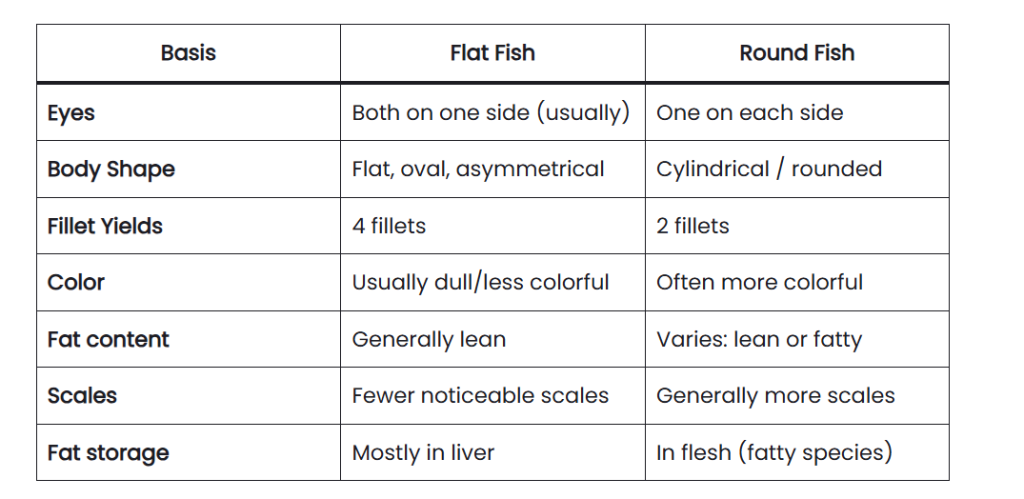
- Differentiate between round fish and flat fish. Brief any three preservation techniques used for fish. (Unit 2: Meat Fabrication)
⇒ Any three preservation techniques used for fish are:- Freezing: Fish is stored at very low temperatures to stop bacterial growth and maintain freshness for a long period.
- Salting (Curing): Salt is applied to fish to remove moisture, prevent spoilage, and extend shelf life.
- Smoking: Fish is exposed to smoke after salting or curing, which adds flavor and helps preserve it by reducing moisture and bacterial activity.
- Elaborate on suitable cooking method for fish. (Unit 2: Meat Fabrication)
⇒ Fish is a delicate food item, so it requires gentle cooking methods that preserve its soft texture, moisture, and flavor. The most suitable cooking methods for fish are moist heat and light dry heat methods.- Steaming:
Steaming is one of the best methods for cooking fish as it uses steam heat without direct contact with water or oil. It helps retain the natural flavor, nutrients, and softness of fish. It is ideal for whole fish or fillets. - Poaching:
In poaching, fish is cooked gently in a liquid such as water, milk, or stock at a low temperature. This method keeps the fish moist and tender and prevents it from breaking apart. - Grilling and Broiling:
These are dry heat methods where fish is cooked quickly over direct heat. They give a smoky flavor and slightly crispy texture on the outside while keeping the inside tender. - Baking:
Fish can also be baked in an oven with light seasoning, herbs, and sauces. This method is suitable for whole fish or large portions and ensures even cooking.
- Steaming:
- How does integration of flavors, shapes and textures enhance food presentation? (Unit 5: Food & Buffet Presentation)
⇒- It makes the food visually more attractive by using different shapes and arrangements on the plate.
- It improves the overall eating experience by combining different textures like crispy, soft, and creamy.
- Balanced flavors (sweet, sour, salty, spicy) make the dish more tasty and enjoyable.
- Proper combination of all elements creates harmony and balance on the plate.
- It shows the skill and creativity of the chef, especially in buffet and fine dining presentation.
- Mention the guidelines for preparing sandwiches and canapes. (Unit 1: Garde Manger)
⇒ The guidelines for preparing sandwiches and canapes are:- Use fresh bread, rolls, or bases to ensure good taste and texture
- All ingredients should be fresh, clean, and properly pre-prepared
- Spread butter or dressing evenly to prevent sogginess
- Use balanced fillings without overstuffing or underfilling
- Cut sandwiches and canapés into neat, uniform shapes and sizes
- Ensure attractive presentation with proper color combination and garnish
- Keep items well-chilled if served cold and fresh if served hot
- Avoid preparing too early to maintain freshness and quality
- Use appropriate utensils or picks for easy handling (especially canapés)
- Explain about different types of breakfast. (Unit 4: Breakfast)
⇒ The different types of breakfast are:- Continental Breakfast : This is a light breakfast commonly served in Europe and hotels. It usually includes bread, butter, jam, pastries, cereals, tea, coffee, and fruit juice. It is simple, quick, and non-cooked.
- American Breakfast : This is a heavier breakfast compared to continental. It includes eggs (fried, scrambled, omelette), bacon or sausage, toast, pancakes, cereals, fruits, and beverages like tea or coffee. It is more filling and protein-rich.
- English Breakfast (Full Breakfast) : This is a traditional heavy breakfast. It includes eggs, bacon, sausages, baked beans, grilled tomatoes, mushrooms, toast, and beverages. It is very rich and high in energy.
- Indian Breakfast : This breakfast varies by region and includes items like paratha, poha, idli, dosa, upma, puri, and tea. It is usually spicy and flavorful.
- Define ‘Steak’. Explain about its degree of cooking? (Unit 2: Meat Fabrication)
⇒ Steak is a slice of high-quality meat, usually beef, cut across the muscle fibers and cooked by dry-heat methods such as grilling, pan-frying, or broiling. It is known for its tenderness, flavor, and quick cooking.
The doneness of steak is based on how long it is cooked and the internal temperature. The main degrees are:- Rare:
The steak is quickly seared outside but remains very red and raw inside. It is very soft and juicy. - Medium Rare:
The inside is warm and red with slight browning outside. It is considered the ideal doneness for many people as it is tender and flavorful. - Medium:
The center is pink and firm, with more cooked edges. It has less juice than medium rare but still tender. - Medium Well:
The steak is mostly brown with only a slight hint of pink in the center. It is firmer and less juicy. - Well Done:
The steak is fully cooked with no pink color. It is firm, dry, and has the least juiciness.
- Rare:
- Define Garde manger. Explain in detail about different sections of Garde manger. (Unit 1: Garde Manger)
⇒ Garde manger is the cold kitchen section of a hotel or restaurant responsible for the preparation, storage, and presentation of cold dishes such as salads, cold meats, pâtés, terrines, hors d’oeuvres, and dressings.
The garde manger is divided into different functional sections to manage cold kitchen operations efficiently:- Salad Section:
This section is responsible for preparing all types of salads such as green salads, fruit salads, composed salads, and dressed salads. It also prepares salad dressings and ensures proper washing, cutting, and storage of vegetables. - Cold Meat Section (Butchery/Charcuterie):
This section deals with cold cuts of meat, ham, bacon, sausages, and other cured meat products. It also handles slicing, portioning, and arranging cold meat platters for service. - Hors d’oeuvre Section:
This section prepares small appetizers such as canapés, finger foods, and other bite-sized items served before meals or at receptions. Presentation and decoration are very important here. - Fish and Seafood Section (Cold Preparations):
This section handles smoked, cured, or cold seafood items like smoked salmon, prawn cocktails, and fish terrines. It ensures proper cleaning, filleting, and presentation. - Pâté and Terrine Section:
This section prepares items like pâtés, terrines, galantines, and mousses. These are usually molded, cooked or set preparations served cold in slices.
- Salad Section:
- Discuss on structure of meat. How is meat graded based quality and yield grading? (Unit 2: Meat Fabrication)
⇒ Structure of Meat:
Meat is mainly composed of muscle tissue, connective tissue, fat, blood vessels, and bone.- Muscle fibers: These are the basic units of meat. They are long, thin cells that contract and give structure to meat. After slaughter, they become the main edible part.
- Connective tissue: This includes collagen and elastin that hold muscle fibers together. It affects tenderness; more connective tissue means tougher meat.
- Fat (marbling and external fat): Fat is found between muscles (marbling) and around the meat. It adds flavor, juiciness, and tenderness.
- Blood vessels and nerves: These supply blood and nutrients during life but are removed during processing.
- Bone: In some cuts, bone remains attached and can influence flavor and cooking time.
Meat Grading Based on Quality and Yield: Meat grading is divided into quality grading and yield grading to determine its overall value and usefulness. Quality grading focuses on the eating quality of meat, such as tenderness, juiciness, flavor, marbling, and the age or maturity of the animal. Meat with high marbling and good tenderness is considered superior in quality. Based on these factors, meat is classified into grades such as Prime, Choice, and Select, where Prime represents the highest quality with excellent flavor and tenderness.
Yield grading, on the other hand, refers to the amount of usable lean meat obtained from a carcass after trimming fat and bone. It helps to determine how much edible meat can be produced from the animal. Yield grading is based on factors like fat thickness, ribeye area, carcass weight, and internal fat content. It is usually categorized from Yield Grade 1 to Yield Grade 5, where Yield Grade 1 gives the highest amount of usable meat and Yield Grade 5 gives the lowest due to higher fat content.
- Why is Japanese cuisine considered a healthy cuisine? Elaborate focusing on the features. (Unit 3: Chinese, Thai and Japanese Cuisine)
⇒ Refer to our note for its answer – Link above
Year-2016
- List any three features of Thai cuisine.
⇒ Any three features of Thai cuisine are:- Balance of flavors: Thai cuisine is known for balancing sweet, sour, salty, spicy, and bitter tastes in one dish.
- Use of fresh ingredients: It heavily uses fresh herbs and spices like lemongrass, basil, lime leaves, chili, and coriander.
- Spicy and aromatic food: Thai dishes are generally hot and flavorful, with strong aromas from spices and sauces.
- What is Sushi?
⇒ Sushi is a traditional Japanese dish made of vinegared rice combined with seafood, vegetables, or fish, served in various forms such as rolls or pieces. - What are the three advantages of bulk food production?
⇒ Any three advantages of bulk food production are:- Cost efficiency: Producing food in bulk reduces the cost per portion due to economies of scale and less wastage.
- Time saving: Large quantities can be prepared in advance, which saves time during peak service hours.
- Suitable for large groups: It helps serve a large number of customers quickly, especially in hotels, banquets, and catering events.
- List the food items of continental breakfast.
⇒ A continental breakfast mainly includes light and simple foods. It includes includes bread, butter, jam, pastries, cereals, tea or coffee, fruit juice, and fresh fruits. - What are the different techniques of curing ham?
⇒ Ham is cured by dry curing, wet curing (brining), and injection curing, often followed by smoking to enhance flavor and shelf life. - Define Aspic.
⇒ Repeated Question – Please refer back for answer - What is hors d’oeuvre?
⇒ Hors d’oeuvre are small bite-sized food items served before the main course, usually during receptions or cocktail hours, to stimulate the appetite. - List the ingredients required for Thousand Island dressing.
⇒ The ingredients required for Thousand Island dressing are:- Mayonnaise
- Ketchup (tomato sauce)
- Finely chopped onion
- Finely chopped pickles or gherkins
- Hard-boiled egg (chopped or mashed)
- Vinegar or lemon juice
- Mustard (optional)
- Salt and pepper
- Olive oil (optional, in some recipes)
- Mention any three characteristics of fast food establishment.
⇒ Any three characteristics of fast food establishment are:- Fast service (food is prepared and served quickly)
- Limited and fixed menu items
- Self-service or counter service system
- Standard taste and quality
- Ready-to-eat or pre-prepared food
- Affordable and budget-friendly prices
- Who is a steward?
⇒ A kitchen steward is responsible for maintaining cleanliness, hygiene, and support services in the kitchen.
Year 2017
- List any two features of Japanese Cuisine.
⇒ Any two features of Japanese cuisine are:- Priority on freshness and seasonal ingredients
- Simple and natural presentation with minimal seasoning
- What are the components of sandwich?
⇒ The components of sandwich are:- Bread: Base of the sandwich (white, brown, whole wheat, bun, etc.)
- Spread: Butter, mayonnaise, mustard, or sauce to add flavor and moisture
- Filling: Main ingredient such as meat, cheese, eggs, vegetables, or fish
- Garnish (optional): Lettuce, tomato, cucumber, onion, or herbs for taste and presentation
- Mention two objectives of bulk food production.
⇒ Any two objectives of bulk food production are:- To produce large quantities of food efficiently for a large number of people
- To reduce production cost by saving time, labor, and resources
- What are four P’s as marketing consideration of fast food?
⇒ The four P’s as marketing consideration of fast food are:- Product: The type of food offered (burgers, fries, pizza, beverages) with quality, taste, and variety.
- Price: Affordable and competitive pricing suitable for mass customers.
- Place: Convenient location, online delivery, takeaway, and drive-through services.
- Promotion: Advertising, discounts, combo offers, and social media marketing to attract customers.
- Define dressing.
⇒ Dressing is a cold liquid or semi-liquid sauce used to add flavor and moisture to salads and other cold preparations. - List parts of salad.
⇒ The parts of salad are:- Base: The foundation of the salad (usually leafy greens like lettuce or cabbage)
- Body: Main ingredients such as vegetables, fruits, meat, or seafood
- Dressing: Sauce added to enhance flavor (e.g., mayonnaise, vinaigrette)
- Garnish: Decorative items like herbs, nuts, or cheese to improve presentation
- Define Rechauffé .
⇒ Rechauffé is a dish prepared from previously cooked food that is reheated and reused for service. - Mention name of any two hot and two frozen desserts.
⇒ Any two hot and frozen desserts are:- Hot Desserts: Apple pie, Bread pudding
- Frozen Desserts: Ice cream, Sorbet
- List food items of American breakfast.
⇒ The food items of American breakfast are:- Eggs (fried, scrambled, poached, omelette)
- Bacon, sausage, ham
- Toast or bread with butter and jam
- Pancakes or waffles with syrup
- Cereals (cornflakes, muesli)
- Fresh fruits or fruit salad
- Fruit juice
- Tea or coffee
- Hash browns or fried potatoes
- What is invalid cooking?
⇒ Invalid cookery is the preparation of special meals for sick or weak people, using easily digestible and nutritious foods.
Year-2018
- Write down four types of sushi.
⇒ Any four types of sushi are:- Nigiri Sushi
- Maki Sushi
- Uramaki Sushi
- Temaki Sushi
- List any four specialty dishes of Thai cuisine.
⇒ Any four specialty dishes of Thai cuisine are:- Tom Yum Goong (spicy and sour shrimp soup)
- Pad Thai (stir-fried rice noodles with vegetables, egg, and sauces)
- Green Curry (Gaeng Keow Wan) (spicy coconut milk curry)
- Som Tum (green papaya salad)
- What do you mean by bacon?
⇒ Bacon is pork meat (usually from the belly or loin) that is cured with salt and often smoked to enhance flavor and preservation. - List down four different hot hors d’oeuvres.
⇒ Any four different hot hors d’oeuvres are:- Mini spring rolls
- Chicken satay
- Meatballs (cocktail meatballs)
- Stuffed mushrooms (hot baked)
- Define fast food restaurant.
⇒ A fast food restaurant is a type of food service establishment that prepares and serves food quickly, offering a limited menu of ready-to-eat or pre-cooked items at affordable prices, usually with counter or self-service. - Define terrine.
⇒ A terrine is a type of dish made by layering or finely chopping meat, fish, or vegetables, cooked and set in a mold, usually served cold in slices. - Write down the names of four classical frozen desert.
⇒ The names of four classical frozen desert are:- Ice Cream
- Sorbet
- Parfait
- Mousse (frozen mousse)
- Write down four types of caviar.
⇒ Any four types of caviar are:- Beluga caviar (from Beluga sturgeon)
- Osetra caviar (from Osetra sturgeon)
- Sevruga caviar (from Sevruga sturgeon)
- Siberian caviar (from Siberian sturgeon)
- What is invalid cookery?
⇒ Repeated question – Please refer back for answer - What do you mean by charcuterie?
⇒ Charcuterie is the art of preparing and preserving pork products like sausages, ham, bacon, pâtés, and terrines.
Year- 2019
- Define Sushi.
⇒ Repeated question – Please refer back for answer - Define canapes.
⇒ Canapés are small, decorative bite-sized hors d’oeuvres made with a base of bread, pastry, or cracker, topped with savory spreads, meats, fish, or vegetables. - Name four specialty features of Japanese cuisine.
⇒ Any four specialty features of Japanese Cuisine are:- Emphasis on freshness and seasonal ingredients
- Simple and natural presentation with artistic plating
- Light seasoning to preserve original taste of food
- Use of rice, seafood, and soy-based products as staple ingredients
- What do you mean by ham?
⇒ Ham is pork meat taken from the hind leg of a pig, which is cured and often smoked before consumption. - List down five fast food restaurant chain.
⇒ Any 5 fast food restaurant chain are:- McDonald’s
- KFC (Kentucky Fried Chicken)
- Burger King
- Subway
- Pizza Hut
- Who is kitchen steward?
⇒ Repeated Question - List down the names of 4 hot desserts.
⇒- Apple Pie
- Bread Pudding
- Chocolate Soufflé
- Crepes Suzette
- Gulab Jamun
- Jalebi
- Gajar Halwa (Carrot Halwa)
- Define century egg.
⇒ A century egg (also called preserved egg or thousand-year egg) is a traditional Chinese food product made by preserving duck, chicken, or quail eggs in a mixture of clay, ash, salt, quicklime, and rice hulls for several weeks or months until the yolk becomes dark green/grey and the white becomes jelly-like. - Define Curing.
⇒ Curing is the process of preserving food, especially meat or fish, by using salt, sugar, nitrates/nitrites, and sometimes smoking or drying to extend shelf life and enhance flavor. - Define garde manger.
⇒ Garde manger is the cold kitchen section where salads, cold appetizers, and cold meat dishes are prepared and stored.
Year- 2021
- What is bulk kitchen and write down features of bulk food production.
- Define breakfast and write down food items of continental breakfast?
- Define fast food and explain considerations of fast food.
- What is dessert? Explain its types.
- What is rechauffe dishes? Mention guidelines for preparing of rechauffe dishes.
- What is invalid cookery? Write down its guidelines for preaparation of invalid cooking.
- Why Chinese cuisine is popular in worldwide? Explain its with regional cuisine.
- What is kitchen stewarding? Make a neat hierarchy of stewarding and explain its job and responsibilities.
Year- 2022
- What do you mean by wasabi?
⇒ Wasabi is a spicy green paste used in Japanese cuisine as a condiment, especially with sushi and raw fish dishes. - Enlist five seasoning and flavoring of Chinese cuisine.
⇒ Any five seasoning and flavoring of Chinese cuisine are:- Soy sauce
- Ginger
- Garlic
- Spring onion (scallion)
- Sesame oil
- Give the meaning of sashimi.
⇒ Sashimi is a traditional Japanese dish consisting of thinly sliced raw fish or seafood, served without rice, usually with soy sauce, wasabi, and garnishes. - Define the term breakfast.
⇒ Breakfast (petit-déjeuner: in french)is the first meal of the day, eaten in the morning after a night’s sleep, which breaks the overnight fasting period. - What is Forcemeat?
⇒ Forcemeat is a smooth mixture of finely minced meat, fat, and seasoning used for making sausages, pâtés, and similar dishes. - What do you mean by Teppanyaki table?
⇒ A Teppanyaki table is a special dining setup where food is cooked on a flat iron griddle (teppan) directly in front of guests by a chef, often as part of Japanese cuisine. - Describe fast food in brief.
⇒ Fast food refers to food that is prepared and served quickly, usually in standardized portions, with minimal table service. It is designed for convenience, affordability, and speed of service.
Fast food is commonly served in restaurants where customers order at a counter or drive-through and receive ready-to-eat items within minutes. - Give the definition of rechauffe.
⇒ Repeated question – Please refer back - Write the meaning of scone.
⇒ A scone is a small baked bread or cake, usually slightly sweet or plain, often served with tea and eaten with butter, jam, or cream. - Define a term curing in sausage making.
⇒ Curing in sausage making is the process of preserving and flavoring minced meat using salt, sugar, and curing agents such as nitrates or nitrites, which help prevent spoilage, improve color, and enhance taste.
Year- 2023
- Describe the term Sashimi.
⇒ Repeated question – Please refer back - List down basic ingredients for making scones.
⇒ The basic ingredients for making scones are:- Flour (usually all-purpose or self-raising flour)
- Baking powder
- Butter
- Sugar
- Milk (or cream)
- Salt
- Eggs (optional, in some recipes)
- What are the different types of chocolates?
⇒ The different types of chocolates are:- Dark chocolate
- Milk chocolate
- White chocolate
- Compound chocolate
- Define appetizers with examples.
⇒ An appetizer is a small portion dish served before the main meal to stimulate appetite, such as soup, salad, or spring rolls.
For example: Soup (tomato soup), Salad, Spring rolls, Shrimp cocktail - Mention any four considerations when selecting a dishwasher.
⇒ Any four considerations when selecting a dishwasher are:- Capacity: Should match the kitchen’s workload and number of dishes to be washed.
- Energy and water efficiency: Should consume less electricity and water to reduce operating cost.
- Speed of operation: Should clean dishes quickly, especially in high-volume kitchens.
- Ease of use and maintenance: Should be simple to operate and easy to clean and maintain.
- Name any two fresh cream-based dressing.
⇒ Any two fresh cream-based dressing are:- Ranch dressing
- Blue cheese dressing
- Differentiate between ham and gammon.
⇒ - Why is breakfast considered as an important meal?
⇒ Repeated question - Write down the objectives of bulk food production.
⇒ Repeated question - How is invalid cookery important in today’s kitchen?
⇒ Invalid cookery is important in today’s kitchen because it provides easily digestible and nutritious food for sick and recovering patients, helping in their fast recovery and health improvement.
And atlast, if you find this collection of past and old question papers helpful, please share our website with your other hotel management learners. This will allow us to reach even more students and help them achieve their academic goals. Thank you again for visiting our website, and we look forward to continuing to support you in your academic journey. Happy Learning !
Follow us in Facebook Group through below link.