
| Dear Students, If you find any question paper missing from any year, please contact us through our email address “bhmaims@gmail.com“ Also, if you have any missing past-year board question papers, kindly forward them to us so that we can update in our website. |
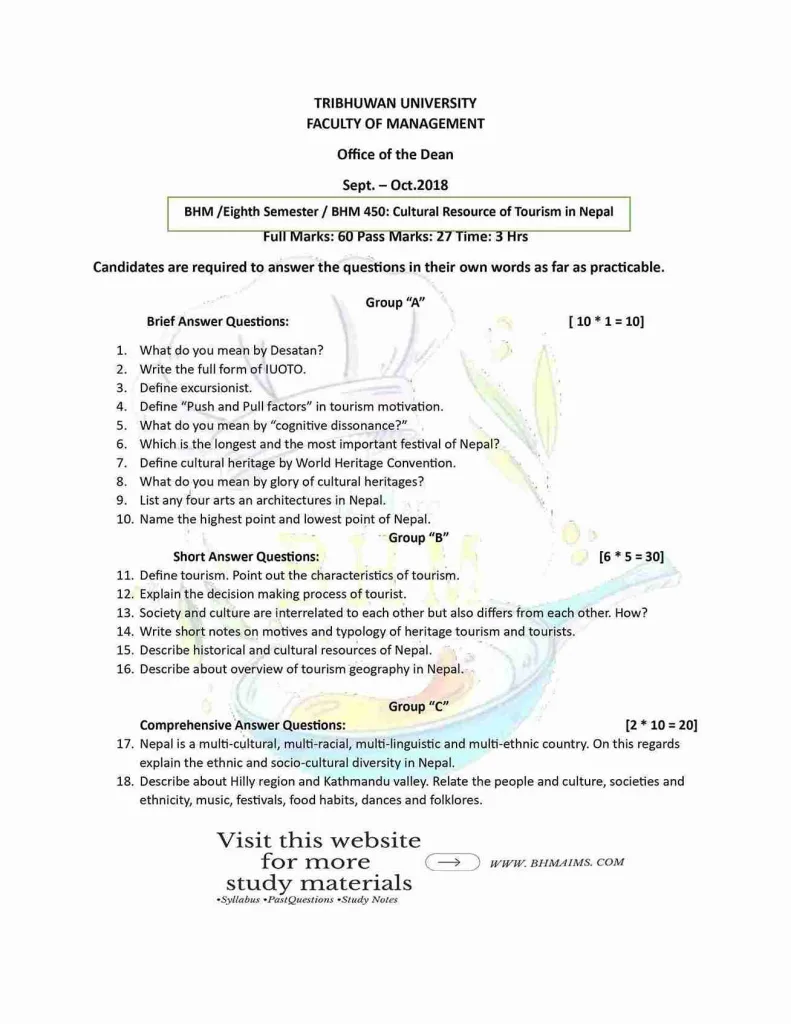
Cultural Resource of Tourism in Nepal Question Paper Year 2018
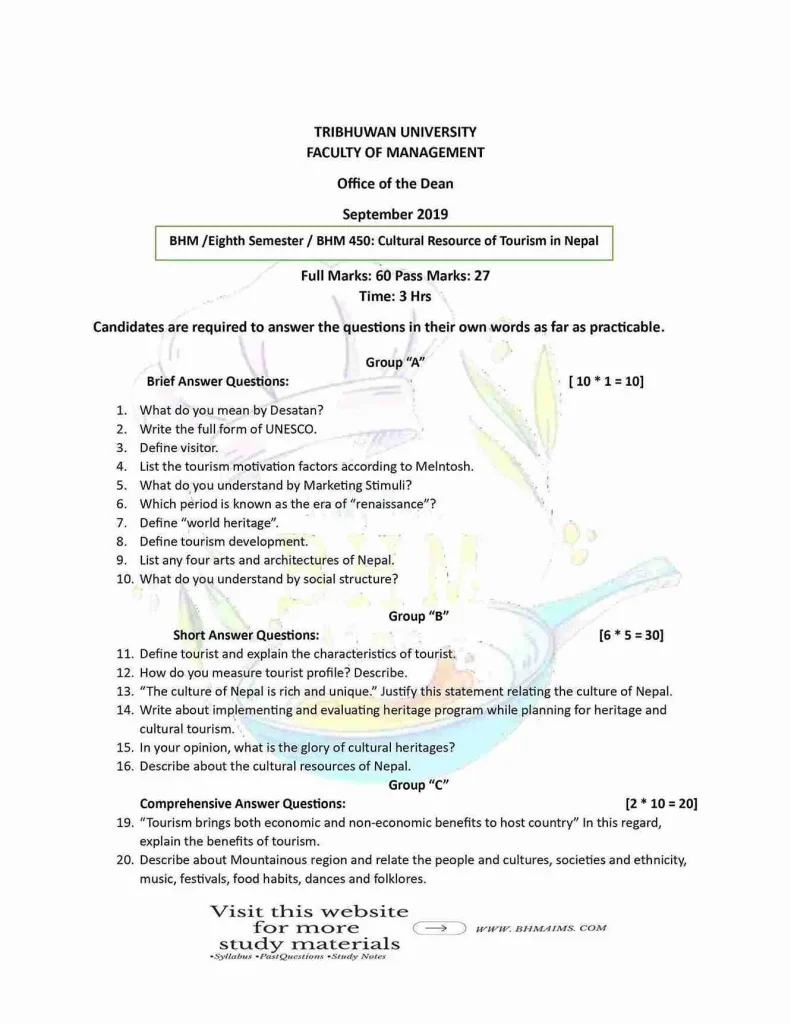
Cultural Resource of Tourism in Nepal Question Paper Year 2019
Cultural Resource of Tourism in Nepal Question Paper Year 2021
Pending – if you have please forward us in “bhmaims@gmail.com”
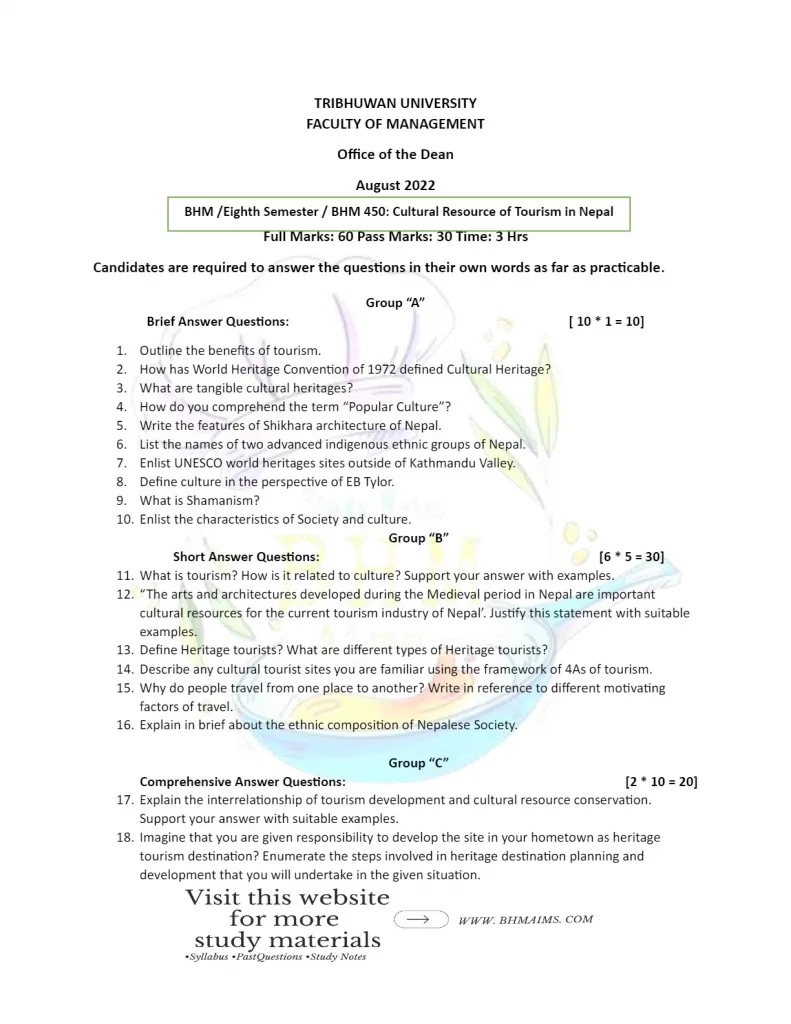
Cultural Resource of Tourism in Nepal Question Paper Year 2022
Cultural Resource of Tourism in Nepal Question Paper Year 2023
Pending
Cultural Resource of Tourism in Nepal Question Paper Year 2024
Pending
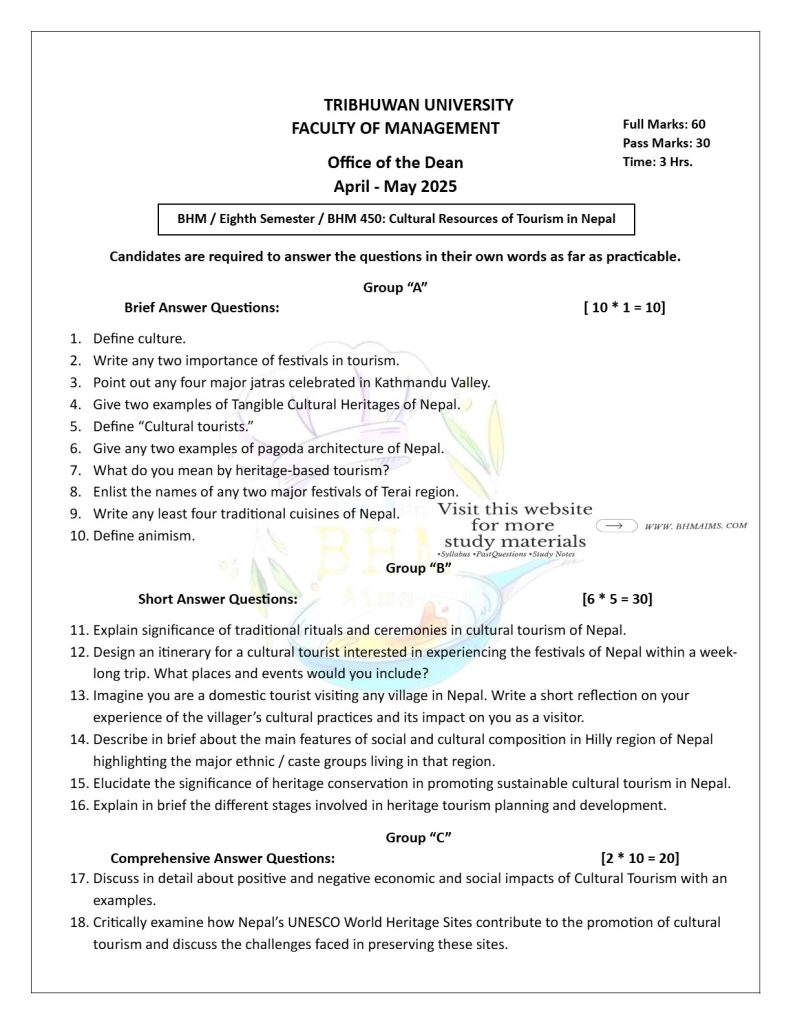
Cultural Resource of Tourism in Nepal Question Paper Year 2025
Cultural Resource of Tourism in Nepal Question Paper Year 2026
Pending
Year- 2018
- What do you mean by Desatan? (Unit 1: Tourism Perspective)
⇨
Desatan refers to traveling from from one’s own country to another for economic gain. It is generally used to describe international travel/tourism where a person visits different places outside the national boundary by crossing international borders. - Write the full form of IUOTO. (Unit 1: Tourism Perspective)
⇨
IUOTO stands for International Union of Official Travel Organisations. - Define excursionist. (Unit 1: Tourism Perspective)
⇨
An excursionist is a temporary visitor who travels to a place for a short duration (usually less than 24 hours) without staying overnight, and then returns to their place of residence on the same day. - Define “Push and Pull factors” in tourism motivation. (Unit 1: Tourism Perspective)
⇨
Push factors are the internal psychological forces that encourage a person to travel, such as escape from routine, relaxation, adventure, or social needs.
Pull factors are the external attractions of a destination that attract tourists, such as natural beauty, cultural heritage, climate, facilities, and events. - What do you mean by “cognitive dissonance”? (Unit 1: Tourism Perspective)
⇨
Cognitive dissonance is the mental discomfort a tourist feels when there is a conflict between their expectations and the actual experience after making a travel decision. - Which is the longest and the most important festival of Nepal? (Unit 2: Introduction to the society and culture of Nepal)
⇨
Dashain is the longest and the most important festival of Nepal.
It is celebrated by Hindus throughout the country to mark the victory of good over evil. The festival usually lasts for 15 days and generally falls between late September and mid-October. - Define cultural heritage by World Heritage Convention. (Unit 3: Concept of heritage and Cultural Tourism)
⇨
According to the World Heritage Convention (1972), cultural heritage refers to Monuments, groups of buildings, and sites which are of outstanding universal value from the point of view of history, art, science, ethnology, or anthropology. - What do you mean by glory of cultural heritages? (Unit 4: Cultural Resources of Nepal)
⇨
Glory of cultural heritages means the great importance, pride, and outstanding value of cultural monuments, traditions, and historical sites that represent the identity, history, and achievements of a society or nation.
In simple terms, it refers to the beauty, fame, and significance of cultural heritage that makes a country proud and attractive to the world. - List any four arts an architectures in Nepal. (Unit 4: Cultural Resources of Nepal)
⇨- Pagoda style architecture
- Stupa architecture
- Shikhara style architecture
- Stone sculpture
- Name the highest point and lowest point of Nepal. (Unit 5: Cultural Tourism Resources of Nepal)
⇨
The highest and lowest point of Nepal are:- Highest point: Mount Everest (8,848.86 m)
- Lowest point: Kechana Kalan, Jhapa (about 60 m above sea level)
- Define tourism. Point out the characteristics of tourism. (Unit 1: Tourism Perspective)
⇨
Tourism is the activity of traveling to and staying in places outside one’s usual environment for leisure, business, or other purposes for a limited period of time, without permanent settlement or earning income at the destination.
The characteristics of tourism are:- It involves travel outside the usual place of residence
- It is a temporary movement (not permanent migration)
- It includes both travel and stay activities
- It involves consumption of goods and services at the destination
- It is a multi-sector industry (transport, hotel, food, etc.)
- It generates economic, social, and cultural impacts
- It depends on motivation and purpose of travel
- Explain the decision making process of tourist. (Unit 1: Tourism Perspective)
⇨
The tourist decision-making process refers to the steps a person follows before, during, and after choosing a travel destination and experience. It generally includes:- Need Recognition – The tourist feels a desire or need to travel (relaxation, escape, adventure, etc.).
- Information Search – The tourist collects information from friends, internet, travel agents, or past experiences.
- Evaluation of Alternatives – Different destinations or options are compared based on cost, attractions, safety, and accessibility.
- Decision Making (Purchase Decision) – The tourist selects a destination and makes bookings for travel and accommodation.
- Travel and Consumption – The actual travel takes place and services are used at the destination.
- Post-Travel Evaluation – The tourist evaluates satisfaction level, which influences future travel decisions and word-of-mouth recommendations.
- Society and Culture are interrelated to each other but also differs from each other.How? (Unit 2: Introduction to the society and culture of Nepal)
⇨
Society and culture are closely related because both develop together and influence each other. Society provides the structure in which people live, while culture provides the way of life of those people. A society cannot exist without culture, and culture cannot develop without society.
Interrelationship between Society and Culture- Society is made up of people, and culture is the shared behavior and traditions of those people.
- Culture develops within society through interaction among members.
- Society transmits culture from one generation to another.
- Culture gives identity, values, norms, and traditions to society.
- Both help maintain social order and unity.
| Society | Culture |
|---|---|
| Society is a group of people living together. | Culture is the way of life of people. |
| It is a system of social relationships. | It consists of beliefs, values, customs, and traditions. |
| Society is concrete and organized. | Culture is abstract. |
| Society focuses on people and institutions. | Culture focuses on behavior and lifestyle. |
| Society provides structure. | Culture provides identity and meaning. |
- Write short notes on motives and typology of heritage tourism and tourists. (Unit 3: Concept of heritage and Cultural Tourism)
⇨
Heritage tourism refers to travel motivated by the desire to experience and learn about the historical, cultural, archaeological, religious, and natural heritage of a place.
It includes visits to historical monuments, museums, temples, cultural festivals, heritage sites, traditional settlements
Motives of Heritage Tourism and Tourists
a. Educational Motive: Tourists travel to gain knowledge about history, art, architecture, culture, and civilization; for example, visiting museums, ancient palaces, and historical monuments.
b. Cultural Experience Motive: Tourists want to experience local traditions, festivals, customs, lifestyle, and food habits; for example, participating in Indra Jatra or Lhosar festival.
c. Religious and Spiritual Motive: People visit heritage sites for pilgrimage, worship, and spiritual peace; for example, visiting Pashupatinath Temple or Lumbini.
d. Nostalgia and Emotional Attachment Motive: Some tourists visit heritage places to reconnect with ancestors, family roots, and past memories.
e. Prestige and Status Motive: Visiting famous heritage destinations gives tourists social prestige, recognition, and personal satisfaction.
f. Recreation and Leisure Motive: Tourists visit heritage places for enjoyment, relaxation, refreshment, and entertainment during holidays.
g. Curiosity and Exploration Motive: Many tourists travel to discover new cultures, traditions, and historical places different from their own society.
Typology of Heritage Tourists
Heritage tourists can be classified into different types according to their interest and level of involvement.- Purposeful Heritage Tourist: These tourists are highly interested in heritage and culture and travel mainly to gain deep cultural and historical knowledge; for example, historians, researchers, and archaeologists.
- Sightseeing Heritage Tourist: These tourists visit heritage sites mainly for sightseeing and enjoyment rather than serious learning; for example, tourists visiting heritage monuments during vacations.
- Casual Heritage Tourist: Heritage is not the main purpose of travel, but tourists casually participate in cultural activities during their trip.
- Incidental Heritage Tourist: These tourists visit heritage sites accidentally while traveling for another purpose such as business, education, or family visit.
- Serendipitous Heritage Tourist: These tourists initially have little interest in heritage tourism but become deeply interested after visiting a heritage site and gaining unexpected cultural experiences.
- Describe historical and cultural resources of Nepal. (Unit 4: Cultural Resources of Nepal)
⇨
Historical resources of Nepal:
a. Ancient palaces and Durbar Squares (Kathmandu, Patan, Bhaktapur)
b. Temples and shrines (Hindu and Buddhist heritage sites) – Pashupatinath, Changunarayan temple
c. Stupas and monasteries (Swayambhunath, Boudhanath)
d. Archaeological sites, inscriptions, and ancient ruins
e. Forts, monuments, and heritage buildings
Cultural resources of Nepal:
a. Festivals (Dashain, Tihar, Chhath, Lhosar, Eid, Christmas) – diverse celebrations showing religious harmony and cultural identity
b. Arts and architecture (Pagoda, Stupa, Shikhara styles) – unique traditional building styles and artistic expressions of Nepal
c. Music, dance, and folklore (Lakhey, Maruni, Deuda, Tamang Selo) – traditional performing arts reflecting local lifestyle and beliefs
d. Languages and literature (120+ languages, Nepali official) – rich linguistic diversity and oral/written traditions
e. Traditional food culture (Dal Bhat, Dhido, Momo, Newari/Thakali cuisine) – food habits reflecting geography and ethnicity
f. Ethnic diversity (Brahmin, Chhetri, Newar, Gurung, Magar, Rai, Limbu, Tharu, etc.) – multiple groups with distinct customs, dress, and traditions
Nepal’s historical and cultural resources are highly diverse and rich, representing ancient civilization, religious heritage, ethnic diversity, and living traditions, making Nepal a unique destination for heritage and cultural tourism. - Describe about overview of tourism geography in Nepal. (Unit 5: Cultural Tourism Resources of Nepal)
⇨ - Nepal is multi-cultural, multi racial, multi-linguistic and multi-ethnic country. On this regards explain the ethnic and socio-cultural diversity in Nepal. (Unit 2: Introduction to the society and culture of Nepal)
⇨
Nepal is a multi-cultural, multi-racial, multi-linguistic, and multi-ethnic country rich in social and cultural diversity. People of different castes, ethnic groups, religions, languages, and cultural backgrounds have been living together in harmony for centuries. There are more than 126 caste and ethnic groups and over 123 languages spoken in Nepal. These groups mainly belong to four racial groups: Mongoloid, Caucasoid, Dravid, and Munda. Similarly, the major language families found in Nepal are Indo-European, Tibeto-Burman, Munda, and Dravid. Nepali is the official national language, while Maithili, Bhojpuri, Tharu, Tamang, Newari, and Limbu are also widely spoken.
Nepal is also religiously diverse. Hinduism, Buddhism, Islam, Christianity, Kirat, Sikhism, and Jainism are practiced in Nepal. Despite religious differences, people maintain religious tolerance and harmony. The geographical diversity of Nepal has also created different social and cultural patterns in different regions. In the Himalayan region, communities like Sherpa, Bhote, and Thakali follow Tibetan-influenced culture and Buddhism. In the hilly region, groups such as Gurung, Magar, Rai, Limbu, Tamang, and Newar are famous for their folk dances, music, and festivals. In the Terai region, Tharu, Maithili, Bhojpuri, Rajbanshi, and Muslim communities have their own distinct traditions, language, dress, and food habits.
Nepalese society is famous for “Unity in Diversity.” Although people differ in religion, language, culture, customs, and traditions, they live together peacefully under a common national identity. This socio-cultural diversity has enriched Nepal in terms of festivals, art and architecture, music and dance, literature, and cultural heritage. It has also played an important role in promoting tourism and preserving traditional culture. Therefore, the ethnic and socio-cultural diversity of Nepal is one of the major identities and strengths of the nation. - Describe about Hilly region and Kathmandu valley. Relate the people and culture, societies and ethnicity, music, festivals, food habits, dances and folklores. (Unit 5: Cultural Tourism Resources of Nepal)
⇨
Year- 2019
- What do you mean by Desatan? (Unit 1: Tourism Perspective)
⇨
Repeated question - Write the full form of UNESCO. (Unit 4: Cultural Resources of Nepal)
⇨
UNESCO stands for United Nations Educational, Scientific and Cultural Organization. - Define visitor. (Unit 1: Tourism Perspective)
⇨
A visitor is any person who travels to a place outside their usual environment for a short duration (less than one year) for purposes such as tourism, business, leisure, or other personal reasons, without engaging in permanent employment at that place. - List the tourism motivation factors according to Mclntosh. (Unit 1: Tourism Perspective)
⇨
According to McIntosh, tourism motivation factors are classified into four main categories:- Physical factors – related to relaxation, health, sport, and recreation
- Cultural factors – desire to learn about other cultures, traditions, and heritage
- Interpersonal factors – meeting people, social interaction, family visits
- Status and prestige factors – recognition, self-esteem, and social status enhancement through travel
- What do you understand by Marketing Stimuli? (Unit 1: Tourism Perspective)
⇨
Marketing stimuli refer to the external marketing influences such as advertisements, promotions, travel brochures, social media content, pricing strategies, and branding efforts that attract and influence tourists’ travel decisions. - Which period is known as the era of “renaissance”?
⇨
The era of “Renaissance” is the period between the 14th century and 17th century AD in Europe, which marked the revival of art, literature, science, and learning after the Middle Ages.
In Nepal, the Malla period (12th–18th century AD) is known as the era of renaissance due to its great development in art, architecture, and culture. - Define “world heritage”. (Unit 3: Concept of heritage and Cultural Tourism)
⇨
World Heritage refers to cultural or natural sites that are considered to have outstanding universal value to humanity and are officially recognized and protected by UNESCO under the World Heritage Convention of 1972.
These sites are important because of their historical, cultural, scientific, or natural significance and should be preserved for future generations. - Define tourism development. (Unit 4: Cultural Resources of Nepal)
⇨
Tourism development refers to the planned process of improving and expanding tourism activities, facilities, and infrastructure in a destination to attract more tourists and enhance their satisfaction while ensuring sustainable use of resources.
It includes the development of attractions, accommodation, transportation, accessibility, and tourism services, along with the conservation of cultural and natural resources for long-term benefits. - List any four arts and architectures of Nepal. (Unit 4: Cultural Resources of Nepal)
⇨
Any four arts and architectures of Nepal are:- Pagoda style architecture
- Stupa architecture
- Shikhara style architecture
- Stone sculpture (statues and carvings)
- What do you understand by social structure? (Unit 2: Introduction to the society and culture of Nepal)
⇨
Social structure refers to the organized pattern of social relationships, roles, institutions, and norms that shape and guide human behavior in a society.
In simple terms, it is the framework of society that shows how people are arranged and how they interact with each other in different positions like family, caste, class, and institutions. - Define tourist and explain the characteristics of tourist. (Unit 1: Tourism Perspective)
⇨
According to the United Nations World Tourism Organization, a tourist is a person who travels to and stays in places outside his/her usual environment for at least 24 hours and not more than one consecutive year for leisure, business, pilgrimage, health, or other purposes without engaging in permanent employment there.
The characteristics of tourist are:- Travels outside the usual place of residence
- Travels temporarily and returns back home
- Does not engage in permanent employment at destination
- Travels for leisure, business, pilgrimage, health, adventure, etc.
- Consumes tourism products and services
- Contributes to local economy through spending
- Influenced by motivation and personal interests
- Searches information before travelling
- Interacts with local culture and society
- Makes travel-related decisions such as destination, budget, and accommodatio
- How do you measure tourist profile? Describe. (Unit 1: Tourism Perspective)
⇨
A tourist profile is measured by collecting and analyzing data about tourists to understand their characteristics and behavior. It is usually assessed using the following indicators:- Socio-economic characteristics – age, gender, income level, education, occupation, and family status.
- Geographical origin – where the tourist comes from (domestic or international, country/region).
- Travel purpose – leisure, business, pilgrimage, education, adventure, etc.
- Travel behavior – frequency of travel, duration of stay, type of accommodation, and transport used.
- Psychological factors – interests, motivations, preferences, and lifestyle.
- Spending pattern – budget, daily expenditure, and purchasing behavior during travel.
- “The culture of Nepal is rich and unique”. Justify this statement relating the culture of Nepal. (Unit 2: Introduction to the society and culture of Nepal)
⇨
The culture of Nepal is considered rich and unique because it reflects the diversity of ethnic groups, religions, languages, traditions, and lifestyles that have developed over centuries. Nepal is a multi-cultural, multi-ethnic, multi-linguistic, and multi-religious country where people from different backgrounds live together in harmony, making its culture highly diverse and distinctive.
Nepal’s cultural richness can be seen in its festivals such as Dashain, Tihar, Chhath, Lhosar, Eid, and Christmas, which are celebrated with great enthusiasm by different communities. The country is also famous for its traditional dances, music, folklores, and arts that vary from one ethnic group to another. For example, Newar culture is rich in art, architecture, and festivals like Indra Jatra, while Himalayan communities like Sherpa and Tamang follow Buddhist traditions and unique lifestyles.
The uniqueness of Nepalese culture is also reflected in its religious harmony, where Hinduism, Buddhism, Islam, Christianity, and Kirat coexist peacefully. Nepal is the birthplace of Lord Buddha in Lumbini and home to many sacred Hindu and Buddhist sites such as Pashupatinath, Swayambhunath, and Boudhanath, which further enrich its cultural identity.
Similarly, Nepalese society shows unity in diversity, where different ethnic groups maintain their own cultural identity but still share mutual respect and national unity. Traditional food habits like Dal Bhat, Dhido, and Momo also add to cultural diversity.
Thus, the combination of ethnic diversity, religious harmony, traditional practices, festivals, arts, and heritage makes the culture of Nepal both rich and unique in the world. - Write about implementing and evaluating heritage program while planning for heritage and cultural tourism. (Unit 3: Concept of heritage and Cultural Tourism)
⇨
Implementing and evaluating a heritage program is an important stage in heritage and cultural tourism planning because it ensures that planned activities are properly executed and their results are assessed for improvement.
Implementing Heritage Program
Implementation refers to putting the heritage tourism plan into action. It involves organizing resources, coordinating stakeholders, and carrying out planned activities at heritage sites.
It includes activities such as:
a. Developing basic infrastructure like roads, signage, and visitor facilities
b. Restoring and conserving heritage monuments, temples, museums, and cultural sites
c. Training local guides and tourism staff to provide quality services
d. Promoting the heritage destination through marketing and promotional campaigns
e. Involving local communities in tourism activities to ensure participation and ownership
f. Managing visitor flow to reduce overcrowding and protect heritage sites
Effective implementation ensures that heritage sites are accessible, well-managed, and attractive to tourists while maintaining their authenticity.
Evaluating Heritage Program
Evaluation is the process of assessing the success and effectiveness of the heritage tourism program after implementation. It helps to understand whether the objectives have been achieved or not.
Evaluation helps planners identify strengths and weaknesses of the program and make necessary improvements for future development.
It includes:- Measuring tourist satisfaction through feedback and surveys
- Assessing the condition and conservation status of heritage sites
- Analyzing economic benefits such as income generation and employment
- Evaluating social and cultural impacts on local communities
- Checking environmental impacts like pollution or damage to sites
- Reviewing whether tourism growth is sustainable or not
Implementing and evaluating heritage programs ensures that heritage and cultural tourism is properly developed, sustainably managed, and continuously improved for the benefit of both tourists and local communities.
- In your opinion, what is the glory of cultural heritages? (Unit 4: Cultural Resources of Nepal)
⇨
The glory of cultural heritages refers to the historical, religious, artistic, and cultural importance of the traditions and heritage inherited from past generations. Cultural heritages represent the identity, civilization, and pride of a nation and help preserve its history and culture for future generations.
The glory of cultural heritages can be seen in ancient temples, monuments, arts, festivals, languages, architecture, rituals, and traditions. Nepal is rich in cultural heritage such as Pashupatinath Temple, Boudhanath Stupa, and Bhaktapur Durbar Square, which reflect the country’s rich civilization and cultural beauty.
Cultural heritage promotes tourism, strengthens national identity, preserves traditional knowledge, and creates respect for cultural diversity. Therefore, cultural heritages are considered valuable assets and symbols of national glory.
Describe about the cultural resources of Nepal. (Unit 4: Cultural Resources of Nepal)
⇨
Cultural resources of Nepal refer to the tangible and intangible cultural elements created, practiced, and preserved by different ethnic, religious, and social groups. They reflect Nepal’s identity, traditions, lifestyle, and cultural diversity, making the country rich in heritage tourism resources.
Festivals and Celebrations
Nepal is a land of festivals, celebrated by different communities throughout the year. Major festivals include Dashain, Tihar, Chhath, Lhosar, Eid, and Christmas. These festivals reflect religious harmony, cultural unity, and traditional beliefs of Nepalese society.
Arts and Architecture
Nepal is famous for its unique artistic and architectural styles. The Pagoda style, Stupa style, and Shikhara style are widely seen in temples and monuments. Traditional wood carving, stone sculpture, metal crafts, and paubha paintings represent Nepal’s rich artistic heritage.
Music, Dance, and Folklore
Traditional music and dances are important cultural expressions. Folk dances like Lakhey, Maruni, Deuda, and Tamang Selo represent different ethnic communities. Folk songs and stories reflect daily life, emotions, agriculture, love, and religion.
Languages and Literature
Nepal has more than 120 languages, showing strong linguistic diversity. Nepali is the official language, while other languages like Maithili, Bhojpuri, Tamang, and Newari are widely spoken. Oral traditions and written literature preserve cultural knowledge.
Religious and Philosophical Traditions
Nepal is a multi-religious country where Hinduism, Buddhism, Islam, Christianity, and Kirat religion are practiced. Religious harmony is a key feature of Nepalese culture. Sacred sites like Pashupatinath Temple and Lumbini are major cultural resources.
Traditional Food Culture
Nepali cuisine reflects cultural diversity and geography. Common foods include Dal Bhat, Dhido, Gundruk, Momo, and Sel Roti. Different ethnic groups such as Newar and Thakali have their own unique cuisines.
Ethnic Diversity and Lifestyle
Nepal has more than 120 ethnic groups such as Brahmin, Chhetri, Newar, Gurung, Magar, Rai, Limbu, and Tharu. Each group has its own customs, dress, rituals, and social practices, contributing to Nepal’s cultural richness. - “Tourism brings both economic and non-economic benefits to host country” In this regard, explain the benefits of tourism. (Unit 1: Tourism Perspective)
⇨
Tourism provides a wide range of economic and non-economic benefits to the host country:
Economic benefits:
a. Employment generation – creates jobs in hotels, transport, travel agencies, guiding, etc.
b. Foreign exchange earnings – brings foreign currency into the country from international tourists.
c. Income generation – increases income for local people and businesses.
d. Infrastructure development – improves roads, airports, communication, and public services.
e. Government revenue – through taxes, fees, and permits.
f. Regional development – promotes development of rural and remote areas.
Non-economic benefits:- Cultural exchange – promotes understanding between different cultures.
- Preservation of heritage – encourages conservation of historical and cultural sites.
- National pride – increases awareness and respect for local traditions and identity.
- Social development – improves education, lifestyle, and community interaction.
- Peace and harmony – promotes mutual understanding among people of different countries.
- Describe about Mountainous region and relate the people and cultures, societies and ethnicity, music, festivals, food habits, dances and folklores. (Unit 5: Cultural Tourism Resources of Nepal)
⇨
Year- 2022
- Outline the benefits of tourism. (Unit 1: Tourism Perspective)
⇨
The benefits of tourism are:- Employment generation
- Foreign exchange earnings
- Increase in national income
- Promotion of cultural exchange and understanding
- How has World Heritage Convention of 1972 defined Cultural Heritage? (Unit 3: Concept of heritage and Cultural Tourism)
⇨
According to the World Heritage Convention (1972), cultural heritage is defined as monuments, groups of buildings, and sites which are of outstanding universal value from the point of view of history, art, science, ethnology, or anthropology. - What are tangible cultural heritages? (Unit 3: Concept of heritage and Cultural Tourism)
⇨
Tangible cultural heritages are the physical and material forms of culture that can be seen, touched, and preserved, such as monuments, buildings, temples, sculptures, artifacts, and historical sites. - How do you comprehend the term “Popular Culture'”? (Unit 2: Introduction to the society and culture of Nepal)
⇨
Popular culture refers to the shared ideas, practices, beliefs, entertainment, and lifestyle patterns that are widely accepted and followed by the general people of a society at a particular time.
In simple terms, popular culture is the common culture of ordinary people, influenced by media, globalization, fashion, music, films, social media, and modern lifestyle trends.
It includes like- movies and TV shows
- fashion trends
- pop music
- social media habits
- fast food culture
- modern entertainment styles
- Write the features of Shikhara architecture of Nepal. (Unit 4: Cultural Resources of Nepal)
⇨
The features of Shikara architecture of Nepal are:- Tower-like Structure: The main feature is a tall, curvilinear (curved) tower rising above the sanctum (garbhagriha), symbolizing a mountain peak.
- Stone Construction: Shikhara temples are mainly built using stone, often without much use of wood compared to pagoda style.
- Vertical Emphasis: The design focuses on height and upward movement, representing spiritual ascent toward heaven.
- Sanctum-centered Design: The temple is built around a central shrine where the main deity is placed.
- Curved Shikhara (Spire): The tower gradually narrows toward the top and ends with an amalaka (circular ribbed stone) and kalash (finial).
- Minimal Woodwork: Unlike pagoda style, decorative wooden carvings are limited.
- Example in Nepal: A well-known example is the Krishna Mandir in Patan Durbar Square.
- List the names of two advanced indigenous ethnic groups of Nepal. (Unit 2: Introduction to the society and culture of Nepal)
⇨
The names of two advanced indigenous ethnic groups of Nepal are:- Newar
- Thakali
- Gurung
- Magar
- Rai
- Limbu
- Tamang
- Sherpa
- Enlist UNESCO world heritages sites outside of Kathmandu Valley. (Unit 4: Cultural Resources of Nepal)
⇨ The UNESCO world heritages sites outside of Kathmandu Valley are:- Chitwan National Park
- Sagarmatha National Park
- Lumbini (Birthplace of Lord Buddha)
- Define culture in the perspective of E. B. Tylor. (Unit 2: Introduction to the society and culture of Nepal)
⇨
According to E. B. Tylor, culture is “That complex whole which includes knowledge, belief, art, morals, law, custom and any other capabilities and habits acquired by man as a member of society.” - What is Shamanism? (Unit 2: Introduction to the society and culture of Nepal)
⇨
Shamanism is a traditional belief system in which people believe that a shaman (spiritual healer or priest) can communicate with spirits and supernatural forces to heal diseases, solve problems, and bring balance between humans and nature.
In simple terms, Shamanism is a practice where a shaman acts as a mediator between the human world and the spirit world to perform healing rituals, fortune telling, and religious ceremonies. - Enlist the characteristics of Society and culture. (Unit 2: Introduction to the society and culture of Nepal)
⇨
The characteristics of society are:- Society is a group of people
- Society is based on social relationships
- Society shows likeness and differences among people
- Society involves interdependence of individuals
- Society includes both cooperation and conflict
- Society is a network of social relations
- Society is permanent and continuous
- Society is abstract in nature
- Society is dynamic (changes over time)
- Society is connected with culture
The characteristics of culture are:
- Culture is socially learned
- Culture is shared by members of society
- Culture is transmitted from generation to generation
- Culture is continuous and cumulative
- Culture is dynamic and changeable
- Culture varies from society to society
- Culture is adaptive and flexible
- Culture is gratifying (fulfills human needs)
- Culture includes values, beliefs, customs, traditions, language, and lifestyle
- What is tourism? How is it related to culture? Support your answer with examples. (Unit 1: Tourism Perspective)
⇨
Tourism and culture are closely connected because culture is one of the main attractions of tourism, and tourism helps to promote and preserve culture.
a. Tourism allows visitors to experience local traditions, customs, languages, food, festivals, and lifestyles of host communities.
b. Culture provides the identity and uniqueness of a destination, attracting tourists.
c. Tourism also helps in the preservation of cultural heritage such as monuments, museums, and religious sites.
d. Interaction between tourists and local people leads to cultural exchange and understanding.
Examples:- Tourists visiting Kathmandu Valley UNESCO sites like Swayambhunath and Patan Durbar Square experience Newari art, architecture, and traditions.
- Foreign visitors attending Dashain and Tihar festivals in Nepal learn about Hindu culture and rituals.
- Trekking tourists in Gurung and Sherpa regions experience local music, dances, and hospitality.
- “The art and architectures developed during the Medieval period in Nepal are important cultural resources for the current toursim industry of Nepal”. Justify this statement with suitable examples. (Unit 4: Cultural Resources of Nepal)
⇨ - Define Heritage tourists? What are the different types of Heritage tourists? (Unit 3: Concept of heritage and Cultural Tourism)
⇨
Heritage tourists are those tourists who travel mainly to experience, explore, and learn about the historical, cultural, religious, and archaeological heritage of a destination. Their main purpose is to visit heritage sites such as monuments, temples, museums, traditional settlements, and cultural landscapes.
The different types of Heritage tourists are:- Purposeful Heritage Tourist: These tourists are highly motivated by heritage and culture and travel specifically to gain deep knowledge and experience of historical and cultural sites.
- Sightseeing Heritage Tourist: These tourists visit heritage sites mainly for sightseeing and general enjoyment rather than in-depth learning or study.
- Casual Heritage Tourist: Heritage is not the main reason for their travel, but they may participate in heritage-related activities during their trip.
- Incidental Heritage Tourist: These tourists visit heritage sites accidentally while traveling for other primary purposes such as business, education, or family visits.
- Serendipitous Heritage Tourist: These tourists initially have little interest in heritage, but after visiting a site they develop strong interest and appreciation for it.
- Describe any cultural tourist sites you are familiar using the framework of 4As of tourism. (Unit 1: Tourism Perspective)
Cultural Tourist Site: Pashupatinath Temple
⇨
Using the 4As of tourism framework:
1. Attraction:
a. One of the most sacred Hindu temples dedicated to Lord Shiva
b. UNESCO World Heritage Site
c. Famous for traditional pagoda-style architecture
d. Arya Ghat (cremation site) and religious rituals attract pilgrims and tourists
e. Major festivals like Maha Shivaratri increase its importance
2. Accessibility:
a. Located in Kathmandu, near Tribhuvan International Airport
b. Easily reachable by taxi, bus, and private vehicles
c. Well-connected with major city roads
3. Accommodation:
a. Many hotels available in nearby areas like Gaushala, Boudha, and Thamel
b. Options range from budget lodges to luxury hotels
c. Facilities for both pilgrims and international tourists
4. Amenities:
a. Guide services and ticket counters available
b. Restaurants and shops around the area
c. Pilgrim services and religious support facilities
d. Banking, communication, and transport services nearby
Thus, Pashupatinath Temple is a major religious-cultural tourism site fulfilling all 4As of tourism. - Why do people travel from one place to another? Write in reference to different motivating factors of travel. (Unit 1: Tourism Perspective)
⇨
People travel from one place to another due to various motivating factors that influence their desire to visit different destinations. These motivations can be explained as follows:- Physical factors : People travel to relax, rest, and improve health. Example: Going to hill stations for cool climate or spa tourism for wellness.
- Cultural factors : People travel to experience new cultures, traditions, heritage, and lifestyles. Example: Visiting Kathmandu Valley to see temples, monuments, and festivals.
- Interpersonal factors : People travel to meet friends and relatives or to socialize and escape loneliness. Example: Visiting family members in another city or country.
- Status and prestige factors : Some people travel to gain social recognition, prestige, or self-esteem. Example: Traveling abroad for luxury holidays or unique experiences.
- Explain the brief about the ethnic composition of Nepalese Society. (Unit 2: Introduction to the society and culture of Nepal)
⇨
Nepalese society is highly diverse in terms of ethnicity and is known as a multi-ethnic country. The ethnic composition of Nepal reflects centuries of migration, settlement, and cultural interaction among different groups of people living in different ecological regions such as the Himalayas, Hills, and Terai.
According to the national census, Nepal has more than 126 caste and ethnic groups, each with its own language, culture, traditions, and social practices. These groups mainly belong to four broad racial categories: Mongoloid, Caucasoid, Dravid, and Munda.
The ethnic groups are also distributed geographically:
In the Himalayan region, ethnic groups such as Sherpa, Bhote, and Thakali live, whose culture is strongly influenced by Tibetan Buddhism and mountain lifestyle. In the Hill region, major groups include Gurung, Magar, Rai, Limbu, Tamang, and Newar. These communities are rich in folk culture, traditional dances, music, and festivals. In the Terai region, groups such as Tharu, Maithili, Bhojpuri, Rajbanshi, and Muslim communities dominate. Their culture is influenced by plains agriculture, Hindu traditions, and cross-border cultural exchange with India.
Nepalese ethnic composition is characterized by unity in diversity, where different groups maintain their own identity but live together peacefully. It is also marked by cultural tolerance, interdependence, and social harmony.
Thus, the ethnic composition of Nepalese society is a major strength of the country, contributing to its rich cultural heritage and tourism potential. - Explain the interrelationship of tourism development and cultural resource conservation. support your answer with suitable examples. (Unit 4: Cultural Resources of Nepal)
⇨ - Imagine that you are given responsibility to develop the site in your hometown as heritage tourism destination? Enumerate the steps involved in heritage destination planning and development that you will undertake in the given situation. (Unit 3: Concept of heritage and Cultural Tourism)
⇨
If I am given responsibility to develop a site in my hometown as a heritage tourism destination, I would follow these systematic steps:- Site Identification and Assessment: First, I would identify the heritage value of the site and assess its historical, cultural, religious, and archaeological importance, along with its current condition and potential for tourism.
- Feasibility Study: I would conduct a feasibility study to analyze tourism potential, accessibility, market demand, infrastructure availability, and possible economic, social, and environmental impacts.
- Stakeholder Consultation: I would involve local communities, government bodies, historians, conservation experts, and tourism professionals to ensure participation and support in the development process.
- Heritage Conservation Planning: I would prepare a conservation plan to protect and restore the site while maintaining its authenticity and cultural significance.
- Infrastructure Development: Basic tourism infrastructure such as roads, signage, visitor centers, rest areas, sanitation, and security systems would be developed to make the site accessible and visitor-friendly.
- Product Development and Interpretation: I would develop tourism products such as guided tours, cultural performances, museums, and information boards to help tourists understand the heritage value of the site.
- Marketing and Promotion: The destination would be promoted through digital media, tourism campaigns, travel agencies, and partnerships to attract domestic and international tourists.
- Community Involvement: Local people would be encouraged to participate through homestays, handicrafts, guiding services, and cultural programs to ensure economic benefits.
- Environmental and Cultural Protection Measures: I would ensure sustainable tourism practices to protect the environment, cultural integrity, and avoid overcrowding or damage.
- Monitoring and Evaluation: Finally, I would regularly monitor visitor satisfaction, site condition, and tourism impact, and make necessary improvements for sustainable development.
Year- 2025
- Define culture. (Unit 2: Introduction to the society and culture of Nepal)
⇨
Culture refers to the total way of life of a group of people, which includes their beliefs, values, customs, traditions, language, religion, art, morals, knowledge, and behaviors that are learned and shared within society.
In simple terms, culture is everything that people learn, share, and practice in their daily social life. - Write any two importance of festivals in tourism. (Unit 2: Introduction to the society and culture of Nepal)
⇨
The two importance of festivals in tourism are:- Promotes cultural attraction
- Increases tourism income
- Point out any four major jatras celebrated in Kathmandu Valley. (Unit 2: Introduction to the society and culture of Nepal)
⇨ Any four major jatras celebrated in Kathmandu Valley are:- Indra Jatra
- Rato Machhindranath Jatra
- Seto Machhindranath Jatra
- Gai Jatra
- Bisket Jatra
- Ghode Jatra
- Matsyendranath Jatra
- Swotantra Kumari Jatra (Kumari Jatra)
- Give two examples of Tangible Cultural Heritages of Nepal. (Unit 3: Concept of heritage and Cultural Tourism)
⇨
Any examples of Tangible Cultural Heritages of Nepal are:- Pashupatinath Temple
- Swayambhunath Stupa
- Boudhanath Stupa
- Kathmandu Durbar Square
- Patan Durbar Square
- Bhaktapur Durbar Square
- Changunarayan Temple
- Lumbini
- Rani Pokhari
- Nyatapola Temple
- Define “Cultural tourisms”. (Unit 3: Concept of heritage and Cultural Tourism)
⇨
Cultural Tourism is a form of tourism in which tourists travel primarily to experience, learn, and enjoy the culture, lifestyle, traditions, history, arts, architecture, religion, festivals, and heritage of a destination.
It focuses on the interaction between tourists and the host community’s cultural resources, helping visitors understand and appreciate the way of life of different societies. - Give any two examples of pagoda architecture of Nepal. (Unit 4: Cultural Resources of Nepal)
⇨
Any examples of pagoda architecture of Nepal are:- Pashupatinath Temple
- Nyatapola Temple (Bhaktapur)
- Taleju Bhawani Temple (Kathmandu Durbar Square)
- Kasthamandap (Kathmandu)
- Kumari Ghar (Kathmandu Durbar Square)
- Changunarayan Temple
- Vatsala Temple (Bhaktapur Durbar Square)
- What do you mean by heritage-based tourism? (Unit 3: Concept of heritage and Cultural Tourism)
⇨
Heritage-based tourism refers to tourism activities that focus on visiting and experiencing places of historical, cultural, religious, archaeological, and natural heritage.
It involves travel to heritage sites such as monuments, temples, museums, traditional settlements, and cultural landscapes with the aim of understanding and appreciating the past and present cultural identity of a destination. - Enlist the names of any two major festivals of Terai region. (Unit 2: Introduction to the society and culture of Nepal)
⇨
The names of any two major festivals of Terai region are:- Chhath
- Holi (Fagu Purnima)
- Jitiya
- Sama Chakeva
- Eid (Eid-ul-Fitr / Eid-ul-Adha)
- Ram Navami
- Krishna Janmashtami
- Maghi / Makar Sankranti
- Deepawali (Tihar)
- Teej (also widely celebrated in Terai women groups)
- Write any least four traditional cuisine of Nepal. (Unit 5: Cultural Tourism Resources of Nepal)
⇨- Newari cuisine (food culture of Newar community)
- Thakali cuisine (food culture of Thakali people)
- Himalayan cuisine
- Terai cuisine
- Gurung/Magar traditional cuisine (regional style)
- Define animism. (Unit 2: Introduction to the society and culture of Nepal)
⇨
Animism is the belief system in which people believe that spirits or supernatural forces exist in natural objects and living beings such as trees, rivers, mountains, animals, and even non-living things.
In simple terms, animism is the belief that everything in nature has a soul or spirit. - Explain significance of traditional rituals and ceremonies in cultural tourism of Nepal. (Unit 3: Concept of heritage and Cultural Tourism)
⇨
The significance of traditional rituals and ceremonies in cultural tourism of Nepal are:- Preservation of Culture: They help preserve and promote Nepal’s ancient traditions, beliefs, and customs.
- Attraction for Tourists: Rituals and festivals like Dashain, Tihar, Lhosar, and Chhath attract cultural and religious tourists.
- Authentic Cultural Experience: Tourists get real and living cultural experiences by observing traditional ceremonies.
- Economic Benefits: Festivals and rituals increase spending on hotels, transport, food, and local products, supporting local economy.
- Cultural Exchange: They promote interaction between tourists and local communities, increasing mutual understanding.
- Promotion of Cultural Identity: They showcase Nepal’s unique identity and “unity in diversity” to the world.
- Social Harmony: Rituals strengthen community bonding and maintain social and cultural harmony.
- Intergenerational Transfer: Traditional knowledge and practices are passed from one generation to another.
- Design an itinerary for a cultural tourist interested in experiencing the festivals of Nepal within a week-long trip. What places and events would you include?
⇨
This itinerary is designed for a cultural tourist who wants to experience major festivals, rituals, heritage sites, and traditional culture of Nepal within 7 days.
Day 1: Arrival in Kathmandu – Cultural Welcome
Arrival at Tribhuvan International Airport, hotel check-in, evening walk in Thamel, and welcome dinner with traditional Nepali food.
Day 2: Kathmandu – Religious and Cultural Heritage Exploration
Visit Pashupatinath Temple, Boudhanath Stupa, and Swayambhunath Stupa. Experience Hindu and Buddhist rituals and cultural atmosphere.
Day 3: Kathmandu Durbar Square & Festival Experience
Visit Kathmandu Durbar Square, explore Kumari Ghar, and experience Indra Jatra/Kumari Jatra (if in season) with traditional dances and chariot procession.
Day 4: Bhaktapur
Visit Bhaktapur Durbar Square and experience traditional Newari culture. If available, enjoy Bisket Jatra, along with pottery square, temples, and local food like Juju Dhau.
Day 5: Patan (Lalitpur)
Visit Patan Durbar Square to explore ancient art, temples, museums, and traditional Newari crafts. Experience local rituals and cultural atmosphere.
Day 6: Cultural Village Experience
Visit nearby cultural villages like Kirtipur or Bungamati to experience rural lifestyle, local festivals (seasonal like Teej or community jatras), folk dance, and ethnic culture.
Day 7: Shopping & Departure
Explore Thamel and Asan Bazaar for handicrafts, souvenirs, and cultural items, then departure. - Imagine you are a domestic tourist visiting any village in Nepal. Write a short reflection on your experience of the villager’s cultural practices and its impact on you as a visitor.
⇨ - Describe in brief about the main features of social and cultural composition in Hilly region of Nepal highlighting the major ethnic / caste groups living in that region. (Unit 5: Cultural Tourism Resources of Nepal)
⇨ - Elucidate the significance of heritage conservation in promoting sustainable cultural tourism in Nepal. (Unit 3: Concept of heritage and Cultural Tourism)
⇨
The significance of heritage conservation in promoting sustainable cultural tourism in Nepal are:- Preservation of Cultural Identity: Heritage conservation helps protect Nepal’s historical monuments, traditions, and cultural values, which represent national identity and attract cultural tourists.
- Sustainable Tourism Development: It ensures that tourism activities do not damage heritage sites, allowing them to be used by future generations.
- Attraction of Tourists: Well-preserved heritage sites such as temples, stupas, and palaces increase tourist attraction and enhance Nepal’s image as a cultural destination.
- Economic Benefits: Conservation-based tourism generates income through entrance fees, guiding services, handicrafts, and hospitality, supporting local and national economy.
- Community Involvement: It encourages local community participation in protection and management, creating employment opportunities and ownership of heritage resources.
- Protection of Authenticity: Conservation maintains the originality and historical value of cultural sites, which is essential for meaningful tourist experiences.
- Environmental Balance: Proper conservation helps reduce pollution, overcrowding, and physical damage to heritage sites.
- Promotion of Education and Awareness: Heritage conservation increases awareness among tourists and locals about the importance of preserving culture and history.
- International Recognition: Well-preserved heritage sites, including UNESCO-listed sites, enhance Nepal’s global reputation and attract international tourists
- Explain in brief the different stages involved in heritage tourism planning and development. (Unit 3: Concept of heritage and Cultural Tourism)
⇨
Repeated question – please refer back for the answer - Discuss in detail about positive and negative economic and socio-impacts of Cultural Tourist with an example.
⇨
Repeated questions - Critically examine how Nepal’s UNESCO World Heritage Sites contributed to the promotion of cultural tourism and discuss the challenges faced in preserving these sites. (Unit 4: Cultural Resources of Nepal)
⇨
Nepal’s UNESCO World Heritage Sites, such as Kathmandu Valley’s cultural monuments, Lumbini, and other heritage locations, have played a major role in promoting cultural tourism in the country. However, these sites also face several preservation challenges.
Contribution to Promotion of Cultural Tourism:
a. International Recognition and Visibility: The listing of sites like Kathmandu Durbar Square, Pashupatinath Temple, Swayambhunath Stupa, and Lumbini under UNESCO has increased global recognition, attracting international tourists.
b. Increase in Tourist Arrival: UNESCO branding enhances destination image, leading to increased inflow of cultural and religious tourists.
c. Economic Growth: These sites generate income through entrance fees, guiding services, handicrafts, hotels, and transportation, supporting local and national economies.
d. Promotion of Cultural Identity: They showcase Nepal’s rich history, art, architecture, and religious harmony, strengthening national pride and identity.
e. Development of Infrastructure: Tourism demand has encouraged improvements in roads, museums, visitor centers, and urban facilities around heritage areas.
f. Employment Opportunities: Local communities benefit through jobs in tourism services such as guiding, handicrafts, hospitality, and transportation.
Challenges in Preservation of UNESCO World Heritage Sites- Urbanization and Encroachment: Rapid urban growth around heritage areas has led to illegal construction and loss of original cultural surroundings.
- Overtourism and Crowding: High tourist flow causes wear and tear of monuments and reduces visitor experience quality.
- Poor Maintenance and Funding Issues: Limited financial resources and weak conservation management affect proper restoration and upkeep.
- Earthquake and Natural Disasters: Nepal is highly vulnerable to earthquakes, as seen in the 2015 earthquake that severely damaged many heritage structures.
- Pollution and Environmental Degradation: Air pollution, waste, and traffic congestion negatively impact the physical condition of heritage sites.
- Weak Policy Implementation: Although conservation laws exist, enforcement is often weak due to administrative inefficiency.
- Loss of Authenticity: Modern reconstruction and commercialization sometimes reduce the original cultural and historical value of sites.