
Short Important Questions
- Define the term terrine. (1 Mark, May 2025) (1 Mark, 2018)
- How do you differentiate appetizer and hors d’oeuvre? (1 Mark, May 2025)
- What do you understand by ‘Aspic’? (1 Mark, May 2025)
- How is Bacon cured? (1 Mark, May 2025)
- What are the different techniques of curing ham? (1 Mark, 2016)
- Define Aspic. (1 Mark, 2016)
- What is hors d’oeuvre? (1 Mark, 2016)
- List the ingredients required for Thousand Island dresssing. (1 Mark, 2016) #Old_Course
- What are the components of sandwich? (1 Mark, 2017)
- Define dressing. (1 Mark, 2017) #Old_Course
- List parts of salad. (1 Mark, 2017) #Old_Course
- What do you mean by bacon? (1 Mark, 2018)
- List down four different hot hors d’ oeuvres. (1 Mark, 2018)
- Write down four types of caviar. (1 Mark, 2018)
- What do you mean by charcuterie? (1 Mark, 2018)
- Define canapes. (1 Mark, April 2019)
- What do you mean by ham? (1 Mark, April 2019)
- Define garde manger. (1 Mark, April 2019)
- Define a term “Curing” in sausage making. (1 Mark, Sept 2022)
- Name any two fresh cream-based dressing. (1 Mark, 2023) #Old_Course
Long Important Questions
- Mention the guidelines for preparing sandwiches and canapes. (5 Marks, 2025)
- Define garde manger. Explain in detail about different sections of garde manger. (10 Marks, May 2025)
- Describe the golden rules of making salad. (5 Marks, 2016) #Old_Course
- What are the functions of a garde manger? Describe about appetizers and its types with suitable examples. (10 Marks, 2016)
- Classify hors d’oeuvre. Explain them with example of dishes. (5 Marks, 2017)
- What are the functions of garde manger? Classify salads with example. (10 Marks, 2017)
- Explain the composition of salad. List guidelines for making salad. (5 Marks, 2018) #Old_Course
- Write down the guidelines while preparing base, spreadings, fillings, toppings, garnishes and accompaniments of sandwich. (10 Marks, 2018)
- Explain the composition of salad. (5 Marks, April 2019) #Old_Course
- Write down the differences between pate and terrines. (5 Marks, April 2019)
- Write down the guidelines of making salads with one example. (5 Marks, April 2019) #Old_Course
- Write down the aspic making process. (5 Marks, Sept 2022)
- Describe the different types of dressing. #Old_Course
- Illustrate the types of sandwich. (5 Marks, Sept 2022)
- Define garde manger. List down the roles of garde manger. (5 Marks, 2023)
- Explain forecemeat with examples. How is cutting of Sausages done? (10 Marks, 2023)
Introduction to Garde Manger
The word Garde Manger comes from the French language and means “to keep or preserve food.” In hotel kitchens, garde manger refers to the cold kitchen or larder department.
The garde manger chef, also called the pantry chef or larder chef, is responsible for planning, preparing, and presenting cold foods in an artistic and attractive way. This section mainly deals with foods that are served cold or need special cold storage.
The garde manger department prepares items such as:
- Salads and dressings
- Cold sauces
- Sandwiches and canapés
- Hors d’oeuvres and appetizers
- Cold platters
- Pâtés, terrines, and other cold meat items
It is also the department where perishable foods like meat, fish, poultry, cheese, fruits, and vegetables are stored, processed, and issued.
In large hotels and restaurants, the garde manger section may also be responsible for:
- Cold buffet displays
- Ice carving
- Fruit and food decorations
Because of this, garde manger is not only concerned with food preparation, but also with food storage, hygiene, and presentation.
Functions of Garde Manger
The functions of the garde manger department are wide and important. They can be divided into the following main areas:
- Preparation of Cold Foods
The garde manger prepares all types of cold and chilled dishes, including:- Salads and cold starters
- Cold soups
- Sandwiches and canapés
- Hors d’oeuvres and appetizers
- Cold cuts and cured meats
- Pâtés, terrines, and galantines
These items must be prepared with great care, as they are often eaten without reheating.
- Storage and Preservation of Food
Another major function of garde manger is the storage of perishable food items, such as:- Meat, poultry, and fish
- Sausages and cold meats
- Cheese and dairy products
- Fruits and vegetables
These foods are stored in cold rooms and refrigerators at correct temperatures to prevent spoilage and food poisoning.
- Larder Control
Because this department handles costly and highly perishable food, strict control is essential. The chef garde manger must ensure:- Proper ordering (indenting) so that there is no over-stocking or shortage
- Checking quality and quantity of all supplies received
- Correct storage temperature for different food items
- Protection from contamination by insects, vermin, or other foods
- Proper portion control to avoid waste
- Regular stock rotation using the first-in-first-out method
- Maintaining cleanliness and hygiene
- Reducing wastage and preventing pilferage
- Maintaining daily stock records for proper planning
These controls help the department work efficiently and reduce food cost.
- Presentation and Display
Garde manger also looks after the visual appeal of food.
It prepares:- Cold platters
- Buffet arrangements
- Fruit and vegetable carvings
- Ice carvings
- Decorative edible displays
- Food Safety and Hygiene
The garde manger must follow strict hygiene rules, such as:- Clean work surfaces and tools
- Proper hand washing
- Correct refrigeration
- Safe food handling
- Support to Other Kitchen Departments
The garde manger also supports the hot kitchen by:- Supplying pre-prepared meats, salads, and garnishes
- Providing cold accompaniments and side dishes
- Preparing items needed for banquets and buffets
This helps the entire kitchen run smoothly.
Cold Cuts (Charcuterie)
Charcuterie is a traditional part of the garde manger kitchen that deals with the preparation, preservation, and presentation of meat products. The word charcuterie comes from the French words “chair” meaning flesh and “cuit” meaning cooked. It originally referred to the art of preparing pork and other meats in ways that allowed them to be stored safely for a long time.
Traditionally, charcuterie was mainly based on pork, because it was widely available and suitable for curing and smoking. Over time, the practice expanded to include beef, poultry, game, and seafood, making charcuterie an important and skilled branch of cold kitchen work.
In modern kitchens, charcuterie is also seen as a style of serving. Today it often appears as an attractively arranged platter or board of cured meats, cheeses, breads, fruits, nuts, pickles, and condiments. This modern presentation is commonly served as an appetizer or hors d’oeuvre, offering a balance of salty, sweet, smoky, creamy, and tangy flavours.
| A charcuterie board is an attractively arranged serving platter that includes a variety of cured meats, cheeses, breads or crackers, fruits, nuts, and condiments, designed to offer a balance of flavours and textures as an appetizer or light meal. |
| Charcuterie is the art of preparing, preserving, and presenting meat products—especially pork—using methods like curing, smoking, and cooking. |
Sausages
The word sausage comes from the Latin word “salsus”, which means “salted” or “preserved by salting.”
A sausage is a meat product made by chopping, grinding, or mincing meat, mixing it with salt, spices, and other ingredients, and then filling it into a casing of a particular shape and size.
Sausages are usually made from:
- Pork
- Beef
- Veal
- Or a mixture of meats
The casing is traditionally made from animal intestine, but in modern production it may also be synthetic.
| A sausage is a coarse or finely comminuted meat product prepared from one or more types of meat or meat by-products, containing water, seasonings, and curing agents, and usually filled into a casing. |
Sausage making is one of the oldest methods of food preservation. Meat is preserved in sausages by:
- Salting
- Curing
- Drying (sometimes with fermentation or culturing)
- Smoking
- Freezing
These methods help to:
- Increase shelf life
- Improve flavour
- Prevent spoilage
Parts of Sausage / Components of Sausage
A sausage has two main parts:
- Casing
- Fillings
Both are equally important for the shape, quality, safety, and taste of the sausage.
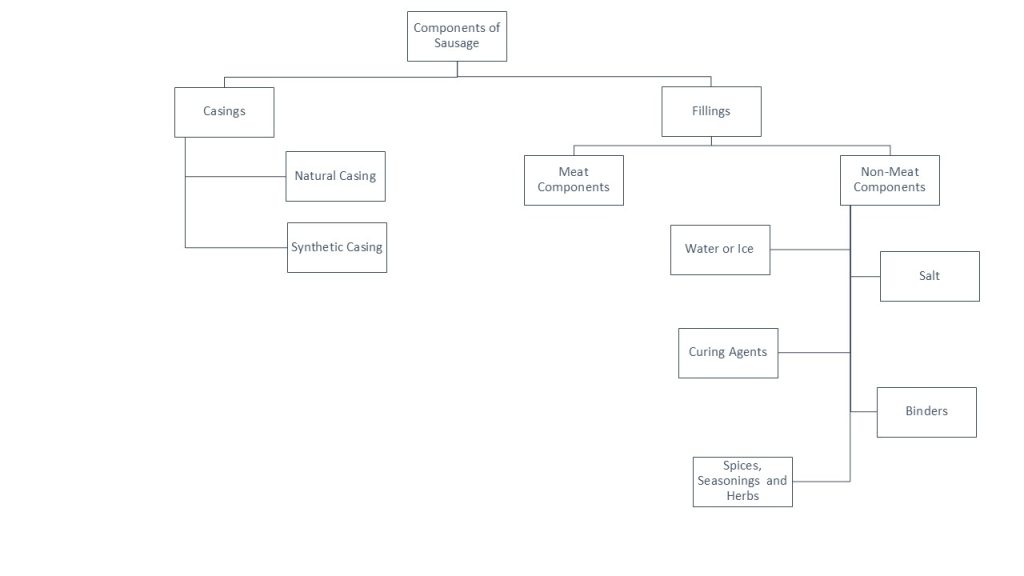
A. Casing
The casing is the outer covering of the sausage. It holds the filling together and gives the sausage its shape and size. It can be of two types: Natural and Synthetic
A. Natural Casings
Natural casings are the traditional and most widely used casings in sausage making. They are made from the intestines of animals such as:
- Hog (pig)
- Sheep (Lamb / Mutton)
- Wild Boar
- Cattle / Beef
Preparation of Natural Casings
Before being used, natural casings must be properly cleaned and prepared:
- The intestines are flushed thoroughly from inside to remove all waste matter.
- They are then soaked in a chlorine solution to disinfect them.
- Sinews, blood vessels, and fat sticking to the inside must be carefully removed.
- They should not be over-handled, as they can easily tear or puncture.
- Natural casings must be kept refrigerated at all times to prevent spoilage.
The ideal storage temperature for natural casings is 40°F to 45°F.
Functions of Natural Casings
- Hold the meat mixture in place
- Give the sausage its shape and size
- Affect the appearance of the sausage
- Improve the mouthfeel when eaten
Advantages of Natural Casings
- They are semi-porous, allowing deeper smoke penetration
- They absorb flavours and release fat better
- They usually hold their shape well and do not burst easily during cooking
- They are edible and do not need to be removed before eating
- They have a natural colour and better appearance
Caul Fat as a Natural Casing
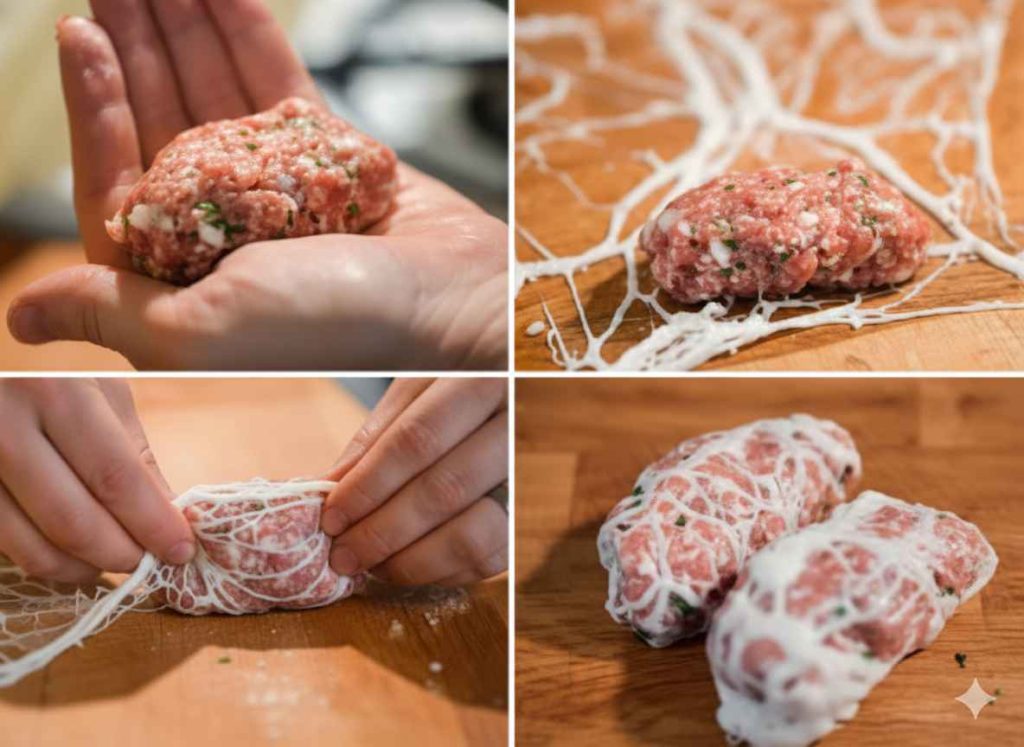
Caul fat is a thin, membrane-like lining of the stomach. It looks like a spider-web with streaks of fat.
Caul fat is used to make flat sausages such as:
- Crepinette
- Loukanika
It is especially useful because it can wrap items of uneven shape and size.
Types of Natural Casings
- Sheep Casings
- Made from sheep intestines
- Very thin and delicate
- Used for small, fine sausages like breakfast sausages and frankfurters
- Considered the highest quality natural casing
- Hog (Pig) Casings
- Made from pig intestines
- The most commonly used casing
- Used for medium and large sausages like bratwurst and chorizo
- Beef Casings
- Made from cattle intestines
- Thicker and stronger
- Used for large sausages like bologna and salami
- Caul Fat (Fat Netting)
B. Synthetic Casings
Synthetic casings are artificially made sausage coverings used in modern sausage production. They are made from materials such as:
- Cellulose
- Collagen
- Plastic
These casings are made to be uniform, strong, and easy to handle, especially in commercial sausage making.
Functions of Synthetic Casings
- Hold the meat mixture in shape
- Give sausages a uniform size and appearance
- Help in easy handling during stuffing and cooking
- Improve efficiency in large-scale production
Advantages of Synthetic Casings
Synthetic casings are popular because:
- They are strong and do not tear easily
- They have uniform size and thickness
- They are easy to store and handle
- They are hygienic
- Suitable for mass production
Disadvantages or Limitations of Synthetic Casings
- Some are not edible
- They do not give the same natural bite and flavour as natural casings
- Plastic casings do not allow smoke penetration
Types of Synthetic Casings
- Collagen Casings
- Made from animal collagen derived from animal hides, tendons or bones
- Edible and some are non-edible
- Used for fresh and smoked sausages
- Have a texture similar to natural casings
- Cellulose Casings
- Made from plant fibers
- Not edible
- Usually peeled off after cooking
- Commonly used for hot dogs and frankfurters
- Plastic Casings
- Made from plastic material
- Not edible
- Used for large sausages, pâté, and luncheon meats
- Do not allow smoke to pass through
B. Filling
The filling is the mixture of ingredients that is stuffed into the casing. It is the most important part of a sausage because it determines the taste, texture, colour, and quality of the product.
The filling is made up of two main components:
a. Meat Components
b. Non-Meat Components
- Meat Components
Meat components form the main body of a sausage. They include lean meat and fat, which together decide the structure, taste, and texture of the sausage.
Lean Meat
Lean meat is taken from pork, beef, veal, or poultry. It provides:
- Protein
- Firm Structure
- Body of the sausage
The lean meat is comminuted, meaning it is chopped, minced, or ground into small pieces so that it mixes well with other ingredients.
Fat
Fat is added to improve:
- Juiciness
- Flavor
- Softness
Without enough fat, sausages become dry and hard. A proper balance of lean meat and fat gives the sausage a pleasant texture and taste.
- Non-Meat Components
Non-meat components are added to the sausage mixture to improve its flavour, texture, appearance, and keeping quality. It generally incorporates additives and preservatives.
They do not form the main body of the sausage but they play a very important role in its quality.
a. Water or Ice
Water or crushed ice is added to:
- Help in proper mixing
- Keep the meat cool during grinding
- Make the sausage juicy
- Prevent fat from melting too quickly
It also helps in giving a smooth texture to the sausage.
b. Salt and Curing Agents
Salt
- Adds flavour
- Helps in preserving the meat
- Improves the binding of meat particles
Curing agents (such as nitrate or nitrite):
- Improve the pink colour of sausages
- Prevent the growth of harmful bacteria
- Increase shelf life
c. Binders
Binders help to hold the mixture together and improve texture.
Common binders are:
- Breadcrumbs
- Starch
- Flour
They also help to retain moisture and prevent the sausage from becoming dry.
d. Spices and Seasonings
Spices and seasonings give sausages their special flavour and aroma. For example:
- Pepper
- Paprika
- Garlic
- Nutmeg
- Herbs
Non-meat components are essential to make sausages tasty, stable, and safe to eat.
Ham
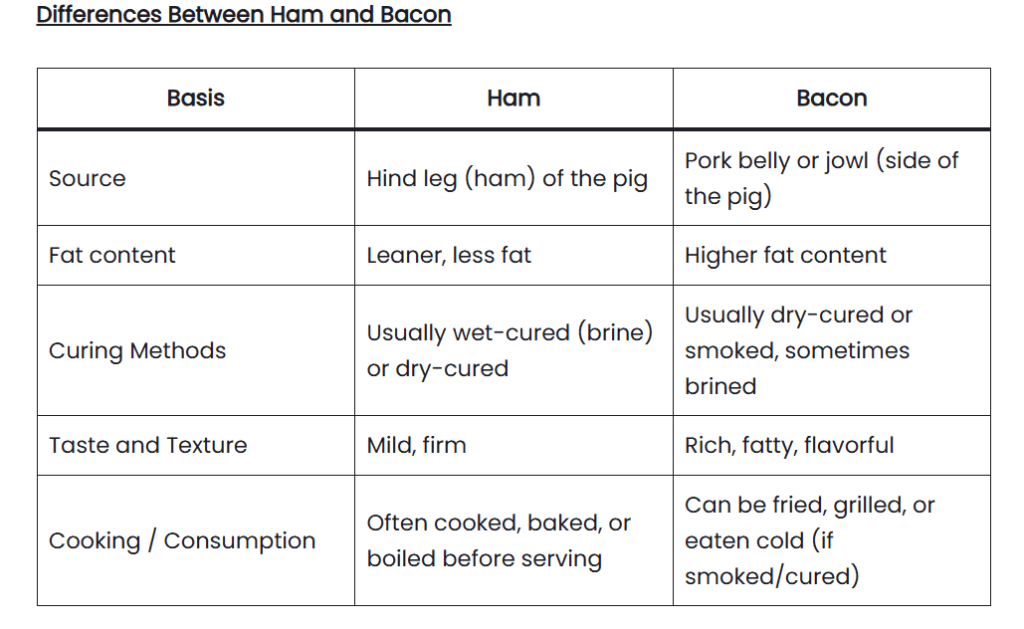
Ham is the leg of pork that has been preserved by curing, with or without smoking. It is one of the oldest and most important products of charcuterie.
From ancient times, ham was developed as a way to store pork for long periods without refrigeration. By using salt, drying, and smoking, people could keep pork safe for consumption for months.
Curing
Curing is the process of preserving meat by using:
- Salt
- Sugar
- Nitrates or Nitrites
- Spices or Herbs
These ingredients helps in:
- Remove moisture from the meat
- Prevent the growth of bacteria
- Improve flavour and colour
- Increase shelf life
Techniques of Curing Ham
Ham can be cured by several methods:
- Dry Curing
- Salt, sugar, and spices are rubbed directly on the pork leg
- The ham is kept for several weeks or months
- Moisture slowly comes out
- This produces a firm, strongly flavoured ham
- Wet Curing (Brining / Brine Solution)
- The pork leg is soaked in a solution of salt, sugar, and water
- This method gives a milder flavour and softer texture
- Injection Curing
- another form of wet curing but,
- Brine is injected directly into the meat
- Ensures quick and even curing
- Used in modern commercial ham production
- Smoking
- After curing, the ham is often smoked
- Smoking adds flavour, colour, and extra preservation
Types of Ham
- Fresh Ham (Not Cured)
- Dry-cured Ham
- Wet-cured Ham
- Smoked Ham
Uses of Ham
Ham is commonly used in:
- Sandwiches
- Canapés
- Hors d’oeuvres
- Cold platters
- Salads
- Breakfast dishes
- Pizza and pasta toppings
- Stuffing for rolls, croquettes and pastries
- Garnishing and decoration of cold dishes
Bacon
Bacon is pork, usually from the belly or back, that has been cured with salt and other agents and often smoked before use.
| Note: The curing process of bacon is similar to the curing of ham, using dry curing, wet curing (brining), or injection curing, followed by smoking in most cases. |
Uses of Bacon
Bacon is used for:
- Breakfast dishes
- Sandwiches and burgers
- Salads
- Soups and sauces
- Garnishing and flavouring
Pate
Pâté is a spreadable meat preparation. It is usually made using:
- Liver (Chicken, duck, goose,pork)
- Meat
- Fat
- Seasonings, herbs and spices
- Sometimes wine, brandy or cognac
The mixture is cooked and then chilled so it sets into a firm but soft paste.
| Definition: Pâté is a smooth or coarse paste made from finely chopped or puréed meat, liver, fat, seasoning and sometimes alcohol, cooked and served cold. |
Characteristics of Pate
- Soft, smooth or slightly coarse texture
- Spreadable
- Rich and creamy
- Served cold
- Often spread on bread, toast, crackers or used in canapés
Examples
- Chicken liver pâté
- Duck liver pâté
- Pork pâté
- Goose liver pâté (Foie gras pâté)
| Note: Foie gras is a special type of duck or goose liver that becomes very rich, soft, and fatty because the bird is carefully fed a high-energy diet. This process makes the liver much larger than normal and gives it a smooth, creamy texture and deep flavour. In garde manger and charcuterie, foie gras is mostly used to make pâtés, terrines, and other cold preparations, and it is considered a luxury ingredient in classical French cuisine. |
Terrine
A terrine is made by placing layers or a mixture of:
- Meat
- Poultry
- Fish
- Vegetables
- Herbs and Seasonings
into a terrine mould, which is then cooked slowly in a water bath (bain-marie) and allowed to cool and set.
| Definition: Terrine is a cold dish made by cooking a mixture of meat, fish, or vegetables in a covered mould (also called a terrine) and serving it in slices after chilling. |
Characteristics:
- Firm and sliceable
- May be smooth or coarse
- Shows visible layers or pieces
- Served cold in slices
- Looks decorative and elegant
Pate vs Terrine
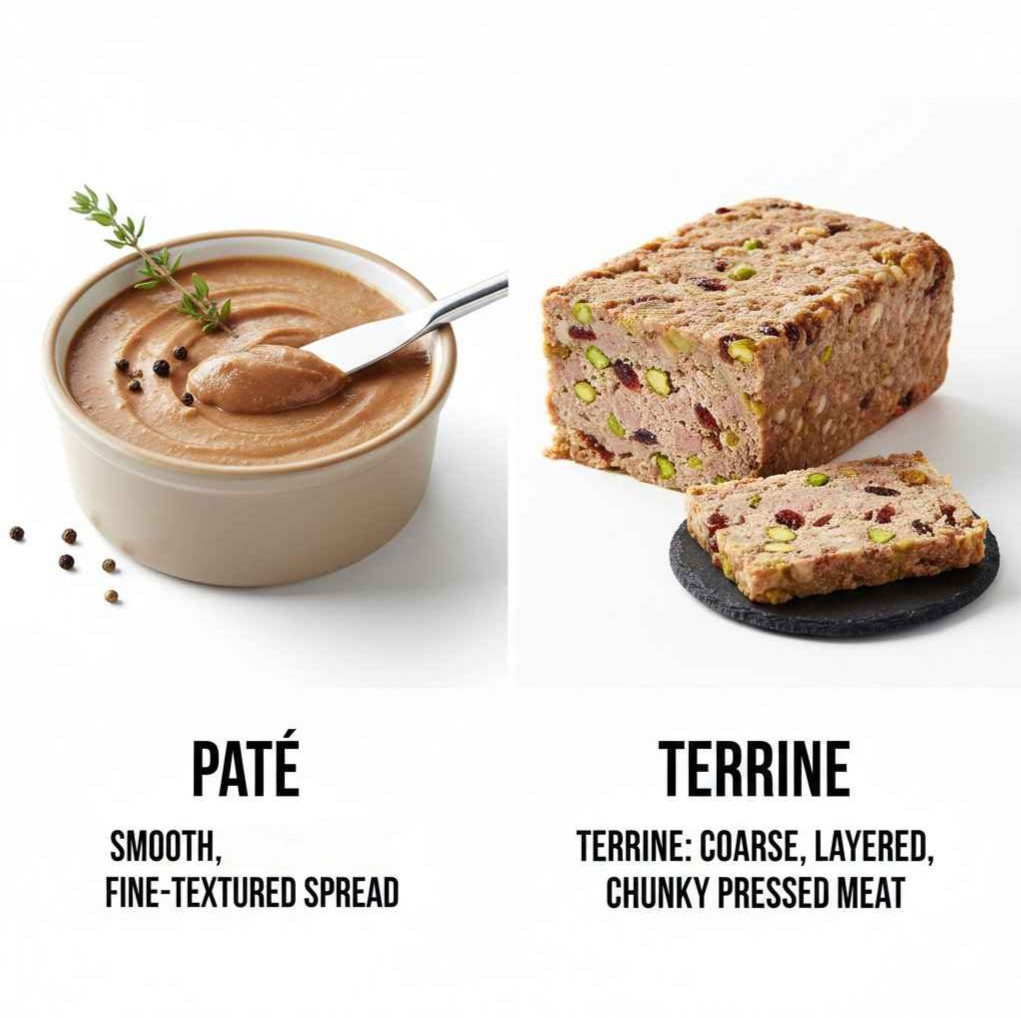
The differences between pate and terrine are listed below:
| Basis | Pate | Terrine |
|---|---|---|
| Meaning | A smooth or coarse paste made from minced meat, liver, fat, and seasonings | A moulded cold dish made from layered or mixed meat, fish, or vegetables |
| Texture | Usually smooth and spreadable (can also be coarse) | Firm and Sliceable |
| Method | Ingredients are finely ground and blended into a paste | Ingredients are arranged in layers or mixed and cooked in a mould |
| Presentation | Served as a spread on bread or crackers | Served in slices |
| Uses of Liver | Usually liver-based | May or may not contain liver |
Galantine
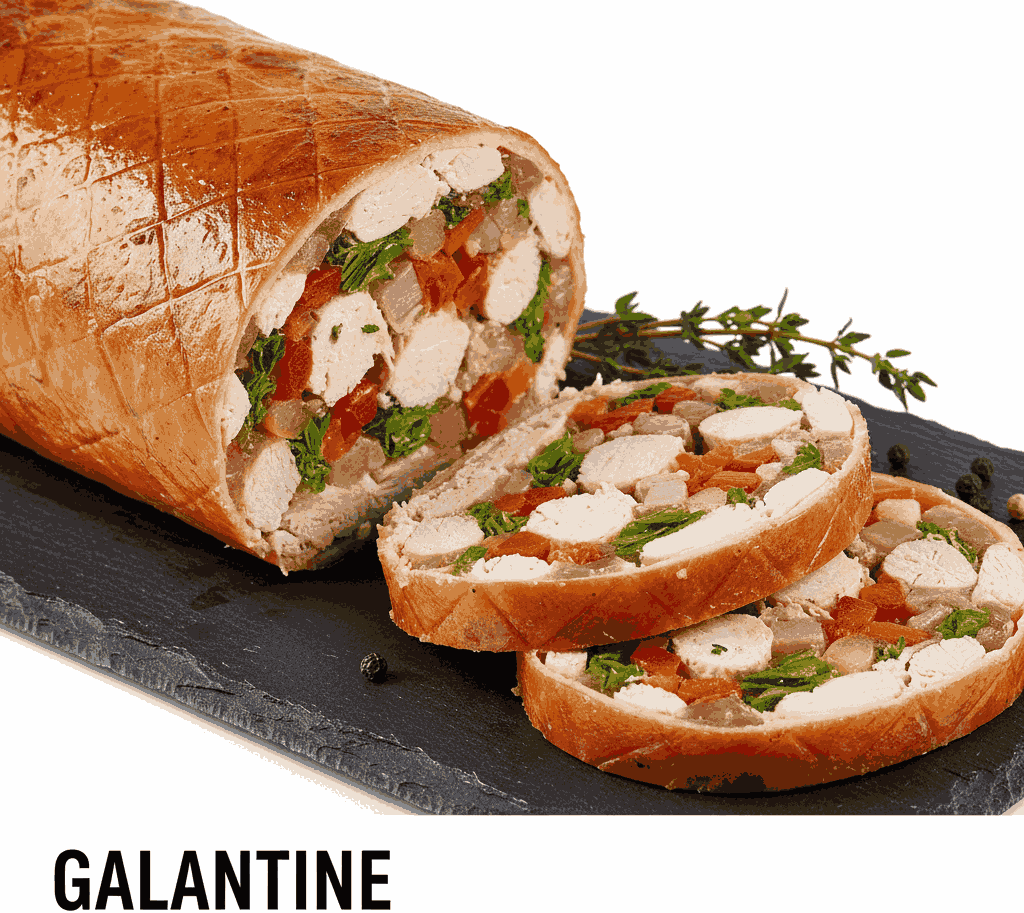
The word ‘galantine’ comes from French cuisine and refers to an elegant cold preparation commonly served in buffets and formal cold platters.
Galantine is a classic cold dish made from boned poultry, meat, or fish that is stuffed with a seasoned forcemeat, rolled into a cylindrical shape, gently poached, and then served cold, usually coated with aspic.
Process of making Galantine
- The meat (usually chicken, turkey, duck, or fish) is boned carefully without tearing the skin.
- A forcemeat filling (minced meat, fat, seasoning, herbs, sometimes nuts or pistachios) is spread over the meat.
- The meat is then rolled tightly into a log shape and wrapped in cloth or foil.
- It is poached gently in stock until fully cooked.
- After cooking, it is cooled, pressed to set its shape, and often coated with aspic for shine and protection.
- Finally, it is sliced and served cold.
Uses
- Served as part of cold buffets
- Used as a hors d’oeuvre or appetizer
- Common in banquets and formal garde manger displays
| Galantine is a rolled, stuffed, poached meat dish served cold, usually shiny with aspic and cut into neat slices. |
Aspic
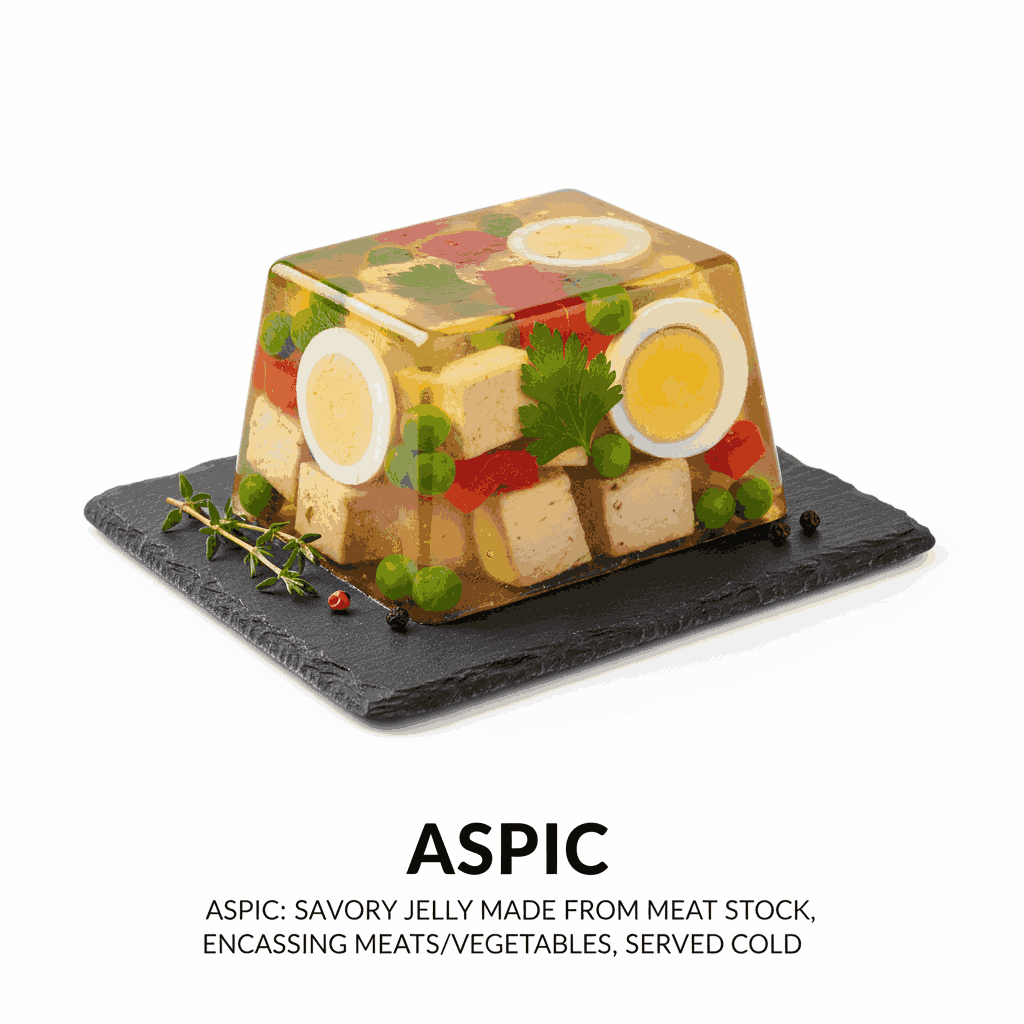
Aspic is widely used in garde manger and charcuterie to give cold foods a shiny appearance and to help preserve and protect them.
Aspic is a clear, savoury jelly made from well-flavoured meat or fish stock that contains natural gelatin and is used to coat, decorate, or set cold dishes.
Uses of Aspic
- To coat galantines, terrines, and pâtés
- To set cold dishes in moulds
- To decorate cold platters
- To protect food from air and drying
Aspic Making Process
- Preparae Strong Stock
Use bones, meat trimmings, and vegetables to make a rich stock. - Add Gelatin
Extra gelatin may be added to ensure proper setting. - Clarify the Stock
Egg whites and crushed shells are used to remove impurities, making the liquid clear. - Strain Carefully
The clear liquid is passed through muslin or fine cloth. - Season and Chill
The liquid is seasoned and chilled / refrigerate overnight so it sets into a jelly.
Hors d’oeuvres
Hors d’oeuvres are small, savory, bite-sized, flavorful dishes served before the main meal, often as finger-food, to stimulate the appetite.
They are a key part of classical French and international cuisine and are often served at banquets, buffets, and formal meals.
Purpose of Hors d’oeuvres
- To stimulate appetite
- To add elegance to a meal
- To showcase chef’s skill in presentation and flavour combination
- To introduce guests to the meal in a light and appealing way
Features of Hors d’oeuvres
- Always served small and bite-sized
- Can be hot or cold
- Often accompanied by dips, sauces, or garnishes
Classification of Hors d’oeuvres
Hors d’oeuvres can be classified into several types based on preparation, temperature, and presentation.
Hors d’oeuvres are mainly classified into two main types: Hot and Cold.
Other types such as canapés, stuffed, skewered, and finger hors d’oeuvres come under these two main groups.
- Cold Hors d’oeuvres
These are served chilled or at room temperature and are prepared in advance. They are very common in garde manger and cold buffets.
Examples: Canapés, Pâtés and terrines, Smoked salmon, Shrimp cocktail, Cold cuts (ham, salami, chicken roll), Stuffed eggs, crudités with dips
Features:- Light and refreshing
- Easy to store and display
- Often decorated with aspic, herbs, or salad garnishes
- Hot Hors d’oeuvres
These are served hot and are usually cooked just before service.
Examples: Mini samosas, Chicken croquettes, Stuffed mushroos, Spring rolls, Mini kebabs, Cheese balls
Features:- More filling than cold hors d’oeuvres
- Crispy or soft texture
- Served fresh and hot
- Canapé-based Hors d’oeuvres
These are small bite-sized items served on a base of bread, toast, cracker, or pastry.
Examples: Smoked salmon on toast, Cheese and olive canapé, Chicken salad on bread - Stuffed or Filled Hors d’oeuvres
These are items where a filling is placed inside another food.
Examples: Stuffed tomatoes, Devilled eggs, Stuffed mushrooms, Filled pastry shells - Skewered or Finger Hors d’oeuvres
These are served on toothpicks, skewers, or held by hand.
Examples: Chicken tikka skewers, Cheese and grape sticks, Prawn skewers
Appetizers
Appetizers are light food items served at the beginning of a meal to stimulate the appetite and prepare the guest for the main course.
They are usually slightly larger and more filling than hors d’oeuvres, and are served as the first course in a formal menu.
Appetizers can be hot or cold and are chosen in such a way that they do not overpower the taste of the main dish.
Purpose of Appetizers:
- Increase hunger and interest in food
- Stimulate taste buds
- Prepare the digestive system
- Give a pleasant start to the meal
Classification of Appetizers
Appetizers are mainly classified into the following types:
- Cold Appetizers
These are cold appetizers usually served in glasses.
Examples: Prawn cocktail, Fruit cocktail, Crab cocktail - Hors d’oeuvre-based Appetizers
Some hors d’oeuvres can also be served as appetizers.
Examples: Canapés, Smoked salmon, Pâtés and terrines - Soups (as appetizers)
Light soups are often served as appetizers.
Examples: Clear soup, Consommé, Cold soups like gazpacho - Salads
Light and fresh salads are common appetizers.
Examples: Green salad, Caesar salad, Russian salad - Hot Appetizers
These are warm dishes served before the main course.
Examples: Chicken wings, Cutlets, Spring rolls, Stuffed mushrooms - Chips and Dips
Chips and dips are a simple and popular type of appetizer. Chips may be potato chips, tortilla chips, crackers, or breadsticks, while dips are thick sauces served for dipping, such as salsa, cheese dip, sour cream, hummus, guacamole, or mayonnaise-based dips.
Difference Between Hors d’oeuvre and Appetizer
| Hors d’oeuvre | Appetizer |
|---|---|
| Served before the meal begins | Served as the first course of a meal |
| Always small and bite-sized | Given in slightly larger portion |
| Often served at parties, receptions, or cocktail hours | Served at the dining table |
| Usually finger foods like canapés, cutlets, or cold cuts | Can be soup, salad, or hot dish |
| Usually eaten by hand | Eaten with cutlery most of the time |
Sandwich and Canapés
A sandwich is a food item made by placing a filling like meat, cheese or vegetables placed between two slices of bread or inside a split roll.
It is one of the most popular portable and practical foods because it is easy to prepare, easy to serve, and can be served hot or cold.
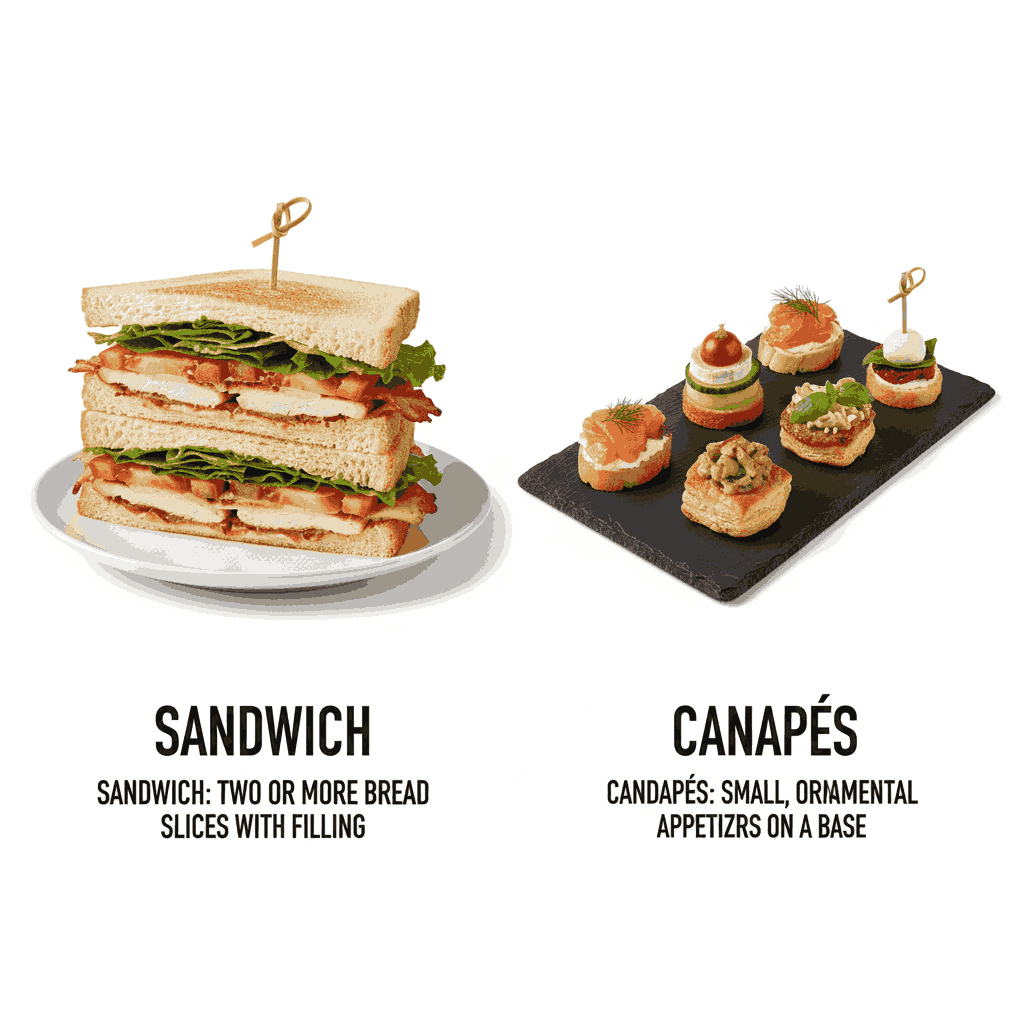
A canapé is a small, decorative, open-faced sandwich served as an appetizer or hors d’oeuvre. It is designed to be eaten in one or two bites and is usually served at parties, receptions, and buffets.
Classification of Sandwich
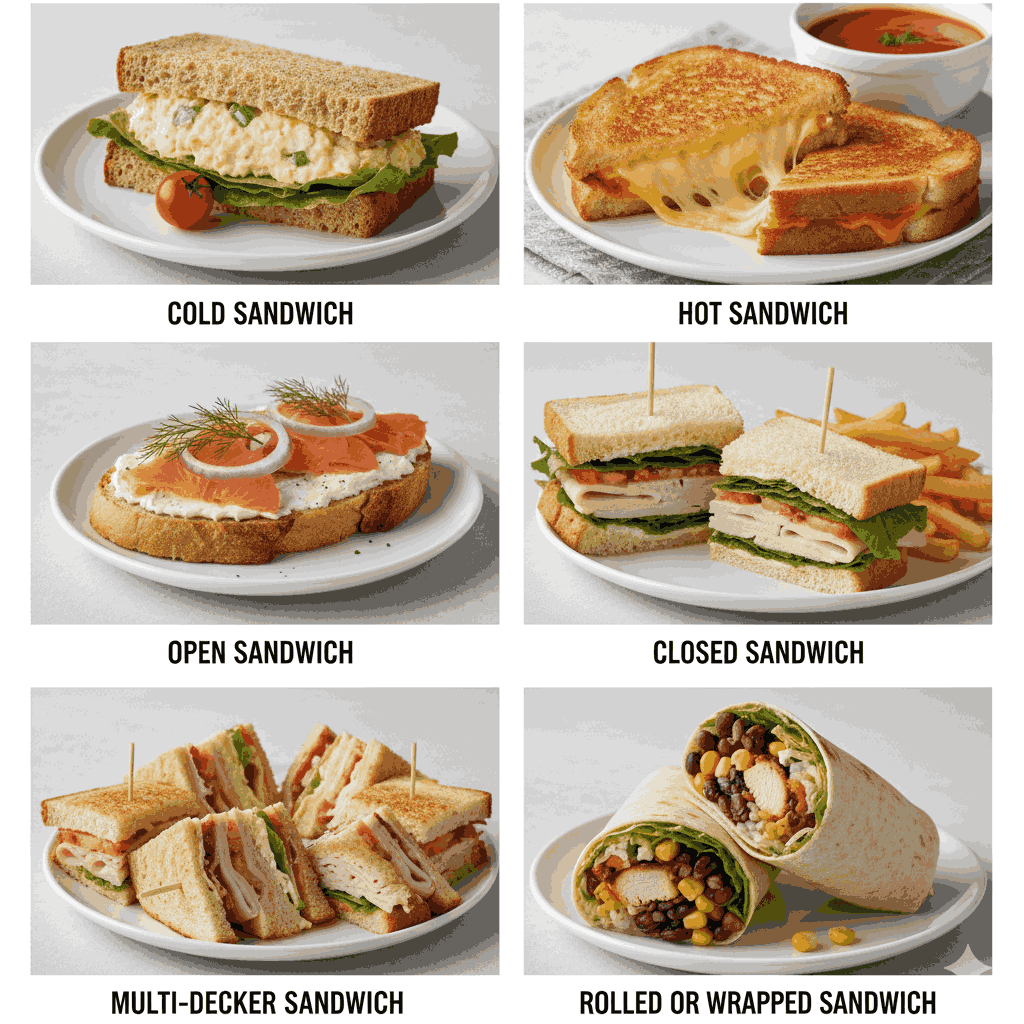
Sandwiches are classified into different types:
- Cold Sandwich
These sandwiches are prepared and served without heating. They are very common in garde manger, lunch boxes, and buffets.
Examples: Egg sandwich, Chicken salad sandwich, Cheese and tomato sandwich, Ham sandwich
Features:- Made with cooked or ready-to-eat fillings
- Served chilled or at room temperature
- Easy to prepare and store
- Hot Sandwich
These sandwiches are served hot after cooking, grilling, or frying.
Examples: Grilled cheese sandwich, Club sandwich, Burger, Hot chicken sandwich
Features:- Bread or filling is toasted, grilled, or fried
- More filling and heavy than cold sandwiches
- Open Sandwich
These are made with only one slice of bread and the filling is placed on top. Examples: Smoked salmon on toast, Cheese and tomato on bread, Egg on toast
Features:- Attractive and decorative
- Often eaten with knife and fork
- Closed Sandwich
These are the most common type, made with two slices of bread with filling in between. Examples: Veg sandwich, Egg sandwich, Chicken sandwich
Features:- Easy to carry and eat
- Popular in cafés and fast food outlets
- Multi-Decker Sandwich
These sandwiches are made with more than two slices of bread and several layers of filling. Example: Club sandwich
Features:- Rich and heavy
- Served in hotels and restaurants
- Rolled or Wrapped Sandwich
Here, soft bread or flatbread is rolled around the filling. Examples: Tortilla wraps, Chapati rolls
Features:- Easy to hold and eat
- Popular in fast food and takeaway
Classification of Canapés
Canapés are classified mainly on the basis of their base and style of preparation.
- Bread-Based Canapés
These are made using small pieces of bread such as toast, baguette slices, or sandwich bread. Examples: Smoked salmon on toast, Cheese and tomato on bread, Chicken paste on bread
Features:- Most commonly used
- Easy to cut into shapes like round, square, or triangle
- Cracker-Based Canapés
Here, crackers or crisp breads are used as the base. Examples: Cheese on water cracker, Tuna salad on cream cracker
Features:- Crisp and dry
- Do not become soggy easily
- Pastry-based Canapés
These are made using small pastry items like puff pastry, tart shells, or vol-au-vent cases. Examples: Chicken filling in pastry cup, Mushroom in tart shell
Features:- Rich and flaky
- Often used for hot canapés
- Vegetable-based Canapés
Slices of vegetables are used instead of bread. Examples: Cucumber slice with cream cheese, Tomato slice with tuna topping
Features:- Light and fresh
- Suitable for health-conscious guests
- Meat or Fish-based Canapés
Slices of meat, fish, or cold cuts act as the base. Examples: Ham roll with cheese, Smoked salmon roll
Guidelines for Preparing Sandwich and Canapés
- Guidelines for Base
The base forms the foundation of a sandwich or canapé.- Use fresh bread, rolls, crackers, or pastry
- Bread should be firm and not crumbly
- For canapés, cut the base into neat shapes (round, square, triangle)
- Bases should not be too thick or too thin
- Toasted bases should be crisp but not burnt
- Guidelines for Spread
Spreads add flavour and moisture.- Use spreads like butter, mayonnaise, cream cheese, or chutney
- Spread evenly to cover the surface
- Spread helps to prevent the base from becoming soggy
- Flavour should match the filling
- Guidelines for Fillings
The filling is the main part of the sandwich.- Use fresh and good quality ingredients
- Cut or prepare fillings neatly and evenly
- Do not overload the sandwich
- Flavour should be balanced, not too strong
- Fillings should be properly seasoned
- Guidelines for Toppings
Toppings are mainly used for canapés.- Topping should be small and attractive
- It should match the flavour of the base and spread
- Should be light and not heavy
- Must be placed neatly in the centre
- Guidelines for Garnishes
Garnish improves appearance.- Use fresh and colourful items like parsley, olives, tomato slices
- Garnish should be edible
- Do not over-garnish
- Guidelines for Accompaniments
Accompaniments are served on the side.- Examples: chips, salad, pickles
- They should complement the sandwich
- Must be served fresh and neatly arranged
General Guidelines for Sandwich and Canapes
Here are some extra general guidelines you can add.
- Always use fresh and good quality ingredients
- Bread, meat, vegetables, and spreads should not be stale
- Food should be prepared under clean and hygienic conditions
- Neatness is very important
- Cut sandwiches evenly and cleanly
- Remove messy edges and wipe the plate before serving
- Eye appeal matters
- Food should look colourful and attractive
- Use different colours of fillings and garnishes
- Size should be proper
- Sandwiches should not be too big or too small
- Canapés should be bite-sized
- Taste should be balanced
- No one flavour should dominate
- Salt, spice, and sourness should be in balance
- Serve at the right temperature
- Hot items should be hot
- Cold items should be cold
- Do not overcrowd the plate
- Leave some space so the food looks neat and elegant