
Short Important Questions
- Who is a Steward? (1 Mark, 2016)
- Who is a Kitchen Steward? (1 Mark, 2019)
- Mention and four considerations when selecting a dishwashers. (1 Mark, 2023)
- List the duties of Kitchen Steward. (1 Mark, 2025)
Long Important Questions
- Draw an organization chart of kitchen stewarding Department. Explain the job responsibilities of Steward staff. (10 Marks, 2016)
- Draw a neat organization chart of kitchen stewarding department. Write the job responsibility of kitchen steward. (5 Marks, 2017, 2018)
- What is kitchen stewarding? Make a neat hierachy of stewarding and explain its job and responsibilities. (10 Marks, 2021)
- Explain the types of dishwasher. (5 Marks, 2022)
- Who is kitchen steward? List down the job responsibilities of Executive Steward. (5 Marks, 2023)
- Write down the duties and responsibilities of kitchen steward. (5 Marks, 2019)
- List different types of dishwashers in commercial kitchens. Explain any two. (5 Marks, 2025)
Introduction
Kitchen Stewarding is the department in a hotel or catering establishment that is responsible for:
- Cleaning and sanitizing all kitchen and service equipment
- Washing, storing and issuing utensils
- Maintaining hygiene in food production and service areas
- Supporting smooth functioning of the Food & Beverage department
It is ‘back of the house department’ which means it works in the background, but without stewarding, no kitchen can operate.
| Definition: The Kitchen Stewarding Department is section of a hotel which is responsible for the cleanliness, maintenance, storage and issue of all crockery, cutlery, glassware and kitchen equipment, and also for keeping the kitchen and back areas clean and hygienic. |
Importance of Kitchen Stewarding
Kitchen stewarding is often called the “backbone of food service operations.” Although it works behind the scenes, it affects the entire hotel.
- Provides clean and hygienic crockery, cutlery and kitchen equipment
- Ensures smooth and uninterrupted kitchen and restaurant operations
- Prevents delay in food production and service
- Maintains food safety and sanitation standards
- Reduces guest complaints and dissatisfaction
- Helps in controlling breakage and loss of equipment
- Supports efficient functioning of the Food & Beverage department
- Contributes to overall hotel reputation and profit
To understand the importance of this department in simple just consider, if stewarding fails:
- Plates will not be available
- Pots will not be cleaned
- Kitchen operations will stop
- Service will be delayed
- Guests will become dissatisfied
Therefore, this department directly influences:
- Service speed
- Hygiene
- Food safety
- Guest satisfaction
- Hotel profit
Objectives of Kitchen Stewarding
- To provide clean, safe and hygienic equipment
- To ensure smooth flow of kitchen and restaurant operations
- To maintain high standards of sanitation
- To reduce breakage and loss
- To support food safety and hygiene laws
Relationship with other Department
Kitchen stewarding works closely with:
- Kitchen (Food Production) – supplies clean pots, pans and tools
- Restaurant (Service) – supplies plates, glasses and cutlery
- Stores – receives and stores equipment
- Engineering – for repair of machines
- Housekeeping – for waste and hygiene coordination
Organization Chart of Kitchen Stewarding
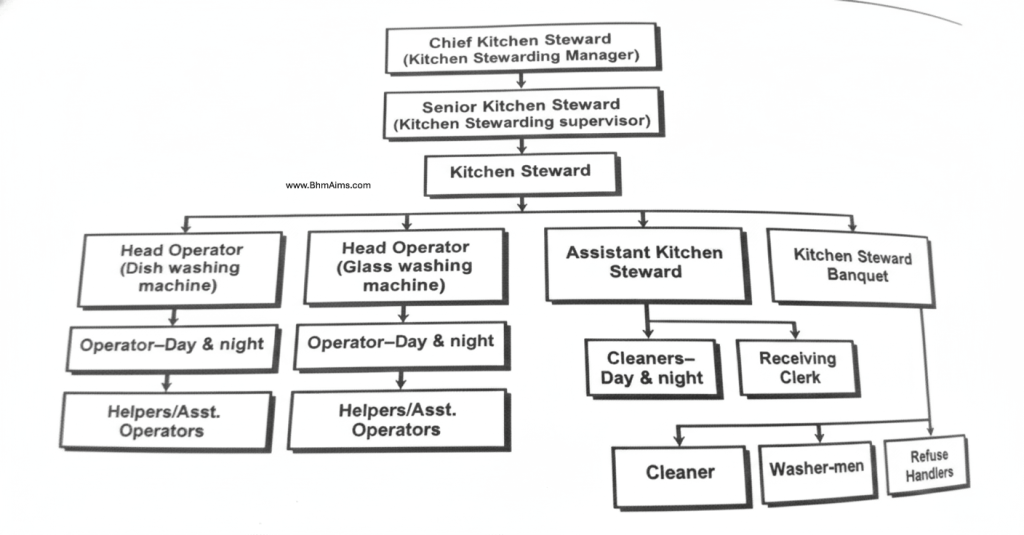
Chief Kitchen Steward
Position: Chief Kitchen Steward / Executive Steward / Steward Manager
Reports to : Food and Beverage Director / Executive Chef
Duties and Responsibilities:
- Financial and Budgetary Control
- Controls the overall budget of the stewarding department
- Monitors breakage and loss of crockery, cutlery and glassware
- Maintains records of equipment usage and replacement
- Controls the cost of cleaning chemicals and detergents
- Plans staff duty rosters to avoid overstaffing and extra labor cost
- Inventory and Store Control
- Maintains records of all service and kitchen equipment
- Ensures proper storage, issue and replacement of utensils
- Investigates causes of frequent breakage and takes corrective action
- Coordinates with the store for purchase and supply of equipment
- Food Safety and Hygiene Control
- Ensures all utensils, equipment and surfaces are properly sanitized
- Checks that dishwashers operate at correct temperature for hygiene
- Maintains clean and pest-free kitchen areas
- Coordinates with pest control team
- Ensures compliance with food safety and health regulations
- Equipments and Maintenance
- Ensures dishwashers, glass washers and pot washers are in good working condition
- Arranges regular servicing and preventive maintenance
- Ensures careful handling of expensive china, glassware and silverware
- Staff Management and Training
- Recruits and trains stewarding staff
- Trains staff on:
- Use of cleaning chemicals
- Operation of dishwashing machines
- Safety and hygiene procedures
- Conducts performance evaluations
- Guides supervisors and senior stewards
- Coordination with Other Departments
- Works with Executive Chef for supply of clean kitchen equipment
- Works with Restaurant and Banquet Managers to ensure enough clean plates, glasses and cutlery are available
- Coordinates with Engineering for equipment repair
- Coordinates with Stores for supplies
Overall, they are responsible for smooth, safe and hygienic functioning of the stewarding department ensuring no delay in food production or service due to lack of clean equipment.
Senior Kitchen Steward
Position: Senior Kitchen Steward / Steward Supervisor
Reports to: Chief Kitchen Steward (Executive Steward)
Duties and Responsibilities:
- Shift Supervision
- Supervises all stewarding activities during his assigned shift
- Controls the work of:
- Dish washing section
- Pot washing area
- Glass washing area
- Cleaning staff
- Quality Control
- Inspects plates, glasses, cutlery and kitchen utensils
- Ensures all items meet cleanliness and hygiene standards before they are sent for service
- Checks cleanliness of stewarding and kitchen areas
- Training and Guidance
- Trains Staffs on:
- Proper stacking of dishes
- Correct loading of machines
- Use and dilution of cleaning chemicals
- Gives short instructions at the beginning of shifts
- Gives short instructions at the beginning of shifts
- Trains Staffs on:
- Record Keeping and Reporting
- Maintains the daily log book
- Records:
- Staff attendance
- Equipment breakdowns
- Accidents or problems
- Reports important matters to the Chief Steward
- Coordination (Liaison Work)
- Acts as a link between:
- Kitchen (chefs)
- Restaurant and banquet areas
- Stewarding staff
- Ensures continuous supply of clean plates, pans and utensils, especially during busy hours
- Acts as a link between:
- Control of Equipment and Breakage
- Monitors handling of:
- Crockery
- Glassware
- Machines
- Reports losses and breakage
- Ensures machines are operated safely
- Monitors handling of:
Kitchen Steward
Position: Kitchen Steward (General)
Reports to: Senior Kitchen Steward / Supervisor
Duties and Responsibilities:
- Cleaning and Responsibilities
- Maintains cleanliness of:
- Kitchen floors
- Walls
- Drains
- Stores and refrigerators
- Keeps all work areas clean and hygienic
- Maintains cleanliness of:
- Washing of Equipment
- Washes: Pots and pans, Trays, Kitchen tools
- Helps in washing plates, glasses and cutlery when required
- Waste Management
- Collects and empties garbage bins from kitchen and stewarding areas
- Cleans and sanitizes garbage containers
- Helps in keeping the kitchen free from bad smell and pests
- Transport of Equipment
- Carries clean utensils from:
- Dishwashing area to kitchen
- Store to service areas
- Ensures safe handling to avoid breakage
- Carries clean utensils from:
- Use of Cleaning Chemicals
- Uses detergents, sanitizers and degreasers correctly
- Follows safety instructions while handling chemicals
- Prevents damage to equipment and injury to staff
- Supports to Supervisors
- Works as instructed by Senior Steward
- Assists in:
- Setting up cleaning areas
- Preparing for busy service periods
Head Operator (Dish / Glass Washing Machine)
Reports to: Senior Kitchen Steward / Stewarding Supervisor
Duties and Responsibilities:
- Operates industrial dishwashing and glass washing machines
- Starts, stops and cleans the machines properly
- Ensures correct water temperature and pressure
- Organizes the dirty dish area for smooth flow of items
- Prevents overloading and blockage of machines
- Cleans filters, spray arms and nozzles regularly
- Identifies minor faults and reports major breakdowns
- Checks detergent, sanitizer and rinse-aid levels
- Replaces chemical containers when empty
- Ensures all washed items are clean and hygienic
Kitchen Steward – Banquet
Reports to: Senior Kitchen Steward and Banquet Manager
Duties and Responsibilities:
- Collects required plates, cutlery and glassware as per Banquet Event Order (BEO)
- Transports banquet equipment to function halls
- Sets up:
- Buffet counters
- Chafing dishes
- Coffee urns
- Juice dispensers
- Polishes and burnishes silverware and service equipment
- Maintains cleanliness of temporary and mobile banquet kitchens
- Clears and returns all banquet equipment after events
- Ensures banquet inventory is ready for the next function
Assistant Kitchen Steward / Helpers
Reports to: Senior Kitchen Steward
Duties and Responsibilities:
- Washes large pots, pans and baking trays manually (scullery work)
- Assists dish and glass washing machine operators
- Clears dirty dish landing areas
- Carries heavy equipment safely
- Sweeps and mops floors near washing and prep areas
- Ensures all equipment is completely dry before stacking
- Prevents bacterial growth due to wet nesting
Night Cleaning Team
Also known as ” Kitchen Deep Cleaners”
Duties and Responsibilites:
- Deep cleans:
- Grills
- Ovens
- Fryers
- Salamanders
- Removes grease from kitchen equipment
- Cleans exhaust hoods and grease filters
- Uses industrial machines to scrub kitchen floors
- Cleans floor drains to prevent:
- Bad odor
- Pest problems
Refuse Handlers / Garbage Technician
Reports to: Senior Kitchen Steward
Duties and Responsibilites:
- Segregates waste into:
- Food waste
- Recyclable waste
- General waste
- Operates garbage compactors and balers safely
- Washes and disinfects garbage bins
- Keeps loading dock and waste area clean
- Prevents pests and foul smell in waste area
Types of Dishwasher
Commercial dishwashers are designed to wash and sanitize utensils quickly and hygienically. Most machines complete a wash cycle in 90 to 180 seconds, which is much faster than domestic dishwashers.
Selection of a dishwasher depends on:
- Volume of work
- Space available
- Power supply
- Type of operation (restaurant, hotel, bar, banquet, hospital, etc.)
Let’s explain the types of dishwasher:
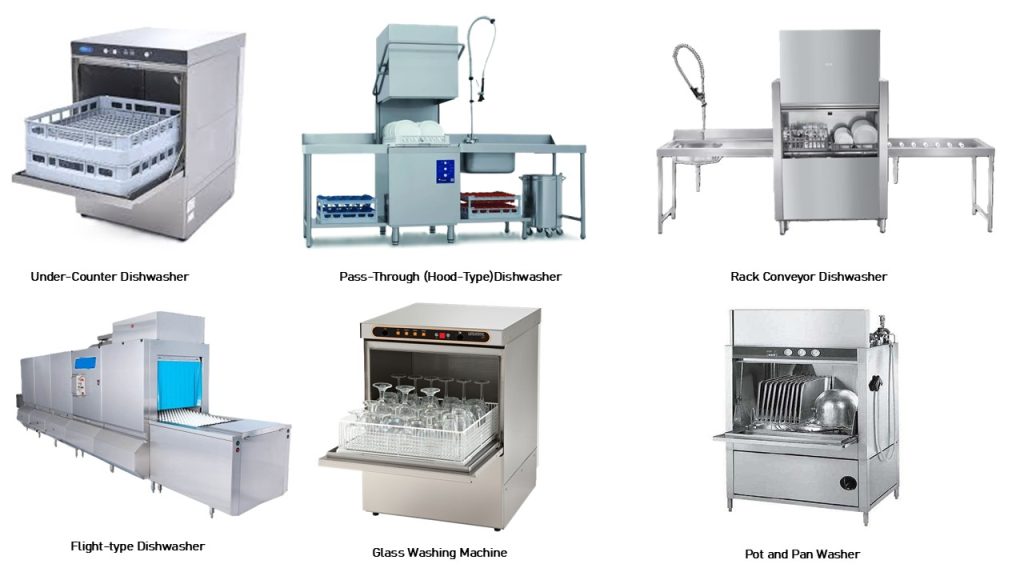
- Undercounter Dishwasher
An undercounter dishwasher is a compact commercial dishwashing machine designed to fit under a standard kitchen or bar counter. It is mainly used where space is limited but quick washing is required.
Main Features:- Installed below the counter
- Has a front-loading door
- Uses rack system for dishes
- Wash cycle usually takes 90 to 120 seconds
- Available in high-temperature and low-temperature models
Capacity:
- Washes about 20 to 55 racks per hour
- Suitable for small to medium volume washing
Uses:
It is commonly used in:
- Bars
- Cafés
- Coffee shops
- Small restaurants
- Front-of-house service areas
Mainly used for:
- Glassware
- Cups and saucers
- Small plates
- Cutlery
Advantages:
- Requires very little space
- Easy to operate
- Provides quick cleaning during service
- Ideal for continuous small-batch washing
Disadvantages:
- Not suitable for large-scale operations
- Cannot handle heavy pots and large utensils
- Lower capacity compared to hood or conveyor machines
- Pass-Through (Hood-Type) Dishwasher
A pass-through dishwasher is a medium-capacity commercial dishwasher fitted with a lift-up hood. It is placed between two tables so dirty dishes enter from one side and clean dishes come out from the other.
Features:- Has a sliding or lift-up hood
- Uses dish racks
- Installed between:
- Inlet table (dirty dishes)
- Outlet table (clean dishes)
- Wash cycle usually 90–120 seconds
Capacity:
- Washes about 50–70 racks per hour
- Suitable for medium-size operations
Uses:
It is commnly used in:
- Hotels
- Restaurants
- Banquet kitchens
- Institutional kitchens
Used for washing:
- Plates
- Glasses
- Cutlery
- Trays
Advantages:
- Faster than undercounter dishwasher
- No bending required – racks slide in at table height
- Handles higher volume of dishes
- More hygienic due to separate dirty and clean sides
Disadvantage / Limitations:
- Requires more space
- Higher cost than undercounter machines
- Needs proper electrical and water supply
- Conveyor (Rack Conveyor) Dishwasher
A conveyor dishwasher is a high-capacity commercial dishwashing machine in which racks of dishes move automatically through different washing stages on a motorized belt or chain.
Features:- Works like a tunnel
- Racks move through:
- Pre-wash
- Main wash
- Rinse
- Sometimes drying
- Continuous operation
Capacity:
- Washes about 100 to 250 racks per hour
- Can process 350–1000 racks per day
Uses:
It is commnly used in:
- Large hotels
- Staff cafeterias
- Banquet kitchens
- Hospitals
Used for washing:
- Plates
- Glasses
- Cutlery
- Trays
Advantages:
- Very fast and efficient
- Suitable for heavy workload
- Continuous flow saves time
- Requires less manual handling
Disadvantages / Limitations:
- Needs large space
- High installation and running cost
- Requires trained staff and electrician
- Flight-Type Dishwasher
A flight-type dishwasher is the largest and fastest type of commercial dishwasher. It does not use racks; instead, dishes are placed directly on a peg or finger conveyor belt which moves them through different washing stages.
Features:- No racks are used
- Items move on a continuous conveyor system
- Has different zones:
- Pre-wash
- Wash
- Rinse
- Dry
Capacity:
- Can wash 8,000 or more plates and utensils per hour
Uses:
It is commonly used in:
- Airports
- Large hospitals
- Mega hotels
- Industrial and institutional kitchens
Advantages:
- Extremely high output
- Saves time by removing rack loading and unloading
- Ideal for very heavy volume operations
DIsadvantages / Limitations:
- Very expensive
- Requires large space and power supply
- Needs skilled operators and maintenance
- Glass Washing Machine
A glass washing machine is a special type of commercial dishwasher designed only for washing glassware safely and quickly without causing breakage.
Features:- Uses low water pressure to protect delicate glasses
- Short wash cycle of about 90 seconds
- Can be under-counter, pass-through or rack type
Uses:
It is commonly used in:
- Bars
- Pubs
- Coffee shops
- Restaurants
- Hotels
Used for washing:
- Drinking glasses
- Wine glasses
- Cups
- Barware
Advantages:
- Fast cleaning during busy hours
- Reduces breakage of glassware
- Keeps glasses spot-free and hygienic
Disadvantages:
- Can wash only glassware
- Not suitable for plates or pots
- Pot and Pan Washer
A pot and pan washer is a heavy-duty commercial dishwasher specially designed to wash large cooking utensils that cannot fit into normal dishwashers.
Features:- Has tall doors and wide chambers
- Uses high water pressure and strong detergents
- Available in:
- Front-loading
- Pass-through
- Lift-door models
It washes:
- Large pots
- Pans
- Baking trays
- Mixing bowls
It is commonly used in:
- Hotels
- Large restaurants
- Bakeries
- Hospitals
- Cafeterias
Advantages:
- Saves time and labour compared to hand washing
- Uses less water than manual washing
- Ensures better hygiene
Limitations:
- Requires more space
- Higher cost than normal dishwashers
Basic Operational Considerations of Dishwasher
- Temperature Control (HACCP Standard)
- Correct temperature is essential for hygiene and removing grease.
- The temperature of ‘Wash tank’ should be 60°C – 65°C so it melts fat and activates detergent.
- Also, the temperature of ‘Final rinse’ (sanitizing)should be around 82°C – 85°C which kills bacteria and makes dishes safe to use.
- Proper Preparation and Loading
- Scraping
Scraping is most important. It means removing food waste like bones, napkins and leftovers before loading. - Pre-rinsing
- Use lukewarm water (around 40°C)
- Hot water should not be used because it sets egg, cheese and starch
- Correct Racking
- Plates: Place facing in the same direction
- Cups and bowls: Place upside down so water does not collect inside cups / bowls
- Cutlery: Soak first, then place in baskets with handles down
- Do not overload or allow items to touch (prevents “nesting”)
- Scraping
| Meaning of Nesting: Placing dishes, bowls, or cups inside or too close to each other, preventing water and detergent from cleaning them properly. |
- Use of Correct Chemicals
Dishwashers use automatic dosing systems to add chemicals.- Detergent
- Breaks grease and food soil
- Must be dishwasher-approved
- Rinse Aid
- Helps water run off dishes
- Prevents water spots
- Improves drying
- Sanitizer
- Used in low-temperature machines to kill germs
- In hard-water areas, dishwasher salt is used to prevent lime scale
- Detergent
- Machine Operation
- Use the correct wash cycle based on dirt level
- Ensure spray arms are not blocked
- Do not allow utensils to block detergent or spray system
- Start machine only after proper loading
- Cleaning and Maintenance
- Filters and scrap trays must be cleaned every few hours
- Spray arms and nozzles must be checked for blockages
- Door seals and machine interior should be wiped daily
- In hard water areas, perform de-scaling (de-liming) weekly
- At the end of the shift:
- Drain the machine
- Leave the door open to dry
- Prevent bad smell and mold
- Hygiene and Safety
- Never use normal soap in dishwasher
- Use only approved detergents
- Wear gloves while handling chemicals
- Keep dishwasher area clean and dry