
Short Important Questions
- Enlist any four flavoring agents used in liqueurs. (1 Mark, 2017)
- Enlist the sweeting agents used in LIquers. (1 Mark, 2023)
- Provide a definition of liqueurs. (1 Mark, 2025)
Long Important Questions
- What are the different methods of imparting flavors into liquers? (5 Marks, 2018)
- Discuss about flavoring, sweetining and colouring agent of Liquor. (5 Marks, 2025)
Introduction
A liqueur is a sweetened and flavoured alcoholic beverage made from a base spirit such as neutral spirit or grain spirit. It is flavoured using fruits, herbs, spices, flowers, seeds, nuts, plants, or cream and may be coloured or colourless.
The word liqueur comes from cordials, which were originally herbal medicines prepared by monks in the 13th century. Today, liqueurs are mainly enjoyed as digestifs (after-dinner drinks) and are also widely used in cocktails and desserts.
Liqueurs usually contain about 27% alcohol by volume, are served in small measures of around 30 ml, and have a sweet, rich, and flavourful taste, making them popular as after-dinner drinks.
Manufacturing Process
The making of a liqueur involves extracting flavours from natural ingredients, blending them with a base spirit, and then sweetening, colouring, maturing, and bottling the drink.
- Selection of Base Spirit
A neutral spirit, grain spirit, brandy, or rum is used as the base. This spirit provides alcohol but very little flavour, allowing the added ingredients to dominate. - Extraction of Flavouring Agents
Flavours are taken from fruits, herbs, spices, seeds, flowers, or peels by different methods:- Maceration (Cold Method)
The ingredients are soaked in cold alcohol for several weeks or months. This is used for soft and delicate fruits. Both flavour and colour are extracted during this process. - Infusion (Warm Method)
The ingredients are soaked in warm alcohol or water for a few days or weeks.
This method is mainly used for herbs and spices and extracts flavour faster than maceration. - Percolation
Hot alcohol is allowed to drip through the flavouring materials or vapours pass through them which extracts flavour quickly. - Mechanical Pressure
Natural oils are extracted by pressing the ingredients, especially citrus peels. - Distillation
The spirit and flavouring agents are placed in a still and distilled together.
This gives a clear, highly aromatic liquid and is used for delicate botanicals and citrus.
- Maceration (Cold Method)
- Compounding (Blending)
All the extracted flavours are mixed with the base spirit in a specific sequence to obtain the desired taste.
Sweeteners are also added at this stage. - Maturation
The liqueur is allowed to rest so the flavours blend properly.
Some are matured in oak casks, while others are kept in stainless-steel tanks. - Sweetening and Colouring
Sugar syrup, honey, or other sweeteners are added. Natural or permitted artificial colours are used to match the flavour and appearance. - Fining and Filtration
Any solid particles or cloudiness are removed using filtration or fining agents such as gelatin, egg white, or isinglass, to make the liqueur clear and bright. - Bottling
The final alcohol strength is adjusted, and the liqueur is filtered one last time before being bottled and sealed for sale.
Flavouring Agents
Flavouring agents are the natural ingredients that give a liqueur its taste, aroma, and character. These are taken from plants, fruits, and different other natural sources.
- Fruits
Used to make fruity and refreshing liqueurs.
Examples: Orange, Lemon, Cherry, Peach, Raspberry, Apricot - Herbs
Used to make bitter, aromatic, or medicinal-style liqueurs.
Examples: Mint, Wormwood, Thyme, Rosemary, Basil, Hyssop, Melissa, Sage - Spices
Used for warm, rich, and spicy flavours.
Examples: Cinnamon, Cloves, Nutmeg, Cardamom, Ginger - Seeds and Nuts
Used to add nutty and earthy flavours.
Examples: Almond, Aniseed, Coffee beans, Cocoa beans - Flowers
Used for delicate and floral aromas.
Examples: Rose, Elderflower, Orange blossom, Lavender, Violet, - Roots
Angelica, Celery, Ginger, Liquorices, Turmeric, Gentian, Orris root, etc
These flavouring agents are extracted by maceration, infusion, distillation, or pressing, and then blended with the base spirit to create different styles of liqueurs.
Sweeting Agents
Sweetening agents are added to liqueurs to give them their sweet taste, smooth texture, and rich mouthfeel. The amount of sugar used is what mainly separates liqueurs from other spirits.
Common Sweetening Agents
The main sweeteners used in liqueur production are:
- Sugar syrup (from cane or beet sugar)
- Maple syrup
- Corn syrup
- Honey (used in traditional liqueurs like Drambuie)
- Grape must (used in some European liqueurs)
- Invert sugar (a mixture of glucose and fructose that prevents crystallization)
Sugar Content in Liqueurs
Liqueurs contain a high level of sugar compared to other spirits.
- Sugar content generally ranges from 2.5% to 35% by weight
- In many countries (such as the EU), liqueurs must contain at least 100 g of sugar per liter
- In the USA, liqueurs must contain a minimum of 25% sugar by weight
- A liqueur containing 10% sugar or less is called a dry liqueur.
Colouring Agents
Colouring agents are used in liqueurs to make them more attractive and to match the colour with the flavour and style of the drink. Many liqueurs are known for their bright and distinctive colours.
Types of Colouring Agents
- Natural Colouring Agents
These come from the ingredients used in the liqueur or from natural substances, such as:- Fruit colours (e.g., red from raspberries, orange from oranges)
- Caramel – used to give brown or golden colour
- Chlorophyll – used for green shades
- Herbs and spices – give natural yellow, brown, or green tones
Natural colours are generally preferred in premium liqueurs because they also add mild flavour and aroma.
- Artificial Colouring Agents
These are approved food-grade dyes used to give strong, bright, or special colours that are hard to obtain naturally.
Example: Blue Curaçao uses artificial blue colour to give its famous bright blue appearance.
Popular Brands
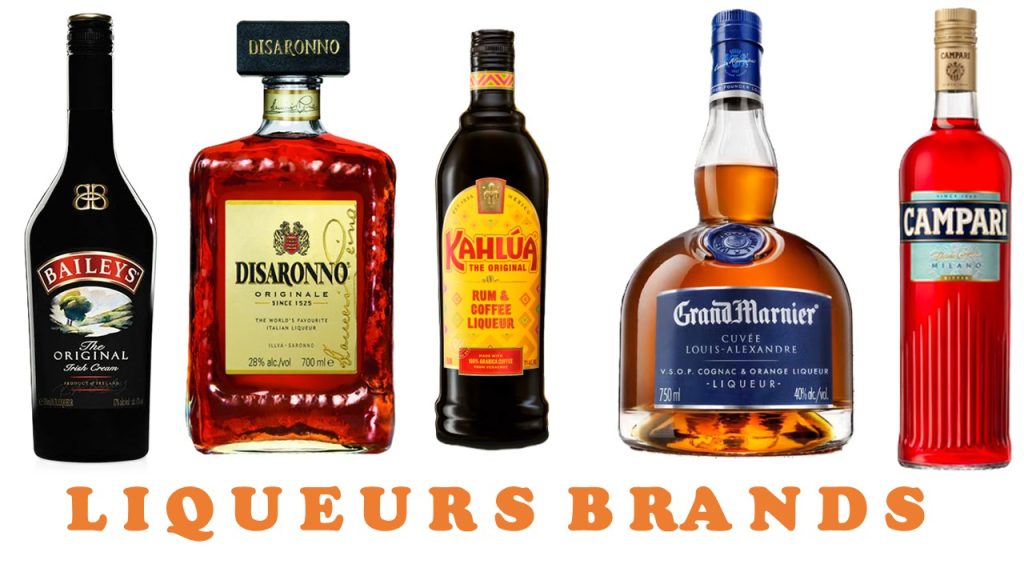
Here are some popular liqueur brands with their country of origin:
| Baileys Irish Cream (Ireland) | Kahlúa (Mexico) | Drambuie (Scotland) |
| St-Germain Elderflower Liqueur (France) | Grand Marnier (France) | Midori (Japan) |
| St-Germain Elderflower Liqueur (France) | Chambord (France) | Cointreau (France) |
| Blue Curaçao (e.g., Bols Blue Curaçao) (Netherlands) | Amaretto Disaronno (Italy) | Sambuca Molinari (Italy) |
| Frangelico (Italy) | Luxardo Liqueurs (Italy) | Campari (Italy) |