
Short Important Questions
- What is over proofed rum. (1 Mark, 2018, 2023)
Long Important Questions
- Trace the history and popularity of Rum. (5 Marks, 2017) #Old_Course #Skip
- Highlight the differences between Rum and Brandy. (5 Marks, 2025)
Introduction of Rum
| Rum is a distilled alcoholic beverage made from sugarcane or its by-products, mainly molasses and sometimes fresh sugarcane juice. |
It is produced mainly in countries where sugarcane is widely grown. After fermentation and distillation, rum is usually matured and bottled as a smooth, sweet, and aromatic spirit.
Rum is generally bottled at 37.5%–40% alcohol by volume (ABV), although overproof rum is much stronger and can reach 58% ABV or more.
| The alcoholic content of rum is strictly regulated by international standards: Standard Bottling: Generally ranges from 37.5% to 45% ABV. In Europe (EU), rum must have at least 37.5% ABV. In the USA, rum must have at least 40% ABV (80 proof) |
Rum has strong historical links with the Caribbean, where it was first developed during the sugar trade. Major rum-producing regions include Puerto Rico, Jamaica, Cuba, Barbados, Trinidad, Guyana, Venezuela, Brazil, Australia, and other West Indian islands.
Rum is popular both as a sipping drink and as a mixing spirit used in famous cocktails like Mojito, Daiquiri, and Piña Colada.
| Overproof rum is a type of rum that has an alcohol content higher than normal, usually above 50% ABV, and in some brands it can go as high as 70–75% ABV, which makes it much stronger and more powerful than regular rum. |
Manufacturing Process of Rum
Rum is produced from sugarcane or its by-products, mainly molasses. The production of rum passes through several important stages.
- Harvesting of SugarCane
Rum is produced from sugarcane or its by-products, mainly molasses. The production of rum passes through several important stages.- Sugarcane takes about 10 months to 2 years to mature
- It is traditionally cut by hand using machetes, but large farms now use machines
- The cane is cut close to the ground where sugar content is highest
- Crushing and Extraction
After harvesting, the sugarcane must be processed quickly to avoid spoilage. The cane is washed and cut into pieces and then crushed in heavy rollers (mills) to extracts the sweet sugarcane juice.
The juice is then heated and clarified to remove dirt, fiber, and other impurities.
| Note: From the clean sugarcane juice, some is used directly to make certain types of rum. Most of it is boiled to produce sugar, and the thick dark liquid left after sugar is removed is called molasses. Since most rum is made from molasses, this leftover liquid becomes the main raw material for rum production. |
- Fermentation
After molasses (or sugarcane juice) is prepared, it is mixed with water and yeast in large fermentation tanks.
The yeast feeds on the sugar and converts it into alcohol and carbon dioxide.
This process usually takes 1 to several days, depending on the style of rum being made. At the end of fermentation, the liquid contains about 7–10% alcohol and is called the wash (or dead wash).
| Note: Fermentation is the process in which yeast converts sugar into alcohol and carbon dioxide to produce an alcoholic liquid. |
- Distillation
After fermentation, the alcoholic liquid (called wash or dead wash) is heated in a still. When heated, alcohol turns into vapor before water. This vapor is collected and cooled back into liquid form.
In this way, the alcohol is separated and concentrated, producing a stronger and purer rum spirit.
| Note: The alcohol percentage after distillation varies by the equipment used, with traditional Pot Stills producing a flavorful spirit around 65-70% ABV, while modern Column Stills produce a much lighter spirit up to 95% ABV. |
- Ageing (Maturation)
After distillation, rum is usually aged in wooden barrels, mainly oak casks.
Freshly distilled rum is clear and harsh, but ageing makes it smoother and more flavorful. During this time, the rum absorbs colour, aroma, and taste from the wood, developing notes of vanilla, caramel, and spice.
In hot tropical climates, rum matures faster because heat increases the interaction between the spirit and the barrel. Some alcohol evaporates — called Angel’s Share.
| Note: Rum type according to ageing duration: a) Light Rum: Aged for about 3 months b) Golden Rum: Aged around 18 months c) Dark Rum: Aged 3 years or more |
- Blending and Finishing
After aging, different rums are mixed together by the master blender to make the flavor consistent.- Some rums are filtered (often through charcoal) to remove excess color, especially for white or light rums.
- Small amounts of caramel (E150a) or sugar may be added to adjust color or mouthfeel, depending on regulations.
- Finally, the rum is diluted with demineralized water to reach the bottling strength, usually around 40% ABV, before being bottled.
- Bottling and Labelling
Types of Rum on the Basis of Colour
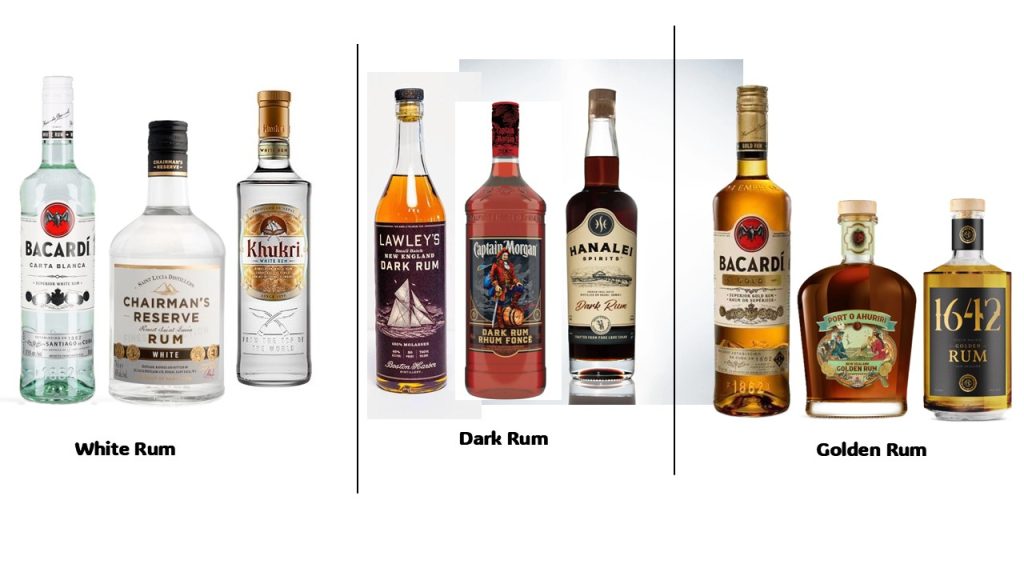
- White Rum (Clear / Silver / Blanco)
White rum (also called light rum) is a clear, light-bodied rum with a subtle flavor, often used as a mixer in cocktails. It is typically unaged or aged for a very short duration (3–12 months).
White rum is usually distilled to be smooth and neutral. If it is aged in oak barrels to develop a gentle / smooth palate, it is often filtered afterward to remove any color. This makes it ideal for mixed drinks like Mojitos, Daiquiris, and other cocktails where a clean, light taste is preferred.
Examples: Appleton White, Bacardi, Havana Club 3-Year-Old - Golden Rum (Amber / Oro)
Golden rum, also called Amber or Oro, is a medium-bodied rum with a pale straw to deep amber color, achieved through medium-term aging (typically 18 months to 3 years) in oak barrels.
The aging process gives Golden Rum a smooth, mellow flavor profile, balancing subtle sweetness with hints of oak and vanilla. It can be enjoyed neat, on the rocks, or in cocktails where a richer rum flavor is desired without the intensity of dark rum.
Examples: Captain Morgan, Myers’s Golden Rich, Bacardi Gold - Dark Rum (Brown / Black / Red)
Dark rum is a full-bodied, richly flavored rum, usually aged longer (3 years or more) in charred oak barrels, giving it a deep brown, mahogany, or nearly black color and robust taste.
Dark rums are typically produced in pot stills, which retain more congeners (flavor compounds) from fermentation. Aging in charred oak barrels enhances the rum with caramel, toffee, and sometimes smoky notes. They are often sipped neat, used in cocktails that require a strong rum flavor, or in cooking and baking for their intense aroma.
Examples: Lemon Hart, Appleton Punch, Gosling’s Black Seal - Spiced Rum
Spiced rum is a rum (white, golden, or dark) that has been infused with spices, botanicals, or sometimes fruit flavors to create a distinctive aromatic and flavored spirit.
The base rum is blended with ingredients like cinnamon, nutmeg, cloves, vanilla, ginger, or citrus peel. The result is a warm, aromatic spirit with a sweet-spicy profile. Spiced rum is popular in cocktails like Rum & Cola, Mojitos, and tropical punches, and is also used in cooking or baking for added flavor.
Examples: Captain Morgan Original Spiced, Sailor Jerry, Kraken Black Spiced Rum
Popular Brands
Here is the list of popular brands name with country of orgin:
| Myers’s (Jamaica) | Havana Club (Cuba) | Captain Morgan (Jamaica) |
| Bacardi (Cuba / Puerto Rico) | Mount Gay (Barbados) | Appleton Estate (Jamaica) |
| Old Monk (India) | Ron Zacapa (Guatemala) | Goslings (Bermuda) |
| Diplomático (Venezuela) | Malibu (Barbados) | Bundaberg (Australia) |
| Tanduay (Philippines) | Wray & Nephew (Jamaica) | Don Q (Puerto Rico) |
| El Dorado (Guyana) | Pusser’s (British Virgin Islands) | Cruzan (US Virgin Islands) |
Service of Rum
Rum can be served in multiple ways depending on its type and the occasion, from neat tasting to mixed cocktails.
- Standard Measure: Typically 30ml (single) or 60ml (double).
- Glassware:
- Tumbler / Old-Fashioned glass (for neat or on the rocks)
- Highball / Collins glass (for mixed drinks and long drinks)
- Snifter / Tulips Glass: Used for premium Aged (Dark) Rums, wide bowl and narrow top trap the aromas for sipping
- Ways of Serving:
- Neat (Straight): Served at room temperature without ice to experience the pure flavor.
- On the Rocks: Poured over ice cubes; ice slightly chills and dilutes the rum for smoother taste.
- With Water or Soda: Enhances drinkability without masking the character.
- Cocktails / Mixed Drinks: Used as a base in drinks like Mojito, Daiquiri, Piña Colada, Rum & Coke.
- Accompaniments: Ice cubes, soda water, tonic, or garnishes like lime, lemon, or mint.