
Introduction
Thai cuisine is the national cuisine of Thailand. It is internationally known for its balanced taste, fresh ingredients, and attractive presentation. Thai food does not focus on a single dominant flavor; instead, it combines different tastes in a harmonious way. A typical Thai dish aims to balance sweet, sour, salty, bitter, and spicy elements.
Thai cooking emphasizes light preparation, strong aromatic herbs, and a fresh, vibrant character. Even spicy dishes are carefully balanced so that the heat does not overpower the overall flavor.
Geography and Location:
Thailand is situated in the center of mainland Southeast Asia. The country experiences a tropical monsoon climate, characterized by warm temperatures, seasonal rainfall, and high humidity. These climatic conditions are ideal for agriculture throughout most of the year.
The fertile river plains, especially the Chao Phraya River basin, along with long coastlines and inland water sources, support the cultivation of rice and the availability of fish and seafood. As a result, rice became the staple food of Thailand and is eaten at almost every meal.
Rice also holds cultural importance in Thai life. The Thai word “khao” means both rice and food, showing its central role in daily eating habits.
Historical Development of Thai Cuisine:
Thai cuisine developed over many centuries through migration, trade, and cultural contact.
- Early Thai people migrating from southern China brought rice cultivation, noodles, soy sauces, and stir-frying techniques.
- Indian influence introduced curries, spices, and certain cooking ideas, often linked with Buddhism.
- Malay and Indonesian influences, especially in southern Thailand, contributed coconut milk, grilled foods, and spicy curries.
- Chinese influence added techniques such as stir-frying, steaming, and deep-frying, as well as the use of the wok.
- European contact, particularly with the Portuguese, introduced chili peppers from the Americas, which later became a key ingredient in Thai cooking.
These influences shaped Thai cuisine without changing its local identity.
Key Characteristics of Thai Cuisine:
Thai cooking focuses on:
- Fresh ingredients rather than dried ones
- Aromatic herbs such as lemongrass, galangal, kaffir lime leaves, basil, and coriander
- Simple cooking methods that preserve natural flavors
- Careful balance of tastes instead of excessive richness or heaviness
Fish sauce, lime juice, palm sugar, chilies, and shrimp paste are commonly used to create depth of flavor.
Today, Thai cuisine is enjoyed worldwide and is considered one of the most popular global cuisines. Its success comes from its unique flavor balance, use of fresh herbs, and ability to suit both spicy and mild preferences.
Features of Regional Thai Cuisine
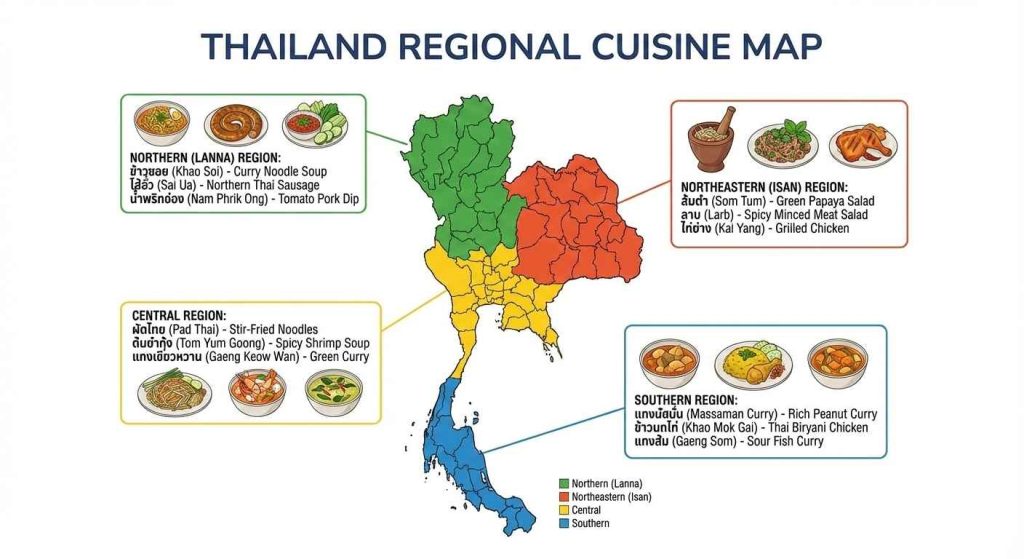
Thailand is better understood as a country of many regional cuisines rather than a single cuisine. Stretching over 1,700 km from north to south, Thailand shows great variation in climate, geography, and cultural contact. As a result, each region developed its own cooking style, ingredients, and flavor preferences, while still following the Thai principle of balance and harmony.
- Central Thai Cuisine
Central Thai cuisine comes from the fertile Central Plains of Thailand, especially the area around the Chao Phraya River. This region has long been the political and cultural heart of Thailand and was home to major kingdoms such as Sukhothai and Ayutthaya. Because of good irrigation and rich soil, the region became the country’s main rice-producing area.
Staple Food
Jasmine rice (khao hom mali) is the staple food of Central Thailand. It is steamed and served with most meals. Rice forms the base of the meal, with several dishes eaten alongside it to create balance.
Flavor
Central Thai cuisine is known for its well-balanced taste. All five flavors—sweet, sour, salty, spicy, and bitter—are carefully combined, with none overpowering the others. Compared to other regions, the food is moderately spicy and slightly sweet, often using palm sugar and coconut milk to soften heat.
Ingredients Used
Common ingredients include:
- Coconut milk
- Fresh herbs such as lemongrass, galangal, kaffir lime leaves, basil, and coriander
- Fish sauce, shrimp paste, lime juice, and palm sugar
- Freshwater fish, prawns, chicken, pork, and vegetables
The region also benefits from easy access to seafood and market-fresh produce.
Cooking Techniques
- Stir-frying (often in a wok)
- Boiling and simmering (soups and curries)
- Deep-frying
- Steaming
These methods reflect strong Chinese influence, combined with local Thai practices.
Influence of Royal Thai Cuisine
Central Thai cuisine is deeply influenced by Thai royal cuisine, which developed during the Ayutthaya period and later refined in the Rattanakosin period. Royal cooking focused on the use of fresh, high-quality ingredients and careful selection of seasonal produce. Flavors were kept delicate and well balanced, avoiding excessive heat or heaviness.
Great importance was given to neat preparation and attractive presentation. Foods were often prepared in bite-sized portions, with bones removed to make dishes easy and graceful to eat. This royal influence made Central Thai cuisine more refined, elegant, and visually appealing compared to other regional styles.
Popular Dishes
Some well-known Central Thai dishes include:
- Tom Yum Goong – spicy and sour shrimp soup
- Green Curry (Kaeng Khiao Wan)
- Red Curry (Kaeng Phet)
- Pad Thai – stir-fried rice noodles
- Phat Thai basil chicken and stir-fried dishes
- Gaeng Phed Pen Yang
- Panang Curry
- Tom Kha Kao
- Northern Thai Cuisine
Northern Thai cuisine originates from the mountainous northern region of Thailand, once ruled by the Lanna Kingdom. The area has a cooler climate, valleys, and forests, and shares borders with Myanmar, Laos, and southern China (Yunnan). These factors strongly influenced the food habits and ingredients of the region.
Staple Food
The staple food of Northern Thailand is sticky rice (khao niao). It is traditionally eaten by hand, rolled into small balls, and used to scoop up curries, chili dips, and side dishes. Jasmine rice is rarely used in everyday northern meals.
Flavor
Northern Thai food is generally mild to moderately spicy, less sweet, and not very sour compared to Central Thai cuisine. The dominant tastes are salty and earthy, with flavors coming mainly from herbs, chili pastes, and fermented ingredients rather than coconut milk.
Ingredients Used
Common ingredients include:
- Fresh herbs such as lemongrass, garlic, shallots, galangal, and coriander
- Fermented ingredients like fermented soybeans and chili pastes
- Local vegetables, forest mushrooms, and edible flowers
- Pork, chicken, and freshwater fish
Coconut milk is used very little, as coconuts were historically scarce in this landlocked region.
Cooking Methods
Traditional cooking methods in Northern Thailand include:
- Boiling and simmering in broth
- Charcoal grilling
- Slow roasting and steaming in banana leaves
These methods often give dishes a smoky and rustic flavor, reflecting village-style cooking.
Cultural Influence
Northern Thai cuisine is shaped by strong influences from Myanmar, Laos, and southern China (Yunnan) due to geographical closeness and long-standing trade and migration. The region was part of the Lanna Kingdom, which developed a food culture different from Central Thailand.
Popular Dishes
Some well-known Northern Thai dishes include:
- Khao Soi – coconut curry noodle soup
- Nam Prik Noom – green chili dip
- Nam Prik Ong – tomato-based chili dip
- Sai Ua – northern Thai sausage
- Gaeng Hang Lay – Burmese-style pork curry
- Northeastern Thai Cuisine (Isan)
Isan cuisine comes from northeastern Thailand, mainly the Khorat Plateau. The region has a dry climate and poorer soil, which influenced a simple, rustic food culture. Isan shares strong cultural and linguistic ties with Laos and also shows Khmer influence from Cambodia.
Staple Food
The staple food of Isan is sticky rice (khao niao). It is served in small bamboo baskets and eaten by hand. Sticky rice is eaten with almost every meal and used to scoop up salads, dips, and grilled foods.
Flavor
Isan food is known for its bold and intense flavors. The dominant tastes are spicy, sour, and salty, while sweetness is very limited. Dishes often have a strong and pungent character due to the use of fermented ingredients.
Ingredients Used
Common ingredients include:
- Fresh chilies and chili flakes
- Lime juice and tamarind for sourness
- Fish sauce and pla ra (fermented fish sauce)
- Fresh herbs such as mint, culantro, and coriander
- Freshwater fish, pork, chicken, and grilled meats
Coconut milk is rarely used in Isan cuisine.
Cooking Methods
Cooking methods are simple and practical, including:
- Pounding and mixing in a mortar (e.g., som tam)
- Grilling over charcoal
- Quick boiling and tossing
These methods suit the region’s climate and lifestyle.
Cultural Influences
Isan cuisine is heavily influenced by Lao food culture, especially in the use of sticky rice, fermented fish, and spicy salads. Khmer influence can be seen in steamed curry dishes such as homok. The region’s historical isolation helped preserve its traditional food practices.
Popular Dishes
Well-known Isan dishes include:
- Som Tam – green papaya salad
- Larb – spicy minced meat salad
- Gai Yang – grilled chicken
- Nam Jim Jaew – spicy dipping sauce
- Sai Krok Isan (Fermented Sausage)
- Nam Tok Moo (Spicy Grilled Pork Salad)
- Khao Nio (Sticky rice)
- Southern Thai Cuisine
Southern Thai cuisine comes from the narrow peninsula of southern Thailand, bordered by the Andaman Sea and the Gulf of Thailand. The region has a hot and rainy climate throughout the year and rich access to the sea. Southern Thai food is also shaped by long contact with Malaysia, India, and Muslim cultures.
Staple Food
Unlike the North and Isan, the South mainly eats jasmine rice (khao suay) rather than sticky rice. Rice is usually served with strongly flavored curries and seafood dishes.
Flavor
Southern Thai cuisine is known as the spiciest in Thailand. The flavors are bold, intense, and fiery, often combining strong heat with sourness and saltiness. Sweetness is used very little.
Ingredients Used
Common ingredients include:
- Coconut milk
- Fresh turmeric, chilies, lemongrass, and kaffir lime leaves
- Seafood such as fish, prawns, and shellfish
- Fermented fish products such as tai pla
Spices like cumin, cloves, and aniseed—rare in other regions—are also used.
Cooking Methods
Southern Thai cooking includes:
- Slow simmering of rich curries
- Dry frying of spice-heavy dishes
- Grilling and deep-frying of seafood
The use of thick curry pastes is common.
Cultural Influences
Southern cuisine reflects strong Malay and Muslim influences, especially in the deep south. Indian influence appears in spice usage and certain curries. The region also has Sino-Thai influence, particularly in Phuket, where Chinese-style food traditions exist.
Popular Dishes
Famous Southern Thai dishes include:
- Gaeng Som – spicy, sour fish and vegetable curry without coconut milk, flavored with tamarind.
- Kua Kling – dry, intensely spicy curry with minced pork or beef and herbs.
- Sataw Pad Kapi Goong – stir-fried stink beans with prawns, shrimp paste, and chilies.
- Moo Hong – sweet and savory slow-braised pork belly.
- Hat Yai Fried Chicken – crispy marinated fried chicken topped with shallots.
- Khao Yam – colorful rice salad with herbs, vegetables, dried shrimp, and sweet-sour dressing.
- Gaeng Tai Pla – very spicy fish curry made with fermented fish innards.
- Golae Chicken – skewered chicken grilled with spicy curry marinade.
Seasoning and Flavorings Used in Thai Cuisine
Thai cuisine is known for its careful balance of sweet, spicy, sour, salty, and bitter flavors. Each dish aims to achieve harmony rather than allowing one taste to dominate. This balance is central to Thai cooking and is adjusted according to region and dish type.
Fresh Herbs and Aromatics
Thai food relies heavily on fresh herbs rather than dried ones, giving dishes their fragrance and brightness. Common herbs include:
- Lemongrass – citrusy aroma, used in soups and curries
- Galangal – earthy and pungent, essential in curry pastes
- Makrut (kaffir) lime leaves – intense lime fragrance
- Thai basil and sweet basil – add aroma and flavor
- Coriander (leaves, stems, roots) – fresh, citrusy taste
- Shallots and garlic – base ingredients for pastes and stir-fries
Spices and Chilies
Spices add warmth and depth rather than overpowering heat:
- Thai bird’s eye chilies – heat and fruity sharpness
- Turmeric – earthy flavor and golden color
- Coriander seed and cumin – mild citrusy and nutty notes
- White and black pepper – subtle heat and aroma
- Cinnamon – used in rich curries like Massaman
Sauces and Seasoning Liquids
Liquids play a major role in flavor development:
- Fish sauce (nam pla) – main salty and umami element
- Shrimp paste – deep savory flavor
- Soy sauce – adds saltiness and color
- Coconut milk – richness and sweetness
- Tamarind and lime – sourness
- Palm sugar – natural sweetness
Most Thai dishes begin with a freshly pounded paste, made using chilies, herbs, spices, garlic, and shallots. These pastes are traditionally ground by hand using a mortar and pestle, which enhances aroma and texture.
Equipments Used in Thai Cuisine
Thai cuisine depends on a set of traditional tools that help achieve its authentic flavor, aroma, and texture. While modern appliances are now used, many traditional tools remain important.
Preparation Tools
- Mortar and Pestle (Krok & Sak)
The mortar and pestle is the most important preparation tool in Thai cuisine. It is mainly used to pound curry pastes, chili pastes, herbs, spices, and salads such as som tam. Pounding releases essential oils from herbs and spices, creating deeper aroma and flavor than blending. This tool is considered the heart of the Thai kitchen.- Wooden Mortar (Krok Mai) – used in Central Thailand for making tough curry pastes
- Granite Mortar (Krok Hin) –preferred in Northern and Isan regions for softer ingredients like green papaya
- Cleaver (Ee-to / Ki)
Traditionally, Thai kitchens used one main knife, usually a Chinese-style cleaver. The Thai cleaver is a multi-purpose tool used for chopping herbs, slicing meat, crushing garlic, and even cutting through small bones.
Because metal tools were limited in the past, this single knife handled almost all cutting tasks, making it an essential preparation tool. - Chopping Block (Kieng)
The chopping block works together with the cleaver. It is traditionally made from tamarind wood, which is strong and resistant to cracking. A solid chopping block is necessary for heavy cutting tasks such as chopping meat, herbs, and bones. - Hand Grater (Kratai Kood Maprao)
The coconut grater is a traditional seated tool used to shred fresh coconut meat. The grated coconut is later squeezed with water to produce fresh coconut milk, an important ingredient in many Thai curries and desserts.
This tool shows the traditional practice of using fresh coconut rather than packaged coconut milk. - Stone Grinder (Hin Bun)
A stone grinder is sometimes used to grind dry spices, seeds, and herbs into fine powders. Although less common today, it was important before ready-made spice powders became available. - Manual Coconut Press (Tum Maprao)
Before modern strainers, grated coconut was pressed by hand or with simple tools to extract coconut milk. This method allowed cooks to control the thickness and richness of the milk used in curries.
Cooking Equipments
- Wok (Grata / Kratae)
The wok is one of the most important cooking vessels in Thai cuisine. Introduced through Chinese influence, it is used for stir-frying, deep-frying, boiling, and cooking curries. Its curved shape allows fast cooking over high heat, helping retain freshness and create strong aromas.
Because of its versatility, the wok often replaces several other pans in traditional Thai kitchens. - Clay Pot (Mor Din)
Clay pots are used for slow-cooking curries, soups, and stews. They distribute heat evenly and help retain warmth for a longer time, enhancing depth of flavor. Some traditional clay pots include a built-in fire space to keep food warm during meals. - Brass Pot (Mor Tong Luang)
Brass pots are traditionally used for preparing Thai desserts, many of which require long, continuous stirring. The heavy metal prevents burning and helps maintain steady heat. These pots are still used today, especially for ceremonial and traditional sweet dishes. - Traditional Steamer (Maw Neung)
Apart from sticky rice, steamers are widely used for fish, vegetables, desserts, and rice flour dishes. Steaming preserves natural flavor, nutrients, and moisture, making it a common healthy cooking method in Thai cuisine. - Sticky Rice Steamer (Huad & Maw Neung)
This traditional steamer consists of a woven bamboo or straw basket (huad) placed over a pot of boiling water (maw neung). It is specially designed to steam sticky rice, allowing steam to circulate evenly without making the rice watery.
This tool is essential in Northern and Northeastern Thailand, where sticky rice is the staple food. - Charcoal Stove (Tao Tao)
Before gas and electric stoves, Thai cooking relied on charcoal stoves. Charcoal provides strong, steady heat and adds a smoky aroma, especially important for grilling and wok cooking. - Grill Rack (Yang)
Grill racks are used over charcoal fires for grilling meats, fish, and skewers. Grilled items are usually served with spicy dipping sauces, especially in Northern and Isan cuisine. - Banana Leaves – wrapping, steaming, grilling, and serving food
Storage & Serving Tools
- Sticky Rice Basket (Gratib / Kratib)
The sticky rice basket is a woven bamboo or straw container used to store and serve sticky rice after steaming. It keeps the rice warm, dry, and fluffy during meals. This basket is especially common in Northern and Northeastern Thailand.m and fresh - Bamboo Trays (Kratib Mai / Taae)
Bamboo trays are traditionally used for drying chilies, herbs, fish, and rice in the sun. They are lightweight, breathable, and well-suited to Thailand’s warm climate. - Earthenware Bowls
Clay and earthenware bowls are commonly used to serve curries, soups, and side dishes. They help retain heat and are suitable for sharing food at the table. - Wooden Ladles (Thap) – stirring and serving
- Coconut Shell Bowls
In rural areas, coconut shells were traditionally used as bowls, ladles, or scoops, reflecting the use of natural and locally available materials. - Fish Basket (Chang) – holding fresh fish
- Fermatation Jars (Mor Dong)
Large ceramic or earthen jars are used to prepare and store fermented foods such as fish sauce, shrimp paste, and fermented fish (pla ra). Fermentation is an important part of Thai flavor development. - Chopsticks