Course Contents
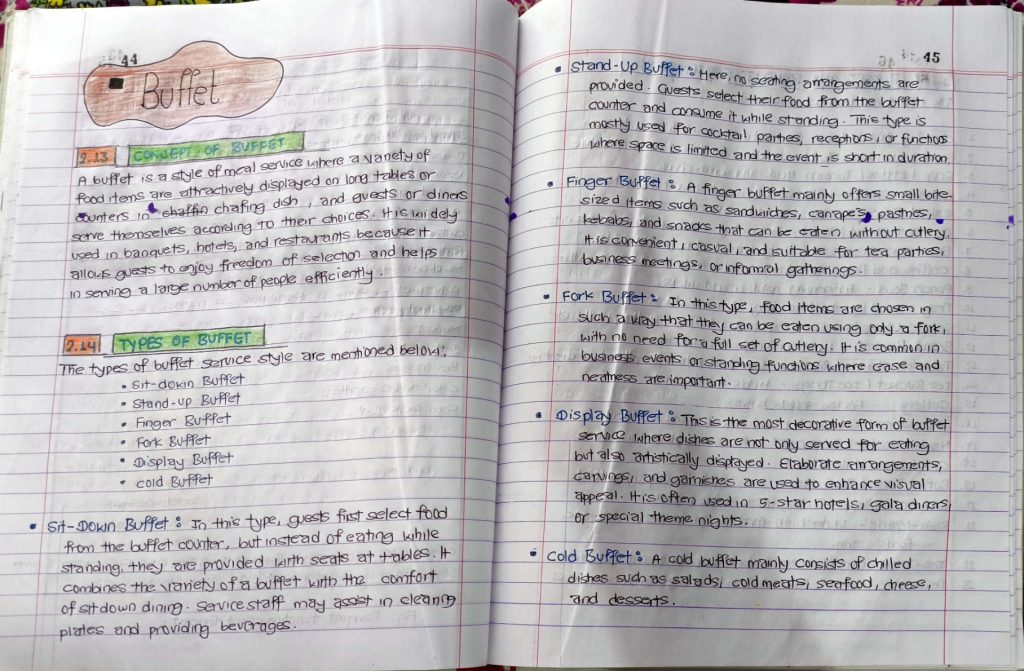
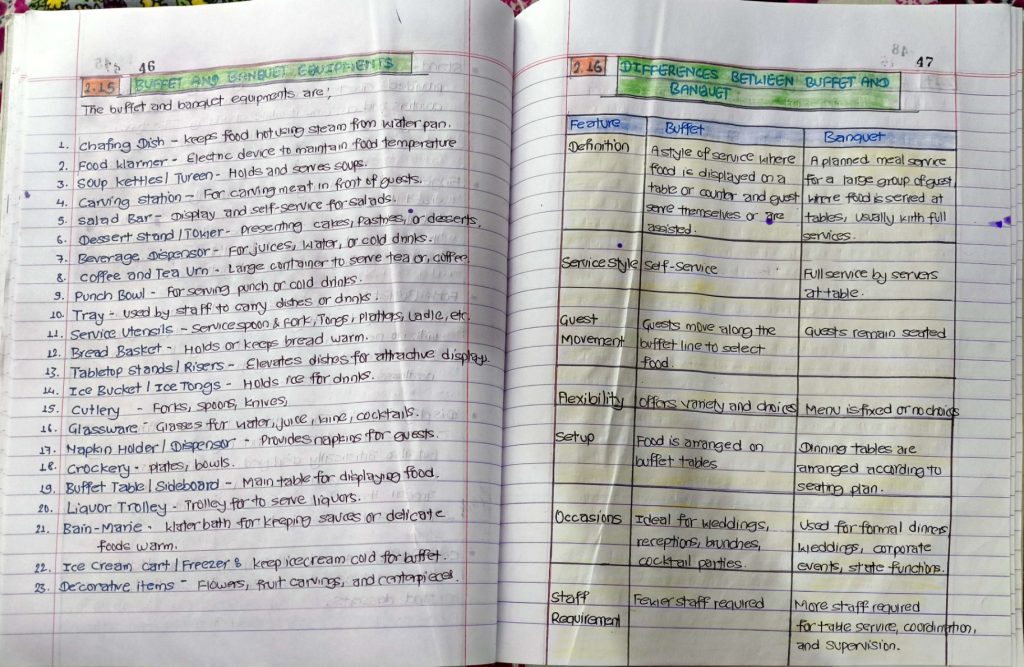
| 1.Introduction 2.Type of Banquet 3. Organization chart 3. Banquet planning 4. Organizing the operation & service of a banquet 5. Banquet seating plan 6. Banquet Space Calculation (size, table no., sprigs, service staff) 7. Banquet booking procedure 8. Banquet function prospectus (format) 9. Buffet and types 10. Buffet and Banquet equipments |
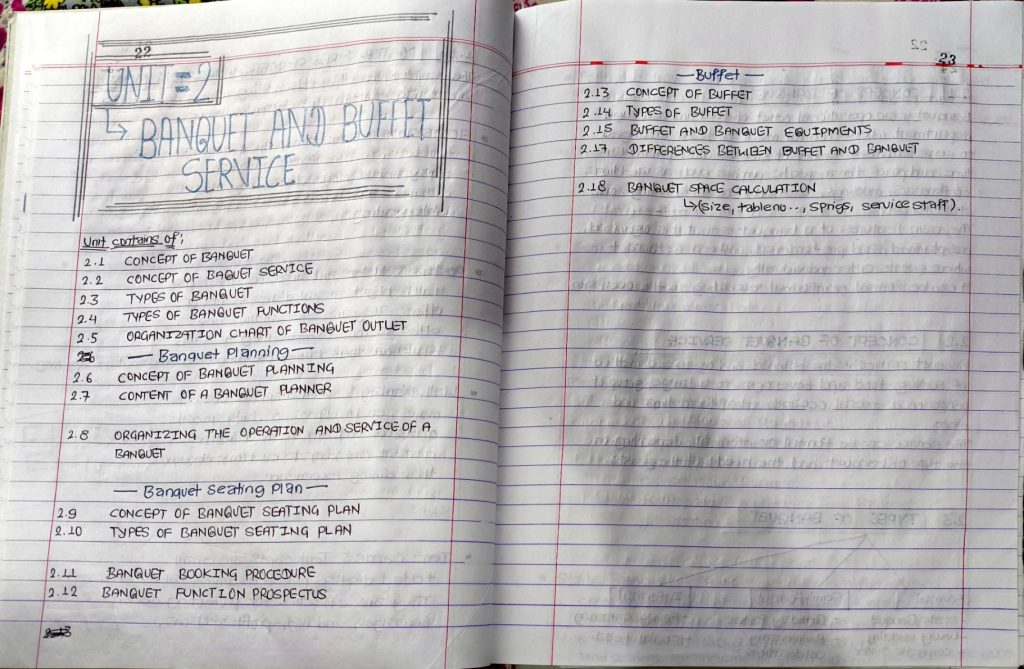
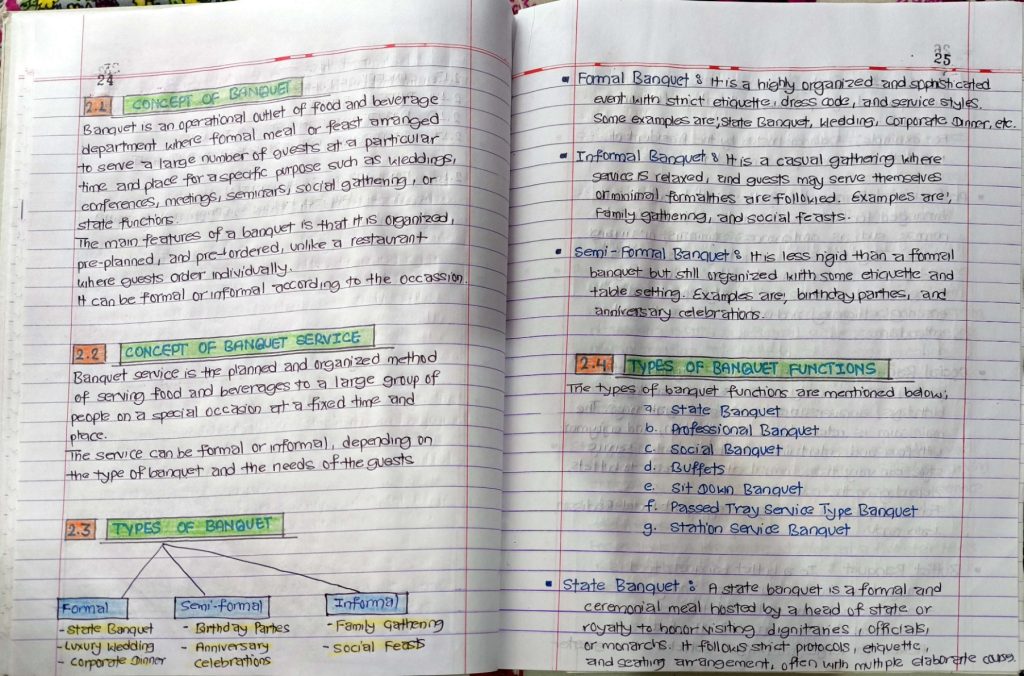
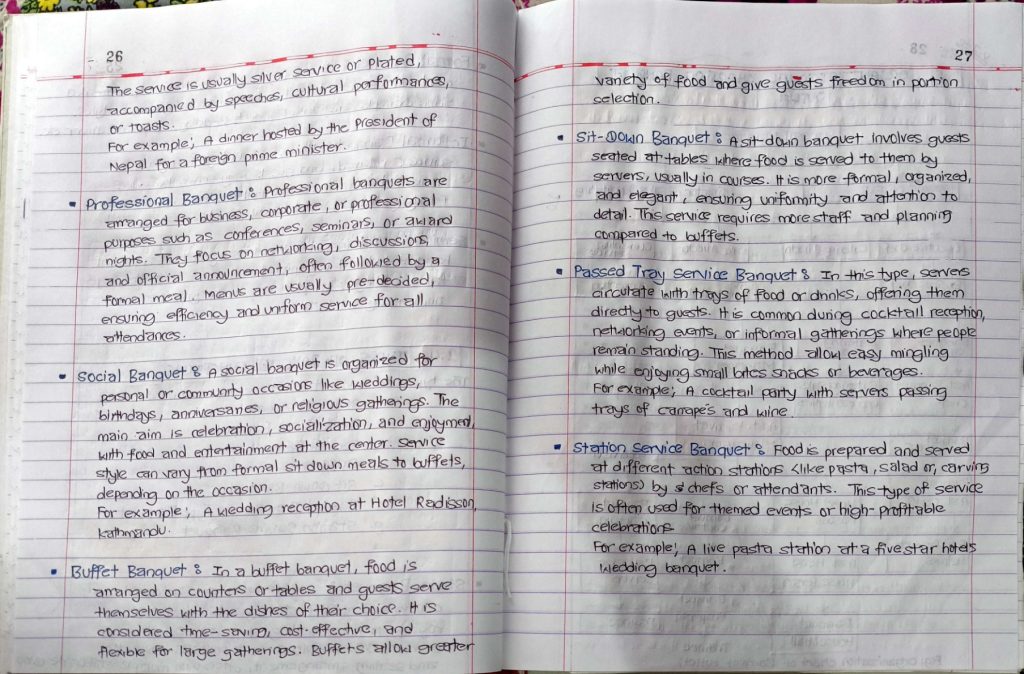
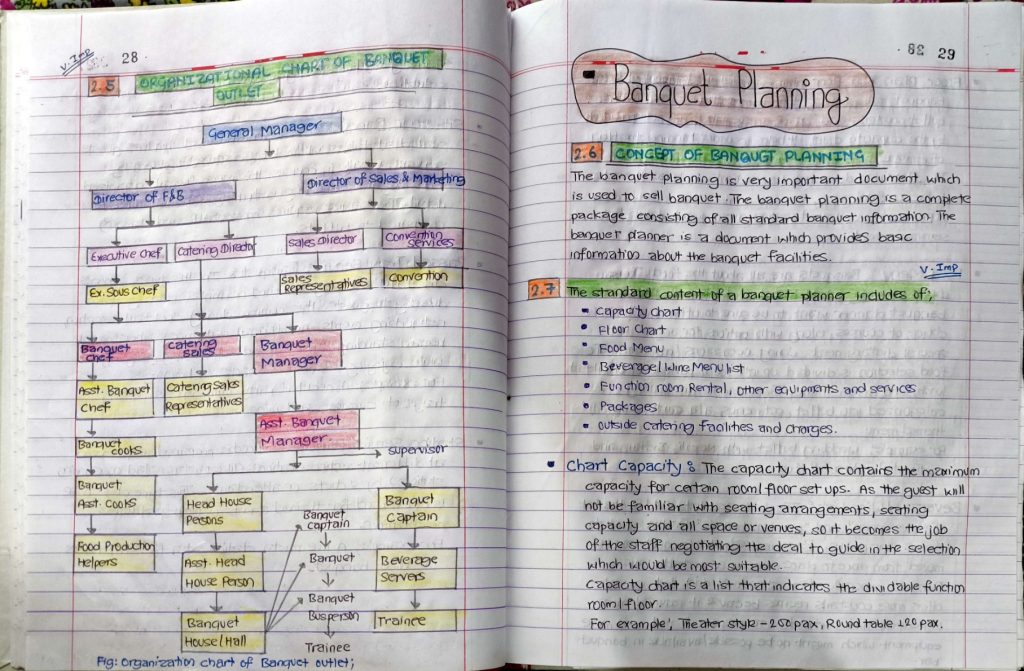
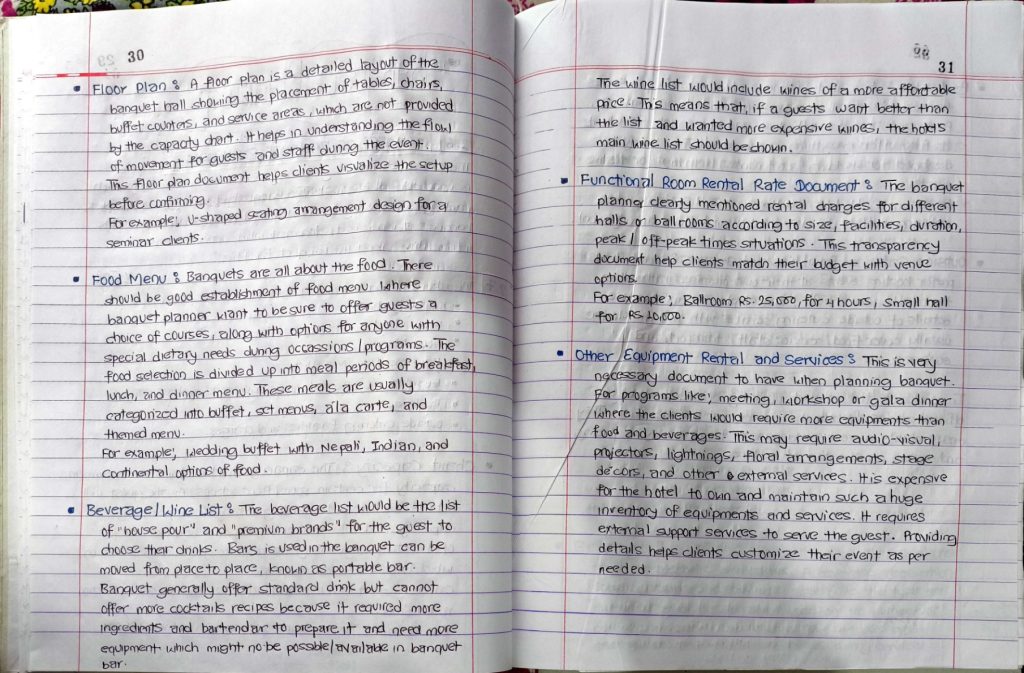
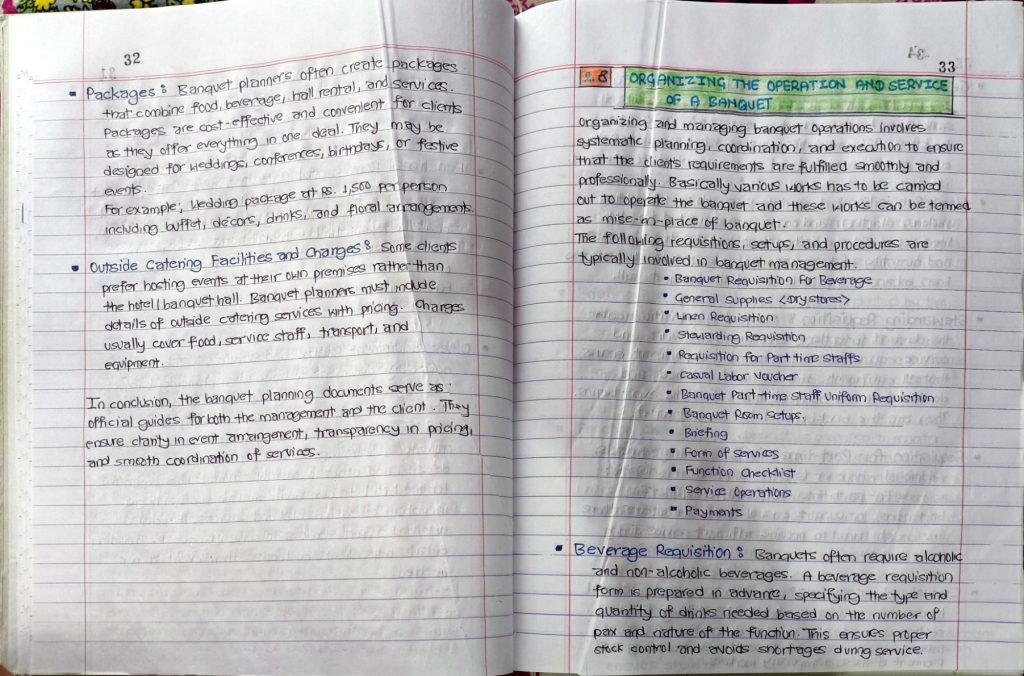
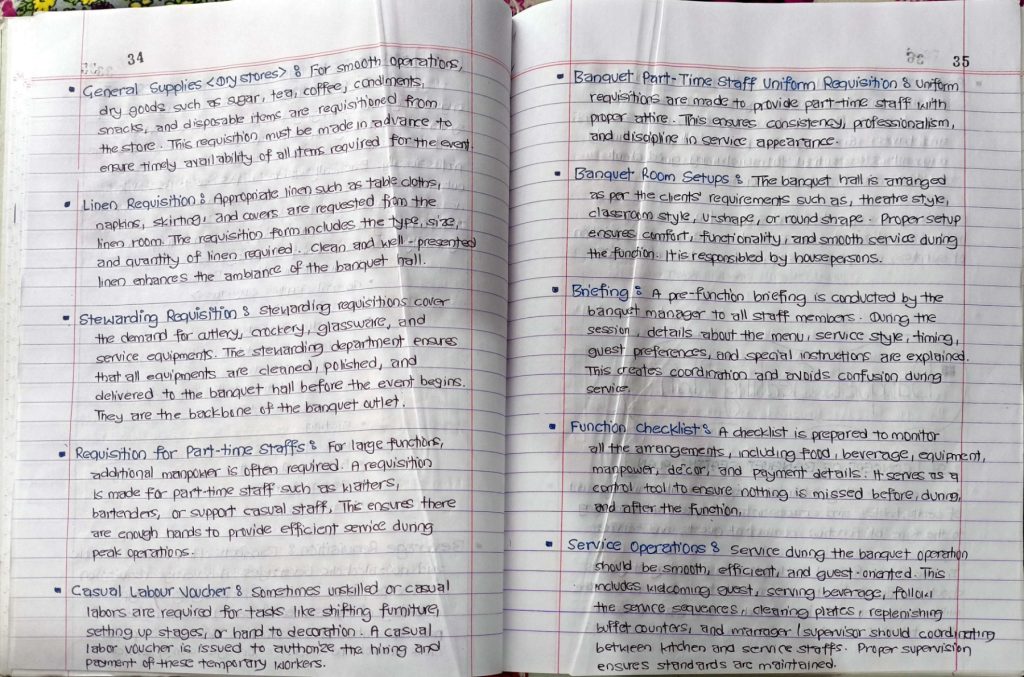
| We’ve included notes and an additional set of reference notes in this post. You can read either version—choose the one that feels clearer and more helpful for your study. |
Introduction
The word “banquet” is derived from the French word “banc”, meaning bench. A banquet is a pre-arranged service of food and beverages provided at a specified time and location to a certain number of people, based on a predetermined menu and price, usually organized to celebrate or conduct special events such as weddings, corporate functions, or ceremonies.
- The banquet department is a key operational unit under the Food and Beverage (F&B) Department. It plays a important role in revenue generation and customer satisfaction.
- It is managed by the Banquet Manager, who is responsible for planning, organizing, arranging staff, and making sure the event runs smoothly.
- Some hotels have several banquet halls for different group sizes, or one large hall that can be divided into smaller rooms using temporary partitions, allowing multiple events to happen at the same time and making better use of space.
| Note: MICE stands for Meetings, Incentives, Conferences, and Exhibitions |
Type of Banquet
Banquets can be classified into different types based on the purpose of the event, the formality level, and the nature of the guests. Each type of banquet serves a unique objective and is planned accordingly in terms of menu selection, seating arrangement, service style, and decor. Knowing the types of banquets is critical for hospitality staff because it helps them to choose the right service style, number of staff, table setup, and way of communicating based on the event.
Based on the purpose or nature of the event, Banquets are generally divided into three main categories:
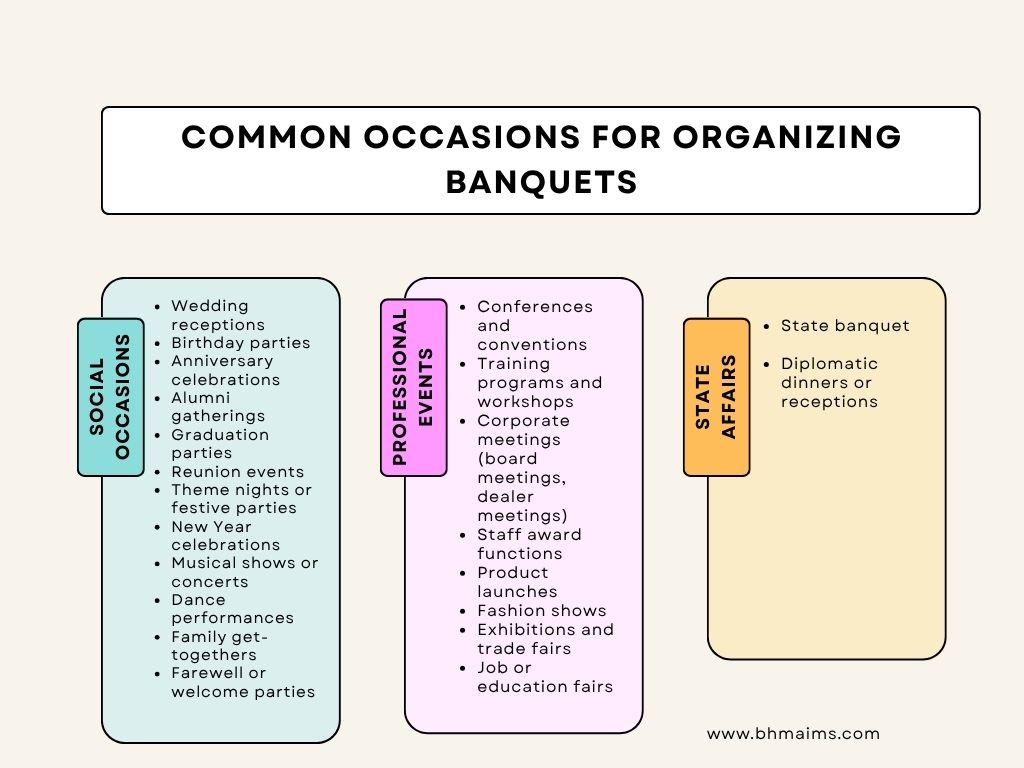
- Social Banquets: A social banquet is generally organized to celebrate personal or social occasions. These events are usually about bringing people together to enjoy, celebrate, or mark a special day. The atmosphere can be formal or informal, depending on the event. It may involve music, dancing, decoration, and entertainment.
Examples:
a. Weddings
b. Birthday Parties
c. Festive Parties (Holi parties, New Year Eve, Teej parties)
d. Musical Shows or Concerts - Professional Banquets: A professional banquet is organized for business, official, or educational purposes. These events are usually formal or semi-formal. It may include audio-visual setups for presentations. Also, in most cases, events are time-bound and follow a structured agenda.
Examples:
a. Company luncheons or staff dinners
b. Conferences, seminars, and workshops
c. Board meetings, press meets
d. Product launches, exhibitions, and trade fairs
e. Training programs and networking events - State Banquet: A state banquet is a formal event organized by a government or official body to honor important national or international guests. These events follow strict protocols and procedures and are attended by high-level dignitaries such as presidents, prime ministers, ambassadors, or royalty.
Examples:
a. Banquets for visiting heads of state or government
b. National day celebrations
c. Diplomatic dinners and receptions
d. Official meals during international summits or state visits
Common Features:
a. Highly formal with fixed seating plans and dress codes
b. Mostly involves speeches, national anthems, and official ceremonies
Organization Chart
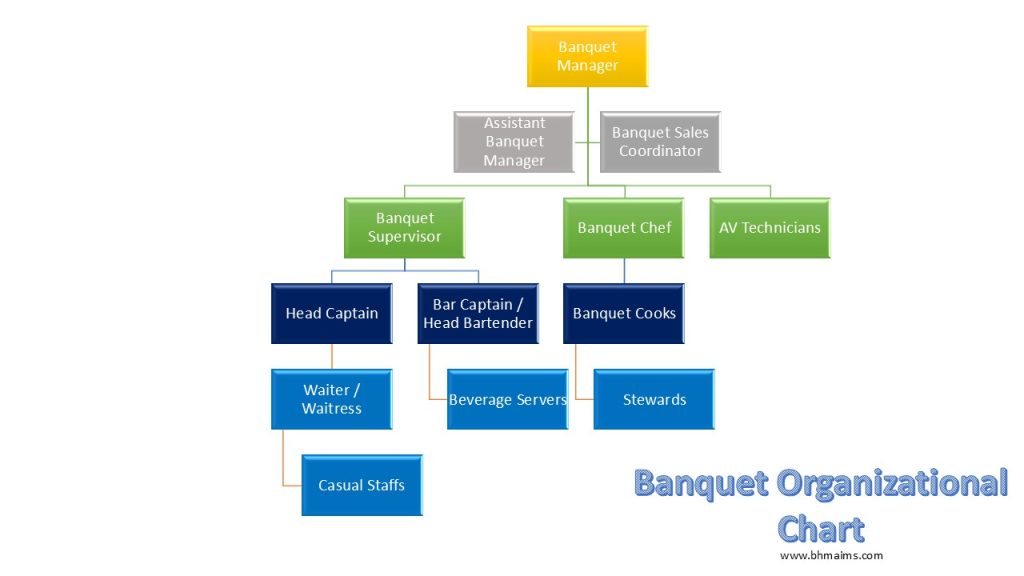
Here is the few job descriptions of several roles:
- Banquet Manager:
- Overall in-charge of the banquet operations.
- Responsible for meeting banquet sales targets and developing banquet business.
- Maintains customer relations and handles banquet administration.
- Supervises all arrangements related to events and functions.
- Banquet Sales Coordinator
- Prepares sales materials such as kits, fact sheets, event layouts, and proposed menus.
- Visits potential clients to generate business and acts as the main contact person internally.
- Conducts familiarization (FAM) tours of banquet facilities for clients.
- Often present at events to maintain ongoing client relationships.
- Banquet Supervisor
- Coordinates all resources needed for events including table layouts and staff scheduling.
- Oversees banquet setup to ensure smooth function execution.
- Waiters and Casual Staff
- Handle the physical setup by carrying furniture and arranging table appointments.
- Provide food and beverage service during the function and assist with clearing afterward.
- Head Bartender
- Leads the bar team during events and daily operations.
- Responsible for setting up the bar and ensuring all drinks and supplies are ready.
- Manages inventory and orders bar stock as needed.
- Supervises bartenders and beverage servers to ensure smooth and efficient service.
- Ensures quality and consistency in drink preparation and presentation.
- Handles guest requests and resolves any issues related to beverage service.
- Coordinates with the banquet manager to meet event requirements.
- Handles all correspondence, bookings (including phone reservations), and filing.
- Assists with conducting familiarization tours for guests.
- Beverage Servers
- Serve alcoholic and non-alcoholic drinks to guests during banquets and events.
- Take drink orders and deliver beverages promptly
- Assist bartenders by preparing and clearing drink stations.
- Banquet Chef and Kitchen Brigade
- Specialized in large-scale food production and kitchen cleanup.
- Cooks prepare large quantities of food and keep them warm in bain-maries.
- Cooking starts hours before the event due to the volume of food required.
- Stewards
- Cleaning and maintaining the banquet kitchen and service areas
- Washing and sanitizing dishes, glassware, cutlery, and cooking utensilsManaging waste disposal and ensuring hygiene standards are met
- Supporting kitchen and banquet staff during busy service times
Banquet Planning
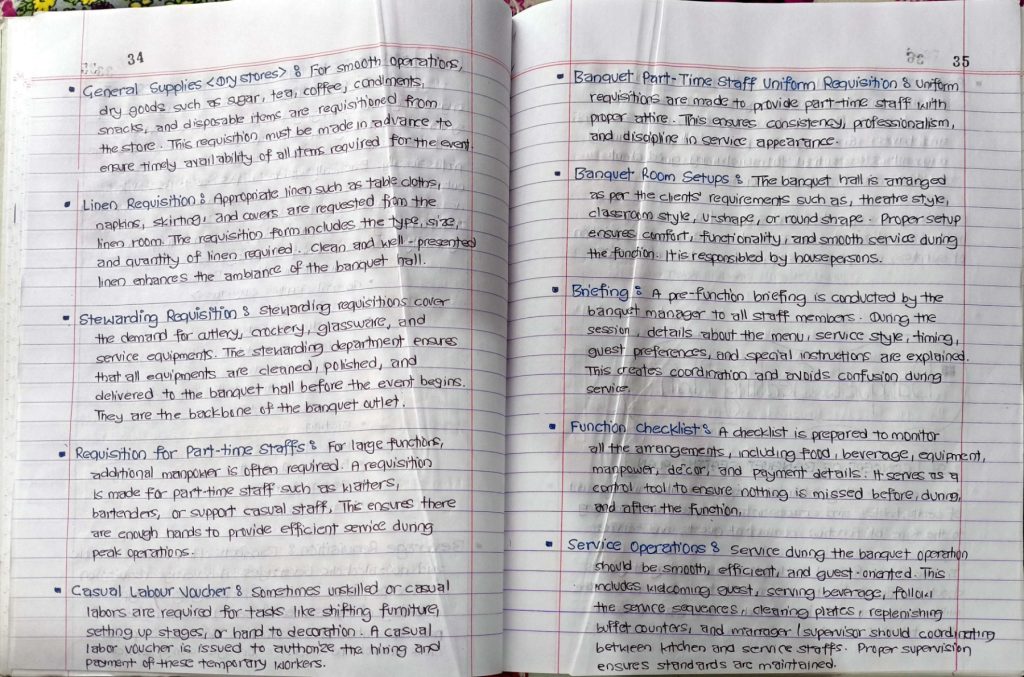
Organizing the operation & service of a banquet
Banquet seating plan
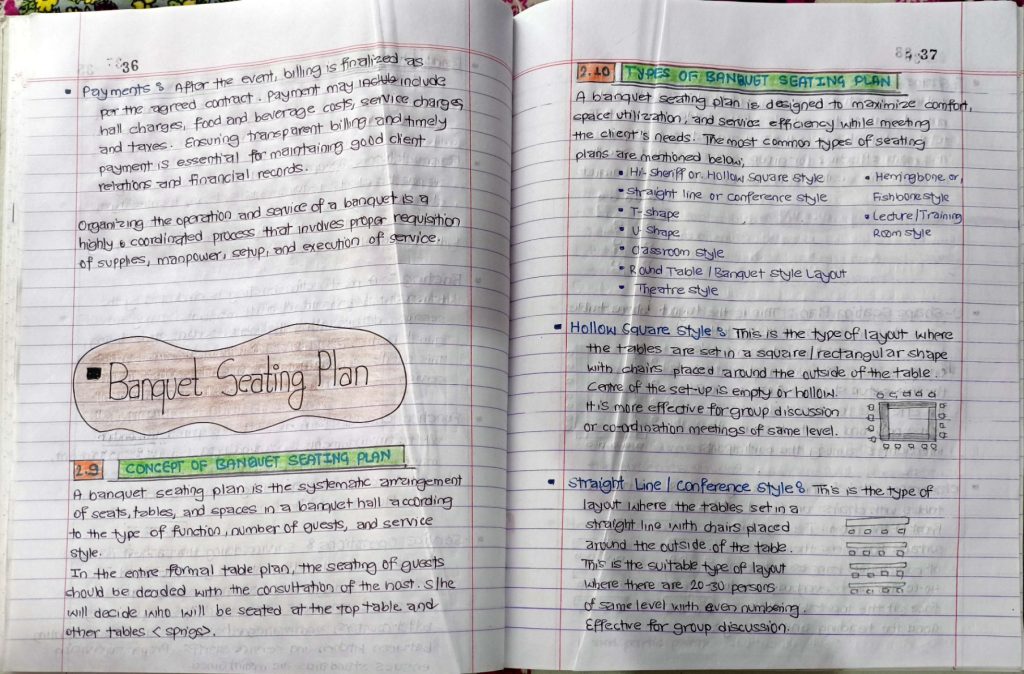
A banquet seating plan is a carefully designed layout showing where guests will be seated during a formal or informal function such as a wedding, conferences, corporate meeting, or any other event. It plays a key role in ensuring the smooth flow of the event, guest comfort, and efficient service.
In a formal banquet, the seating arrangement is not random—it is finalized only after consulting the host, since the host decides:
- Who will be seated at the top table (usually VIPs, chief guests, close family, or dignitaries).
- The arrangement of other tables, known as sprigs, where the remaining guests will be placed.
The seating plan should be placed at the hall entrance so guests can easily find their tables. A copy must also be given to the organizer and banquet manager for smooth coordination.
While placing guests, one important etiquette is that no guest should be seated with their back to the top table. However, in layouts with round tables, this may not always be possible. On the assigned table, name/place cards are positioned at the head of each cover so that every guest can easily find their seat without assistance.
Tips for effective seating plan:
- Consult with the host/organizer before finalizing.
- Place the top table in a visible position.
- Avoid placing tables directly in front of doors or near washrooms.
- Display seating chart at entrance.
- Distribute tables evenly in the hall.
- Leave 3–4 feet space between tables for smooth movement.
- Keep emergency exits clear.
- Provide reserved/VIP seating near the stage.
- Ensure clear view of stage/podium.
- Use name cards at each cover.
- Avoid overcrowding tables.
- Provide copies of the plan to organizer & manager.
- Keep an extra copy for staff reference.
- Keep a flexible layout for unexpected guest additions or cancellations.
- Provide wheelchair-accessible seating for special abled guest.
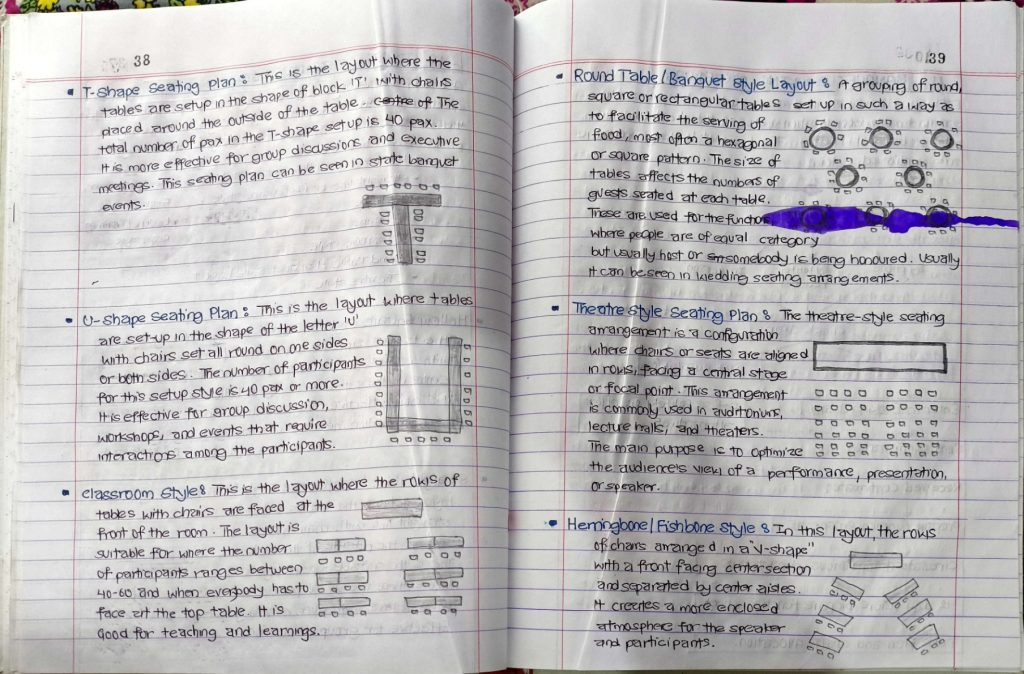
The various banquet seating plan are as listed below:-
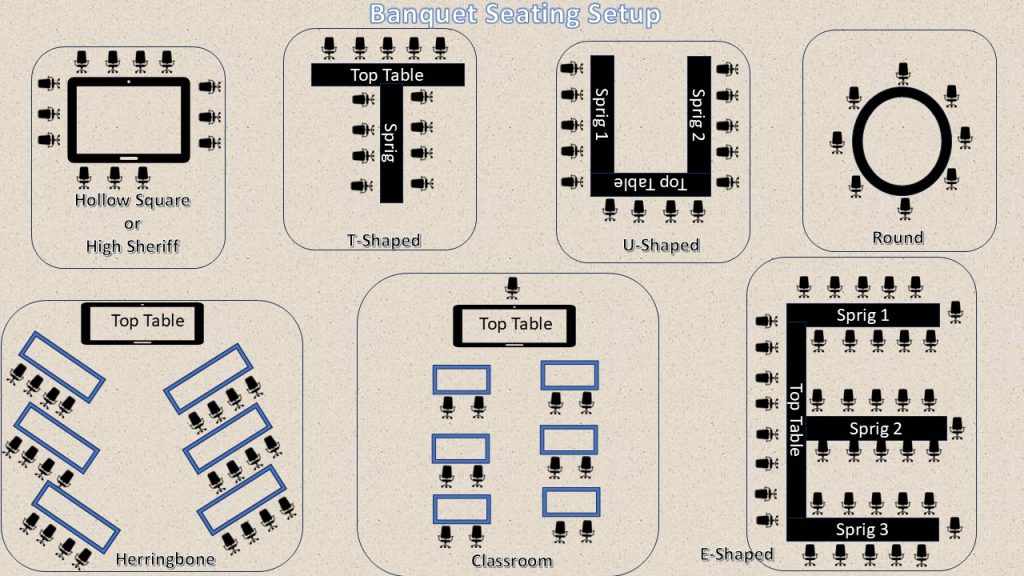
- Hi – Sheriff or Hollow Square
- Tables are arranged in a square or rectangle with an open center.
- Guests sit around the outer edge facing inward.
- Often used for meetings, discussions, or events requiring interaction among all participants.
Advantages:
- Encourages direct face-to-face communication.
- All participants can see each other clearly, promoting discussion.
- Flexible layout for medium-sized groups.
- Good for formal meetings, group discussions, workshops where interaction is important.
Disadvantages:
- Limited seating capacity compared to banquet or theatre layouts.
- Not suitable for very large groups.
- May take more space than other layouts.
- Participants at corners may feel less engaged.
- Can be difficult for service staff if food or drinks are served.
- Less effective for meetings or events that require presentations or key speakers or different level of people.
- T – Shaped Layout
- Tables are arranged in the form of the letter “T”.
- One long head table placed horizontally, with another table placed vertically connecting at the center.
- Commonly used for weddings, formal dinners, or VIP events where a top table is required.
Advantages:
- Provides a distinct position for VIPs/hosts at the top table.
- Allows good visibility of the host/guest of honor for most attendees.
- Creates a formal and organized look.
- Easier for servers to access tables compared to crowded layouts.
- Suitable for small to medium gatherings.
Disadvantages:
- Guests seated far from the “T” connection may feel less engaged.
- Not effective for teaching and learning or workshop type events
- May require larger floor space depending on table size.
- U – Shaped
- Tables/chairs arranged in the shape of the letter “U”, with the open end facing a stage, screen, or speaker.
- Participants sit around the outer edges, leaving the center open.
- Commonly used for training sessions, workshops, conferences, and meetings.
Advantages:
- Encourages interaction and discussion among participants.
- Provides good visibility of the presenter, stage, or screen.
- Open center allows for demonstrations, role-plays, or movement.
- Presenter can walk into the U for closer engagement.
- Works well for medium-sized group
Disadvantages:
- Not ideal for very large audiences.
- Requires a larger space to set up properly.
- Herringbone Setup
- Chairs and/or tables are arranged in angled rows, slanting toward a central focal point (stage, podium, or screen).
- The angle resembles a fishbone or herringbone pattern.
- Commonly used in seminars, training sessions, and conferences where participants need a good view of the presenter.
Advantages:
- Provides a clear view of the stage/speaker for most participants.
- Better sightlines compared to straight classroom.
- Creates a sense of focus and direction toward the presenter.
- Allows for more interaction with the speaker than straight rows.
- Works well in rectangular rooms to maximize seating.
Disadvantages:
- Limited interaction among participants (mostly focuses on presenter).
- Requires precise setup; angles must be consistent.
- May take up more floor space than straight rows.
- Not ideal for banquet-style service or group discussions.
- Can be awkward for servers to move between angled rows if food/drinks are served.
- Classroom Style Setup
- Tables and chairs are arranged in parallel rows facing the front (stage, presenter, podium, or screen).
- Commonly used in training sessions, lectures, seminars, and workshops.
Advantages:
- Provides a writing surface for note-taking or using laptops.
- Ensures clear view of the presenter/screen for all participants.
- Familiar and formal setup suitable for academic teaching.
- Works well for medium to large groups.
- Orderly arrangement makes it easy to manage participants
Disadvantages:
- Limited interaction among participants (focus is mostly on presenter).
- Takes more floor space than theatre style due to tables.
- Can feel less engaging or rigid for interactive sessions.
- Service staff movement may be difficult in narrow aisles.
- Participants at the back may feel disconnected.
- E – Shaped or Comb Style Setup
- Tables are arranged in the form of the letter “E”.
- One long table serves as the head table, with three shorter tables placed perpendicular to it.
- Commonly used for conferences, banquets, and training sessions where both discussion and presentations are needed.
Banquet Space Calculation
- Top Table with Sprig: It is the arrangement with top table where the host, chief guest, guest of honour, and VIPs are seated and the sprigs where the other invitees are seated. Who will be seated at the top table and sprigs will be decided by the host.
The length of the top table is calculated according to the number of people accommodated at the top table. The sprigs should be attached to the top table and always positioned within the length of the top table.
Some table specifications are given below:
- Usually the standard length of cover is 24” (inches) and breadth is 18” (inches) i.e. the cover size is 24” x 18”.
It might vary according to conditions such as 27 inches X 15 inches
Remember this Formulas:- Length of Top Table = No of Guest at Top Table x Cover Length
(Remember: Length of Top Table should always be even number) - Number of Sprigs = Length of top table / 9
(Remember always use the front digit, ignore the value after decimal) - Length of Sprig = No. of Guest at each side of Sprig x Cover Length
(Remember: Guest seating at sprigs should be even so that they can be equally divided into two sides of sprig) - Size of Gangway (Space between sprigs) = 3feet (excluding chair) = 6 feet (including chair)
- The distance between the top table and sprig is: 3 feet (minimum)
- The top table should be raised from the ground by a minimum of 6 inches to 1 foot so that each can see the guests who are seated on the top table.
- Minimum space between two tables is 6 feet or 72 inches.
(It includes two chair widths: from the edge of the table to back of the chair 2 X 18″ = 36″ and a gangway between the back of two chairs, or row of chairs = 36″) - Space between back of table and wall is 3 feet
- Space between table(with chair) and wall is 4.5 feet (3 feet gangway + 18” chair width)
- No. of Staff Required: 1 Banquet Manager for the event
(1 waiter for every 6 guest in sprigs & 1 waiter for every 4 guests in top table 1 supervisor at top table & 1 supervisor at each sprig irrespective of no. of guest)
- Length of Top Table = No of Guest at Top Table x Cover Length
Numerical Problems:
Calculate sprigs for formal banquet with the given data -Dinner for 135 guests -14 guests at the top table and rest at the sprigs (5 marks-2016)
You are going to organize a dinner for 140 guests. 18 guests at top table and the rest at the sprigs.
Calculate a) minimum are required for this plan b) Length of top table c) no of sprigs required d) no of staff required for the function (10 marks-2018)
Arrange the formal corporate dinner of 140 guests. 18 guests at top table and the rest at the sprigs.
Requirement cover size 27”, minimum space per guest-18 sq. ft. Available tables 3’X3’=25, 3’X6’=25,
3’X8’=25. 10 marks-2021)
i). Calculate hall size
ii). Calculate the length of top table
iii). Calculate the length of sprig table
iv). Calculate the required table for table layout.
v). Calculate the total area required
US-Embassy Plan to host the function with 120 delegates where 15 will be seated of 140 guests on top table and the rest on sprigs. Requirement cover size 27”, Available tables 3’X3’=20, 3’X6’=20,
3’X6’=25. (10 marks-2022)
i). Calculate the length of top table
ii). Calculate Number of Sprigs
iii). Calculate the length of top table
iv). Calculate the total area required
v). Calculate the table area required for the layout.
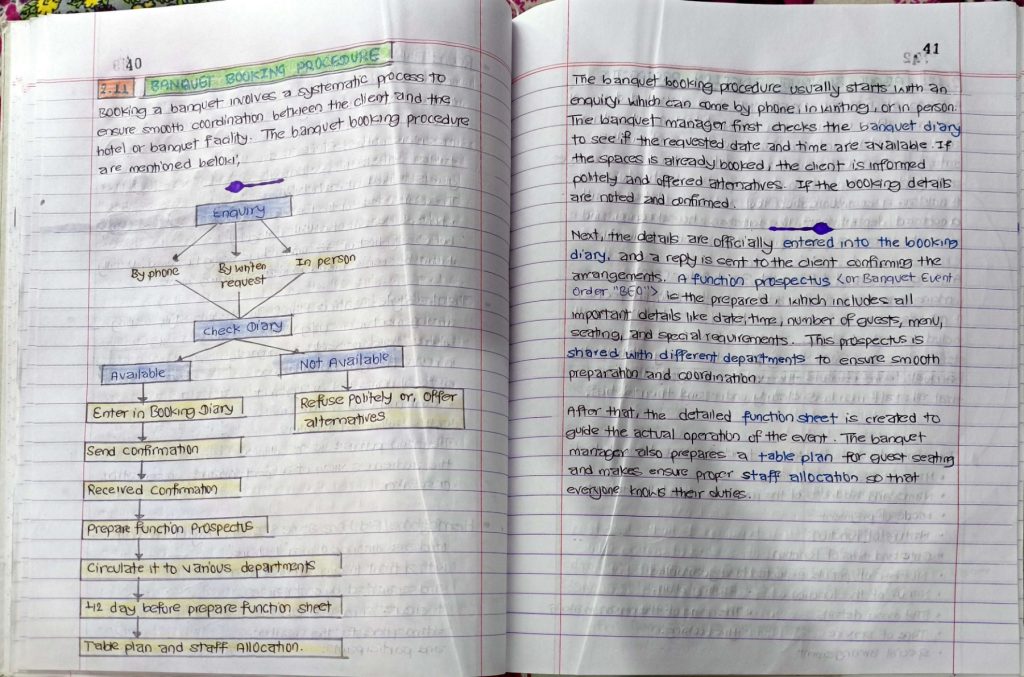
Banquet Booking Procedure
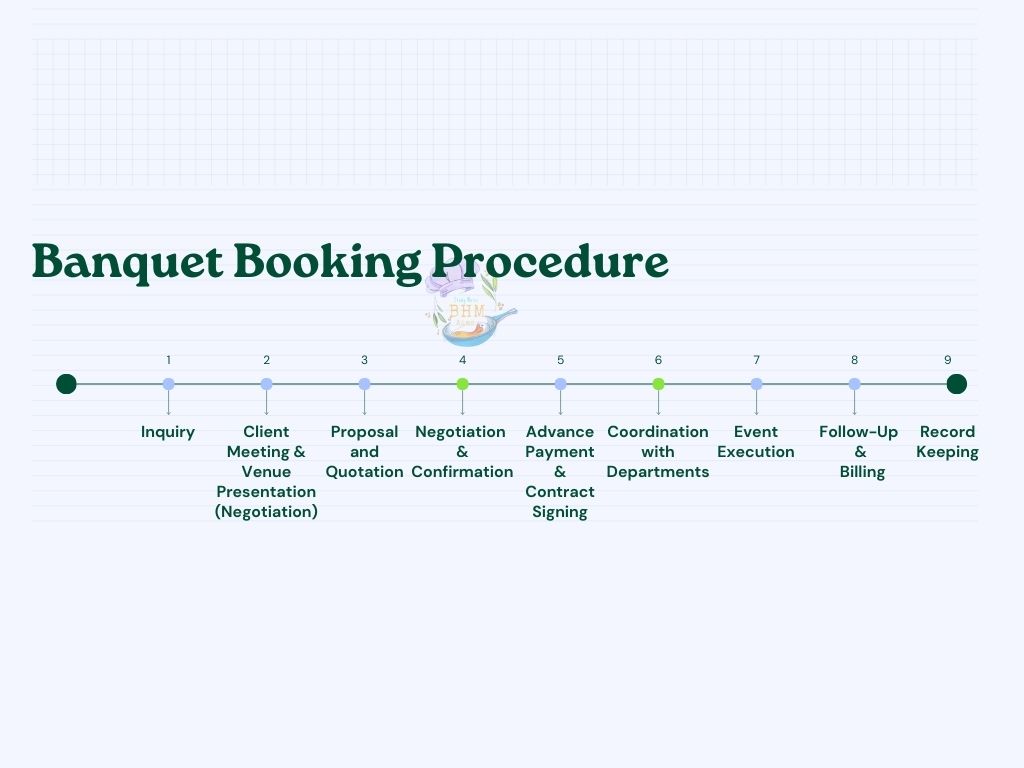
- Inquiry
- Client contacts the banquet sales office via phone, email, or in person or any other mode of communication
- Banquet Sales Coordinator records details like:
– Event date and time
– Type of function (wedding, conference, meeting, etc.)
– Expected number of guests
– Special requirements (menu preference, AV equipment, decoration, etc.) - Availability of date and venue space is checked.
- Client Meeting & Venue Presentation (Negotiation)
- The Sales Coordinator or Banquet Manager meets the client to:
- Understand event objectives and expectations
- Presents available banquet spaces and seating plan
- Discuss menu packages, menu pricing and packages available
- Offer additional services (decoration, photographs, lightnings, entertainment, etc)
- The Sales Coordinator or Banquet Manager meets the client to:
- Proposal and Quotation
- Based on client requirements, a formal proposal is prepared, including:
- Menu details with pricing per person.
- Rental charges for the venue.
- Cost of additional services (sound system, projector, lighting, etc.).
- Payment terms, taxes, and cancellation policy.
- Proposal is sent to the client for review.
- Based on client requirements, a formal proposal is prepared, including:
- Negotiation & Confirmation
- Sales team discusses adjustments if the client requests changes.
- Final agreement is reached on menu, décor, pricing, and services.
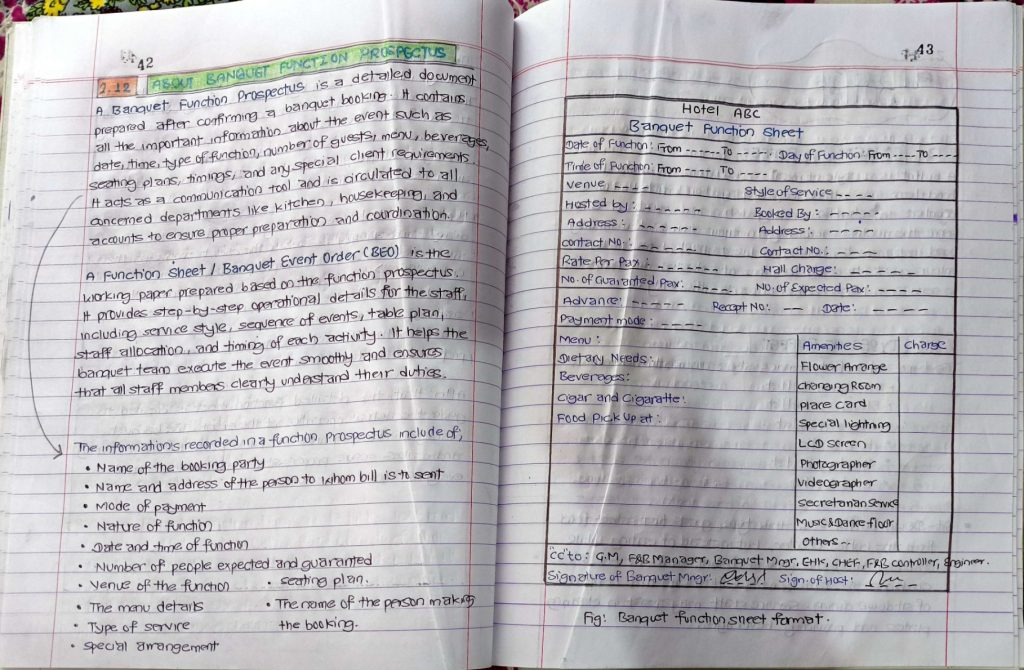
- The Banquet Event Order (BEO) is drafted — a detailed document with:
- Event date, timing, and agenda
- Banquet setup style (theatre, classroom, round tables, U-shape)
- Food & beverage service plan (menu items, service type)
- Technical requirements
- Contact person details
- Advance Payment & Contract Signing
- Client signs a contract confirming terms and conditions.
- A non-refundable deposit (usually 25–50% of total estimated cost) is collected.
- The booking is officially confirmed and blocked in the hotel’s reservation system.
- Coordination with Departments
- Copies of the BEO are sent to:
- Kitchen (for menu preparation and special dietary needs).
- Housekeeping (for linen, cleanliness, and décor).
- Engineering/Maintenance (for lighting, AC, AV systems).
- Security (guest safety, parking, crowd control).
- Banquet Service Team (for staffing and setup)
- Copies of the BEO are sent to:
- Event Execution
- Banquet team ensures timely setup as per BEO.
- Service staff provide food and beverage service.
- Banquet Captain supervises operations.
- Sales/banquet manager remains available to handle issues.
- Post-Event Follow-Up & Billing
- Client is presented with the final bill including:
- Additional charges (extra guests, extended hours, additional beverages).
- Less any deposit already paid.
- Payment is settled as per the contract.
- A thank-you letter or follow-up call so good relation is made to encourage repeat business.
- Record Keeping
- All booking details, contracts, and feedback are filed for reference.
- Any information is recorded into the sales database for future marketing.
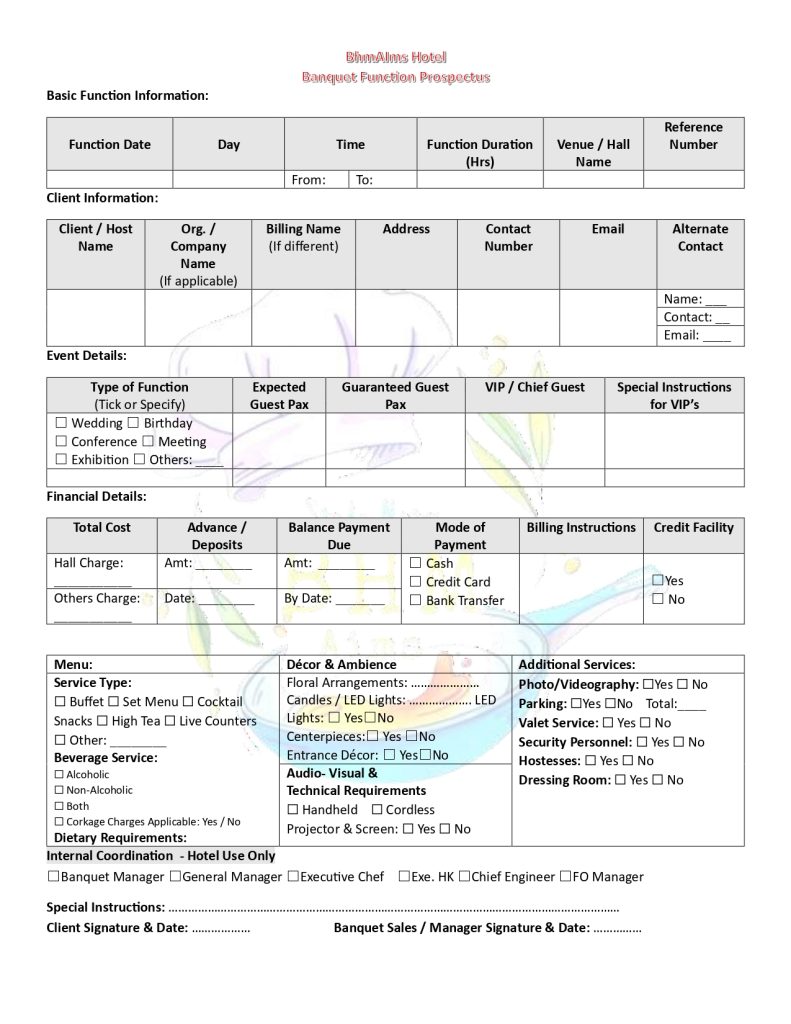
Banquet Function Prospectus (Format)