
Short Important Questions
- Write the reason behind malting the barley in whiskey-making process. (1 Mark, 2023)
Long Important Questions
- Define Whisky. Explain its types. (5 Marks, 2017)
- Why are aged whisky and brandies considered better than young ones, and why are they more expensive? (10 Marks, 2017)
- How does a whisky become scotch? List and explain types of popular scotch whiskey with their characteristics. (10 Marks, 2018)
- Classify Whisky with the help of classification chart. Write down the characteristics of any four popular whisky. (10 Marks, 2023)
- Explain the various types of whiskey on the basis of region. (5 Marks, 2025)
Introduction
Whisky (or whiskey) is a distilled alcoholic beverage made from fermented grain mash. The grains commonly used are:
- Barley (Main Product)
- Rye
- Wheat
- Maize (corn)
The mash is first fermented and then distilled to produce a strong spirit, which is later aged in wooden casks to develop flavour, colour and smoothness.
| Definition: Whisky is a potable spirit obtained from the distillation of fermented mash of cereals such as barley, maize, rye or wheat and then matured in wooden casks. The alcoholic strength of whisky usually lies between 37% and 43.5% alcohol by volume (ABV). |
Whisky vs Whiskey
There is a small but important difference in spelling:
| Spelling | Used for |
|---|---|
| Whisky | Scotland, Canada, Japan |
| Whiskey | USA, Ireland |
The difference between whisky and whiskey is mainly based on regional origin rather than meaning. Both words refer to the same alcoholic drink, but countries follow different spellings. “Whisky” is used in Scotland, Canada and Japan, while “whiskey” is used in Ireland and the United States. It also reflects variations in production methods and taste style in different regions.
Therefore, the spelling generally indicates the country where the drink is produced, not a different type of beverage.
Origin of Whisky (For Knowledge Only)
The word whisky comes from the old Gaelic term “Uisge Beatha” (Scottish) or “Uisce Beatha” (Irish), which means “Water of Life.”
Whisky is believed to have originated in Ireland and later spread to Scotland, where it became highly refined and popular. Over time, it spread to other countries like Canada, USA and Japan, each developing its own style.
Manufacturing Process of Whisky
The production of whisky follows a carefully controlled series of steps. Each stage plays an important role in developing the flavour, aroma, strength and quality of the final spirit.

- Selection and Cleaning of Grain
Good-quality grains such as barley, maize, rye or wheat are selected. For malt whisky, barley is mainly used. The grains are cleaned to remove dust, stones and other foreign materials. - Malting
Malting is the process by which barley is prepared so that its starch can be converted into sugar, which is necessary for alcohol production. It is carried out in three main stages:- Steeping
Barley is soaked in water for about 2-3 days (48–70 hours) so that it absorbs moisture and becomes soft. - Germination
The soaked barley is spread on malting floors and allowed to sprout. During this stage, natural enzymes develop which later help to convert starch into fermentable sugar. - Kilning
The sprouted barley (called green malt) is dried in a kiln to stop further growth. - Peating (Optional)
If a smoky flavour is required, peat is burned during the drying stage. The smoke passes through the barley and gives the whisky its smoky character. The level of smokiness depends on how much peat smoke is used.
In Scotch whisky, peat smoke is often used.
- Steeping
- Mashing
Mashing is the process of extracting sugar from malted grains, which will later be converted into alcohol during fermentation. It is carried out in such steps:- Milling
The dried malted barley is ground into a coarse flour called grist. - Mixing in Mash Tun
The grist is mixed with hot water (usually 62–65°C) in a large vessel called a mash tun.- The hot water helps extract sugars from the grains.
- The liquid obtained after this process is called wort, which is sweet and sticky.
- Multiple Extractions
Many distilleries wash the grain three times, increasing the temperature each time, to ensure maximum sugar extraction.
- Milling
- Fermentation
The wort from Mash tun is cooled and transferred into large tanks called washbacks. Yeast is added, which feeds on the sugar and converts it into alcohol and carbon dioxide. After about 2–3 days, the liquid becomes a weak alcoholic drink called wash, containing about 6–8% alcohol.
| Scientific Name of Yeast (baker’s or brewer’s yeast) is : Saccharomyces cerevisiae |
- Distillation
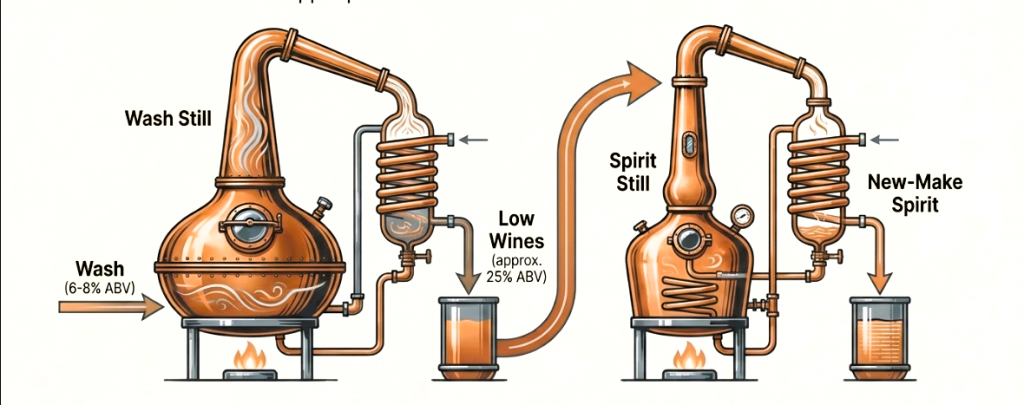
Distillation is the process of concentrating alcohol and refining the spirit. Whisky is usually distilled twice in copper pot stills. Followings steps are done in distillation process:- First Distillation – Wash Still
- The fermented wash is boiled.
- Alcohol evaporates at 78°C, lower than water, and rises as vapour.
- The vapour is cooled and condensed into liquid called low wines, with about 25% ABV.
- Second Distillation – Spirit Still
- The low wines are distilled again.
- The distiller makes “cuts” to separate different fractions:
- Heads (Foreshots): Early, volatile part; discarded or recycled.
- Heart (Middle Cut): High-quality spirit; kept for aging (65–70% ABV).
- Tails (Feints): Oily end; discarded or recycled
- First Distillation – Wash Still
| Note: Only the heart is used for maturation. |
- Maturation (Aging)
The new whisky is filled into oak wooden casks and stored for aging. During this period:- The whisky becomes smoother
- It gains colour
- It develops flavour and aroma
Whisky does not age in the bottle; it ages only in the cask. Some amount of whisky (roughly 1.5–2%) evaporates every year, known as the “Angel’s Share.”
- Blending
After maturation, different malt and grain whiskies may be mixed to achieve a consistent taste and quality. Blending is done by expert blenders using secret formulas. Single malt whisky is not blended, but most Scotch whiskies are blended. - Filtration and Bottling
Finally, the whisky is filtered, sometimes diluted with pure water to reach the desired strength, and then bottled with labelling for sale.
Types on the basis of Malt, Aging, and Region
On the basis of Malt
On the basis of the type of grain used and whether the whisky contains malt or not, whisky is classified into the following main types:
- Malt Whisky
Malt whisky is made from 100% malted barley and is distilled in copper pot stills. It has a strong aroma, rich flavour and complex character.
There are two types of malt whisky:- Single Malt Whisky
Single malt whisky is made from only malted barley and produced in one single distillery. It may come from different casks and different years, but it always belongs to the same distillery.
Examples: Glenfiddich, Glenlivet, Macallan
Characteritics:- Made from malted barley only
- Produced in one single distillery
- Not mixed with whisky from other distilleries
- Has a distinctive and unique flavour
- Blended Malt Whisky
Blended malt whisky is a mixture of two or more single malt whiskies from different distilleries. It does not contain any grain whisky.
Example: Monkey Shoulder, Johnnie Walker Green Label, Compass Box Peat Monster, Famous Grouse Malt Whisky, Teacher’s Highland Cream Malt
Characteritics:- A blend of two or more single malt whiskies from different distilleries.
- Only malt whisky is used.
- Contains no grain whisky
- Smoother than single malt but richer than blended whisky
- Has a balanced but rich flavour
- Single Malt Whisky
- Grain Whisky
Grain whisky is made from malted barley along with other grains such as maize, wheat or rye. It is distilled in continuous (Coffey) stills, making it lighter and smoother than malt whisky.
Grain whisky is mainly used for blending. - Blended Whisky
Blended whisky is made by mixing malt whisky and grain whisky. This is the most popular and widely sold type of whisky in the world.
It is smooth, balanced and more affordable than single malt.
Examples: Johnnie Walker, Chivas Regal, Ballantine’s - Single Grain Whisky
Single grain whisky is made from malted barley and other grains but is produced in one single distillery. It is lighter in taste and usually used in blends.
On the basis of Aging / Maturation
Whisky is classified on the basis of the length of time it is matured in wooden casks. Aging plays a major role in developing the flavour, colour, aroma and smoothness of whisky.
Minimum Legal Aging
- Scotch, Ireland and Canadian whisky: minimum 3 years
- Straight Bourbon and Rye (USA): minimum 2 years
Only after this period can the spirit be legally sold as whisky.
- No-Age-Statement (NAS) Whisky
No-Age-Statement whisky does not display any age on the bottle.
The blender selects whiskies to maintain a uniform taste, even without mentioning an age.
Characteristics:- Made by blending whiskies of different ages
- Focus is on flavour consistency, not age
- May include younger whiskies
- Usually more affordable / Less expensive
- Age-Statement Whisky
Age-statement whisky clearly shows the age on the label, such as 10 years, 12 years or 18 years.
Characteristics:- These whiskies are usually more expensive due to longer storage and evaporation loss
- Longer aging results in
- Smoother taste
- More strong flavour
- Darker colour
On the basis of Region
Whisky is produced in many regions of the world, and each region gives whisky a unique character based on grains, distillation method, water, climate, and cask type. Whisky is commonly classified by its region as follows:
- Scotch Whisky (Scotland)
Scotch whisky is a distinctive product of Scotland, made mainly from malted barley (for malt whisky) or other grains like corn (for grain whisky). It must be produced entirely in Scotland and matured in oak casks for at least 3 years.
Many Scotch whiskies use peat smoke during malting, giving a signature smoky flavour. Scotch whisky can be either single malt, single grain, or blended.
| Base: Malted barley (for malt whisky), corn (for grain whisky) Distillation: Single malt in pot stills, grain whisky in column (Coffey) stills Maturation: Minimum 3 years in oak casks |
The country is divided into six whisky-producing regions, each creating whiskies with unique character.
- Highlands: Strong, full-bodied, sometimes peaty (e.g., Dalmore, Glenmorangie)
- Speyside: Fruity, sweet, lightly peated (e.g., Macallan, Glenlivet)
- Lowlands: Light, floral, and smooth (e.g., Auchentoshan)
- Islay: Intensely peaty and smoky (e.g., Laphroaig, Lagavulin)
- Campbeltown: Rich, slightly salty, complex
- Islands: Varied, often smoky
Scotch whisky is divided into following two types:-
- Malt Whisky: 100% malted barley, pot still distilled
- Grain Whisky: Malted barley + other grains, column still distilled
Examples: Glenfiddich, Laphroaig, Macallan, Johnnie Walker (blend)
- Irish whiskey (Ireland)
Irish whiskey is a smooth and approachable spirit made primarily in Ireland. It is produced from barley (malted and unmalted) and sometimes mixed with oats or wheat. Irish whiskey is usually triple distilled in pot stills, which removes heavier impurities and gives it a lighter, cleaner taste compared to Scotch whisky. During malting, the barley is dried in closed kilns, so no peat smoke is used, resulting in a mild, smooth flavour. It must be aged for at least 3 years in oak casks.
| Base: Mostly barley (malted and unmalted), sometimes oats or wheat Distillation: Usually triple distilled, pot stills Maturation: Minimum 3 years in oak casks |
Characteristics:
- Triple distilled, making it smoother and lighter
- Made mainly from barley (malted and unmalted)
- No peat smoke is used during drying of barley
- Mild, clean and slightly sweet in taste
- Light-bodied compared to Scotch whisky
- less harsh
- Aged in oak casks for a minimum of three years
- Often used both for sipping and for cocktails
Examples: Jameson, Bushmills, Redbreast
Legal Definition (Irish Whiskey Act) Just For Knowledge
To be legally called Irish Whiskey, the spirit must meet these conditions:
- Must be distilled and matured on the island of Ireland (Republic of Ireland or Northern Ireland)
- Must be made from a mash of cereals, in which malted barley is compulsory
- Must be distilled to not more than 94.8% alcohol by volume, so that the natural grain flavour is retained
- Must be aged in wooden casks (usually oak) not exceeding 700 litres for at least three years
- Must be bottled at not less than 40% alcohol by volume (ABV)
- Only water and plain caramel colouring (E150a) are allowed as additives
- Canadian Whisky (Canada)
Canadian whisky is a light, smooth and well-balanced spirit produced in Canada. It is usually made from a blend of different grain whiskies, mainly corn, rye and barley malt. Unlike American whisky, where grains are mashed together, Canadian distillers often distil each grain separately and blend them after aging, giving Canadian whisky its soft and mellow character. It is commonly known as “Rye whisky” in Canada, even though the rye content may be low.
| Base grains: Corn, rye and barley malt Style: Blended whisky (flavoured whisky + neutral whisky) Distillation: Usually continuous stills Maturation: At least 3 years in wooden casks (often longer |
Characteristics:
- Usually lighter and smoother than Scotch and American whiskey
- Mellow and soft flavour
- Often blended from different grain whiskies
- Less intense oak and spice than Bourbon
- Often slightly sweet and easy to drink
- Well suited for mixing and cocktails
- Known for its balanced and clean taste
Additional Details:
- Canadian whiskies may be blended before or after aging
- Most are aged longer than the legal minimum, often 6 years or more
- “Rye whisky” in Canada is a legal name, not a guarantee of high rye content
Examples: Black Velvet,Canadian Club,Crown Royal (Seagram’s Crown Royal)
Legal Definition of Canadian Whisky
According to Canadian Food and Drug Regulations, a spirit must meet these rules to be called Canadian Whisky, Canadian Rye Whisky, or Rye Whisky:
- Must be mashed, distilled and aged in Canada
- Must be made from a mash of cereal grains (no fixed grain percentage required)
- Must be aged in small wooden casks (less than 700 litres) for a minimum of 3 years
- Must be bottled at not less than 40% alcohol by volume (ABV)
- Must have the aroma, taste and character typical of Canadian whisky
- American Whiskey (USA)
American whiskey is made from a fermented mash of cereal grains such as corn (maize), rye, wheat and malted barley. It must have the taste, aroma and character commonly associated with whiskey. By law, American whiskey is distilled to not more than 80% alcohol by volume (160 proof) and is usually matured in oak barrels. The use of new, charred oak casks gives American whiskey its strong vanilla, caramel and smoky wood flavours.
Types of American Whiskey
- Bourbon Whiskey
It is the most famous American whiskey. It must be made from a mash containing at least 51% corn (maize). It is distilled using the sour mash process and aged in new, charred oak barrels, which gives it strong sweet, vanilla and caramel flavours. There is no minimum age for bourbon, but Straight Bourbon must be aged for at least two years.
Examples: Jim Beam, Wild Turkey, Maker’s Mark, Old Grand-Dad - Tennessee whiskey
It is a type of American whiskey that is made only in the state of Tennessee. It is very similar to Bourbon because it uses the same grains (at least 51% corn) and is aged in new, charred oak barrels.
What makes Tennessee whiskey different is one special step called the Lincoln County Process. Before the whiskey is put into barrels, it is slowly filtered through charcoal made from sugar maple wood. This removes harsh impurities and makes the whiskey smoother and softer in taste.
Because of this charcoal filtering, Tennessee whiskey is often described as mellow and easy to drink
Example: Jack Daniel’s, George Dickel - Rye Whiskey
Rye whiskey must be made from a mash containing at least 51% rye grain. It is aged in new, charred oak barrels and has a spicy, peppery and dry flavour compared to the sweetness of bourbon. Straight Rye must be aged for at least two years.
Examples: Old Overholt, Sazerac, Rittenhouse - Blended American Whiskey
Blended American whiskey contains at least 20% straight whiskey, mixed with other whiskies or neutral grain spirits. Unlike straight whiskey, it may contain up to 2.5% colouring or flavouring (such as caramel or sherry) to maintain consistency.
Examples: Seagram’s 7 Crown, Kessler
| Nepalese whisky: Signature, Antiquity, Old durbar, Golden oak, Black oak, Blue oak, Gorkhas and Guns, Royal stag, J89, Bandipur, Yarasagumba, Kala Patthar, The Himalayan Reserve, etc. |
Service of Whiskey
In hotels, bars and restaurants, whisky should always be served in a clean glass, at the correct temperature, and in the style preferred by the guest.
- Standard Measure: The standard measure for whisky is 30ml (Single) or 60ml (Double).
- Glassware:
Whisky is normally served in:- Tumbler (Old-fashioned glass)
- Tulip-shaped glass (Nosing glass / Glencairn)
- Common Ways of Serving Whisky
Whisky can be served in several styles:- Neat: Whisky served alone without ice or water. This allows the drinker to experience the true flavour.
- On the Rocks: Whisky served over ice cubes. Ice slightly dilutes and cools the whisky, making it smoother.
- With Water: A few drops ofroom temperature water are added to open up the aroma and soften strong alcohol notes.
- With Mixers: Whisky can be mixed with soda, water, ginger ale or cola, especially in bars and casual drinking.
- Accompaniments: Ice cubes, soda water, ginger ale, or plain (still) water.
Additional:
- Always serve a glass of chilled plain water on the side as a palate cleanser.
- Presentation and etiquette:
- The bottle should be shown to the guest before pouring
- The glass should be clean and free from smell
- Do not overfill the glass
- Serve from the right side of the guest
Popular Whisky Brands
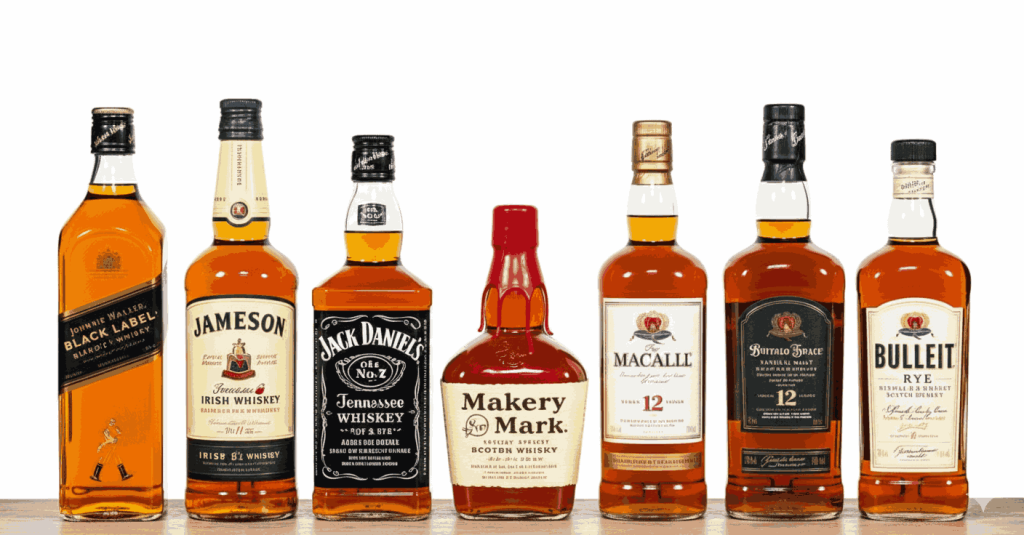
| Country | Top Popular Brands |
| Scotland | Johnnie Walker, Chivas Regal, Dewar’s, Ballantine’s, Glenfiddich, The Glenlivet, The Macallan, Glenmorangie |
| Ireland | Jameson, Tullamore D.E.W., Bushmills Original, Redbreast, Green Spot, Bushmills (Aged), Teeling |
| USA | Jim Beam, Maker’s Mark, Wild Turkey, Buffalo Trace, Jack Daniel’s, George Dickel, Bulleit Rye, Old Overholt, Rittenhouse, Seagram’s 7 Crown |
| Canada | Crown Royal, Canadian Club, J.P. Wiser’s |
| Nepal | Old Durbar, Gurkhas & Guns, Kala Patthar, 8848 Whiskey, Golden Oak, Royal Blue |
| Japan | Yamazaki, Hibiki, Nikka, Suntory Toki |