
Contents: Introduction, distillation and its types, History and definition of spirits,
international understanding and measurement of alcoholic strength. Proof:
Definition, Types of proof, Standard calculation of proof
Past Board Questions
- Define the term “distillation”. ( 1 Mark – 2025)
- Convert 40 ABV in US proof. ( 1 Mark – 2025)
- What are the features of Patent Still Distillation? ( 1 Mark – 2026)
- Define proof in alcoholic beverage. ( 1 Mark – 2026)
- Classify the different types of proof and demonstrate the standard calculation of proof. ( 5 Marks – 2026)
- What is proof? Write down its types with standard calculation. ( 5 Marks – 2025)
- Highlight on the history of spirits. Elaborate on international understanding and measurement of alcoholic strength. ( 10 Marks – 2025)
- Convert 22% into UK proof. ( 1 Mark – 2017)
- Define pot still distillation. ( 1 Mark – 2018)
- What is proof? Write a short history and its type. ( 5 Marks – 2018)
- What indicated alcohol proof in the label? (1 Mark, 2023)
- Discuss the distillation methods in making of alcohol. (5 Marks, 2023)
Introduction
The word beverage comes from the Latin word “bibere” meaning “to drink,” which evolved through the Old French word “bevrage” before becoming the English word “beverage.”
Alcoholic beverages are among the oldest products created by humans, with evidence of their production dating back to around 8000 BCE during the Neolithic Era. The earliest known archaeological evidence of fermented alcoholic beverages was discovered at Jiahu, China, dating back approximately 9000 years.
| An alcoholic beverage is a potable liquid that typically contains 1.5% – 75% alcohol (ethanol), produced through fermentation and, in some cases, further concentrated through distillation, made for human consumption. |
Note: The word “potable” means safe and suitable for drinking.

A bar is a retail business establishment that serves alcoholic beverages such as beer, wine, spirits (liquor), and cocktails to customers for consumption on the premises. It is a specialized area where beverages are prepared, stored, and served by trained personnel called bartenders.
Depending on the method of production and alcohol content, alcoholic beverages are generally categorized into fermented beverages, distilled spirits, and fortified wines.
Classification of Alcoholic Beverage

- Fermented Alcoholic Beverage
Fermented beverages are alcoholic drinks produced through the process of fermentation, where yeast converts the natural sugar present in fruits, grains, or other raw materials into alcohol (ethanol) and carbon dioxide.
Process:
Sugar + Yeast → Alcohol + Carbon dioxide + Energy
It includes:- Beer
- Wine
- Cider
- Perry
- Distilled Alcoholic Beverage (Spirits)
Distilled beverages are alcoholic drinks produced by distilling fermented liquids to increase the concentration of alcohol. During distillation, alcohol is separated from water and other components based on differences in boiling points.
It includes:- Whisky
- Vodka
- Rum
- Brandy
- Gin
- Tequila
- Compounded Beverage
Compounded beverages are alcoholic drinks made by blending or mixing alcohol with other ingredients such as herbs, fruits, spices, sugar, flavors, or extracts to create a specific taste and character.
It includes:- Bitters
- Liqueurs
- Vermouth
- Cocktail
Distillation vs Fermentation Process
| Basis | Fermentation | Distillation |
|---|---|---|
| Defintion | A biological process in which yeast converts sugars into alcohol and carbon dioxide. | A physical process used to separate and concentrate alcohol by heating and condensing vapors. |
| Purpose | To produce alcohol naturally from sugars. | To increase the alcohol concentration of a fermented liquid. |
| Main Agent | Yeast and other microorganisms. | Heat and distillation equipment (still). |
| Chemical process | It includes chemical change process i.e. sugars are chemically converted into alcohol. | It doesn’t involve chemical change process as existing alcohol is only concentraded. |
| Raw Material | Sugary substances such as fruits, grains, molasses, or honey. | Fermented liquid (wash, beer, wine, etc.). |
| Alcohol Content | Produces low-alcohol beverages (usually 3–15% ABV). | Produces high-alcohol beverages (typically 20–95% ABV). |
| By-products | Carbon dioxide (CO₂) and heat. | No major by-products; mainly separates alcohol and water. |
| Example | Beer, Wine, Cider | Whisky, vodka, rum, gin, brandy. |
Distillation and its Types
Distillation is the process of separating alcohol from a fermented liquid by heating and cooling.
Alcohol boils at approximately 78.3°C, while the water boils at the temperature of 100°C. When a fermented liquid is heated, alcohol evaporates first. Then, vapor is collected and cooled back into liquid form, which results in a distilled beverage with a higher alcohol content.
| Definition: Distillation is a process in which a fermented liquid is heated to separate alcohol from water and other components based on their different boiling points, where alcohol vapor is collected and condensed back into a liquid form to produce a spirit with a higher alcohol concentration. |
Objectives of Distillation:
- To increase alcohol strength / content.
- To improve flavor and aroma.
- To remove impurities.
- To produce different types of spirits.
- To ensure consistency and quality.
Principle of distillation:
Distillation works on the simple principle that different liquids have different boiling points.
| Substance | Boiling Point / Temperature |
|---|---|
| Alcohol | 78.3°C |
| Water | 100°C |
Since alcohol vaporizes before water, it can be separated and concentrated.
Types of Distillation
Distillation can be done in two ways:
- Pot Still Distillation (Batch Distillation)
- Column Still Distillation (Patent Still / Continuous Still)
- Pot Still (Batch Distillation)Distillation
It is the oldest and traditional method of producing spirit where the fermented liquid is heated in a copper pot still and distilled in batches.
It is used to produce heavier spirits like- Brandy
- Whisky
- Dark rum

In this method, the spirit has to be distilled twice to receive an acceptable quality. It has got high impurities. In this method, small quantity can be produce at a time.
And by law, it must be matured for a minimum of 2 years. Most of the finest spirits are made by pot distillation. But it requires more time and labor and it is very costly to operate.
Process:
- Fermented liquid is poured into a copper pot.
- Heat is applied.
- Alcohol vapor rises.
- Vapor passes through a condenser.
- Vapor cools and becomes liquid spirit.
- (Note: This overall process might be repeated twice or thrice to receive acceptable quality of spirits.)
- Column Still (Patent Still or Continuous Still) Distillation
Column distillation is a continuous process in which alcohol is separated using tall columns containing plates or trays.
It is the recent method of producing spirits. It is used to produce the lighter spirits like- Vodka
- Gin
- Tequila
- White rum
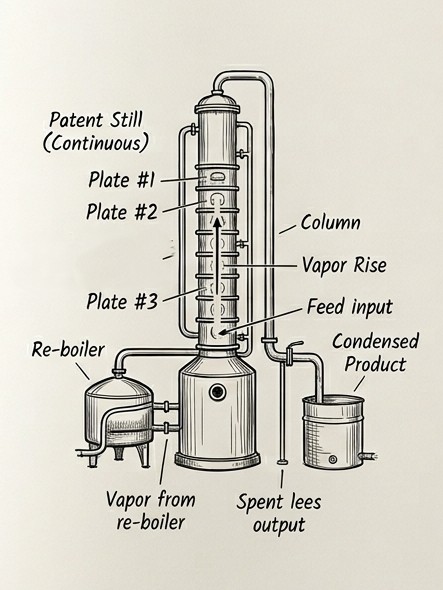
It was invented by Robert Stein, in 1828, who was related to Scotch whisky maker and it was modify and popularized by Aeneas Coffey in 1831, an Irish chemist. Single distillation is enough to receive an acceptable quality in a patent still. Less impurities or pure alcohol is obtained by this method.
By this process, large quantities can be produce at a time. Also, it doesn’t require too much of labour cleaning and refining.
| Basis | Pot Still | Column Still |
|---|---|---|
| Process | Distillation is carried out in separate batches. | Distillation occurs continuously without stopping. |
| Definition | It is a traditional method done using a pot-shaped still.. | It is a modern method done using a tall column containing multiple plates or trays. |
| Used for | It is generally used for producing premium spirits. | It is generally used for mass production. |
| Flavor | Spirits produced has rich flavor. | Spirits produced has lighter flavor. |
| Production Volume | Produces smaller quantities. | Produces large quantities efficiently. |
| Cost | It is considered expensive method compared to column still. | It is considered cheaper method compared to pot still. |
| Labour required | More labor-intensive | Less labor-intensive |
| Alcohol Strength | Produces spirit with lower alcohol concentration in a single distillation. | Produces spirit with higher alcohol concentration in a single run. |
| Time required | Slower process. | Faster process. |
| Operation | Requires cleaning and refilling after each batch. | Operates continuously as long as raw material is supplied. |
How Pot Still and Patent Works? Click Here to watch real video
Spirits
A spirit is an alcoholic beverage obtained by distilling a fermented liquid and usually containing a higher percentage of alcohol than fermented beverages.
| In simple way, Spirits are strong potable alcoholic drinks produced through distillation. |
All the spirits are produced by distillation in stills. A still is an apparatus used in the distillation of alcohol beverage. There are two main methods of production spirits:
- Pot still method
- Patent or continuous still method
History of Spirits
The history of the spirits can be traced back before thousands of year.
Let’s divide into different parts so its easy for understanding:
Ancient Beginning of Alcohol Production (Around 7000 BCE – 800 BCE):
The earliest history of alcoholic beverages had began with the accidental discovery of fermentation. Ancient people noticed that fruits, grains, and other sugary substances could naturally transform into alcoholic liquids when exposed to yeast.
In the early civilization such as the Egyptians, Greeks, and Chinese practiced various methods of producing fermented beverages. In ancient China, people produced drinks by fermenting the ingredients like rice, honey and fruits.
During this ancient period, beverages were produced only through fermentation, so their alcohol content was comparatively low. However, the idea of producing stronger alcoholic beverages/drinks was developed later with improvements in distillation techniques.
Development of Distillation (1st – 10th Century CE):
Rather than producing alcoholic beverage, distillation was initially used for purposes such as producing perfumes, medicines, and essential oils. The early forms of distillation equipment were developed by ancient scholars, and later improvements made the process more effective.
The use of the alembic still became an important development in the history of distillation. Arab scholars and chemists further improved distillation methods, allowing the better purification and concentration of alcohol. Scholars such as Jabir ibn Hayyan and Al-Kindi contributed to the development of chemical techniques, while later scholars improved cooling methods used in distillation.
At this stage/era, distilled alcohol was mainly considered a medicinal substance rather than a recreational drink. The Arabic word “Al-Kuhl” later evolved into the English word Alcohol.
The Era of “Aqua Vitae” or Water of Life (Middle Ages – 15th Century)
As knowledge and idea of distillation spread from the Middle East to Europe, European monks and scholars started producing distilled beverages. These early spirits were known as Aqua Vitae, meaning “water of life.” It was called eau de vie in French, usquebaugh in Gaelic and aqua vitae in Italian.
People believed these liquids had medicinal properties and used them as remedies for various illnesses. During this period, the early forms of some famous spirits began to appear. Historical documents indicate that Armagnac was being produced for local consumption as early as 1411. During the same period, northern Italy and Alsace (i.e. historic region on the border of France and Germany) had already gained a reputation for making distilled spirits.
- Brandy was produced by distilling wine.
- Early forms of whisky was developed from grain-based fermented liquids in Scotland and Ireland.
Although these beverages were consumed in small amounts, they were still mainly associated with medicine rather than entertainment.
Expansion and Commercial Growth of Spirits (16th – 17th Century)
During the Age of Exploration, spirits became more widely available and gradually moved from medicinal use to regular consumption. The various improvements in trade and transportation systems helped to spread different types of spirits around the world.
The availability of new raw materials encouraged the development of new spirits:
- Rum was developed in the Caribbean with the growth of sugarcane plantations. It was produced from sugarcane juice and molasses.
- Cognac and other brandies became established in Europe.
- Gin developed from Dutch jenever and later became highly popular in England.
- Vodka developed in Eastern Europe, especially in Russia and Poland.
This period marked the beginning of the commercial spirit industry.
Industrial Development of Spirits (19th Century)
The 19th century brought major improvements in spirit production. The invention of the continuous column still allowed producers to manufacture spirits more efficiently and on a larger scale for commercelization.
Industrial production helped improve:
- Alcohol purity
- Production speed
- Product consistency
During this period, barrel aging also became an important part of spirit production. Producers discovered that storing spirits in wooden barrels improved their colour, aroma, and flavor, especially in whisky, brandy, and rum.
Modern Era of Spirits (20th Century – Present)
Today, spirits are among the most important products in the global beverage industry. Modern technology has improved production methods, quality control, and safety standards.
The six major base spirits recognized worldwide are:
- Whisky – produced mainly from grains such as barley, corn, and rye.
- Vodka – a neutral spirit produced from grains or potatoes.
- Rum – produced from sugarcane juice or molasses.
- Gin – a spirit flavored mainly with juniper and other botanicals.
- Brandy – produced by distilling wine or fruit juice.
- Tequila – produced from blue agave in Mexico.
Today, spirits are widely used in bars, restaurants, hotels, and cocktail culture. The industry has also moved towards premium products, craft spirits, and various sustainable production methods.
Prohibition and Regulation of Spirits
Although spirits have played an important role in the society and culture, their consumption by people has also created many social concerns. Excessive alcohol consumption led to the numerous health, social, and economic problems.
During the early 20th century, concerns about the harmful effects of alcohol led to the growth of the temperance movement, especially in the United States. This movement supported restrictions on alcohol consumption and eventually resulted in Prohibition, which banned the production, sale, and distribution of alcoholic beverages.
| The Temperance Movement was a social movement that encouraged people to reduce or completely stop drinking alcohol. It began in the 19th century and became very influential in countries like United States (U.S), Canada, and the United Kingdom (UK). |
However, prohibition did not completely eliminate the use of alcohol. Instead, it encouraged illegal production and distribution of alcohol. The period saw the growth of underground bars known as speakeasies and increased activities of organized crime groups involved in alcohol trade.
The failure of Prohibition showed that strict bans alone could not effectively control alcohol consumption. After this period, governments introduced more practical approaches through licensing systems, taxation, and legal regulations.
Modern alcohol regulations focus on:
- Licensing producers and sellers
- Controlling production and distribution
- Setting legal drinking ages
- Restricting advertising
- Promoting responsible consumption
Today, alcohol laws differs between one country to another country, but their main objective remains the same: allowing responsible enjoyment of alcoholic beverages while protecting public health and safety.
International Understanding and Measurement of Alcoholic Strength
Alcoholic strength refers to the amount of alcohol (ethanol) present in an alcoholic beverage. Since alcoholic drinks are produced and traded worldwide, it is important to have a common method for measuring and expressing their strength.
The strength of alcoholic beverages is mainly measured through two system :
- Alcohol by Volume (ABV)
- Proof System
- Alcohol by Volume (ABV)
Alcohol by Volume (ABV), also known as volume percentage (v/v%) is the most commonly used method for measuring alcohol strength around the world. It represents the amount of pure alcohol present in 100 ml of a beverage.
Volume percent is commonly used when preparing solutions by mixing two liquids, where the volume of one component is compared with the total volume of the solution.
For example, a bottle of whisky labeled 40% ABV means that 100 ml of whisky contains 40 ml of pure alcohol and the remaining volume consists of water and other components.
ABV is expressed as a percentage and is widely used in countries such as Nepal, the United Kingdom, Australia, and many European countries.
- Proof System
The proof system is another method of expressing alcohol strength, mainly used in countries like the United States. It was developed before ABV became the international standard.
Let’s understand about proof system in detailed below:
Importance of measuring alcoholic strength:
- It helps to identify the alcohol content of different beverages.
- It helps to maintain product quality and consistency.
- It helps to follow government regulations and taxation systems.
- It helps bartenders in accurate drink preparation.
- It provides correct information to consumers.
Proof
Proof is a traditional method of expressing the alcoholic strength of a beverage. It indicates the amount of alcohol present in a spirit and is mainly used for distilled beverages such as whisky, rum, vodka, and brandy.
The proof system was developed before the widespread use of Alcohol by Volume (ABV). Although many countries now use ABV as the standard measurement, proof is still commonly used, especially in the United States.
Types of Proof
There are mainly three types of proof systems used around the world:
- European / Gay-Lussac (GL) Proof System
- British / Canadian Proof System
- United States (US) Proof System
- European / Gay-Lussac (GL) Proof System
The Gay-Lussac system expresses alcohol strength directly as a percentage of alcohol by volume.
In this system:
| 100° Proof GL = 100% ABV |
Therefore, the proof value is equal to the alcohol percentage.
For example:
- A spirit containing 43% ABV is considered 43° Proof GL.
- A spirit containing 22% ABV is considered 22° Proof GL.
- British / UK / Canadian Proof System
The British proof system was developed using a hydrometer created by Bartholomew Sykes to measure alcohol strength.
In this system:
| 100° British / UK Proof = 57.1% ABV |
A spirit above 100° proof was considered over proof, while a spirit below 100° proof was considered under proof.
This system was historically used in the United Kingdom and Canada but is no longer commonly used.
- United States (US) Proof System
The US proof system is based on a simple relationship between proof and ABV.
In this system,
| US Proof = ABV × 2 |
For example:
- 40% ABV = 80 US Proof
- 50% ABV = 100 US Proof
This system is still widely used for labeling spirits in the United States.
Calculation
- Convert 185 US proof into UK proof.
⇒
We know,
US Proof = 2 × ABV
Therefore,
ABV = US Proof ÷ 2
= 185 ÷ 2
= 92.5% ABV
Now we got value in ABV – Lets convert it into UK proof
In the UK system:
100° UK Proof = 57.1% ABV
Formula:
UK Proof = (ABV ÷ 57.1) × 100
= (92.5 ÷ 57.1) × 100
= 1.619 × 100
= 161.99° UK Proof
Hence, 185 US Proof ≈ 162° UK Proof
| This above is bit long – Let me give you the most simple way to: |

Explanation:
you didn’t understand Why 175/200?
Let us explain
The fraction 175/200 represents the conversion relationship between the two proof systems used:
| 200 US Proof = 175 UK Proof |
Therefore,
1 US Proof = 175/200 UK Proof
Trick / Idea: Multiply any US Proof value by 0.875 to get UK Proof.
Let’s check our trick :
| Convert 185 US proof into UK proof. ⇒ 185 * 0.875 = 161.875 ≈ 162° UK Proof |
| Convert 160 US proof into UK proof. ⇒ 160* 0.875 = 140 UK Proof |
- Convert 22% into UK proof. (1 Mark – 2017)
⇒ Here,
22% means Gay-Lussac Proof
Step 1: Converting GL Proof into US Proof
US Proof = GL × 2
=22×2
=44∘ US Proof
Step 2: Converting US Proof into UK Proof
UK Proof = (175 * US Proof) / 200
= (175 * 44) / 200
= 38.5 ∘ UK proof
Calculation asked in Board Exams
- Convert 40 ABV in US proof. ( 1 Mark – 2025)
⇒
We know the formula,
US Proof = ABV × 2
So,
US proof = 40 * 2
= 80
Answer: 40% ABV = 80° US Proof - Convert 185 US Proof into UK Proof. (1 Mark – 2017)
⇒
We know,
= 185 * 0.875
= 161.875
Therefore, 185 US Proof is equal to approximately 162° UK Proof.
All-in-One Conversion Relationships
| 1% ABV = 2° US Proof = 1.75 UK Proof |
- From ABV/GL:
- US Proof = ABV * 2
- UK Proof = ABV * 1.75
- From US Proof:
- ABV = US Proof / 2
- UK Proof = US Proof * 0.875
- From UK Proof:
- ABV = UK Proof / 1.75
- US Proof = UK Proof * 1.143
This is extra note for knowledge:
Explain Heart cut / fraction during distillation.
The heart cut is the middle portion of the distillate collected during distillation, which contains the desired quality spirit with the best balance of alcohol strength, flavor, and aroma.
During distillation, the liquid coming out of the still is divided into three main parts:
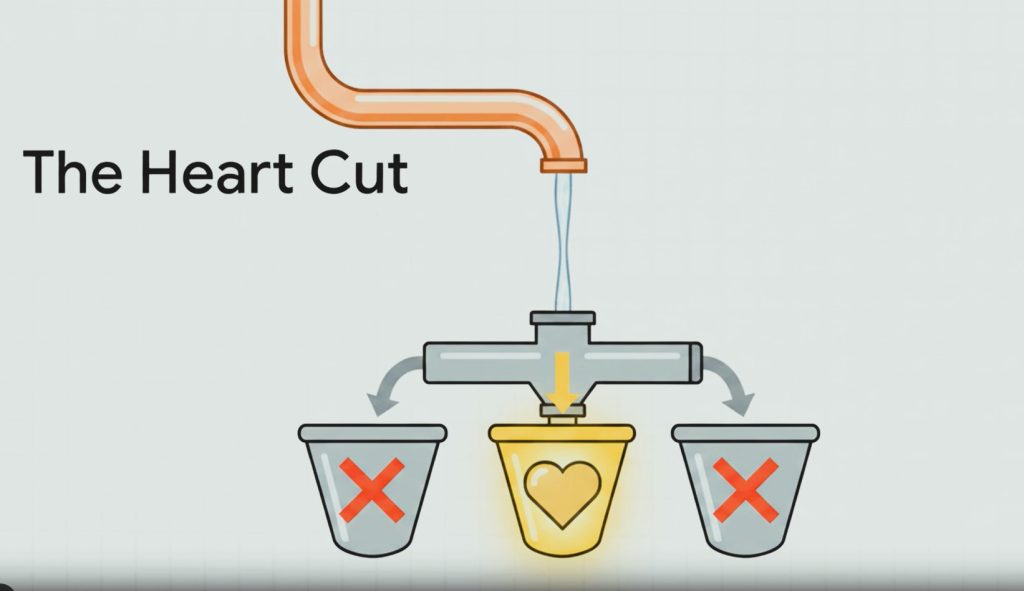
1. Heads (Foreshots)
- The first portion collected.
- Contains unwanted volatile compounds such as methanol and other impurities.
- It is usually removed because it can affect quality and safety.
2. Heart (Middle Cut)
- The main and most desirable portion.
- It contains high-quality alcohol with pleasant flavor compounds.
- It is used for producing the final spirit.
3. Tails (Faints)
- The final portion collected.
- Contains heavier compounds and more unwanted flavors.
- May be redistilled to recover alcohol.