
Contents:
Introduction of Food Hygiene: Necessity of Personal Hygiene, General Personal
Hygiene practices, Cleaning and Sanitizing the Food Contact Surfaces: Cleaning and
Sanitizing Agents, The Methods of Dish Washing, The Three Bucket Method, The Sink
Method, Mechanical Dish Washing, Importance of food hygiene in Food Cycle
(receiving, storing, preparation and service).
- Short Important Questions
- Short Important Questions
- Introduction to Food Hygiene
- Necessity of Personal Hygiene
- Why is Personal Hygiene Necessary?
- General Personal Hygiene Practices
- Cleaning and Sanitizing Food Contact Surfaces
- Sanitizing
- Difference Between Cleaning and Sanitizing
- Cleaning Agents
- Sanitizing Agents
- Methods of Dish Washing
- Food Cycle
- Importance of the Food Cycle
Short Important Questions
- List down the commonly used cleaning agents. (1 Mark, 2018)
- What is sink method of dish washing? (1 Mark, 2019)
- List the various steps involved in food cycle. (1 Mark, 2019)
- List the steps of dishwashing by three sink method. (1 Mark, 2023)
- Outline the process of good cycle in kitchen. (1 Mark, 2023)
- What do you mean by ‘food cycle’? (1 Mark, 2025)
- Identify any two importance of food hygiene. (1 Mark, 2026)
Short Important Questions
- Explain the general properties of cleaning agent. What is the significance of cleaning and sanitizing in catering industry. (5 Marks, 2016)
- Compare and explain the various characteristics and morphological differences of cleaning and sanitizing in catering industry. (5 Marks, 2016)
- Differentiate between cleaning and sanitizing. (5 Marks, 2017 + 2022)
- Elaborate the importance of Food Cycle in maintenance of food hygiene. (10 Marks, 2018)
- Define good personal hygiene. Discuss its significance in catering business. (5 Marks, 2019)
- Describe the various cleaning agents used for food contact surfaces. Explain why cleaning and sanitizing is important in catering business. (10 Marks, 2021)
- Discuss the various types of sanitizing agents used for food contact surface. (5 Marks, 2023)
- Give a brief account on the three Bucket method of Dish Washing. (5 Marks, 2025)
- Highlight the common cleaning agents used in the kitchen. Discuss the various methods of dish washing. (5 Marks, 2026)
Introduction to Food Hygiene
Food is essential for maintaining good health, but it can also become a source of illness if it is not handled properly. During production, storage, preparation, cooking, or serving, food may become contaminated by microorganisms, chemicals, or foreign materials. Food hygiene involves the practices and conditions necessary to prevent such contamination and ensure that food remains safe for consumption.
Maintaining good food hygiene helps prevent foodborne diseases, improves food quality, and protects the health of consumers. It is one of the most important responsibilities of everyone involved in food handling, especially in hotels, restaurants, catering establishments, and other food service industries.
| Simple Definition: Food hygiene is the practice of handling, preparing, cooking, storing, and serving food in a clean and safe manner to prevent contamination and foodborne diseases. Detailed Definition: Food hygiene refers to the conditions and practices followed during the handling, preparation, cooking, storage, transportation, and serving of food to ensure that it is safe, wholesome, and fit for human consumption. It aims to prevent contamination, reduce the growth of harmful microorganisms, and protect consumers from foodborne illnesses. |
Objectives of Food Hygiene
The main objectives of food hygiene are:
- To prevent food contamination.
- To reduce the risk of foodborne diseases.
- To ensure food is safe and fit for consumption.
- To maintain the nutritional quality of food.
- To increase the shelf life of food.
- To protect the health of consumers.
- To maintain cleanliness and sanitation during food handling.
Importance of Food Hygiene
Food hygiene is important for the following reasons:
- Prevents food contamination.
- Reduces the risk of foodborne illnesses.
- Ensures the safety and quality of food.
- Maintains consumer health and confidence.
- Reduces food spoilage and wastage.
- Improves the reputation of food establishments.
- Helps comply with food safety standards and regulations.
Necessity of Personal Hygiene
Personal hygiene refers to the cleanliness and healthy habits maintained by food handlers to prevent the contamination of food. Since food handlers come into direct contact with food, poor personal hygiene can easily transfer harmful microorganisms to food, leading to food spoilage and foodborne diseases. Therefore, maintaining good personal hygiene is an essential part of food safety.
Why is Personal Hygiene Necessary?
Personal hygiene is necessary for the following reasons:
- Prevents food contamination by reducing the transfer of harmful microorganisms from food handlers to food.
- Reduces the risk of foodborne diseases such as food poisoning.
- Protects the health of consumers by ensuring food is safe to eat.
- Maintains cleanliness in the food preparation area.
- Improves the quality and safety of food.
- Prevents cross-contamination during food handling.
- Enhances the reputation of hotels, restaurants, and catering establishments.
- Helps comply with food safety laws and standards.
- Promotes professionalism and builds customer confidence.
Consequences of Poor Personal Hygiene
Poor personal hygiene can lead to:
- Food contamination.
- Foodborne illnesses.
- Food spoilage.
- Cross-contamination.
- Customer complaints and loss of reputation.
- Legal action against food establishments.
- Financial losses due to wasted food and reduced business.
General Personal Hygiene Practices
Food handlers must maintain good personal hygiene to prevent food contamination and ensure food safety. The following practices should be followed in every food establishment:
- Wash Hands Properly
Hands should be washed thoroughly with soap and clean water before handling food, after using the toilet, after touching raw food, coughing, sneezing, handling garbage, or touching any contaminated surface. - Maintain Personal Cleanliness
Food handlers should bathe regularly and keep their body clean to reduce the spread of harmful microorganisms. - Keep Hair Clean and Covered
Hair should be washed regularly and covered with a hairnet or cap to prevent hair from falling into food. - Keep Fingernails Short and Clean
Fingernails should be trimmed and cleaned regularly. Nail polish and artificial nails should be avoided, as they can contaminate food. - Wear Clean Uniform and Protective Clothing
Food handlers should wear clean uniforms, aprons, gloves (when necessary), and closed shoes to protect food from contamination. - Cover Cuts and Wounds
Any cuts, burns, or wounds should be covered with a waterproof dressing or bandage. Disposable gloves should be worn if necessary. - Do Not Handle Food When Sick
People suffering from diarrhea, vomiting, fever, skin infections, or other contagious diseases should not prepare or serve food until they have recovered. - Avoid Wearing Jewellery
Rings, bracelets, watches, and other jewellery should not be worn while handling food, as they may carry microorganisms or accidentally fall into food. - Avoid Smoking, Eating, or Chewing Gum
Smoking, eating, chewing gum, or spitting in food preparation areas should be strictly prohibited to prevent contamination. - Practice Proper Coughing and Sneezing Etiquette
Food handlers should cover their mouth and nose with a tissue or elbow when coughing or sneezing and wash their hands immediately afterward. - Use Gloves Correctly
Disposable gloves should be used when required and changed regularly. Wearing gloves does not replace proper hand washing. - Undergo Regular Medical Check-ups
Food handlers should have regular health examinations to ensure they are free from infectious diseases that could contaminate food.
Cleaning and Sanitizing Food Contact Surfaces
Food contact surfaces include all equipment, utensils, and work areas that come into direct contact with food, such as knives, cutting boards, countertops, dishes, and food preparation tables. If these surfaces are not properly cleaned and sanitized, they can become a source of contamination and lead to foodborne illnesses.
Cleaning and sanitizing are two essential steps in maintaining food hygiene. Cleaning removes visible dirt and food residues, while sanitizing reduces harmful microorganisms to a safe level. Both processes must be carried out regularly to ensure food safety and prevent cross-contamination.
| Simple Definition: Cleaning is the process of removing visible dirt, grease, food particles, and other impurities from food contact surfaces. Detailed Definition: Cleaning is the process of removing visible dirt, grease, food residues, and other unwanted substances from equipment, utensils, and food contact surfaces by using water, detergents, or other cleaning agents. Although cleaning removes most microorganisms, it does not completely destroy them. |
Importance of Cleaning
- Removes food residues, grease, and dirt.
- Reduces the number of microorganisms on surfaces.
- Prevents food contamination.
- Improves the effectiveness of sanitizing.
- Maintains a clean and hygienic kitchen environment.
- Extends the life of kitchen equipment and utensils.
Sanitizing
Sanitizing is the process of reducing the number of harmful microorganisms on cleaned food contact surfaces to a safe level by using heat or chemical sanitizers. Unlike cleaning, sanitizing does not remove dirt; it is performed after cleaning to make surfaces safe for food preparation.
| Simple Definition: Sanitizing is the process of reducing harmful microorganisms on food contact surfaces to a safe level after cleaning. |
Importance of Sanitizing
- Reduces harmful microorganisms to a safe level.
- Prevents food contamination and foodborne diseases.
- Reduces the risk of cross-contamination.
- Ensures food contact surfaces are safe for use.
- Improves food safety and hygiene.
- Helps comply with food safety standards and regulations.
Methods of Sanitizing
Sanitizing can be carried out by two methods:
- Heat Sanitizing
Hot water or steam is used to destroy harmful microorganisms on utensils and equipment. - Chemical Sanitizing
Chemical sanitizers such as chlorine, iodine, and quaternary ammonium compounds (quats) are used to reduce microorganisms to a safe level.
Difference Between Cleaning and Sanitizing
| Basis | Cleaning | Sanitizing |
|---|---|---|
| Definition | Cleaning is the process of removing visible dirt, grease, and food residues from surfaces. | Sanitizing is the process of reducing harmful microorganisms to a safe level after cleaning. |
| Purpose | To remove dirt and food particles. | To reduce harmful microorganisms and make surfaces safe. |
| Removes | Dirt, grease, dust, and food residues. | Harmful microorganisms (bacteria, viruses, etc.). |
| Methods | Uses water and cleaning agents such as detergents. | Uses heat or chemical sanitizers. |
| Order | Performed before sanitizing. | Performed after cleaning. |
| Effect on Microorganism | Removes some microorganisms but does not destroy all of them. | Greatly reduces microorganisms to a safe level. |
| Examples | Washing utensils with detergent and water. | Immersing utensils in hot water or using chlorine solution after cleaning. |
Cleaning Agents
Cleaning agents are substances used to remove dirt, grease, food residues, stains, and other unwanted materials from food contact surfaces, utensils, and equipment. They help maintain cleanliness and prepare surfaces for effective sanitizing.
| Simple Definition: Cleaning agents are substances used to remove dirt, grease, food residues, and stains from food contact surfaces and equipment. Detailed Definition: Cleaning agents are chemical substances used to remove dirt, grease, oil, food particles, stains, and other impurities from kitchen utensils, equipment, and food contact surfaces. Proper cleaning improves hygiene and increases the effectiveness of sanitizing. |
Characteristics of a Good Cleaning Agent
A good cleaning agent should:
- Effectively remove dirt, grease, and food residues.
- Be safe for food contact surfaces.
- Be non-toxic and non-corrosive.
- Dissolve easily in water.
- Be easy to rinse off without leaving residues.
- Be economical and easy to use.
- Have little or no unpleasant odour.
- Not damage utensils or equipment.
Types of Cleaning Agents
- Detergents
Detergents are the most commonly used cleaning agents. They remove dirt, grease, and food residues from utensils, equipment, and work surfaces.
Examples: Dishwashing liquid, liquid soap, washing powder. - Degreasers
Degreasers are used to remove heavy grease, oil, and burnt food deposits from kitchen equipment.
Examples: Oven cleaner, grill cleaner. - Abrasives
Abrasives contain fine particles that help remove stubborn stains and burnt food by scrubbing.
Examples: Scouring powder, scouring pads. - Acid Cleaners
Acid cleaners helps to remove mineral deposits, rust stains, and hard water scale from equipment and utensils.
Examples: Vinegar, phosphoric acid cleaners. - Alkaline Cleaners
Alkaline cleaners are used to remove fats, oils, grease, and protein deposits from kitchen equipment and food preparation surfaces. They are highly effective for heavy-duty cleaning.
Examples: Caustic soda cleaners, oven cleaners. - Solvent Cleaners
Solvent cleaners are used to dissolve grease, wax, ink, adhesives, and oil-based stains that cannot be removed easily with water-based cleaners.
Examples: Alcohol-based cleaners, acetone. - Enzyme Cleaners
Enzyme cleaners contain natural enzymes that break down organic matter such as proteins, fats, and starch. They are commonly used for cleaning drains, kitchen surfaces, and food processing equipment.
Examples: Protease-based cleaners, amylase-based cleaners. - Disinfectant Cleaners (Cleaner-Sanitizer Combination)
These products clean surfaces while also reducing microorganisms. They are mainly used on floors, walls, and other non-food contact surfaces. For food contact surfaces, proper sanitizing should still be carried out after cleaning.
Examples: Chlorine-based disinfectant cleaners, quaternary ammonium (Quat) cleaner-sanitizers.
Sanitizing Agents
After cleaning, food contact surfaces must be sanitized to reduce harmful microorganisms to a safe level. Sanitizing agents are substances or methods used to destroy or reduce microorganisms that may remain on utensils, equipment, and work surfaces after cleaning.
| Simple Definition: Sanitizing agents are substances or methods used to reduce harmful microorganisms on cleaned food contact surfaces to a safe level. Detailed Definition: Sanitizing agents are chemicals or heat treatments used after cleaning to reduce the number of harmful microorganisms on food contact surfaces, utensils, and equipment to a level that is considered safe for food preparation. |
Characteristics of a Good Sanitizing Agent
A good sanitizing agent should:
- Effectively destroy or reduce harmful microorganisms.
- Be safe for use on food contact surfaces.
- Be non-toxic when used correctly.
- Act quickly and effectively.
- Be easy to prepare and apply.
- Be non-corrosive to utensils and equipment.
- Leave no harmful residue after use.
- Be economical and readily available.
Types of Sanitizing Agents
- Chlorine-Based Sanitizers
These are the most commonly used sanitizers in kitchens. They are effective against a wide range of microorganisms and act quickly.
Examples: Sodium hypochlorite (bleach), calcium hypochlorite. - Iodine-Based Sanitizers
Iodine sanitizers are effective against bacteria, viruses, and fungi. They are less corrosive than chlorine but are more expensive.
Examples: Iodophors. - Quaternary Ammonium Compounds (Quats)
Quats are widely used because they are stable, non-corrosive, and odourless. They are commonly used for sanitizing food contact surfaces and kitchen equipment.
Examples: Benzalkonium chloride, cetylpyridinium chloride. - Heat Sanitizing
Heat sanitizing uses hot water or steam to destroy harmful microorganisms. It is commonly used for utensils, dishes, and kitchen equipment.
Examples: Hot water sanitizing, steam sanitizing.
| Just remember this: Chlorine → Most commonly used Iodine → Effective but more expensive Quats → Stable and non-corrosive Heat → Uses hot water or steam |
Methods of Dish Washing
Dish washing is the process of cleaning and sanitizing dishes, utensils, glassware, and kitchen equipment after use. Proper dish washing removes food residues, grease, dirt, and harmful microorganisms, making utensils safe for reuse. It is an essential part of food hygiene and helps prevent cross-contamination and foodborne diseases.
The method of dish washing depends on the size of the establishment, the quantity of utensils, and the facilities available. The three commonly used methods are:
- Three Bucket Method
- Sink Method (Three-Sink Method)
- Mechanical Dish Washing
Three Bucket Method
The Three Bucket Method is a manual dish washing technique commonly used in small restaurants, hotels, and catering establishments. It uses three separate buckets for washing, rinsing, and sanitizing utensils. This method ensures that utensils are properly cleaned and safe for reuse.
| Simple Definition: The Three Bucket Method is a manual dish washing method in which utensils are washed, rinsed, and sanitized using three separate buckets. Detailed Definition: The Three Bucket Method is a systematic process of washing dishes and utensils by using three separate buckets. The first bucket is used for washing with detergent, the second for rinsing with clean water, and the third for sanitizing with hot water or a chemical sanitizer. This method helps maintain food hygiene and prevents cross-contamination. |

Steps of the Three Bucket Method
- Bucket 1 – Washing
- Fill the first bucket with warm water and detergent.
- Scrub the utensils thoroughly to remove food particles, grease, and dirt.
- Bucket 2 – Rinsing
- Rinse the washed utensils in clean water to remove detergent and loosened dirt.
- Bucket 3 – Sanitizing
- Immerse the rinsed utensils in hot water (at least 77°C for 30 seconds) or an approved chemical sanitizer.
- This step reduces harmful microorganisms to a safe level.
- Final Step – Air Drying
- Allow the utensils to air dry on a clean rack.
- Do not wipe them with a cloth, as this may cause recontamination.
Advantages of the Three Bucket Method
- Simple and inexpensive.
- Easy to use in small kitchens.
- Reduces the risk of cross-contamination.
- Ensures proper cleaning and sanitizing.
- Requires minimal equipment.
Disadvantages of the Three Bucket Method
- Time-consuming for large quantities of utensils.
- Requires frequent replacement of water.
- Depends on proper manual handling.
- Less efficient than mechanical dish washing.
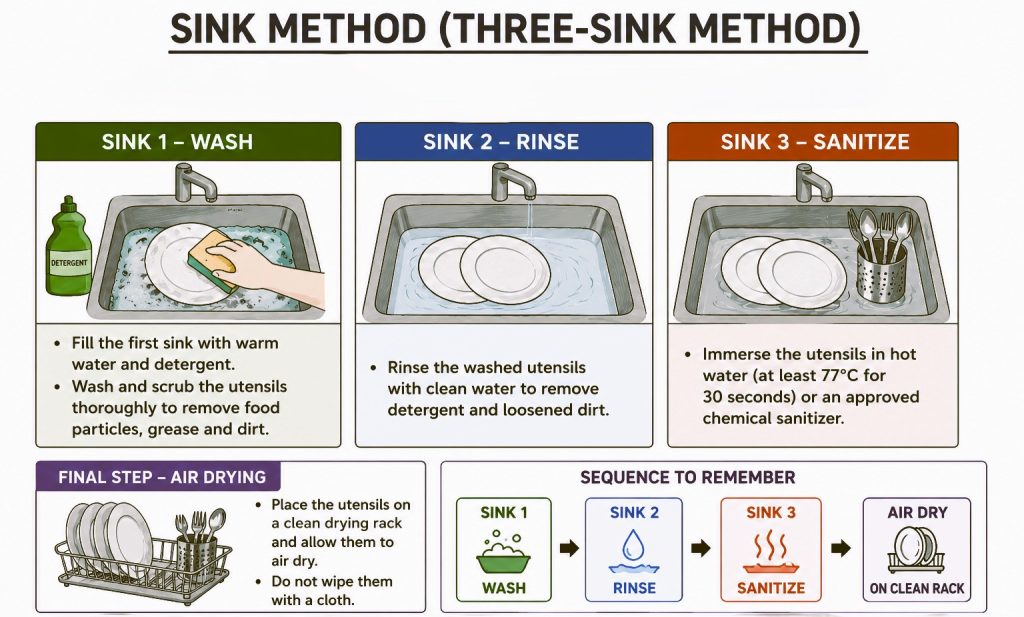
Sink Method (Three-Sink Method)
The Sink Method is a manual dish washing method that uses three separate sinks instead of buckets. It is commonly used in restaurants, hotels, and commercial kitchens where a larger number of utensils need to be cleaned. Each sink has a specific purpose: washing, rinsing, and sanitizing.
| Simple Definition: The Sink Method is a manual dish washing method in which utensils are washed, rinsed, and sanitized using three separate sinks. Detailed Definition: The Sink Method is a systematic process of cleaning utensils by using three sinks. The first sink is used for washing with detergent, the second for rinsing with clean water, and the third for sanitizing with hot water or a chemical sanitizer. This method provides better hygiene and is more suitable for commercial kitchens than the bucket method. |
Advantages of the Sink Method
- Suitable for medium and large kitchens.
- Provides better hygiene than the bucket method.
- Reduces the risk of cross-contamination.
- Allows continuous dish washing.
- Easy to organize and supervise.
Disadvantages of the Sink Method
- Requires more space than the bucket method.
- Installation cost is higher.
- Requires a constant supply of clean water.
- Less efficient than mechanical dish washing for very large operations.
Mechanical Dish Washing
Mechanical dish washing is the process of cleaning and sanitizing dishes, utensils, and kitchen equipment using an automatic dishwashing machine. It is commonly used in large hotels, restaurants, hospitals, and catering establishments where a large number of utensils need to be cleaned quickly and hygienically.
| Simple Definition: Mechanical dish washing is the process of washing, rinsing, and sanitizing utensils using an automatic dishwashing machine. Detailed Definition: Mechanical dish washing is a method of cleaning utensils with the help of a dishwashing machine. The machine automatically washes, rinses, sanitizes, and often dries the utensils using hot water, detergent, and, in some cases, chemical sanitizers. It provides faster, more consistent, and hygienic cleaning than manual methods. |
Steps of Mechanical Dish Washing
- Scrape: Remove leftover food from plates and utensils before placing them in the machine.
- Load: Arrange the utensils properly in the dishwasher racks without overcrowding.
- Wash: The machine washes the utensils using hot water and detergent.
- Rinse: The utensils are rinsed with clean hot water.
- Sanitize: The machine sanitizes the utensils using high-temperature water or an approved chemical sanitizer.
- Dry: Allow the utensils to air dry or use the machine’s drying cycle before storing them.
Advantages of Mechanical Dish Washing
- Cleans large quantities of utensils quickly.
- Saves time and labour.
- Provides consistent cleaning and sanitizing.
- Reduces the risk of cross-contamination.
- Uses less water than manual washing in many commercial machines.
- Suitable for hotels, restaurants, and large catering establishments.
Disadvantages of Mechanical Dish Washing
- High installation and maintenance cost.
- Requires electricity and a continuous water supply.
- Needs trained staff for proper operation.
- Not economical for small food establishments.
Types of Mechanical Dish Washing Machines
The common types of mechanical dish washing machines are:
- Undercounter Dishwasher
- It is a small machine installed under the counter.
- It is mainly suitable for small restaurants, cafés, and bars.
- Door-Type (Hood-Type) Dishwasher
- It is larger than an undercounter dishwasher.
- It is commonly used in hotels and medium-sized restaurants.
- Conveyor Dishwasher
- It uses a moving conveyor belt to carry utensils through the washing process.
- It is suitable for large hotels, hospitals, and catering establishments.
- Flight-Type Dishwasher
- It is a fully automatic, high-capacity dishwasher.
- It is best for very large food service operations such as airports, universities, and large hospitals.
| You will find more detailed notes about types of dishwasher in Click Here |
Food Cycle
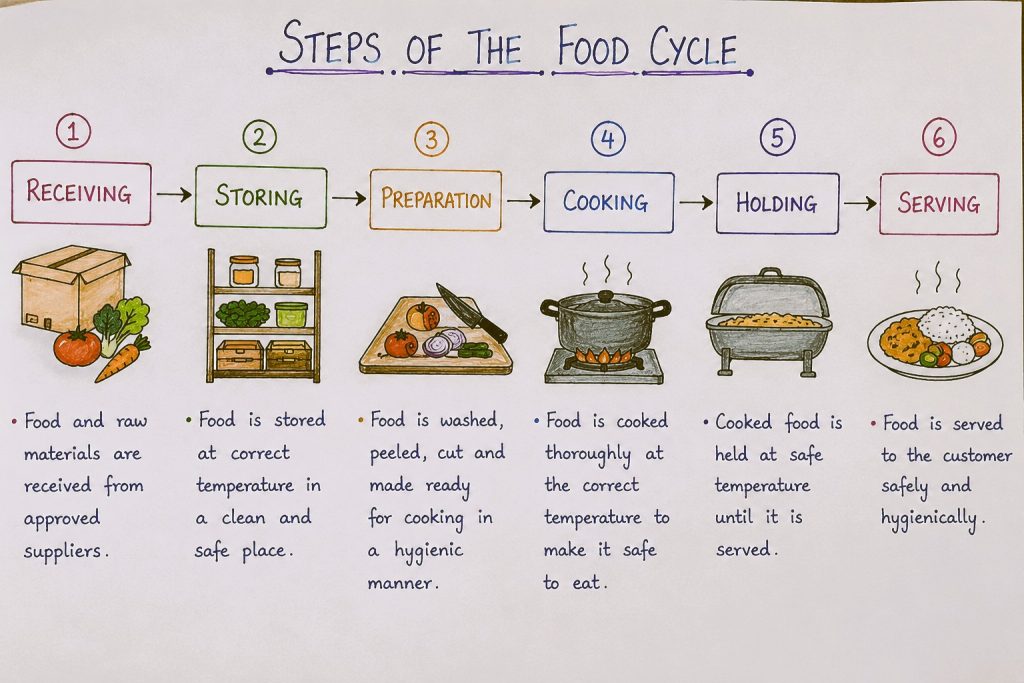
The food cycle is the sequence of steps through which food passes from the time it is received until it is served to the customer. Maintaining proper hygiene at every stage of the food cycle is essential to prevent contamination, preserve food quality, and ensure food safety.
If food is handled improperly at any stage, harmful microorganisms can grow and contaminate the food, increasing the risk of foodborne illnesses.
| Simple Definition: Food cycle is the sequence of steps involved in receiving, storing, preparing, cooking, holding, and serving food safely. |
Detailed Explanation: The food cycle refers to the complete process through which food passes in a food establishment, beginning with receiving raw materials and ending with serving food to the customer. Proper hygiene and safe food handling practices must be followed at every stage to ensure that food remains safe, wholesome, and fit for consumption.
Steps of the Food Cycle
The food cycle consists of the following stages:
- Receiving
- Storing
- Preparation
- Cooking
- Holding
- Serving
Explanation
- Receiving
Receiving is the first stage of the food cycle. It involves accepting food and raw materials from suppliers. The quality and safety of food should be checked carefully before it enters the kitchen, as contaminated or spoiled food can affect the entire food preparation process.
Good Hygiene Practices During Receiving- Purchase food only from approved and reliable suppliers.
- Check the quality, freshness, colour, odour, and appearance of food.
- Inspect the packaging for damage, leaks, or swelling.
- Check the expiry date and manufacturing date.
- Ensure chilled and frozen foods are received at the correct temperature.
- Reject spoiled, damaged, expired, or contaminated food.
- Store received food immediately to maintain its quality and safety.
Common Mistakes to Avoid
- Accepting expired food products.
- Receiving food with damaged or swollen packaging.
- Accepting food from unapproved suppliers.
- Leaving perishable foods at room temperature for a long time.
- Ignoring temperature checks for chilled or frozen foods.
Importance of Hygiene During Receiving
- Prevents contaminated food from entering the kitchen.
- Ensures only safe and high-quality food is used.
- Reduces the risk of foodborne illnesses.
- Maintains food quality and freshness.
- Prevents unnecessary food wastage.
- Storing
Storing is the second stage of the food cycle. After food is received, it must be stored under appropriate conditions to maintain its quality, nutritional value, and safety. Improper storage can lead to food spoilage, contamination, and the growth of harmful microorganisms.
Good Hygiene Practices During Storing- Store food at the correct temperature according to its type.
- Keep raw and cooked foods separate to prevent cross-contamination.
- Store food in clean, covered, and labelled containers.
- Follow the FIFO (First In, First Out) principle to use older stock first.
- Keep storage areas clean, dry, and well-ventilated.
- Store food away from chemicals, cleaning agents, and other hazardous substances.
- Check stored food regularly for signs of spoilage, pests, or damage.
Common Mistakes to Avoid
- Mixing raw and cooked foods.
- Storing food at incorrect temperatures.
- Leaving food uncovered.
- Using expired food products.
- Overloading refrigerators or storage shelves.
- Storing food near chemicals or cleaning products.
- Preparation
Preparation is the stage where raw ingredients are washed, peeled, cut, mixed, and made ready for cooking. During this stage, food is handled frequently, making it one of the most critical points where contamination can occur. Therefore, proper hygiene practices must be followed to ensure food safety.
Good Hygiene Practices During Preparation- Wash hands thoroughly before handling food.
- Wash fruits and vegetables with clean water before use.
- Use separate cutting boards and knives for raw and cooked foods.
- Keep food preparation surfaces and utensils clean and sanitized.
- Prepare food in small batches to reduce the time food remains at room temperature.
- Cover prepared food if it is not cooked immediately.
- Avoid touching food with bare hands whenever possible; use clean utensils or gloves.
Common Mistakes to Avoid
- Using the same cutting board for raw and cooked foods.
- Preparing food on dirty surfaces.
- Handling food with unwashed hands.
- Leaving prepared food uncovered.
- Allowing food to remain at room temperature for a long time.
- Using contaminated utensils or equipment.
Importance of Hygiene During Preparation
- Prevents cross-contamination.
- Reduces the growth of harmful microorganisms.
- Maintains food quality and freshness.
- Ensures food is safe before cooking.
- Reduces the risk of foodborne diseases.
- Cooking
Cooking is the stage where food is heated to make it safe for consumption. Proper cooking destroys most harmful microorganisms and improves the taste, texture, and digestibility of food. However, undercooking may allow harmful microorganisms to survive, increasing the risk of foodborne diseases.
Good Hygiene Practices During Cooking- Cook food thoroughly to the recommended internal temperature.
- Use a food thermometer to check the temperature of cooked food whenever possible.
- Avoid partial cooking unless the food will be cooked immediately afterward.
- Use clean utensils while cooking.
- Prevent cooked food from coming into contact with raw food.
- Maintain good personal hygiene while handling cooked food.
Common Mistakes to Avoid
- Undercooking food.
- Mixing cooked food with raw food.
- Using dirty utensils during cooking.
- Touching cooked food with unwashed hands.
- Reheating food repeatedly.
Importance of Hygiene During Cooking
- Destroys harmful microorganisms.
- Makes food safe for consumption.
- Reduces the risk of foodborne illnesses.
- Maintains the quality and safety of food.
- Prevents cross-contamination between raw and cooked food.
- Holding
Holding is the stage where cooked food is kept for a period before it is served to the customer. During this stage, food must be maintained at a safe temperature to prevent the growth of harmful microorganisms. Improper holding can lead to food contamination and increase the risk of foodborne illnesses.
Good Hygiene Practices During Holding- Keep hot food hot (above 60°C) and cold food cold (below 5°C).
- Cover food to protect it from dust, insects, and other contaminants.
- Use clean, covered containers for holding food.
- Avoid keeping food at room temperature for long periods.
- Stir hot food occasionally to maintain an even temperature.
- Monitor food temperatures regularly.
Common Mistakes to Avoid
- Keeping food in the temperature danger zone for too long.
- Leaving food uncovered.
- Mixing freshly prepared food with old food.
- Using dirty containers or utensils.
- Holding food for longer than recommended.
- Serving
Serving is the final stage of the food cycle, where prepared food is presented and delivered to the customer. Food must be handled carefully during serving to prevent contamination and maintain its quality, temperature, and appearance. Good hygiene practices at this stage ensure that the food remains safe until it is consumed.
Good Hygiene Practices During Serving- Wash hands before serving food.
- Use clean utensils such as tongs, serving spoons, or gloves to handle food.
- Avoid touching ready-to-eat food with bare hands.
- Serve food at the correct temperature.
- Keep food covered until it is served.
- Use clean plates, bowls, glasses, and cutlery.
- Maintain personal hygiene and wear clean uniforms while serving.
Common Mistakes to Avoid
- Touching food with bare hands.
- Using dirty serving utensils or dishes.
- Serving food at unsafe temperatures.
- Leaving food uncovered before serving.
- Coughing, sneezing, or talking directly over food.
Importance of Hygiene During Serving
- Prevents contamination of ready-to-eat food.
- Maintains the quality and appearance of food.
- Protects customers from foodborne illnesses.
- Improves customer satisfaction and confidence.
- Ensures food remains safe until consumption.
Importance of the Food Cycle
The food cycle is important because it ensures that food remains safe, hygienic, and of good quality from the time it is received until it is served to the customer. Proper management of each stage helps prevent contamination, reduce food spoilage, and protect consumer health.
- Ensures food safety throughout the entire food handling process.
- Prevents food contamination and cross-contamination.
- Reduces the risk of foodborne diseases.
- Maintains the quality, freshness, and nutritional value of food.
- Minimizes food spoilage and wastage.
- Improves customer satisfaction and confidence.
- Promotes cleanliness and hygiene in food establishments.
- Helps comply with food safety standards and regulations.
- Protects the reputation of hotels, restaurants, and catering businesses.
- Contributes to efficient food handling and service.