
Past Board Questions
- Mention the major output of OB system. (1 Mark – 2024)
- Explain the major disciplines that contribute in the field of organizational behavior. (5 Marks – 2024)
Concept and Importance of Organizational Behavior (OB)
Organizations are made up of people working together to achieve common goals. The success of any organization depends not only on technology or finance but also on how people behave at work. Organizational Behavior (OB) helps managers understand employee behavior and improve organizational performance.
In the hospitality industry, where employees directly interact with guests, understanding human behavior becomes even more important. Good organizational behavior helps hotels and tourism organizations provide quality service, maintain teamwork, and achieve customer satisfaction.
| Organizational Behavior is the study of human behavior within organizations which examines how individuals and groups act in the workplace and how organizational structure and environment influence their behavior. |
Definitions of OB according some famous authors
- Stephen P. Robbins – “Organizational Behavior is a field of study that investigates the impact that individuals, groups, and structures have on behavior within organizations for the purpose of applying such knowledge toward improving an organization’s effectiveness.”
- Fred Luthans – “Organizational behavior is directly concerned with the understanding, prediction and control of human behavior in organizations.”
- McShane and Glinow – “OB is the study of what people thinks, feel, and do in and around organizations.”
- Moorhead and Griffin – ” OB is the study of human behavior in organizational settings, the interface between human behavior and the organization, and the organization itself.”
Importance of OB
- Understanding Organization and Employees in a Better Way : OB helps in understanding both the organization and its employees in a systematic and scientific manner. It explains how individuals behave at work and how organizational systems influence that behavior. This understanding builds better relations between management and employees, creating a positive and productive work environment.
OB mainly helps managers in three ways:- It identifies the main factors that influence employee behavior, such as motivation, attitudes, perception, personality, needs, and workplace environment.
- It explains how different background factors like education, experience, family, and culture shape individual behavior in specific situations.
- It helps separate controllable factors (like leadership style, policies, and work environment) from uncontrollable ones (like personality and upbringing), so managers can manage people more effectively.
- Motivation of Employee: One of the major contributions of OB is improving employee motivation. Motivation leads to higher performance, job satisfaction, and organizational success.
Since every employee is different, OB helps managers apply suitable motivational tools and techniques according to individual needs and expectations.
Thus, OB strongly emphasizes individual differences and helps managers inspire employees for better performance. - Improvement of Industrial / Labour Relations: OB is a human-centered approach that deals with human problems in a humane way. It helps managers understand the root causes of workplace conflicts and employee dissatisfaction.
OB contributes to better labor relations by:
a. Identifying root causes of problems
b. Predicting future behavior and outcomes
c. Controlling negative consequences of conflict
When employees are treated with respect and dignity, it leads to cordial (good) relations, peace, and harmony in the organization. - Prediction and Control of Human Behavior : One of the main purposes of studying OB is to predict and influence human behavior in organizations. If managers can understand behavior correctly, they can guide employees toward desired organizational goals.
Proper prediction and control of behavior leads to:- Improved coordination
- Better decision-making
- Higher productivity
- Organizational effectiveness
Therefore, OB knowledge is essential for effective managerial performance.
- Effective Utilization of Human Resources : OB helps managers use human resources in the most effective and efficient manner. It focuses on how employees can be motivated, guided, and developed for better performance.
Through OB, managers can:- Inspire employees
- Improve productivity
- Enhance job performance
- Achieve organizational goals efficiently
Thus, OB ensures the best possible use of human resources, which is essential for organizational success.
- Better Communication and Coordination : OB improves communication among employees and departments. Clear communication reduces misunderstandings and improves teamwork and coordination.
- Reduces Employee Turnover : By improving satisfaction and motivation, OB helps retain employees for a longer period which results in reduced recruitment costs, stable workforce and better organizational continuity.
- Helps in managing Workforce diversity : Modern organizations have employees from different cultural, social, and educational backgrounds. OB helps in promoting inclusion, reducing discrimination and improving teamwork among diverse employees.
- Helps in Conflict Management : Workplace conflicts are common in organizations. OB provides tools and techniques to identify and resolve conflicts effectively.
- Encourage Teamwork and Cooperation
- Enhance Job Satisfaction : A better understanding of OB helps create a healthy and positive working environment where employees feel valued and satisfied.
- Supports Effective Leadership : OB helps managers develop leadership skills by understanding employee needs and behavior patterns.
- Facilitates Organizational Change : Organizations often face changes in technology, policies, and environment. OB helps employees adapt to these changes smoothly.
Importance:- Reduces resistance to change
- Ensures smooth transition
- Improves acceptance of new systems
- Builds Positive Organizational Culture : OB contributes to developing a healthy organizational culture based on trust, respect, and cooperation.
Basic assumptions of OB
Organizational Behavior (OB) is based on certain assumptions about people and organizations. These assumptions help managers understand human behavior in a realistic and systematic way. OB believes that people are the most important resource in any organization and their behavior can be studied, understood, and guided.
| Basic Assumptions of OB | |
| A. The Nature of People | B. The Nature of Organizations |
| 1. Individual differences 2. A whole person 3. Caused behavior 4. Value of the person | 5. Social systems 6. Mutual interest |
A. The Nature of People
In this category, there are four basic assumptions:
- Individual differences : Though people have a lot of things in common, every individual is unique. People differ in physical characteristics, intelligence, personality, attitude, skills, perception, and behavior. Therefore, managers cannot treat all employees in the same way. Also, every person should be selected, trained and treated on the basis of what the kind of person he is.
- A whole person : An employee cannot be treated only as a worker. When an employee comes to the work station as a complete person, s/he also brings background sentiments, emotions, personal life, feelings, values, and social needs to the workplace, which influence behavior at work.
Similarly, their home life is influenced by their work life. Therefore, managers need to help an all-round development of the man rather than a particular aspect of a person. - Caused behavior : Human behavior does not happen without reason. According to psychologist, every behavior is caused by certain factors such as needs, motives, experiences, goals and environment. Employees behave in ways that they believe will help them satisfy their needs and achieve their goals.
Therefore, managers need to motivate employees, and determine what managerial action satisfy human needs and what actions threaten their need fulfillment. - Value of the person (Human Dignity):This concept states that employees should be treated differently from other organizational resources. People have feelings, aspirations, emotions, talents, and skills that must be recognized and respected by the organization. Therefore, OB emphasizes treating employees with dignity, fairness, and respect rather than considering them merely as tools for production.
B. The Nature of Organization
This category contains two basic assumptions about organization. They are:
i. Organizations are social system.
ii. Orgaizations are formed on the basis of mutual interest.
- Social Systems: Organizations are social systems where people interact and work together to achieve common goals. Employee behavior is influenced by social and psychological factors, personal needs, and organizational objectives.
Both formal and informal relationships exist within organizations, and all parts of the organization are interconnected. Since each part influences the others, organizations are dynamic in nature.
The concept of social systems helps managers understand and manage organizational behavior more effectively. - Mutual Interest: This concept is represented by the statement that organizations need people and people also need organizations. Organizations and employees depend on each other for success. Employees need organizations for income and career growth, while organizations need employees to achieve organizational goals. The interest of both parties must be protected. Therefore, both must work together for mutual benefit.
If the mutuality of interest is not present (For Example):
- If goal of organization is satisfied but peoples’ goal is not satisfied = people resign from that organization.
- If interest of people is satisfied but organizations’ interest is not fulfilled = Organization kicks out such type of employee.
Levels of OB analysis
Organizational Behavior is studied at different levels to clearly understand how people behave when they work individually, work in a group and work with with organizations. Each level focuses on a different unit of analysis.
OB analyses the behavior of people at all three levels viz., individual, group/team, and organizational levels. For OB,
– Individual level analysis is the micro level analysis
– Group Level analysis is meso-level analysis (i,e. in between micro and macro level analysis)
– Organizational level analysis is the macro level analysis.
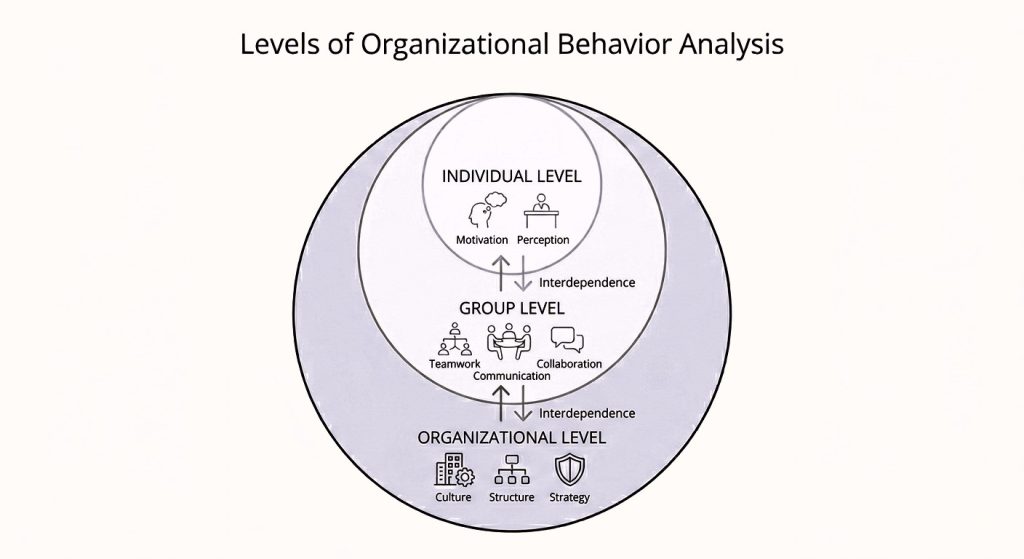
- Individual Level Analysis : This level focuses on the behavior of individual employees in the organization. Individuals working in organizations are the building blocks for group formation. They are very different in nature.
It studies:- Personality
- Attitudes
- Motivation
- Perception
- Learning
- Values
- Group Level Analysis: This level focuses on behavior of people in groups or teams. Most of the individuals work in a group/team.
It studies:- Group dynamics
- Communication
- Leadership
- Power
- Conflict
- Teamwork
- Organizational Level Analysis : This level focuses on the organization as a whole. When groups are combined together, they constitute (create) an organization.
It studies:- Organizational structure
- Culture
- Policies
- Change management
- Organizational climate
- Organizational change and development
Contributing disciplines to the field of OB
Organizational Behavior is an interdisciplinary field, meaning it is developed from different social sciences. These disciplines help us understand human behavior in organizations in a better and more scientific way.
- Psychology : Psychology is science that studies individual human behavior and mental processes. Its contributions have been mainly at micro or individual level of analysis.
Example: Understanding why one hotel employee is highly motivated while another is not, even in the same job.
Contributions to OB:- Helps understand employee motivation and needs
- Explains personality differences among individuals
- Studies learning, perception, and decision-making
- Helps in training, attitude development, and behavior change
- Supports employee selection and performance improvement
- Sociology : Sociology studies people in relation to other human beings and how society influences individual behavior. It focuses on human interaction, culture, and social organizations. It is considered the second most important contributor to Organizational Behavior.
Major Contributions of Sociology to OB:- Group dynamics
- Communication
- Power and authority
- Conflict management
- Organizational culture
- Norms, roles, and status
- Socialization process
- Organization theory
- Organizational change
- Social Psychology : Social Psychology is the scientific study of how interaction, interdependence, and influence among individuals affect their behavior. It combines concepts from both psychology and sociology to explain why people behave the way they do in social situations.
It mainly focuses on analyzing behavior at the group level and studies how individuals influence and are influenced by others in organizations.
Major Contributions of Social psychology to OB:- Measuring and changing attitudes
- Communication patterns and effectiveness
- Group decision-making processes
- Leadership behavior and influence
- Interpersonal relationships
- Conflict and cooperation in groups
- Anthropology : Anthropology is the study of human behavior, culture, and learned patterns of living. It examines all behaviors that individuals acquire through social, family, and technical environments, which together form the broader concept of culture.
In Organizational Behavior, anthropology helps analyze behavior at the group and organizational levels by focusing on cultural factors that influence workplace behavior.
Major Contributions of Anthropology to OB:- Organizational culture and values
- Social and family-influenced behavior
- Cultural differences in the workplace
- Comparative norms, beliefs, and attitudes
- Work environment and symbols
- Cross-cultural management
- Political Science :Political science studies power, authority, influence, and decision-making in organizations.
Major Contributions of Political Science to OB:- Explains power structure in organizations
- Studies organizational politics and influence
- Helps in conflict resolution and negotiation
- Analyzes leadership authority and control systems
- Supports decision-making processes
- Other Sciences:
- Economics : incentives, motivation, resource allocation, efficiency
- Management Science : quantitative methods, decision models, planning
- Medicine / Health Sciences : stress management, health, safety, well-being
- History : studies past developments of organizations, management practices, and leadership; helps learn from past organizational successes, failures, and changes in work culture and systems
New challenges for manager in OB of hospitality industry
The hospitality industry is highly dynamic, service-oriented, and human-intensive. Managers face several new challenges in managing employee behavior effectively to ensure high-quality service and guest satisfaction.
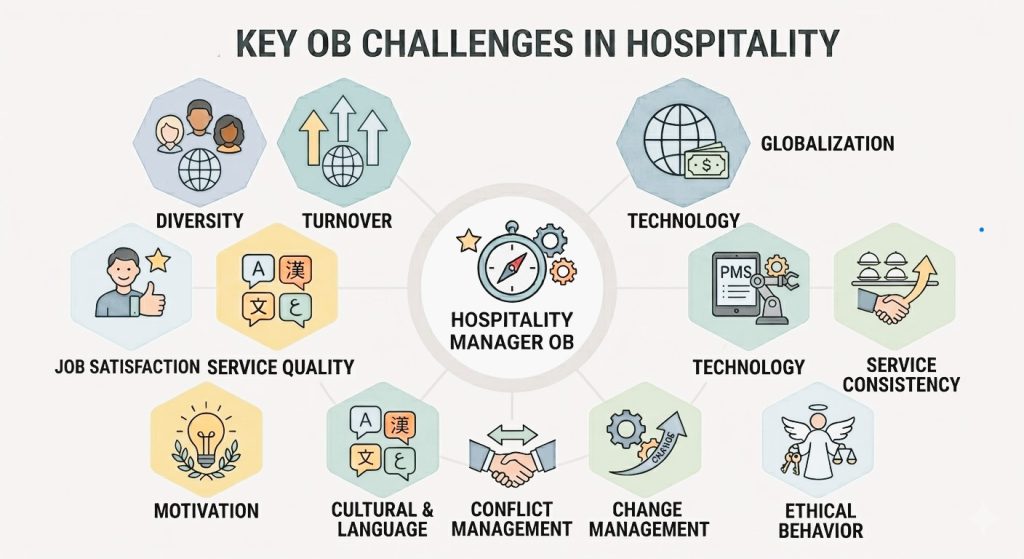
- Workforce Diversity –
Challenges: The main challenge for managers is to handle employees with different cultures, languages, religions, lifestyles, family backgrounds, and work styles. Today, the old “one best way” of managing people is no longer effective. Instead, managers must respect and adjust to individual differences and manage people in a more flexible way.
Opportunities: If managed properly, diversity can be very beneficial. It can increase creativity, innovation, and better problem-solving in the organization. However, if it is not managed well, it may lead to misunderstandings, communication gaps, interpersonal conflicts, and higher employee turnover. - High Employee Turnover :
Challenges: The hospitality industry faces frequent job changes, making it difficult to retain trained and experienced employees. Managers must continuously focus on motivation, job satisfaction, and career development. Continuous recruitment and training increase workload for managers.
Opportunities: If employees are retained properly, it leads to better service quality, lower training costs, and a more stable workforce. - Globalization :
Challenges: Managing in a global organization involves several challenges because behavioral processes differ significantly across cultural and national boundaries. These differences can be seen in various aspects such as:
a. Cultural values, symbols, and beliefs vary greatly from one society to another.
b. Work norms and the importance given to work in a person’s life influence work behavior and attitudes toward work.
c. These differences also shape supervisory relationships, decision-making styles and processes, as well as organizational structures.
d. Group behavior, inter-group relations, responses to stress, and political behavior also differ across cultures.
Opportunities: Globalization also creates many opportunities when managed effectively. It allows organizations to expand markets and increase revenue, provides chances to learn new knowledge and practices, and offers better career opportunities for employees. Overall, it helps organizations become more competitive and globally aware, provided managers adapt their practices to meet these challenges. - Technological Changes :
Challenges: Technological changes in the hospitality industry require employees to continuously learn new systems like PMS, online booking, and digital payment methods. Some employees may resist these changes due to lack of skills or fear of technology. It may also increase training needs and operational costs. Employees also may feel job insecurity due to automation and AI-based systems.
Opportunities: Technology improves service speed, accuracy, and efficiency. It enhances customer experience, supports better communication, and helps managers make quicker and better decisions. - Service Quality Pressure :
Challenges: Managers must ensure consistent, fast, and high-quality service because customer expectations are very high in the hospitality industry. Small mistakes can affect guest satisfaction.
Opportunities: Good service quality increases customer satisfaction, loyalty, and organizational reputation. - Cultural and Language Barriers :
Challenges: Employees and guests come from different cultural and language backgrounds, which can create misunderstandings and communication problems.
Opportunities: Improves cultural awareness, learning, and better global guest handling. - Conflict Management :
Challenges: Conflicts may arise between employees, departments, or with customers due to workload pressure and miscommunication.
Opportunities: Proper conflict handling improves teamwork and workplace harmony. - Service Quality Consistency :
Challenges: Maintaining the same level of service quality across all employees and shifts is difficult. Human errors and lack of coordination can affect guest satisfaction.
Opportunities: Standardized training and clear procedures help improve consistency and customer trust. - Employee Motivation :
Challenges: Keeping employees motivated in a stressful and demanding environment is difficult, especially in low-paid or high-pressure jobs.
Opportunities: Motivated employees improve productivity, service quality, and guest satisfaction. - Change Management :
Challenges: Employees often resist changes in policies, systems, or working methods.
Opportunities: Successful change management improves adaptability and organizational growth. - Ethical and Professional Behavior :
Challenges: Ensuring honesty, discipline, and professional behavior among employees is important but sometimes difficult to maintain.
Opportunities: Ethical behavior builds trust, reputation, and long-term success.