
Minerals Short Important Questions
- What is goitre? (1 Mark, 2016)
- Write the general function of minerals. (1 Mark, 2023)
- What is IDD? (1 Mark, 2022)
- List down the names of major minerals. (1 Mark, 2025)
- List down the four functions of minerals. (1 Mark, 2026)
Minerals Long Important Questions
- Differentiate between fat-soluble and water-soluble vitamins. Explain the general functions of major minerals. (10 Marks, 2016)
- What are trace minerals? List down the general functions of minerals. (5 Marks, 2022)
Water Short Important Questions
- What are the sources of water? (1 Mark, 2016)
- What are the objectives of blanching. (1 Mark, 2016)
- List four functions of water. (1 Mark, 2018)
- State the function of metabolic water. (1 Mark, 2026)
- Why do we blanch vegetables? (1 Mark, 2026)
Water Long Important Questions
- Describe the process by which the body balances water. (5 Marks, 2017)
Introduction of Minerals
Minerals are inorganic nutrients required by the body in small amounts for normal growth, development, and the maintenance of good health. Unlike carbohydrates, proteins, fats, and vitamins, minerals do not provide energy, but they play essential roles in building body tissues, regulating physiological processes, and maintaining normal body functions. Since the human body cannot synthesize minerals, they must be obtained from a balanced diet.
Minerals are involved in the formation of bones and teeth, maintenance of fluid and electrolyte balance, muscle contraction, nerve transmission, oxygen transport, and the proper functioning of enzymes and hormones. A deficiency or excess of certain minerals can lead to various health problems and deficiency diseases.
| Simple Definition: Minerals are inorganic micronutrients required in small amounts for normal growth, development, and maintenance of body functions. Detailed Definition: Minerals are inorganic micronutrients that are essential for the growth, maintenance, and regulation of various physiological processes in the human body. They do not provide energy but are necessary for the formation of body tissues, enzyme activity, nerve function, muscle contraction, and overall health. |
Classification of Minerals
Minerals are classified into two groups based on the amount required by the body.
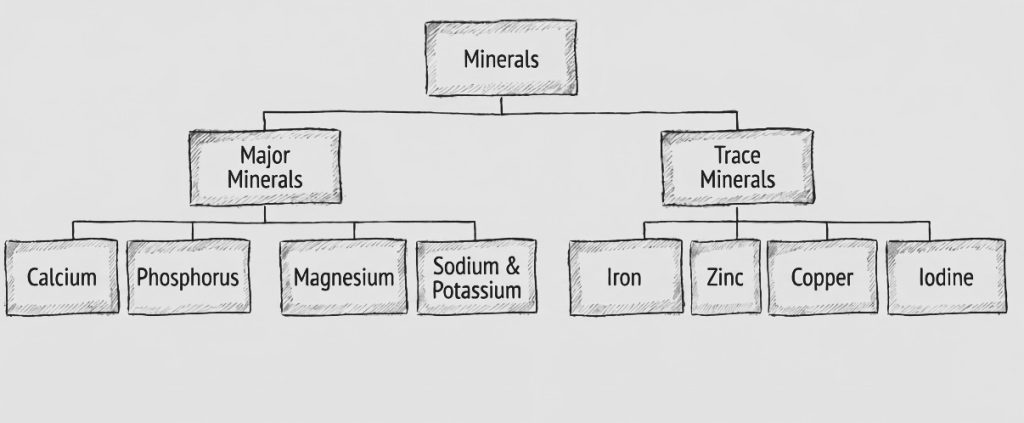
- Major Minerals (Macrominerals)
Major minerals are those required by the body in relatively large amounts (more than 100 mg per day).
Examples- Calcium (Ca)
- Phosphorus (P)
- Potassium (K)
- Sodium (Na)
- Chloride (Cl)
- Magnesium (Mg)
- Sulfur (S)
- Trace Minerals (Microminerals)
Trace minerals are required in very small amounts (less than 100 mg per day) but are equally important for maintaining good health.
Examples:- Iron (Fe)
- Zinc (Zn)
- Iodine (I)
- Copper (Cu)
- Fluoride (F)
- Selenium (Se)
- Manganese (Mn)
- Chromium (Cr)
- Molybdenum (Mo)
Difference Between Major Minerals and Trace Minerals
| Major Minerals (Macrominerals) | Trace Minerals (Microminerals) |
|---|---|
| Required by the body in large amounts (more than 100 mg/day). | Required by the body in very small amounts (less than 100 mg/day). |
| Present in relatively larger quantities in the body. | Present in very small quantities in the body. |
| Mainly involved in the formation of bones, teeth, muscles, and maintaining fluid balance. | Mainly involved in enzyme activity, hormone production, oxygen transport, and immune function. |
| Deficiency mainly affects bones, muscles, and electrolyte balance. | Deficiency mainly affects metabolism, blood formation, immunity, and hormone function. |
| Usually easier to obtain through a balanced diet. | Needed in small amounts but deficiency can still occur if intake is inadequate. |
| Examples: Calcium, Phosphorus, Sodium, Potassium, Magnesium, Chloride, Sulfur. | Examples: Iron, Zinc, Iodine, Copper, Selenium, Fluoride, Manganese, Chromium, Molybdenum. |
General Functions of Minerals
Minerals are essential inorganic nutrients that perform a variety of important functions in the human body. Although they are required only in small amounts, they are necessary for normal growth, metabolism, and the maintenance of good health.
- Formation of Bones and Teeth
Minerals such as calcium and phosphorus are essential for the growth, development, and maintenance of strong bones and teeth. - Maintain Fluid and Electrolyte Balance
Minerals like sodium, potassium, and chloride help regulate the body’s fluid balance, electrolyte balance, and acid-base balance. - Support Muscle Contraction
Calcium, potassium, and magnesium play an important role in normal muscle contraction and relaxation, including the functioning of the heart muscle. - Aid Nerve Transmission
Minerals help transmit nerve impulses, allowing proper communication between the brain, spinal cord, muscles, and other body tissues. - Form Blood Components
Iron is an essential component of haemoglobin, which transports oxygen in the blood. Minerals also contribute to the formation of red blood cells. - Act as Components of Enzymes and Hormones
Many minerals are essential parts of enzymes and hormones that regulate metabolism, growth, and other physiological processes. For example, iodine is required for the production of thyroid hormones. - Support Immune Function
Minerals such as zinc and selenium help strengthen the immune system and protect the body against infections. - Promote Growth and Tissue Repair
Minerals contribute to normal growth, wound healing, tissue repair, and the maintenance of healthy body cells. - Maintain Normal Heart Function
Minerals such as potassium, calcium, and magnesium help maintain a normal heartbeat and support proper cardiovascular function. - Support Normal Metabolism
Minerals participate in many metabolic reactions by activating enzymes involved in the digestion and utilization of nutrients.
Introduction to Water
Water is the most abundant and essential component of the human body, accounting for approximately 50–70% of an adult’s body weight. It is an essential nutrient required for life and plays a vital role in almost every physiological process. Although water does not provide energy or nutrients, it is indispensable for digestion, absorption, transportation of nutrients, regulation of body temperature, removal of waste products, and maintaining the normal functioning of cells and organs.
The body continuously loses water through urine, sweat, faeces, and respiration. Therefore, adequate daily intake of water through drinking water, beverages, and foods is necessary to maintain fluid balance and support overall health.
| Simple Definition: Water is an essential inorganic nutrient that is required for maintaining normal physiological functions and life. Detailed Definition: Water is an essential inorganic nutrient that forms the largest component of the human body and is required for digestion, absorption, transportation of nutrients, regulation of body temperature, removal of waste products, and the maintenance of normal physiological functions. |
Sources of Water
Water is obtained from three main sources:
- Drinking Water and Beverages
This is the major source of water for the body.
Examples:- Drinking water
- Milk
- Tea
- Coffee
- Fruit juice
- Soup
- Food
Many foods naturally contain water and contribute to daily water intake.
Examples:- Watermelon
- Orange
- Cucumber
- Tomato
- Lettuce
- Milk
- Cooked vegetables
- Metabolic Water
Metabolic water is produced inside the body during the oxidation of carbohydrates, fats, and proteins.
Although it contributes only a small amount, it becomes important during prolonged fasting or in desert animals.
General Functions of Water
Water is essential for life and performs numerous physiological functions in the human body. It serves as a medium for various metabolic activities and helps maintain normal body functions.
- Regulates Body Temperature
Water helps maintain a constant body temperature by absorbing and releasing heat. Sweating and evaporation cool the body during hot weather or physical activity. - Transports Nutrients and Oxygen
Water is the main component of blood and other body fluids. It transports nutrients, oxygen, hormones, and other substances to different parts of the body. - Removes Waste Products
Water helps eliminate metabolic waste products through urine, sweat, and faeces, thereby supporting the proper functioning of the kidneys and other excretory organs. - Aids Digestion and Absorption
Water is essential for the digestion of food, absorption of nutrients, and smooth movement of food through the digestive tract. - Acts as a Solvent
Water acts as a universal solvent by dissolving many nutrients, minerals, and other substances, making them available for absorption and transport within the body. - Lubricates and Cushions Body Tissues
Water lubricates joints and moistens tissues such as the eyes, mouth, and digestive tract. It also cushions vital organs and protects them from injury. - Maintains Fluid and Electrolyte Balance
Water helps maintain the balance of body fluids, electrolytes, and acid-base balance, which are necessary for normal cellular functions. - Participates in Metabolic Reactions
Water is involved in many biochemical reactions, including hydrolysis, which is essential for the digestion and metabolism of nutrients. - Maintains Cell Shape and Function
Water helps maintain the structure, volume, and normal functioning of body cells. - Prevents Dehydration
Adequate water intake prevents dehydration and ensures the proper functioning of all body systems.
Loss of Nutrients During Food Processing
Food processing methods such as blanching, heat processing, and milling are commonly used to improve food safety, texture, taste, and shelf life. However, these processes may lead to the loss of certain nutrients, particularly water-soluble vitamins and some minerals. The extent of nutrient loss depends on the type of food, processing method, temperature, duration of heating, and the amount of water used.
- Loss of Nutrients During Blanching
Blanching is the process of briefly immersing vegetables or fruits in boiling water or steam, followed by rapid cooling in cold water. It is mainly carried out before freezing, drying, or canning to inactivate enzymes and preserve colour and texture.
Nutrient Loss During Blanching- Water-soluble vitamins, especially Vitamin C and B-complex vitamins, may leach into the blanching water.
- Some minerals may also be lost through leaching.
- Longer blanching time and excessive water increase nutrient loss.
- Loss of Nutrients During Heat Processing
Heat processing includes cooking methods such as boiling, steaming, frying, roasting, baking, and pasteurization. Heat improves digestibility and destroys harmful microorganisms but can reduce the nutritional value of foods.
Nutrient Loss During Heat Processing- Heat-sensitive vitamins, particularly Vitamin C and Thiamine (Vitamin B₁), are easily destroyed.
- Prolonged heating results in greater nutrient loss.
- Minerals are generally stable but may be lost if cooking water is discarded.
- Proteins, carbohydrates, and fats are comparatively less affected by normal cooking temperatures.
- Loss of Nutrients During Milling
Milling is the process of removing the outer layers of cereal grains to produce refined flour or polished rice.
Nutrient Loss During Milling- Removal of the bran and germ reduces the content of:
- Dietary fibre
- B-complex vitamins
- Vitamin E
- Iron
- Zinc
- Magnesium
- Refined grains are less nutritious than whole grains because many essential nutrients are removed during milling.
- Removal of the bran and germ reduces the content of:
How to Minimize Nutrient Loss
- Use minimum water for cooking.
- Avoid overcooking food.
- Cook vegetables for the shortest time necessary.
- Steam or microwave vegetables instead of boiling whenever possible.
- Do not discard cooking water if it can be used in soups or gravies.
- Prefer whole grains over refined grains.
- Store foods properly and avoid repeated reheating.