
Important Past Board Questions
- What is Machiavellianism? (1 Mark – 2024)
- Briefly explain the determining factors of personality. (5 Marks – 2024)
Concept of Personality
Personality refers to the overall combination of psychological traits, attitudes, emotions, and behavior patterns that make an individual unique. It explains how a person usually thinks, feels, and acts in different situations. Personality is shaped by both internal factors (like heredity and mental makeup) and external factors (like environment and social experiences). It plays an important role in influencing a person’s behavior in personal life as well as in organizations.
In Organizational Behavior, personality is important because it influences work behavior, decision-making, leadership style, and relationships at the workplace.
| Definition :Personality is the relatively stable and unique pattern of thoughts, emotions, attitudes, and behaviors of an individual that is shaped by heredity, environment, and experiences, and determines how a person behaves and responds in different situations. Simple Definition : Personality is the unique way a person thinks, feels, and behaves that makes them different from others. |
Definition of Personality from various popular scholars:
- Port – Personality is the dynamic organization within the individual of psychological systems that determine his unique adjustment to his environment.
- Stephen P. Robbins – Personality is the sum total to ways in which an individual reacts and interacts with others.
- Moorhead and Griffin : Personality is the relatively stable set of psychological attributes that distinguish one person from other.
- Arnold and Feldman – Personality is a stable set of personal characteristics and tendencies that determine the commonalities and differences in people’s thoughts, beings, and actions.
Features of Personality
Personality has several important features that explain its nature and behavior pattern. It shows how individuals are different from each other and how their behavior remains consistent in different situations while still allowing some development over time. The various major features of personality includes:
- Unique to Each Individual : Every person has a different personality, and no two individuals behave in exactly the same way, which makes each person unique.
- Aggregate Whole of an Individual : Personality represents the total combination of physical, mental, emotional, and social traits of a person. It is the “whole person concept”, not just a single aspect of behavior.
- Relatively Stable : Personality remains fairly consistent over time, although minor changes can occur due to learning, experience, and environment.
- Dynamic in Nature : Personality is not completely fixed; it develops and improves continuously through education, training, and life experiences.
- Continuous Development : Personality development starts from birth (even from the womb) and continues throughout life until death.
- Inborn and Acquired : Personality is partly inherited (biological factors) and partly developed through learning, experience, and social environment.
- Total Pattern of Behavior : It includes the overall pattern of an individual’s thoughts, emotions, attitudes, and actions.
- Influences Behavior : Personality strongly affects how a person behaves, reacts, and interacts in different situations.
- Psychological in Nature : It is related to internal mental processes such as emotions, values, beliefs, and attitudes.
- Socially Influenced : Personality is shaped by family, culture, society, education, and environment.
- Goal Directed : Personality helps guide behavior toward achieving goals and objectives.
- Based on Measurable Traits : Personality is often described in terms of observable and measurable traits like honesty, confidence, leadership, aggression, etc.
- Predictable to Some Extent : Understanding personality helps predict how a person is likely to behave in certain situations.
Determinants of personality
Personality is shaped by various factors. These factors influence how an individual thinks, feels, and behaves. In Organizational Behavior, personality is generally determined by both internal (biological) and external (environmental and social) factors.
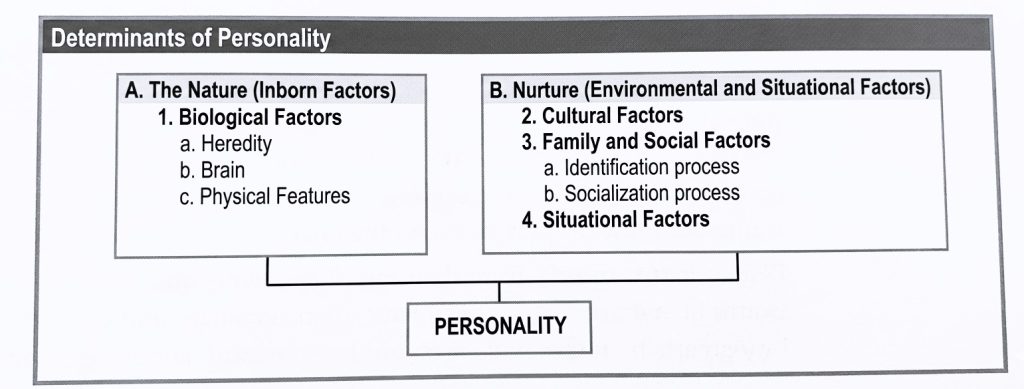
Personality is influenced by various factors which are broadly divided into two major categories: Nature (inborn factors) and Nurture (environmental and situational factors).
A. Nature (Inborn Factors)
These are biological and inherited factors that an individual is born with.
- Biological Factors :
Biological factors include heredity, brain structure, and physical features. These factors influence temperament, intelligence, and physical appearance.- Heredity : Heredity refers to the transfer of traits from parents to children through genes. It has a strong influence on personality development. Physical stature, facial attractiveness, temperament, muscle composition and biological rhythms are the example of heredity characteristics. These characteristics are generally influenced by our parents.
Through research, it has been clearly shown that both physical and psychological characteristics can be transmitted through heredity.
a. Determines basic temperament (calm, aggressive, active, etc.)
b. Influences intelligence level and emotional stability
c. Sets the initial framework of personality
For example: If parents are intelligent and calm, children are likely to inherit similar traits. - Brain :
Another biological factor that influences personality is the role of brain of an individual. The brain controls human thoughts, emotions, and behavior. The structure and functioning of the brain influence personality.
a. Controls decision-making ability
b. Affects emotional responses
c. Determines learning capacity and thinking style
Example: A well-developed mental capacity helps a person become more confident and logical. - Physical Features :
Physical appearance and body structure also influence personality development and social interaction.
a. Includes height, body shape, facial expressions, and physical strength
b. Affects self-confidence and social behavior
c. Society often reacts differently based on appearance
Example: A well-groomed and confident-looking person may receive more positive social responses.
- Heredity : Heredity refers to the transfer of traits from parents to children through genes. It has a strong influence on personality development. Physical stature, facial attractiveness, temperament, muscle composition and biological rhythms are the example of heredity characteristics. These characteristics are generally influenced by our parents.
B. Nurture (Environmental and Situational Factors)
These are external factors that influence personality after birth.
- Cultural Factors
Culture shapes values, beliefs, habits, and behavior of individuals. - Family and Social Factors
Family and society play a major role in shaping personality through interaction and learning.- Identification Process: Learning by observing parents or role models
- Socialization Process: Learning norms, values, and behavior from society
- Situational Factors
Personality is also influenced by specific situations. A person may behave differently in different circumstances.
Example: A quiet person may act confidently during an emergency.
Personality traits and characteristics at workplace
Personality traits refer to the stable patterns of thinking, feeling, and behaving that influence how an individual acts in a work environment. In the workplace, these traits affect job performance, teamwork, leadership, communication, and overall organizational success.
A. Positive Personality Traits in the Workplace
- Responsibility : Responsibility means being accountable for assigned duties or willingness to take ownership of tasks and duties
- Completing work on time without constant supervision
- Being accountable for actions and decisions
- Example: An employee who finishes assigned tasks before deadlines.
- Honesty and Integrity : Honesty means truthfulness, and integrity means ethical behavior.
- Employees follow rules and act fairly.
- Builds trust between staff, management, and customers.
- For example : In workplace, a hotel employee reporting cash mismatch instead of hiding it shows integrity.
- Cooperation and Teamwork : Cooperation means working with others to achieve common goals.
- Employees support colleagues and share responsibilities.
- Essential in team-based environments like hotels.
- In workplace: Front office, housekeeping, and F&B departments coordinate for smooth guest service.
- Positive Attitude : Positive attitude means optimistic thinking even in difficult situations.
- Encourages motivation and better performance.
- Helps in handling complaints and stress.
- In workplace: Handling a rude guest calmly and trying to solve the issue.
- Adaptability : Adaptability is the ability to adjust to new situations.
- Employees accept changes in technology, rules, or environment.
- Very important in dynamic industries.
- In workplace: Learning new booking systems or hotel software quickly.
- Emotional Stability : Emotional stability means controlling emotions under pressure.
- Employees remain calm in stressful situations.
- Prevents conflicts and mistakes.
- In workplace: Managing an angry customer without reacting emotionally.
- Leadership Quality : Leadership means guiding and motivating others.
- Includes decision-making and problem-solving.
- Helps improve team performance.
- In workplace: A supervisor organizing staff during peak check-in hours.
B. Negative Personality Traits at the Workplace
- Laziness : Laziness means avoiding work or delaying tasks.
- Reduces productivity and efficiency.
- Increases workload on others.
- In workplace: An employee frequently postponing assigned duties.
- Dishonesty : Dishonesty means lying or unethical behavior.
- Breaks trust and damages reputation.
- May lead to serious organizational loss.
- In workplace: Manipulating billing records or hiding mistakes.
- Aggressiveness : Aggressiveness means reacting with anger or hostility.
- Creates conflict among staff and customers.
- Damages workplace environment.
- In workplace: Shouting at a guest or colleague during disagreement.
- Lack of Cooperation : Refusing to work with others.
- Leads to poor teamwork and communication gaps.
- Affects service quality.
- In workplace: Not helping colleagues during busy hours.
- Inflexibility : Resistance to change or new ideas.
- Slows down organizational growth.
- Affects innovation and learning.
- In workplace: Refusing to learn new technology or procedures.
- Poor Emotional Control : Inability to manage emotions.
- Leads to impulsive reactions and mistakes.
- Creates conflict and stress.
- In workplace: Overreacting to minor guest complaints.
Personality traits at the workplace can be both positive and negative. Positive traits such as responsibility, cooperation, adaptability, and emotional stability help improve productivity and service quality. On the other hand, negative traits like laziness, dishonesty, and aggressiveness can harm both individual performance and organizational success. Therefore, organizations prefer employees with strong positive personality traits for better growth and efficiency.
To understand personality traits and characteristics we need to understand its development trends. The development trends can be categorized as:
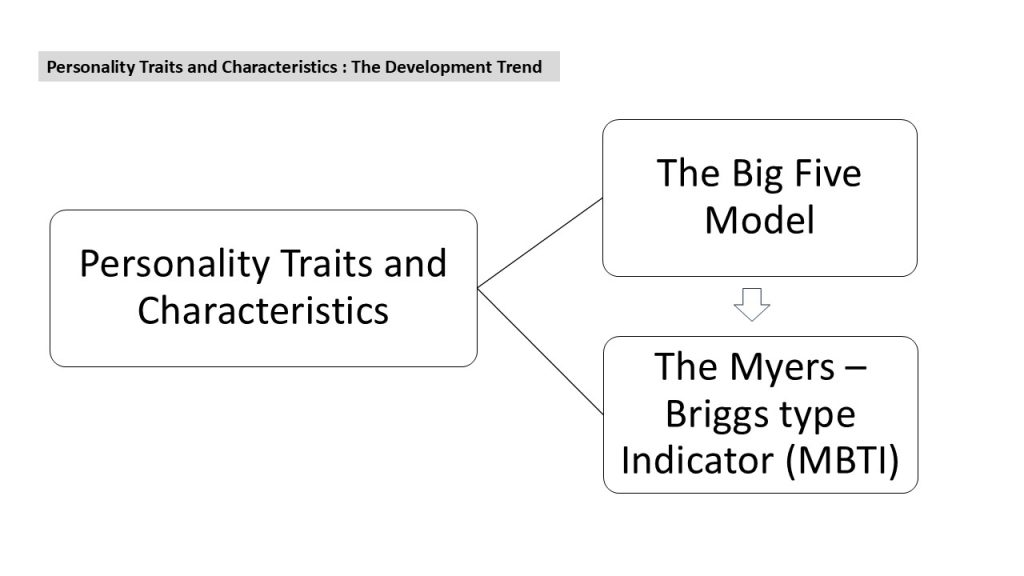
A. The “Big Five” Personality Traits
The Big Five Personality Traits Model is one of the most widely accepted personality theories in psychology and organizational behavior. Psychologists have identified thousands of personality traits that differentiate one person from another. To simplify these many traits, researchers grouped them into five major personality dimensions known as the Big Five Personality Traits.
This model helps organizations understand employee behavior, communication style, teamwork, leadership ability, and job performance. Because of its simplicity and scientific reliability, the Big Five model is widely used in workplaces, education, and psychological research.
The five personality traits are often remembered by the word OCEAN:
| O – Openness to Experience C – Conscientiousness E – Extraversion A – Agreeableness N – Neuroticism |
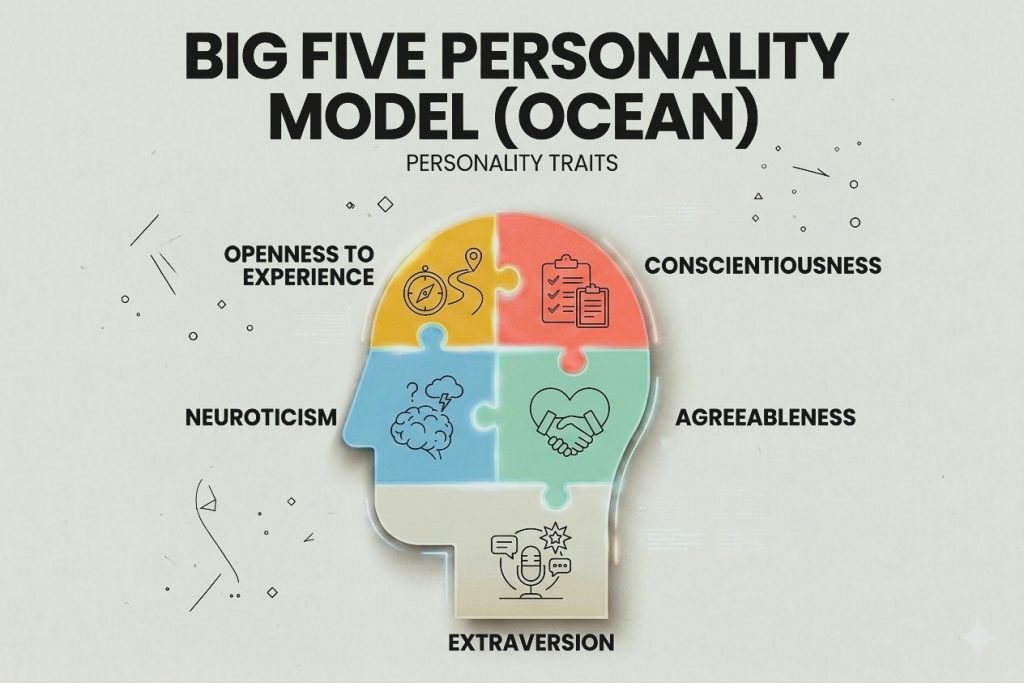
Explanations:
- Openness to Experience : Openness refers to a person’s willingness to accept new ideas, experiences, and changes. In workplace: Employees with high openness easily adapt to new technology, new systems, and creative problem-solving.
- Characteristics of people high in openness
a. Creative and imaginative
b. Curious and innovative
c. Interested in learning new things
d. Open-minded and flexible - Characteristics of people low in openness
a. Prefer routine and traditional methods
b. Resistant to change
c. Less interested in new ideas
- Characteristics of people high in openness
- Conscientiousness : Conscientiousness refers to how responsible, organized, and dependable a person is. In workplace: Conscientious employees complete tasks on time, follow rules, and perform duties seriously. This trait is strongly related to job performance.
- Characteristics of people high in conscientiousness
a. Responsible and disciplined
b. Organized and careful
c. Hardworking and reliable
d. Goal-oriented - Characteristics of people low in conscientiousness
a. Careless and disorganized
b. Lazy or irresponsible
c. Poor time management
- Characteristics of people high in conscientiousness
- Extraversion : Extraversion refers to the degree to which a person is social, energetic, and outgoing. This dimension reflects a person’s comfort level with relationships. In workplace: Extroverted employees perform well in jobs based on personal relationships such as customer service, sales, hospitality, and leadership roles.
- Characteristics of extroverted people
a. Talkative and friendly
b. Energetic and confident
c. Enjoy social interaction
d. Comfortable working with people - Characteristics of introverted people
a. Quiet, shy and reserved
b. Prefer working alone
c. Less socially active
- Characteristics of extroverted people
- Agreeableness : Agreeableness refers to how cooperative, kind, and friendly a person is toward others. In workplace: Agreeable employees maintain good teamwork and positive relationships with coworkers and customers.
- Characteristics of people high in agreeableness
a. Helpful and cooperative
b. Trustworthy and caring
c. Friendly and supportive - Characteristics of people low in agreeableness
a. Competitive and stubborn
b. Less cooperative
c. Sometimes rude or selfish
- Characteristics of people high in agreeableness
- Neuroticism : Neuroticism refers to emotional instability and the tendency to experience stress, anxiety, and negative emotions. In workplace: Employees with low neuroticism can manage stress and difficult situations more effectively.
- Characteristics of people high in neuroticism
a. Easily stressed or worries
b. Emotionally unstable
c. Sensitive to criticism - Characteristics of people low in neuroticism:
a. Calm and emotionally stable
b. Confident and relaxed
c. Able to handle pressure effectively
- Characteristics of people high in neuroticism
B. Myers-Briggs Type Indicator (MBTI)
The Myers–Briggs Type Indicator (MBTI) is a popular personality framework model developed by Isabel Briggs Myers and her mother Katharine Cook Briggs based on the personality theory of Carl Jung.
The MBTI framework differentiates people in terms of four general dimensions as:
a. Sensing
b. Instituting
c. Judging
d. Perceiving
MBTI helps identify different personality types and explains how people:
a. think,
b. make decisions,
c. interact with others,
d. and respond to situations.
The model classifies personality into 16 personality types based on four pairs of preferences.
The Four Dimensions of MBTI
- Extraversion / Introversion : This dimension explains how people gain and direct their energy. Extraverted people are social, active, and enjoy interacting with others. They prefer group activities and are comfortable expressing their thoughts openly. Introverted people are quiet, reserved, and prefer spending time alone or with a small group. They think carefully before speaking and enjoy independent work.
- Extraverts: social, energetic, talkative, outgoing
- Introverts: quiet, reserved, thoughtful, independent
- Sensing / Intuition : This dimension describes how people collect and understand information. Sensing individuals focus on facts, details, and practical information. They prefer realistic approaches and rely on actual experience. Intuitive individuals focus on ideas, possibilities, and future opportunities. They are imaginative and interested in innovation and creativity.
- Sensing: practical, detail-oriented, realistic
- Intuition: creative, imaginative, future-focused
- Thinking / Feeling : This dimension explains how people make decisions. Thinking types make decisions based on logic, facts, and objective analysis. They focus on fairness and efficiency. Feeling types make decisions based on emotions, personal values, and concern for others. They value harmony and relationships.
- Thinking: logical, analytical, objective
- Feeling: emotional, caring, relationship-oriented
- Judging / Perceiving : This dimension explains how people organize their lives and work. Judging individuals prefer planning, structure, and discipline. They like schedules and organized environments. Perceiving individuals are flexible, adaptable, and spontaneous. They prefer freedom and are comfortable with changes.
- Judging: organized, planned, disciplined
- Perceiving: flexible, adaptable, spontaneous
Major personality attributes influencing OB
Personality attributes are the personal qualities of a person that influence how they behave at work. These traits affect how employees think, work, communicate, and make decisions in an organization.
- Locus of Control : Locus of control refers to a person’s belief about who controls the events in their life. Generally, it can be of two types:
- Internal locus of control: People believe success or failure depends on their own effort and ability.
Person believes: “My success depends on my effort.” They take responsibility for their work. They work hard and try to improve themselves. They are confident and self-motivated. For example : If the employee fail, s/he say: “I need to work harder next time.” - External locus of control: People believe outside forces like luck, fate, or environment control outcomes.
Person believes: “Luck, fate, or others control my success.” They blame outside factors and takes less responsibility for their actions. They are less motivated sometimes. For example: If they fail, they say: “It was bad luck” or “manager is unfair.”
- Internal locus of control: People believe success or failure depends on their own effort and ability.
- Self-Esteem : Self-esteem means how much a person values and believes in themselves. Employees with high self-esteem usually perform better and participate actively.
- High self-esteem people are confident and willing to take challenges. For example: They confidently handle guests or difficult tasks.
- Low self-esteem people may lack confidence and avoid responsibility. For example: They hesitate to speak in front of guests or team.
- Self-Monitoring : Self-monitoring means how well a person can change their behavior according to situations.
- High self-monitors can adapt their behavior easily. They act professionally in workplace maintaining good communication skills and understanding social environment.
- Low self-monitors behave consistently regardless of situation. They behave same in all situations being less concerned about impression to others. They also may act casually in formal workplace. They are less adaptable socially.
- Risk-Taking Personality : Risk-taking personality refers to how willing a person is to take risks while making decisions. High risk-takers are confident, make quick decisions, and are not afraid of failure. They are suitable for leadership, sales, and business roles. Low risk-takers are more careful, cautious, and prefer safe decisions. They take more time in decision-making and avoid uncertain situations.
- Type A and Type B Personality : This attribute classifies people based on behavior and lifestyle. Type A personality individuals are very competitive, ambitious, time-conscious, and work under pressure. They try to complete tasks quickly but may become stressed easily. In contrast, Type B personality individuals are calm, relaxed, and patient. They work at a steady pace and handle pressure more easily, but they may be less competitive compared to Type A individuals.
- Authoritarianism : Authoritarianism refers to the degree to which a person believes in strict rules and authority. People with high authoritarianism strongly respect rules, follow instructions, and prefer structured environments. They believe in discipline and control in the workplace. People with low authoritarianism are more flexible, open-minded, and may question authority. They prefer independence and freedom in their work.
- Machiavellianism : Machiavellianism refers to a personality trait where a person is willing to manipulate others for personal gain. Individuals with high Machiavellianism are strategic, smart, and focused on achieving their goals, even if they use manipulation. However, they may lack trustworthiness. Individuals with low Machiavellianism are honest, ethical, and do not manipulate others. They prefer fair and transparent behavior in the workplace.
- Introversion and Extraversion : Introversion and extraversion describe how people interact with others. Extroverted individuals are social, outgoing, talkative, and enjoy teamwork. They are comfortable interacting with customers and colleagues. Introverted individuals are quiet, reserved, and prefer working alone or in small groups. They think carefully before speaking and often perform better in independent tasks.