
Overview of the Coffee Industry
1.1.1 Introduction
Coffee is one of the most widely consumed beverages in the world and an important commodity in international trade. It plays a significant role in the hospitality industry, particularly in hotels, restaurants, cafés, coffee shops, and catering establishments.
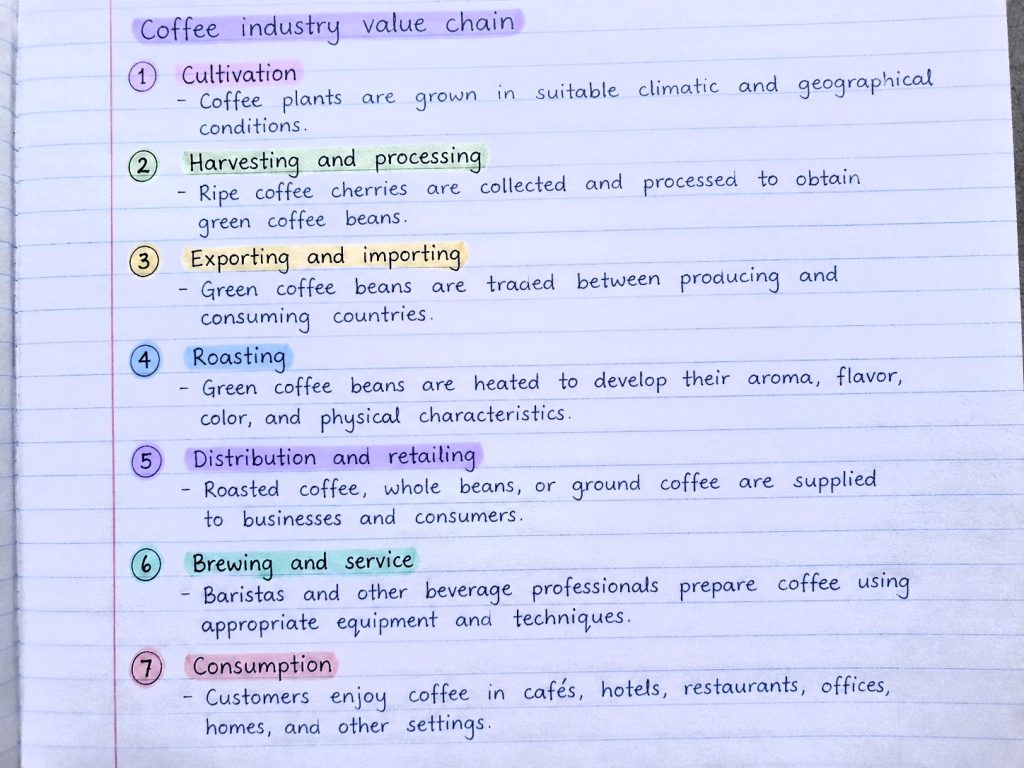
The coffee industry involves much more than preparing and serving a cup of coffee. It includes the cultivation of coffee plants, harvesting and processing of coffee cherries, roasting, distribution, brewing, and final service to consumers.
| Simple definition: Coffee is a non-alcoholic beverage prepared by brewing roasted and ground coffee beans with water. It naturally contains caffeine, a stimulant that can increase alertness. |
1.1.2 Meaning of the Coffee Industry
| Simply, the coffee industry is the collection of activities involved in producing, processing, selling, and serving coffee to consumers. |
The industry connects coffee farmers and agricultural producers with exporters, importers, roasters, wholesalers, retailers, hospitality establishments, and final consumers.
Detailed definition: The coffee industry is a global value chain encompassing the agricultural production of coffee, post-harvest processing, international trade, roasting, distribution, retailing, and beverage preparation, through which coffee is transformed from an agricultural commodity into a finished consumer product.
1.1.3 Major Stages of the Coffee Industry
The coffee industry operates through a series of interconnected stages. Each stage contributes to the quality, availability, and commercial value of the final coffee product.
History of Coffee in the World
Coffee has a long history that began in southwestern highlands of Ethiopia (East Africa), developed as a beverage in the Arabian Peninsula, and gradually spread to Europe, Asia, and the Americas.
| 1.1 Origin of Coffee – Ethiopia |
The coffee plant, particularly Coffea arabica, is associated with the highlands of Ethiopia. Ethiopia is therefore regarded as the natural homeland / origin country of coffee.
There is a famous legend about a goat herder (i.e.गोठालो) named Kaldi, who supposedly noticed that his goats became energetic after eating red coffee berries. However, this story has not been historically confirmed, and there is no clear evidence that Kaldi actually existed or discovered coffee in this way. Modern historical research indicates that the early history of coffee in Ethiopia is difficult to document precisely.
Important point: Ethiopia is considered the origin of the coffee plant, but Yemen played a major role in developing coffee as a cultivated crop and beverage.
| 1.2 Development of Coffee in Yemen |
Coffee moved from Ethiopia across the Red Sea to Yemen, where it became cultivated and prepared as a beverage.
By the 15th century, coffee drinking was established in Yemen, particularly among Sufi communities, who used coffee to remain alert during religious practices and night prayers. Yemen became an important centre for coffee cultivation and trade.
The famous Yemeni port of Mocha (Al-Makha) became strongly associated with the international coffee trade. This is also the origin of the term “Mocha” in coffee history.
For a long period, Yemen maintained considerable control over the coffee trade.
| 1.3 Spread to the Middle East |
From Yemen, coffee spread to other parts of the Muslim world.
During the 16th century, coffee became popular in cities such as:
- Mecca
- Cairo
- Damascus
- Istanbul
Coffeehouses became important social places where people gathered to drink coffee, exchange news, discuss politics, conduct business and socialize.
Thus, coffee changed from being simply a beverage into an important part of social and urban culture.
| 1.4 Introduction of Coffee to Europe |
Coffee reached Europe through trade and travel from the Middle East.
By the 17th century, coffee had become increasingly popular in European countries. One of the earliest European coffeehouses appeared in Venice around 1645, followed by coffeehouses in England and other European countries.
Coffeehouses became important centres for:
- Social interaction
- Business
- Intellectual discussion
- Political debate
- Exchange of information
The development of European coffee culture greatly increased demand for coffee.
| 1.5 Expansion of Coffee Cultivation |
As European demand increased, coffee cultivation expanded beyond Arabia.
European colonial powers introduced coffee plants into suitable tropical regions of:
- Asia
- The Caribbean
- Central America
- South America
- Africa
Coffee gradually became a major plantation crop and international trade commodity.
Brazil eventually became the world’s leading coffee producer and has remained a dominant producer for much of the modern era. Other major producing countries later included Colombia, Ethiopia, Vietnam and Indonesia.
| 1.6 Coffee in the Modern Era |
During the 19th and 20th centuries, coffee became a truly global beverage.
Technological developments improved like:
- Coffee roasting
- Grinding
- Brewing
- Packaging
- Transportation
- Instant coffee production
In the second half of the 20th century, coffee culture developed further through cafés, specialty coffee and international coffee chains. The opening of the first Starbucks store in Seattle in 1971 became one notable milestone in the development of modern coffee culture.
Today, coffee is consumed across the world and is important not only as a beverage but also as a source of employment, export earnings, rural livelihoods and international trade.
History of Coffee in Nepal
Coffee cultivation in Nepal is relatively recent with short history compared with its history in Ethiopia and Yemen.
| 2.1 Introduction of Coffee into Nepal |
Coffee was introduced into Nepal in 1938 AD (1995 B.S.).
According to the National Tea and Coffee Development Board of Nepal, Hira Giri, a resident of Gulmi, brought coffee seeds from Burma (present-day Myanmar) and planted them at Aapchaur in Gulmi District. This is generally recognized as the beginning of coffee cultivation in Nepal.
Initially, coffee attracted very little commercial attention and remained mainly a curiosity crop for several decades.
| 2.2 Expansion During the 1970s |
Coffee cultivation began receiving greater attention during the 1970s.
The Government of Nepal imported coffee seeds from India and distributed them to farmers. This helped coffee cultivation gradually move beyond Gulmi and encouraged farmers to consider coffee as a potential cash crop.
A significant milestone came in 1978, when King Birendra declared Gulmi a coffee region, helping to promote commercial coffee production.
| 2.3 Commercial Development in the 1980s |
The 1980s were an important period in the commercialization of Nepali coffee.
The Nepal Coffee Company (NeCCo) was established at Manigram, Rupandehi, in 1983/84. It purchased dry coffee cherries from farmers and processed them for the domestic market.
This provided farmers with a more organized market for their production and helped move coffee from a small-scale crop toward a commercial agricultural product.
| 2.4 Institutional Development |
Coffee development gradually became more organized through farmer groups and government institutions.
Important developments included:
- Formation of coffee producer organizations
- Government technical and financial support
- Expansion of coffee nurseries and plantations
- Development of processing facilities
- Promotion of organic coffee
- Establishment of the National Tea and Coffee Development Board (NTCDB) in 1993
These institutions helped provide technical assistance, promote production and support the development of Nepal’s coffee sector.
| 2.5 Export and International Recognition |
Nepali coffee gradually entered the international market.
After 2002, increasing exports and growing domestic consumption encouraged farmers to view coffee more seriously as an income-generating crop.
Nepal’s high-altitude, shade-grown and largely smallholder production has also helped create an identity for specialty and organic coffee.
| 2.6 Present Status of Coffee in Nepal |
Coffee cultivation has now spread to approximately 40 districts, particularly in the middle-hill regions of Nepal.
Important coffee-producing districts include:
- Gulmi
- Palpa
- Syangja
- Kaski
- Kavre
- Sindhupalchok
- Lalitpur
- Tanahun
- Lamjung
- Gorkha
- Parbat
- Baglung
- Arghakhanchi
The National Tea and Coffee Development Board identifies coffee cultivation as increasingly widespread across Nepal’s middle hills.
Types of Coffee Beans and Roasts
| Coffee beans are the seeds found inside the fruit (coffee cherry) of the coffee plant, which are processed, dried, roasted and ground to make coffee. |
Coffee belongs to the botanical genus Coffea, which contains numerous species. However, only a few species are commercially important, particularly Arabica and Robusta. The quality and characteristics of coffee depend on several factors, including the coffee species, variety, growing region, altitude, climate, soil, processing method, storage, roasting and brewing techniques.
Structure of a Coffee Cherry
A coffee cherry generally consists of the following layers:
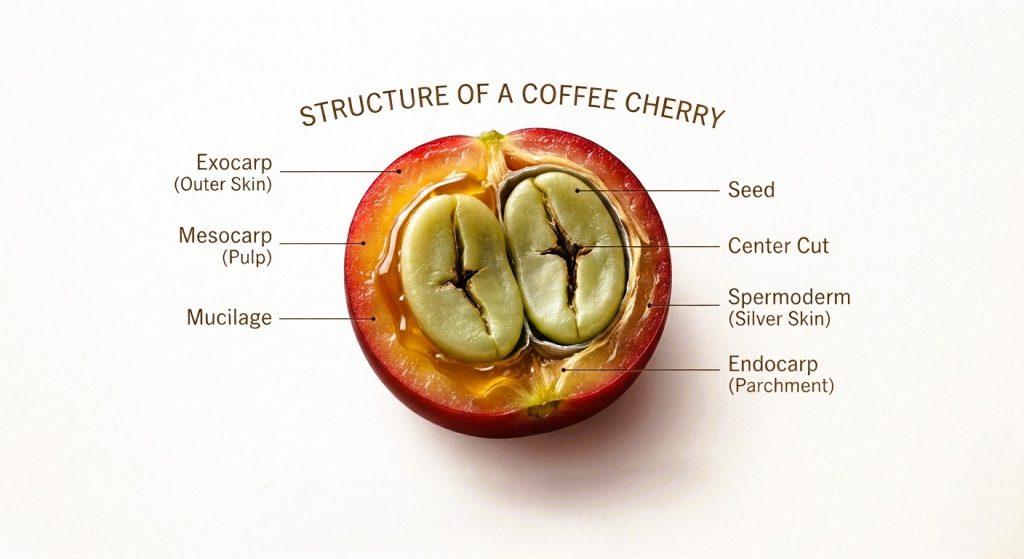
| Skin → Pulp → Mucilage → Parchment → Silver Skin → Seed |
- Exocarp (Skin): It’s outermost protective layer of the coffee cherry. It is generally green when unripe and changes to red, yellow or orange as the fruit matures, depending on the variety.
- Mesocarp (Pulp): The soft, fleshy layer beneath the skin. It contains water, sugars and other compounds and plays an important role in coffee processing and fermentation.
- Mucilage: A sticky, sweet layer surrounding the seeds.
- Endocarp (Parchment): It’s a tough, protective layer surrounding the coffee seeds. After the fruit is processed and dried, this layer becomes hard and paper-like.
- Spermoderm (Silver Skin): It’s a thin membrane directly surrounding each coffee seed. It remains attached to the green coffee bean after processing and is largely removed during roasting as chaff.
- Coffee seed: The seed that is processed, roasted and used to prepare coffee.
- Center Cut (Crease): A small groove or line running along the middle of the coffee seed. It is the natural line that separates the two sides of the seed.
Usually, each coffee cherry contains two seeds. These seeds are separated, processed and dried before being roasted. After roasting, they develop the familiar brown colour, aroma and flavour associated with coffee.
Green Coffee Beans
Before roasting, coffee seeds are known as green coffee beans. They are usually greenish or yellowish in colour, hard and dense in texture. Green coffee beans have a mild smell and do not yet have the strong aroma and flavour associated with roasted coffee.
Green coffee beans contain substances such as carbohydrates, proteins, oils, acids, minerals and caffeine. During roasting, these components undergo physical and chemical changes that develop the characteristic colour, aroma and flavour of coffee.
Major Types of Coffee Beans
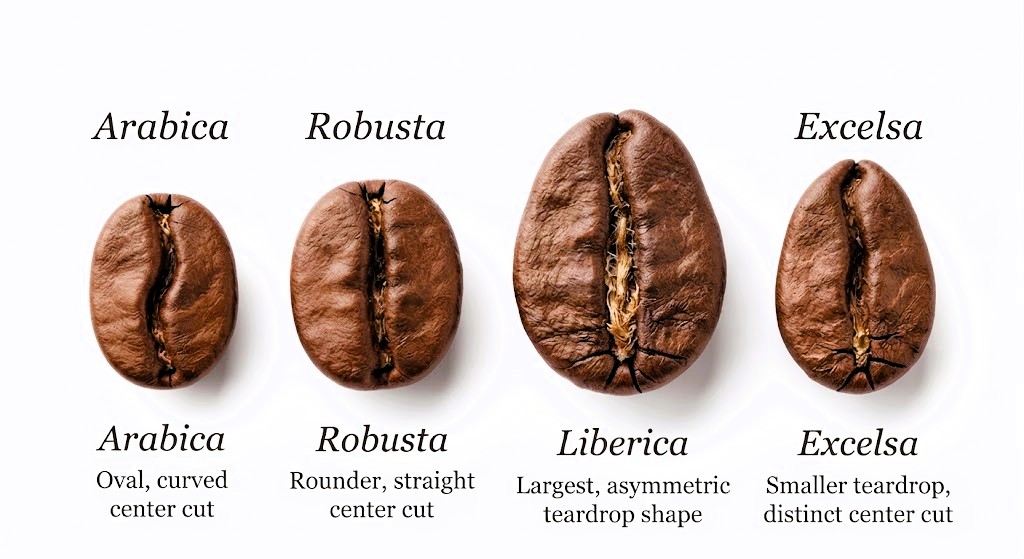
Coffee belongs to the genus Coffea, which contains many species. However, only a few are commercially important. The four commonly discussed types are:
- Arabica
- Robusta
- Liberica
- Excelsa
Explanation:
- Arabica:
| Scientific name: Coffea arabica |
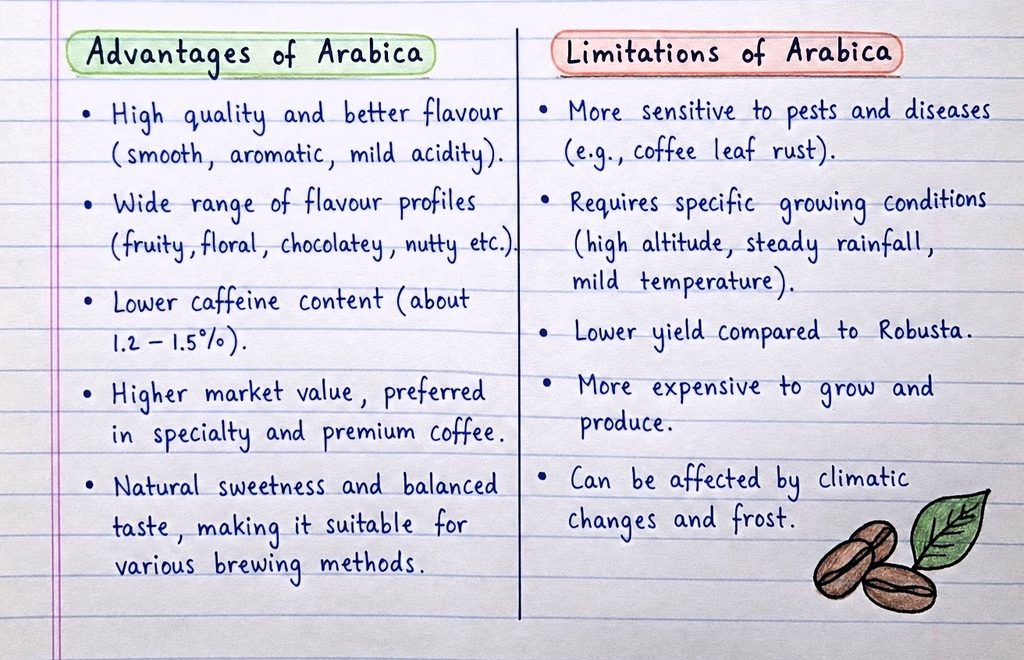
Arabica is the most widely consumed coffee species, known for its mild and smooth taste, pleasant aroma, acidity, sweetness, and complex flavour.
Origin:
Arabica is believed to have originated in the highlands of southwestern Ethiopia. From Ethiopia, it spread to other parts of the world and is now cultivated across Latin America, Africa and Asia.
Brazil and Colombia are among the major producers of Arabica coffee. Other important producing countries include Ethiopia, Honduras, Peru, Guatemala and Kenya.
Arabica is generally associated with higher-altitude and relatively cooler growing environments. A broad range such as 800–2,200 metres above sea level can be used as a general study reference, but the suitable elevation varies according to variety, climate and geographical location.
Growing Conditions
Arabica generally grows well in cooler and suitable highland environments. It prefers:
- Moderate temperatures
- Regular and adequate rainfall
- Well-drained and fertile soil
- Higher elevations in many producing regions
- Suitable sunlight and, in some production systems, shade
Arabica is more sensitive to high temperatures, pests and diseases than Robusta. Therefore, it generally requires more careful cultivation.
Common Arabica Varieties and Cultivars:
Arabica has numerous varieties and cultivars developed or selected in different coffee-growing regions. Examples include:
- Typica
- Bourbon
- Caturra
- Catimor
- Geisha
- Pacamara
- SL28
- SL34
These varieties differ in characteristics such as plant growth, yield, disease resistance and flavour potential.
Characteristics of Arabica:
- Scientific name: Its scientific name is Coffea arabica.
- Global production: Arabica makes up approximately 60–70% of the world’s total coffee production.
- Mild and smooth taste: Arabica generally has a mild, smooth and slightly sweet flavour, making it popular among many coffee consumers.
- Pleasant aroma: It has a pleasant and delicate aroma, which may be floral, fruity, chocolate-like, nutty or caramel-like depending on its origin and processing.
- Good acidity: Arabica generally has noticeable acidity, which gives coffee a fresh and lively taste. In coffee, acidity is not simply the same as sourness; it is an important part of the overall flavour balance.
- Lower caffeine: Arabica generally contains less caffeine than Robusta, giving it a comparatively milder character.
- Light to medium body: Arabica commonly produces a light to medium-bodied coffee, although body is also affected by processing, roasting and brewing.
- Oval-shaped beans: Its green coffee beans are generally oval or elongated in shape.
- Greenish colour: Unroasted Arabica beans are commonly green to bluish-green, although colour can vary according to processing and storage.
- Curved centre line: The groove or line running through the middle of an Arabica bean is generally curved or slightly wavy.
- Sensitive plant: Arabica is more sensitive to pests, diseases and environmental stress than Robusta.
- Popular in specialty coffee: Because of its pleasant flavour and aroma, Arabica is widely used in specialty and premium coffee.
Uses of Arabica
Arabica is commonly used for:
- Specialty coffee
- Premium coffee
- Single-origin coffee
- Filter coffee
- Espresso
- Café beverages
- Coffee blends
It can be used alone or blended with other coffee species, particularly Robusta.
- Robusta
| Scientific Name: Coffea canephora |
Robusta is an important coffee species known for its strong flavour, higher caffeine content, full body, and good resistance to pests and diseases.
Origin and Distribution
Robusta originated in the tropical regions of central and western Africa. It is now cultivated in several coffee-producing countries, particularly in Vietnam, Brazil, Indonesia, Uganda and India. Vietnam is especially important in global Robusta production.
Robusta generally represents around 40% of global coffee production, although its share can vary from year to year depending on production conditions and market supply.
Growing Conditions
Robusta grows well in warm and humid tropical climates and is generally cultivated at lower elevations than Arabica. It can tolerate higher temperatures and is comparatively more resistant to several pests and diseases.
It requires adequate moisture and suitable soil for healthy growth. Its greater tolerance and hardiness make it suitable for areas where the cooler conditions required by Arabica are difficult to maintain.
Characteristics of Robusta
- Scientific name: The scientific name of Robusta is Coffea canephora.
- Production: Robusta contributes approximately 40% of the world’s coffee production, although its share may vary from year to year.
- Flavour: Robusta generally has a strong, bold and bitter flavour compared with Arabica.
- Acidity: It usually has lower acidity than Arabica, giving the coffee a heavier and less bright taste.
- Aroma: Robusta commonly has an earthy, woody and nutty aroma, which can sometimes be quite strong.
- Caffeine content: Robusta contains more caffeine than Arabica, which contributes to its stronger taste and bitterness.
- Body: Coffee made from Robusta generally has a full and heavier body, giving a stronger mouthfeel.
- Bean shape: Robusta beans are generally rounder and less elongated than Arabica beans.
- Centre line: The centre line or crease on a Robusta bean is usually straighter than the curved centre line found in Arabica beans.
- Growing conditions: Robusta grows well in warm and humid tropical climates and can tolerate higher temperatures than Arabica.
- Growing altitude: It is generally cultivated at lower elevations than Arabica, although the suitable altitude varies according to the growing environment and variety.
- Resistance: Robusta plants are comparatively more resistant to many pests and diseases, making them hardier than Arabica plants.
- Productivity: Robusta can produce relatively higher yields under suitable growing conditions, which makes it important for commercial coffee production.
| Advantages | Limitations |
|---|---|
| Hardy and disease resistance | Strong and bitter taste (not preffered by everyone) |
| Grows well in warm climates and low attitudes | Lower acidity and complex flavour compared to Arabica |
| Higher Caffeine content | Less aromatic |
| Lower production cost | Often used in blends rather than single-origin coffee |
| Produces a thick crema (good for espresso) | |
| Suitable for instant coffee and blends |
- Liberica
| Scientific Name: Coffea liberica |
Liberica is a less common species of coffee known for its large beans, tall coffee trees and distinctive smoky, woody and fruity flavour.
Origin and Distribution
Liberica is native to tropical regions of West and Central Africa. It later spread to parts of Southeast Asia, where it became particularly associated with countries such as the Philippines, Malaysia and Indonesia.
Today, Liberica represents only a small proportion of global coffee production and is mainly found in specific growing regions and specialty markets.
Growing Conditions
Liberica grows well in warm and humid tropical climates. The coffee plant can grow much taller than Arabica and Robusta and is capable of developing a large root system.
It can adapt to a range of tropical growing conditions, although suitable soil, moisture and climate are still important for healthy growth and good-quality coffee.
Characteristics of Liberica
- Scientific name: The scientific name of Liberica is Coffea liberica.
- Production: Liberica accounts for only a very small share of global coffee production and is considered a relatively rare commercial coffee species.
- Tree size: Liberica plants can grow much taller and larger than Arabica and Robusta plants, making them distinctive among commercially cultivated coffee species.
- Bean size: Liberica produces unusually large coffee beans compared with the beans of Arabica and Robusta.
- Bean shape: The beans are generally large and irregular in shape, which makes them easy to distinguish from the more uniform beans of Arabica and Robusta.
- Flavour: Liberica has a distinctive flavour that may include smoky, woody, fruity and slightly floral characteristics.
- Aroma: The aroma can be strong and unusual, with fruity, floral and woody notes depending on the variety and processing method.
- Acidity: Liberica generally has moderate acidity, although the level can vary according to growing conditions and processing.
- Body: The coffee can have a noticeable body and a distinctive mouthfeel that differs from the lighter character of many Arabica coffees.
- Growing climate: Liberica grows mainly in warm and humid tropical environments.
- Caffeine: Liberica contains caffeine, but its exact level can vary depending on the variety, growing conditions and bean characteristics.
- Adaptability: The plant can adapt to certain tropical environments and is known for its ability to grow under conditions where some other coffee varieties may be less suitable.
- Market position: Because of its limited production and unusual flavour, Liberica is mainly found in particular regional and specialty coffee markets.
Advantages of Liberica
- Distinctive flavour: Liberica provides a unique flavour profile that is different from the two most widely cultivated coffee species.
- Large beans: Its unusually large beans make it easily recognizable and commercially interesting.
- Adaptability: The plant can grow successfully in suitable warm tropical environments.
- Specialty market potential: Its rarity and distinctive characteristics can make it valuable in regional and specialty coffee markets.
- Cultural importance: Liberica has particular importance in some Southeast Asian coffee-growing communities and traditional coffee markets.
Limitations of Liberica
- Limited production: Liberica is produced on a much smaller scale than Arabica and Robusta.
- Limited availability: It is not easily available in many international coffee markets.
- Large tree size: Its tall growth can make harvesting and general farm management more difficult.
- Less familiar flavour: Its unusual flavour may not appeal to consumers who are accustomed to conventional Arabica or Robusta coffee.
- Smaller market: Because production and consumer demand are limited, Liberica has a much smaller commercial market than Arabica and Robusta.
- Excelsa
| Scientific name: Coffea liberica var. dewevrei |
Excelsa is a less common type of coffee known for its fruity, tart and distinctive flavour. It is mainly found in parts of Southeast Asia.
Origin and Distribution
Excelsa was first identified in Central Africa and later became cultivated in several parts of Southeast Asia. It is particularly associated with countries such as the Philippines, Vietnam and Indonesia.
Unlike Arabica and Robusta, Excelsa is produced on a relatively small scale and is not widely available in the international coffee market.
Growing Conditions
Excelsa grows mainly in warm and humid tropical conditions. Like other coffee plants, it requires suitable temperature, moisture, soil and growing conditions for healthy development.
It is generally associated with lower to moderate elevations and can adapt to different tropical environments.
Characteristics of Excelsa
- Scientific classification: Excelsa is generally classified as Coffea liberica var. dewevrei, rather than as a completely separate coffee species.
- Production: Excelsa represents only a small portion of global coffee production and is considered a relatively uncommon coffee type.
- Flavour: Excelsa is known for its distinctive tart and fruity flavour, which can give the coffee a lively and complex character.
- Aroma: The aroma may contain fruity and floral notes, although its character can vary according to the growing region and processing method.
- Acidity: Excelsa generally has noticeable acidity, which contributes to its bright and lively taste.
- Body: It usually produces a light to medium body, although the final body can change with roasting and brewing methods.
- Bean characteristics: Excelsa beans are generally associated with the larger and distinctive bean characteristics of the Liberica group.
- Caffeine: Excelsa contains caffeine, but its exact caffeine level can vary according to the plant, growing conditions and processing.
- Growing climate: It grows well in warm and humid tropical environments.
- Distribution: It is mainly cultivated on a limited scale in parts of Southeast Asia.
- Blending: Excelsa is often used in coffee blends because its distinctive flavour can add complexity to the overall cup.
- Rarity: Compared with Arabica and Robusta, Excelsa is much less common in commercial coffee production.
Advantages of Excelsa
- Distinctive flavour: Excelsa provides a flavour profile that is different from the more common Arabica and Robusta.
- Adds complexity to blends: Its fruity and tart character can make coffee blends more interesting and complex.
- Specialty market potential: Its rarity and unusual characteristics can create interest among specialty coffee consumers.
- Tropical adaptability: It can grow in suitable warm and humid tropical environments.
- Unique coffee experience: It provides consumers with an alternative to the two major commercially produced coffee species.
Limitations of Excelsa
- Limited production: Excelsa is cultivated on a much smaller scale than Arabica and Robusta.
- Limited availability: It can be difficult to find in many international coffee markets.
- Small commercial market: Its limited production and consumer familiarity restrict its wider commercial use.
- Unusual flavour: Its tart and distinctive character may not be preferred by consumers who are accustomed to milder coffee.
- Limited research and cultivation: Compared with Arabica and Robusta, less commercial research and breeding work has been focused specifically on Excelsa.
Coffee Bean Varieties
Coffee varieties are different cultivated forms of coffee plants that have developed through natural selection, mutation, breeding, or cultivation. Most of the commonly discussed varieties in specialty coffee belong to Arabica (Coffea arabica).
It is important to distinguish a coffee species from a coffee variety. Arabica and Robusta are major coffee species, whereas Typica, Bourbon, Caturra and Geisha are examples of varieties or cultivars within the Arabica group.
| Remember atleast 5 names of varieties for exam. |
- Typica
Typica is one of the oldest and most widely recognized varieties of Arabica coffee. It is known for its tall growth, relatively large beans and good cup quality.
Characteristics of Typica:- Typica is a traditional variety of Coffea arabica.
- The plant generally has a tall and upright growth habit.
- It usually produces relatively large and elongated (लम्बिएको) beans.
- The coffee is commonly known for its clean, sweet and balanced flavour.
- It can produce high-quality coffee under suitable growing conditions.
- The plant is relatively susceptible (संवेदनशील) to several coffee diseases.
- Bourbon
Bourbon is an important traditional Arabica variety that developed on Réunion Island, formerly known as Bourbon Island. It is valued for its sweetness, pleasant acidity and good cup quality.
Characteristics of Bourbon:- Bourbon is also traditional variety of Coffea arabica.
- It generally has a tall growth habit but produces more branches than Typica.
- Its beans are generally smaller and more rounded than Typica beans.
- The cup is often characterized by greater sweetness and pleasant acidity.
- It can produce complex and high-quality coffee under suitable conditions.
- Like Typica, it is relatively susceptible to several coffee diseases.
- Caturra
Caturra is a natural mutation of the Bourbon variety of Coffea arabica. It was first identified in Brazil and became popular because of its compact growth habit and good productivity, making it easier to cultivate at higher planting densities.
Characteristics of Cattura:- Caturra is a variety of Coffea arabica derived from Bourbon.
- The plant has a short and compact growth habit, making harvesting and farm management easier.
- It generally produces relatively good yields compared with traditional tall varieties.
- The coffee can have good sweetness, acidity and overall cup quality when grown under suitable conditions.
- It is relatively susceptible to coffee diseases, particularly coffee leaf rust.
- Catimor
Catimor is a group of Arabica coffee varieties developed by crossing Caturra and Híbrido de Timor. It was developed mainly to combine good productivity with greater resistance to important coffee diseases, particularly coffee leaf rust.- Catimor is a group of varieties derived from Coffea arabica.
- The plants generally have a compact growth habit and good productivity.
- They have greater resistance to coffee leaf rust than traditional varieties such as Typica and Bourbon.
- Catimor varieties are widely cultivated in several coffee-growing regions.
- Cup quality can vary considerably depending on the specific Catimor variety and growing conditions.
| NOTE FOR UNDERSTANDING: Cup quality simply means the overall quality and characteristics of the coffee when it is prepared and tasted as a beverage. In coffee, we don’t judge the bean only by its appearance. We also evaluate how the brewed coffee smells, tastes, and feels in the mouth. |
- Geisha
Geisha is a highly recognized Arabica variety originally associated with Ethiopia and later introduced to other coffee-growing regions. It gained international recognition for its distinctive and complex flavour characteristics, particularly when grown at suitable high-altitude locations. - Pacamara
Pacamara is a hybrid Arabica variety developed in El Salvador by crossing Pacas and Maragogipe. It is known for its very large beans and distinctive cup characteristics. - SL28
SL28 is an important Arabica variety developed in Kenya by Scott Agricultural Laboratories. It is particularly known for its drought tolerance and distinctive cup characteristics. - Other important Arabica varieties/cultivars include:
- SL34
- Pacas
- Maragogipe
- Java
- Villalobos
- Villa Sarchi
- Mundo Novo
- Catuai
- Castillo
- Yellow Bourbon
- Pink Bourbon
Coffee Roasting
| Simple Definition: Coffee roasting is the process of heating green coffee beans at a controlled temperature to develop their characteristic colour, aroma, flavour and texture. |
Coffee roasting is a controlled heating process in which the physical and chemical properties of green coffee beans change through the application of heat. These changes develop the characteristic sensory properties of roasted coffee and prepare the beans for grinding and brewing.
Green coffee beans contain carbohydrates, proteins, acids, oils and other compounds that undergo physical and chemical changes when heated, resulting in the development of the flavour and aroma associated with roasted coffee.
During roasting, the beans gradually lose moisture, expand, change colour and develop new flavour and aroma compounds. The degree of roasting has a significant influence on the final characteristics of brewed coffee.
Objectives of Coffee Roasting
The main objectives of coffee roasting are:
- To develop flavour and aroma: Roasting produces the compounds responsible for the characteristic flavour and aroma of coffee.
- To reduce moisture: Heat removes much of the moisture present in green coffee beans during the roasting process.
- To develop colour: The beans gradually change from green to yellow and then to different shades of brown as roasting progresses.
- To increase bean size: Heat causes the beans to expand and develop a more porous structure.
- To develop the desired taste: The roasting process helps create an appropriate balance of sweetness, acidity, bitterness and body.
- To prepare beans for brewing: Roasting changes the physical structure of the beans so that they can be ground and used to prepare coffee.
Changes During Coffee Roasting
Several physical and chemical changes take place as green coffee beans are heated. The major changes include:
- Moisture Loss
Green coffee beans contain natural moisture. As roasting begins, heat causes this moisture to evaporate. The beans gradually become drier and lose weight, while their internal structure begins to change. - Colour Change
The beans gradually change from green to yellow, light brown and eventually darker brown as roasting progresses. The colour change is associated with chemical reactions that occur during heating and is commonly used as an indication of roast development. - Maillard Reaction
The Maillard reaction occurs when amino acids and reducing sugars react under heat. It produces many compounds that contribute to the brown colour, aroma and complex roasted flavours of coffee. - Caramelization and Sugar Degradation
At high roasting temperatures, sugars undergo thermal breakdown and contribute to sweet, caramel-like and roasted flavour characteristics. In coffee roasting, sugar degradation occurs alongside other chemical reactions, particularly the Maillard reaction. - Bean Expansion
As moisture turns into steam and gases develop inside the bean, internal pressure increases. The beans expand and become more porous. This expansion makes roasted coffee easier to grind and allows water to interact with the coffee during brewing. - First Crack
First crack is a stage during roasting when the pressure and gases inside the expanding beans cause audible cracking sounds. It marks an important stage of roast development.
After the first crack, the roaster can continue roasting to develop lighter, medium or darker roast characteristics. - Second Crack
Second crack occurs later in the roasting process as the bean structure undergoes further breakdown and expansion. The cracking sound is generally finer and more rapid than the first crack.
Continued roasting beyond this stage produces very dark roast characteristics, and oils may become visible on the surface of the beans
Roast Levels
The degree to which coffee is roasted is commonly described as light, medium or dark roast. Roast level affects the colour, aroma, acidity, body and flavour of the resulting coffee.
- Light Roast
Light-roasted coffee generally has:- Light brown colour
- Higher perceived acidity
- Fruity or floral characteristics
- Greater flavour complexity
- Lighter body
- More noticeable characteristics of the original coffee
- Medium Roast
Medium-roasted coffee generally has:- Medium brown colour
- Balanced acidity and sweetness
- Moderate body
- Caramel-like, nutty or chocolate-like flavours
- A balance between the characteristics of the coffee bean and roasting
- Dark Roast
Dark-roasted coffee generally has:- Dark brown to very dark colour
- Lower perceived acidity
- Fuller and heavier body
- Strong roasted, chocolate-like or smoky flavours
- Greater bitterness when heavily roasted
- Less of the original bean’s delicate characteristics
Cooling and Storage of Roasted Coffee
- Cooling
Once the desired roast level is reached, roasted beans are cooled rapidly to prevent them from continuing to roast due to their retained heat. Proper cooling helps preserve the intended flavour and aroma characteristics. - Degassing
Freshly roasted coffee releases carbon dioxide (CO₂) produced during roasting. This process is known as degassing. Coffee is often allowed to rest for a suitable period after roasting before brewing, depending on the coffee and brewing method. - Storage
Roasted coffee should be protected from the main factors that cause quality loss:- Air (oxygen)
- Moisture
- Heat
- Light
Coffee should therefore be stored in an appropriate airtight container in a cool, dry and dark place. Whole beans generally retain their quality longer than ground coffee because grinding increases the surface area exposed to air.
Coffee Brewing Methods
| Coffee brewing is the process of preparing coffee by using water to extract desirable flavours, aromas, and soluble compounds from roasted and ground coffee. |
The final characteristics of brewed coffee depend on factors such as coffee-to-water ratio, grind size, water temperature, brewing time, water quality and filtration.
Principles of Coffee Brewing
Brewing is essentially an extraction process. When water comes into contact with ground coffee, it dissolves and carries various soluble compounds from the coffee grounds into the beverage. The objective is to obtain a balanced extraction that produces desirable flavour and aroma without excessive under-extraction or over-extraction.
The main factors affecting coffee brewing are:
- Coffee-to-Water Ratio
The coffee-to-water ratio refers to the amount of ground coffee used in relation to the amount of water used for brewing. It strongly affects the strength and concentration of the final beverage.
For example, using more coffee with the same amount of water generally produces a stronger beverage, while using less coffee produces a weaker beverage. The appropriate ratio varies according to the brewing method and the desired beverage. - Grind Size: (धुलो पिसाइको size)
Grind size refers to the size of the coffee particles produced when coffee beans are ground. It affects how quickly water can extract soluble compounds from the coffee.
Different brewing methods require different grind sizes. For example, espresso generally requires a fine grind, while French press commonly uses a coarse grind.- Fine grind (मसिनो धुलो): Greater surface area and generally faster extraction.
- Coarse grind (खस्रो धुलो): Smaller surface area and generally slower extraction.
- Water Temperature
Water temperature affects the rate at which soluble compounds are extracted from ground coffee. In general, hotter water extracts compounds more rapidly, while cooler water extracts them more slowly.
However, temperature should be considered together with other brewing factors such as grind size and brewing time rather than treated as an isolated factor. - Brewing Time
Brewing time is the period during which water remains in contact with the coffee grounds.
In general:
More contact time → greater extraction
Less contact time → less extraction
However, longer brewing does not automatically mean better coffee. Excessive extraction can produce undesirable flavours, while insufficient extraction can result in a weak or under-developed cup. - Water Quality
Water is the main ingredient in brewed coffee and acts as the solvent that extracts compounds from the coffee grounds. Therefore, its chemical composition can significantly influence extraction and flavour. Minerals, hardness, alkalinity, pH and other substances in water can affect both the beverage and brewing equipment.
Good brewing water should generally be:- Clean and hygienic
- Free from unpleasant tastes, odours and visible impurities
- Suitable in mineral content and alkalinity for coffee extraction
- Properly treated when necessary to protect brewing equipment
- Filtration
Filtration is the process of separating coffee grounds and other particles from the brewed beverage. The type of filter used can influence the clarity, body and mouthfeel of the coffee.
For example, paper filters generally produce a cleaner and clearer cup by retaining more fine particles and coffee oils, whereas metal filters allow more oils and fine particles to pass through, producing a fuller-bodied beverage. - Freshness of Coffee
The freshness of coffee affects the aroma and flavour of the final beverage. Coffee gradually loses volatile aromatic compounds after roasting and grinding, while brewed coffee also changes during holding.
Therefore, coffee should generally be stored properly, ground close to brewing and served soon after preparation to preserve desirable flavour and aroma.
Common Coffee Brewing Methods
Coffee can be brewed using several different principles. The major categories include:
- Boiling or Decoction
- Percolation
- Gravity Filtration
- Immersion
- Pressure
- Vacuum
The same coffee bean can produce noticeably different characteristics depending on the brewing method, because each method changes the way water interacts with the coffee grounds.
- Boiling or Decoction
In this method, finely ground coffee (coffee beans that have been crushed into small particles) is heated directly with water. The coffee remains in contact with the water during preparation, usually producing a strong and full-bodied coffee. Since it is not completely filtered, some fine coffee particles may remain in the prepared beverage.
Example: Turkish coffee, Greek coffee and Cowboy coffee. - Percolation
Percolation involves passing water through coffee grounds to extract soluble compounds. In some equipment, water is repeatedly circulated through the coffee grounds, producing a strong and concentrated beverage.
Example: Moka pot and stovetop or electric coffee percolator. - Gravity Filtration
In gravity filtration, hot water passes through ground coffee and a filter mainly due to gravity. The filter separates the coffee grounds from the brewed beverage, generally producing a clean, clear and well-defined cup.
Example: V60, Chemex, Kalita Wave, Melitta and automatic drip coffee maker. - Immersion
In immersion brewing, coffee grounds are completely immersed in water for a specific period before the brewed coffee is separated from the grounds. The longer contact between coffee and water often produces a fuller body and richer mouthfeel.
Example: French press, Clever Dripper - Pressure Brewing
Pressure brewing uses pressure to force water into or through coffee grounds. It allows relatively efficient extraction and can produce either concentrated or lighter beverages depending on the equipment and brewing method.
Examples: Espresso machine, AeroPress and lever espresso machine. - Vacuum Brewing
Vacuum brewing uses changes in pressure between chambers to move water through coffee grounds. It is also known as siphon brewing and can produce a clear and aromatic beverage.
Examples: Siphon brewer and vacuum pot.
Common Brewing Problems
During coffee brewing, improper control of factors such as grind size, water temperature, brewing time, coffee-to-water ratio and agitation can lead to undesirable results. Two of the most common brewing problems are under-extraction and over-extraction.
- Under-Extraction
Under-extraction occurs when insufficient soluble compounds are extracted from the coffee grounds during brewing. This means the water has not extracted enough of the desirable compounds needed to produce a balanced flavour.
Common causes:- Grind size is too coarse
- Brewing time is too short
- Water temperature is too low
- Insufficient contact between water and coffee grounds
- Inappropriate brewing technique
Characteristics:
Under-extracted coffee may taste sour, sharp, weak, thin or underdeveloped. The coffee may lack sweetness, body and flavour complexity.
How to correct it:
A barista can generally increase extraction by using a finer grind, increasing brewing time, increasing water temperature within a suitable range, or improving contact between water and coffee grounds.
- Over-Extraction
Over-extraction occurs when too many soluble compounds are extracted from the coffee grounds, including compounds that can contribute undesirable flavours.
Common causes:- Grind size is too fine
- Brewing time is too long
- Water temperature is too high
- Excessive agitation or contact
- Inappropriate brewing technique
Characteristics:
Over-extracted coffee may taste bitter, harsh, dry, astringent or unpleasantly strong. Its desirable sweetness and flavour balance may be reduced.
How to correct it:
A barista can generally reduce extraction by using a coarser grind, reducing brewing time, lowering the water temperature within a suitable range, or reducing excessive agitation.
- Uneven Extraction
Uneven extraction occurs when different parts of the coffee grounds are extracted at different rates. Some particles may be under-extracted while others are over-extracted, resulting in coffee with an unbalanced flavour.
Common causes: Uneven distribution of coffee grounds, inconsistent grind size, poor water flow, or improper brewing technique.
Characteristics: The coffee may have a combination of sour and bitter flavours and lack overall balance. - Channeling
Channeling occurs when water finds easier pathways through the layer of ground coffee instead of flowing evenly through all the coffee grounds. As a result, some areas receive too much water while others receive too little.
Common causes: Uneven distribution, poor tamping, inconsistent grind, or cracks and gaps in the coffee bed.
Characteristics: The resulting coffee may be unbalanced, weak, sour or bitter, depending on the extent of uneven extraction. - Incorrect Grind Size
Using an unsuitable grind size can significantly affect the flow of water and extraction rate. A grind that is too coarse can lead to rapid water flow and insufficient extraction, while a grind that is too fine can slow water flow and may cause excessive extraction.
The appropriate grind size depends on the brewing method. For example, espresso generally requires a fine grind, whereas French press commonly uses a coarse grind. - Incorrect Water Temperature
Water temperature that is unsuitable for the brewing method can affect the rate and quality of extraction. Water that is too cool may result in insufficient extraction, while excessively hot water may increase extraction and contribute to undesirable flavours.
Therefore, the barista should maintain a suitable and consistent water temperature according to the brewing method. - Poor Water Quality
Since water is the main ingredient in brewed coffee, unsuitable water can negatively affect both extraction and flavour. Water containing unpleasant tastes, odours or unsuitable mineral characteristics may produce poor-quality coffee.
Common causes: Poor-quality water, unsuitable mineral composition, excessive hardness or alkalinity, and inadequate water treatment. - Equipment-Related Problems
Dirty, poorly maintained or incorrectly operated brewing equipment can negatively affect the flavour and quality of coffee. Coffee oils and residue can accumulate in equipment, while mineral scale can affect water flow, temperature and equipment performance.
Regular cleaning, descaling, inspection and proper maintenance help maintain beverage quality and equipment performance.
| Balanced Brewing The goal of brewing is to achieve a balanced extraction, in which desirable flavour compounds are extracted in appropriate amounts. A well-extracted coffee generally has a harmonious combination of acidity, sweetness, bitterness, body, aroma and overall flavour. |
Espresso Basics
| Definition: Espresso is a concentrated coffee beverage prepared by forcing hot water under pressure through finely ground coffee for a short period of time, producing a rich and flavourful beverage with a characteristic layer of crema. |
The process extracts soluble compounds, oils and other flavour components from the coffee within a relatively short brewing time
Espresso originated in Italy and forms the base of many popular coffee beverages such as cappuccino, latte, macchiato and americano.
Characteristics of Espresso
Espresso differs from other coffee brewing methods because of its concentrated nature and the way it is prepared. Its main characteristics include:
- Concentration
Espresso is prepared using a relatively small amount of water in relation to the amount of coffee, producing a concentrated beverage with intense flavour and aroma. - Pressure-Based Extraction
Hot water is forced through finely ground coffee under pressure. This allows extraction to take place relatively quickly and contributes to the characteristic body and flavour of espresso. - Crema
Crema is the layer of fine, golden to reddish-brown foam that forms on the surface of a freshly extracted espresso. It is produced mainly by gases released from the coffee and the interaction of coffee compounds during pressurized extraction. Crema can provide information about freshness and extraction, but its presence alone does not determine the overall quality of espresso. - Rich Aroma and Flavour
Espresso contains a concentrated combination of aromatic and flavour compounds, giving it an intense aroma and distinctive taste. Depending on the coffee and brewing conditions, it may show characteristics such as sweetness, acidity, bitterness, fruitiness, nuttiness or chocolate-like notes. - Body
Espresso generally has a relatively rich and full mouthfeel compared with many filtered coffee beverages. Dissolved coffee compounds, oils and fine particles contribute to its body.
Anatomy of an Espresso Shot

- Crema
The upper layer consisting of fine bubbles and emulsified coffee compounds. It is usually golden to reddish-brown in appearance. - Body
The middle portion of the beverage. It contributes much of the espresso’s texture, mouthfeel and overall flavour. - Heart
The lower portion, traditionally described as darker in colour. It contains dissolved coffee compounds and contributes to the overall flavour and balance of the espresso.
These layers are easier to see just after the espresso is prepared, but they gradually mix together. They are not completely separate layers and may change as the espresso sits for some time.
Essential Factors in Espresso Preparation
The quality and characteristics of espresso are influenced by several important factors.
- Coffee Dose
Coffee dose refers to the amount of ground coffee placed in the portafilter before extraction. A consistent dose helps produce consistent results.
A common dose for a modern double espresso is around 18–20 grams, although the appropriate amount varies according to the coffee, basket size, equipment and recipe. - Grind Size
Espresso generally requires a fine grind so that water can pass through the coffee under pressure at an appropriate rate. - Tamping
Tamping is the process of pressing and leveling the ground coffee evenly inside the portafilter before extraction. It creates a firm and even layer of coffee through which water can flow more uniformly.
Proper tamping should be:- Even and level
- Firm and consistent
- Free from gaps or uneven areas
Uneven tamping can cause channeling, where water finds easier paths through the coffee instead of flowing evenly through it.

- Water Quality
Water is a major ingredient in espresso, so its quality affects both flavour and equipment performance. Water should be clean, hygienic and free from unpleasant tastes and odours.
Its mineral content, hardness and alkalinity can also influence extraction and flavour. Properly treated water helps reduce the risk of mineral scale inside the espresso machine. - Water Temperature
The temperature of the water affects how quickly and effectively compounds are extracted from the coffee.
A commonly used range for espresso is approximately 90–96°C (194–205°F), although the appropriate temperature depends on the coffee, roast level and brewing recipe.- Too low: May result in insufficient extraction and a sour or weak taste.
- Too high: May increase extraction excessively and produce harsh or bitter flavours.
- Pressure
Pressure is an important feature of espresso preparation. An espresso machine forces hot water through the compacted coffee using pressure.
Around 9 bar is a common reference point for traditional espresso extraction, although the exact pressure may vary depending on the machine and brewing method. - Extraction Time
Extraction time is the period during which water passes through the ground coffee.
A traditional espresso recipe often begins with a target of around 25–30 seconds, but there is no single correct extraction time for every coffee. Dose, grind size, water temperature, pressure and the amount of espresso produced all affect the appropriate time.
Therefore, extraction time should be considered together with the taste, flow and overall result of the espresso.
Espresso-Making Process
The basic espresso-making process involves the following steps:
- Preheat the Equipment: Preheat the espresso machine, portafilter and serving equipment as required.
- Grind and Measure: Grind fresh coffee to a suitable fine grind and measure the required dose.
- Distribute the Coffee: Spread the ground coffee evenly in the portafilter to avoid uneven areas.
- Tamp: Press and level the coffee evenly to create a uniform coffee bed.
- Lock the Portafilter: Secure the portafilter properly into the group head of the espresso machine.
- Start Extraction: Start the machine and allow hot water to pass through the coffee under pressure.
- Monitor the Extraction: Observe the flow, extraction time and appearance of the espresso.
- Stop and Serve: Stop the extraction at the desired beverage yield and serve the espresso promptly.
Common Espresso Problems
- Under-extraction
- Over-extraction
- Channeling
- Fast or Slow Extraction
If water passes through the coffee too quickly, the espresso may be weak or under-extracted. If it passes too slowly, the espresso may become over-extracted.
Grind size is often adjusted first, while also considering dose, tamping and other brewing variables. - Weak Crema
Weak or quickly disappearing crema may be associated with factors such as older coffee, unsuitable extraction conditions or poor preparation. However, crema alone should not be used as the only measure of espresso quality.