
- Important Past Board Questions
- Concept of Perception
- Nature / Features / Characteristics of Perception
- Importance of perception
- Perceptual process
- Factors influencing perception
- Perception and individual decision making
- Concept of Learning
- Significance of Learning
- Principles of Learning
- Factors influencing Learning
Important Past Board Questions
- List out the factors influencing learning. (1 Mark – 2024)
- Describe how perception influence decision making. (5 Marks – 2024)
Concept of Perception
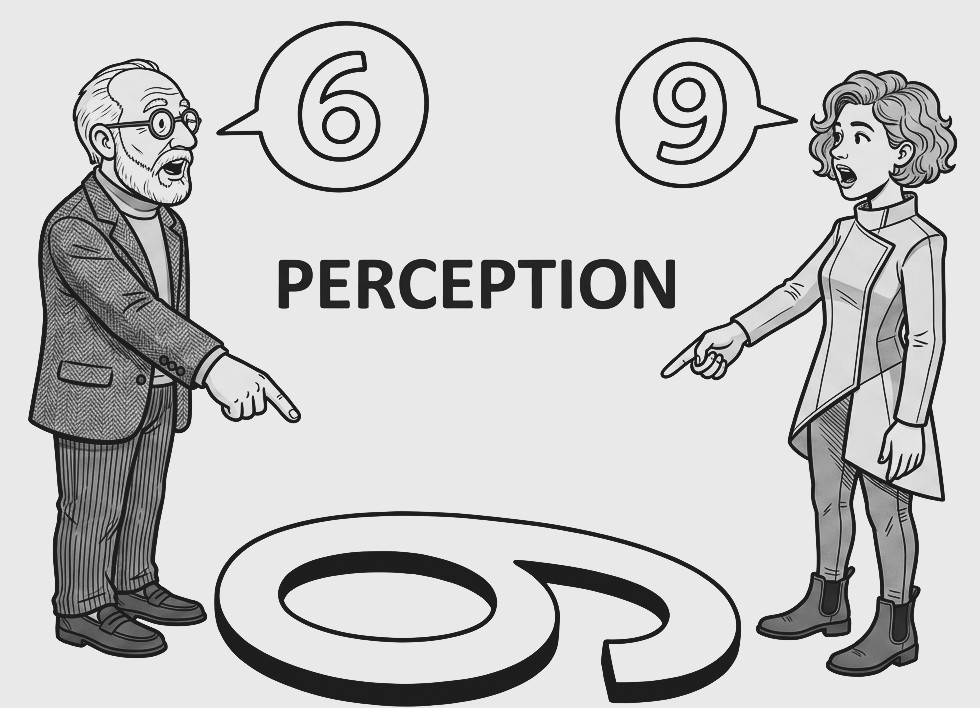
Perception is the process by which individuals select, organize, and interpret sensory stimuli received from their environment to form meaningful information. It is the way people obtain knowledge about external objects and events through their senses.
In simple terms, perception is more than just receiving sensory inputs; it involves interpreting and giving meaning to those inputs. It is the final result of raw and unprocessed sensations, which helps individuals understand and make sense of their work environment.
Thus, perception explains how people “see and understand” reality based on their interpretation rather than just physical stimuli.
In simple terms, perception is the way a person interprets reality, which may or may not be completely accurate.
| Definition: Perception is the process by which individuals select, organize, and interpret sensory stimuli received from their environment through the senses to form meaningful understanding of external objects, events, and their work environment, by converting raw sensations into interpreted knowledge. Simple Definition: Perception is the process by which individuals select, organize, and interpret information received through their senses from the environment to form meaningful understanding of people, objects, and situations. |
Below are some definitions of perception given by popular scholars:
- Bernard and Gray – Perception is defined as the process by which an individual selects, organizes and interprets information inputs to create a meaningful picture of the world.
- Stephen P. Robbins – Perception is a process by which individuals organize and interpret their sensory impressions in order to give meanings to their environment.
- David Krech and Richard Crutchfield: Perception is a cognitive process through which individuals interpret and understand their environment.
- Fred Luthans: Perception is the process by which individuals interpret sensory impressions to give meaning to their environment.
From above definitions, in summary, we can say perception is a cognitive process that forms the basis of an individual’s behavior. It varies from person to person and may not always reflect reality. It plays an important role in organizational life as it is a complex mental process that significantly influences human behavior.
Nature / Features / Characteristics of Perception
- Perception is psychological process
It is a mental (cognitive) process that helps individuals understand their environment. - Perception is subjective
Different people perceive the same situation in different ways based on their experience and background. - Perception is selective
Individuals do not perceive everything; they select only certain information from the environment. - Perception is continuous
It is an ongoing process that keeps changing with new experiences and situations. - Perception is influenced by internal and external factors
Internal factors include personality, attitude, and motivation, while external factors include environment, situation, and stimuli. - Perception may not always be accurate
It is based on interpretation, so it can differ from reality. - Perception is goal-directed
Individuals interpret information based on their needs and objectives. - Base of behavior
It is the base of every individuals behavior/ There can be no behavior without perception without perception. - It can be developed
Perception can be developed through education, experience, training, etc.
Importance of perception
Perception is very important in Organizational Behavior because it directly influences how individuals understand and respond to their work environment.
- It helps individuals understand people, situations, and events in the organization.
- It influences employee behavior and attitude at work.
- It plays a major role in decision-making process.
- It helps in improving communication and interpersonal relationships.
- It affects leadership effectiveness and managerial actions.
- It helps managers to motivate employees based on their understanding.
- It assists in conflict management by understanding different viewpoints.
- It improves workplace coordination and cooperation.
- It helps in predicting and controlling employee behavior.
Perception is essential because it shapes how individuals interpret reality, and this interpretation strongly affects organizational performance and behavior.
Perceptual process
The perceptual process is the way humans organize and interpret sensory information to understand their environment. It explains how we move from simply detecting stimuli to actually making sense of them.
Perception is not a passive activity. It is an active mental process where the brain selects important information, ignores irrelevant data, and creates meaning based on experience, expectations, and context.
Main Stages of the Perceptual Process
- Environmental Stimulus
This is the starting point of perception.
At this stage, everything exists in the environment but is not yet noticed by the individual.- The environment contains many stimuli such as sounds, light, objects, people, and events.
- These stimuli are present in raw form and may or may not attract attention.
- Example: noise in a classroom, advertisement on a billboard, or a ringing phone.
- Attention / Receiving Stimulus
Not all stimuli are noticed. Only some are selected.- The brain focuses on certain stimuli while ignoring others.
- This is called selective attention.
- Factors affecting attention:
- Intensity (loud sound, bright color)
- Size (large object attracts more attention)
- Contrast (something different from surroundings)
- Personal interest or need
- Example: In a noisy street, you may still hear your name being called.
- Registration (Sensory Reception)
At this stage, the sensory organs receive the stimulus.- Eyes, ears, nose, tongue, and skin collect information.
- The stimulus is converted into sensory input.
- Example:
a. Eyes receive light from a moving car
b. Ears receive sound waves from speech - This stage is purely biological.
- Transduction
This is the conversion stage.- Sensory receptors convert physical energy into electrical signals (nerve impulses).
- These signals are sent to the brain through the nervous system.
- Example: Light → retina → electrical signal → brain
- Organization of Information
The brain organizes the received information.- Raw data is structured into meaningful patterns.
- The brain groups similar things together.
- It uses principles like:
- Similarity
- Proximity
- Continuity
- Closure
- Example:
a. We see separate dots as a complete circle.
b. When you see many dishes, tables, waiters, and lights inside a restaurant, your brain organizes all these separate details and identifies the place as a “restaurant.”
- Interpretation / Perception
This is the most important stage.- The brain assigns meaning to the organized information.
- Interpretation depends on:
- Past experience
- Culture
- Knowledge
- Expectations
- Emotions
- Example: A loud sound may be interpreted as danger or fireworks depending on context.
- Response / Behavior
After interpretation, the person reacts.- The response may be physical or emotional.
- It can include speaking, moving, ignoring, or reacting emotionally.
- Example:
a. Seeing a friend → smiling and greeting
b. Seeing danger → running away
| Simple Example of Full Process (You hear a bell ring): |
|---|
| 1. Environmental stimulus → Bell sound exists 2. Attention → You notice the sound 3. Sensory reception → Ear receives sound waves 4. Transduction → Sound becomes nerve signals 5. Organization → Brain identifies it as a bell 6. Interpretation → “Class is over” 7. Response → You stand up and leave |
Factors influencing perception
Perception is not always the same for every person. Different people may perceive the same situation differently because perception is influenced by many factors. These factors shape how individuals select, organize, and interpret information from the environment.
The factors influencing perception can be broadly divided into three categories:
a. Factors in the Perceiver
b. Factors in the Target
c. Factors in the Situation
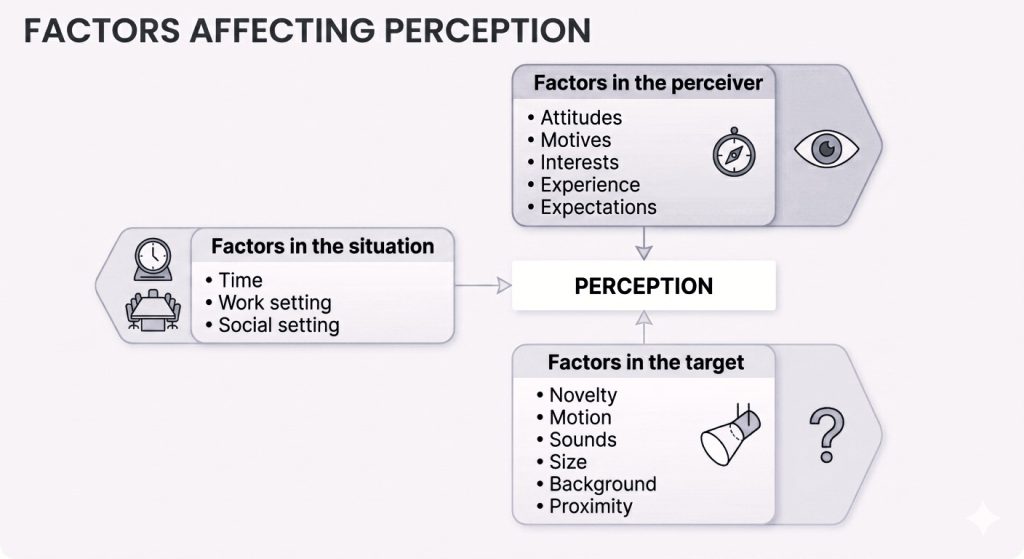
- Factors in the Perceiver
These are factors related to the individual who is perceiving.
People are unique in nature. They differ from each other in terms of perceptual activity. These factors are inside a person. Among the internal factors, the most important are:- Attitude: A person’s attitude affects how they see things. For example: An employee with a positive attitude may see extra work as an opportunity, while another may see it as a burden.
- Positive attitude leads to positive perception.
- Negative attitude leads to negative perception.
- Motive or Need: Needs and desires strongly influence perception. A person’s most urgent needs and desires at any given time can influence perception. For example: A hungry person notices food advertisements more quickly than others.
- Interest : People pay more attention to things that match their interests. We perceive those things quickly for which we have a deep interest. For example: A football fan notices sports news immediately.
- Experience : Past experiences affect present perception. Successful experiences enhance and boost up the perspective ability and lead to accuracy in perception and vice versa. For example: A guest who previously received good hotel service may expect similar service again.
- Expectations : People often perceive things according to what they expect to see. For example: If customers expect excellent service in a five-star hotel, they may judge small mistakes more critically.
- Emotions : Emotional state influences perception. For example: A stressed person may misunderstand a simple comment as criticism.
- Attitude: A person’s attitude affects how they see things. For example: An employee with a positive attitude may see extra work as an opportunity, while another may see it as a burden.
- Factors in the Target (Object Factors)
These are characteristics of the object, person, or event being observed. They can also affect or influence our perception-except factors in the perceiver. They are outside the people but withing the things that an individual is trying to perceive.- Intensity : Bright colors, loud sounds, or strong smells attract attention. For example: A loud alarm immediately grabs attention.
- Size : The size of the things is closely related to intensity. Larger objects attract more attention. For example: A large billboard is noticed faster than a small poster.
- Contrast : Objects that stand out from surroundings are noticed more. For example::A person wearing red in a crowd wearing black attracts attention.
- Movement / Motion : The motion principle says that moving objects attract more attention than stationary objects. For example: Flashing hotel signboards catch people’s eyes quickly.
- Repetition : Repeated messages are more likely to be perceived. For example: Repeated advertisements help customers remember a brand.
- Novelty and Familiarity : This principle says that novel (new) or familiar things in the environment attract attention. For example: Tourists may notice unique cultural practices because they are different from their own culture.
- Sound : Louder and frequent is the sound easier and quicker will be the perception and vice-versa.
- Proximity (nearness) : The things that are proximate to time or physical settings are perceived easily and quickly.
- Background : The smaller or larger background also affects perception.
- Similarity : If the things are similar to us, we perceive it easily and quickly. For example: A student can quickly identify classmates wearing the same school uniform because their appearance is similar.
- Factors in the Situation (Situational Factors)
Beyond those two categories of factors, perception is also influenced by the surrounding environment and situation. These factors exist outside the individual and the object and are situational in nature.
In other words, the same object may be perceived differently in different situations, or it may be noticed in one situation but ignored in another.- Time : Perception may change according to time. For example: A joke may seem funny during leisure time but inappropriate during a serious meeting.
- Work Setting : Environment affects perception. For example: A clean and organized hotel lobby creates a positive impression.
- Social Setting : The presence of other people influences perception. For example: People may behave differently in a formal event than in a casual gathering.
| Extra Just for Knowledge Only Perceptual Errors : These are mistakes in understanding or judging people and situations, where we form wrong perceptions due to bias, emotions, or limited information. Major types of Perceptual Errors: a. Halo Effect : When we judge a person based on one positive trait. For example: A student who is very good in one subject is assumed to be good in all subjects. b. Horn Effect : Opposite of halo effect; one negative trait affects overall judgment. For example: If an employee is late once, the manager may think they are always irresponsible. c. Stereotyping : Forming judgment about a group based on general belief. For example: Assuming all hotel staff from a certain region are lazy or hardworking. d. Selective Perception : We interpret only what we want to see based on our expectations. For example: A manager notices only mistakes of an employee and ignores their good work. e. Projection : Attributing our own feelings or traits to others. For example: A dishonest person may think others are also dishonest. f. First Impression Error : Forming a judgment based on initial interaction. For example: Deciding a receptionist is rude after one short conversation. g. Contrast Effect : Judging someone by comparing them with others. For example: A good employee may seem average when compared to an exceptional employee. |
Perception and individual decision making
Individual decision-making is the process by which a person identifies a problem, evaluates alternatives, and selects the best course of action.
Perception and individual decision-making are closely related concepts in Organizational Behavior. Perception refers to how a person selects, organizes, and interprets information from the environment, while decision-making refers to the process of choosing the best alternative from available options. The way an individual perceives a situation directly influences the decisions they make.
In simple terms, people do not make decisions based on reality itself, but based on how they perceive reality. Since perception differs from person to person, decision-making also varies among individuals even in the same situation.
Decision-making is a process of identifying a problem, evaluating alternatives, and selecting the best solution. Most decisions arise from problems or gaps between desired performance and actual performance. However, whether a situation is seen as a problem or opportunity depends on perception.
Thus, perception defines:
- What is considered a problem
- How information is interpreted
- Which alternatives are selected
- What final decision is made
Role of Perception in Decision Making Process
- Problem Identification : Perception helps individuals identify whether a situation is a problem or not. If perception is incorrect, the problem itself may be wrongly defined.
- Information Collection : People selectively gather information based on what they perceive as important. Irrelevant information may be ignored due to selective perception.
- Evaluation of Alternatives : Different individuals evaluate the same alternatives differently because of differences in perception, experience, and expectations.
- Choice of Alternative : Final selection of an alternative is highly influenced by how a person perceives risks, benefits, and outcomes.
- Implementation and Feedback : Even after making a decision, perception affects how success or failure is interpreted and how feedback is understood.
Why Perception Differs in Decision Making
Perception varies due to:
- Past experience
- Attitudes and values
- Emotions
- Expectations
- Cultural background
- Individual biases
Because of these differences, two people may make completely different decisions in the same situation.
For Example:
Two employees are given the same difficult task:
- Employee A perceives it as a burden (Perception) → avoids responsibility (Decision-making)
- Employee B perceives it as a learning opportunity (Perception) → accepts it positively (Decision-making)
Same situation, different perception, different decisions.
Hence, in conclusion, we can say that perception is the foundation of individual decision-making. It shapes how problems are defined, how information is processed, and how alternatives are chosen. Since perception varies among individuals, decision-making also varies. Therefore, understanding perception is essential for improving the quality and effectiveness of decisions in organizations.
Concept of Learning
Learning is a process of change in behavior that occurs through experience, practice, observation, or training. It helps individuals adjust to their environment and improve their knowledge, skills, attitudes, and behavior.
Learning brings modification in behavior, and the learned behavior can usually be retained for a certain period of time. Therefore, learning results in a relatively permanent change in behavior.
Learning is not a meaningless or useless activity. It is generally goal-oriented and need-directed, meaning people learn things to fulfill their needs, solve problems, or improve performance.
Learning is also considered a prerequisite for behavior because most human behaviors are learned.
Example:
- An employee’s working skills
- A manager’s leadership style and attitude
- A receptionist’s manners and communication skills
- Housekeepers perfect bed making and towel art skills
- Waiter taking order correctly and doing professional service
Therefore, managers need to understand:
- how learning occurs,
- what people learn,
- and why people learn,
so that they can improve employee performance and organizational effectiveness.
| Definition : Learning is a continuous process through which an individual acquires Skills, Habit, Attitudes, Knowledge and Experiences (SHAKE) that bring a relatively permanent change in behavior. It occurs through education, training, observation, practice, and experience, and helps individuals adjust effectively to their environment and improve their performance. Simple Definition: Learning is the process of gaining knowledge or skills through experience and practice that brings change in behavior. |
Given below are a few important definitions of learning according to popular scholars:
- Stephen P. Robbins: Learning is any relatively permanent change in behavior that occurs as a result of experience.
- Hilgard and Bower: Learning refers to the change in a subject’s behavior or behavior potential due to experience.
- Steers and Porter : Learning can be defined as relatively permanent change in behavior potentially that results from reinforced practice or experience.
- Moorhead and Griffin : Learning is a relatively permanent change in behavior or behavioral potential resulting from direct or indirect experience.
Significance of Learning
Learning is very important for individuals and organizations because it helps in developing Skills, Habit, Attitudes, Knowledge and Experiences (SHAKE). It supports personal growth and improves performance in different areas of life.
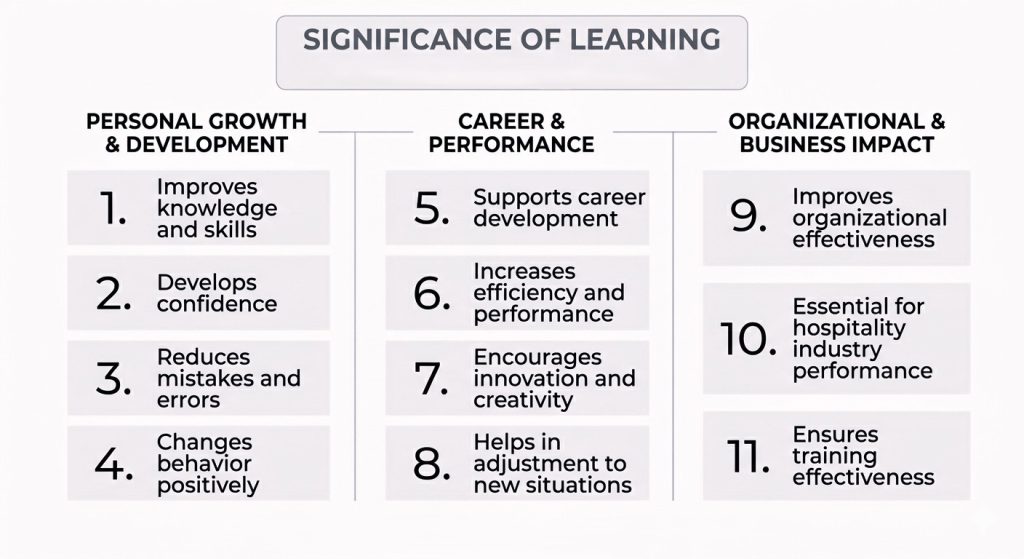
- Improves Knowledge and Skills : Learning helps individuals gain new knowledge and develop practical skills required for work and daily life. So, to maintain or improve the desired level of skills among employees, the managers attempt to design a learning element in jobs.
- Changes Behavior Positively : It brings positive changes in attitude, habits, and behavior, making individuals more responsible and professional.
- Helps in Adjustment : Learning helps people adjust to new situations, environments, and changes in society or workplace. Example: Employees learning new technology in hotels.
- Increases Efficiency and Performance : Trained individuals perform tasks more quickly, correctly, and efficiently.
- Supports Career Development : Continuous learning improves career growth, promotion chances, and job opportunities.
- Reduces Mistakes : Proper learning helps individuals avoid errors and improves accuracy in work.
- Develops Confidence : Learning increases self-confidence and helps individuals handle challenges effectively.
- Encourages Innovation : It promotes creativity and new ideas, leading to better problem-solving.
- Ensures training effectiveness : Training becomes successful only when learning takes place and leads to behavioral change
- Improves Organizational Effectiveness : In organizations, learning improves employee performance, teamwork, and productivity.
- Essential for Hospitality Industry : In hospitality, learning improves customer service, communication, and guest satisfaction. Example: A waiter learning polite communication and service standards.
Principles of Learning
Principles of learning are the basic rules or guidelines that explain how people learn effectively. These principles help individuals and organizations improve the learning process and make it more meaningful and result-oriented.
A person’s or employee’s learning depends on certain principles of learning. These principles have been developed by psychologists through research and experiments. They explain how learning takes place in a more effective and scientific way.
Learning becomes more effective, less costly, and easier when managers apply these principles in organizations. In Organizational Behavior (OB), these principles are important for improving training, performance, and employee development.
In Organizational Behavior, principles of learning are discussed from two perspectives:
A. Educational Perspective (How to make people learn better?)
This perspective focuses on improving the learning process so that individuals can learn effectively.
- Principles of Readiness : Learning takes place only when a person is mentally and physically ready to learn. If someone is not prepared or interested, learning will not be effective. For example: A tired employee cannot learn training properly after a long shift.
- Principles of Exercise (Practice) :Learning improves through repetition and continuous practice. The more a person practices something, the stronger the learning becomes. For example: A waiter becomes perfect in serving food by doing it repeatedly.
- Principles of Effect : Learning becomes stronger when it produces a positive and satisfying result. If the outcome is good, the person is more likely to repeat the behavior. For example: If an employee is praised for good work, they will continue performing well.
- Principles of Primacy : First learning or first impression is very strong and long-lasting. What we learn first is remembered better. For example: First training experience in a hotel strongly affects an employee’s working style.
- Principles of Intensity : Strong, clear, and emotional experiences are learned better than simple or weak experiences. For example: A real-life emergency training is remembered more than just reading instructions.
- Principles of Recency : The most recent information is remembered more easily than old information. Fresh learning stays stronger in memory. For example: Students remember last day revision better during exams.
- Principles of Multi-sensory Learning : Learning becomes more effective when more than one sense is used like seeing, hearing, and doing. It improves understanding and memory. For example: Learning hotel service by watching, listening, and practicing is more effective than just reading.
- Principles of Levels of Learning : Learning happens in different stages:
- Knowledge (knowing)
- Understanding (comprehending)
- Application (using in real life)
- Behavior change (permanent improvement)
Example: A trainee first learns rules, then understands them, then applies them, and finally improves behavior at work.
B. Principles of Learning: Managerial Perspective (How to derive desired behavior?)
This perspective focuses on how managers can shape employee behavior in organizations. It explains how learning can be used to develop desired behavior and reduce unwanted behavior at work.
- Reinforcement : Reinforcement means encouraging and strengthening desired behavior by providing positive outcomes or rewards.
When employees are rewarded or appreciated for good performance, they are more likely to repeat that behavior again.
For example : A waiter who receives praise or tips for good customer service will continue serving guests politely and efficiently. - Punishment : Punishment means discouraging or reducing unwanted behavior by applying negative consequences.
It is used when employees show poor performance or violate rules.
For example: An employee may receive a warning or salary cut for being late repeatedly.
Factors influencing Learning
Learning is influenced by several internal and external factors. These factors determine how effectively a person learns and how quickly they can acquire and retain knowledge, skills, and behavior.
- Motivation : Learning is strongly influenced by motivation. A person learns better when they have a strong desire or need to learn. Example: An employee learns faster when training is linked to promotion or reward.
- Readiness : A person learns effectively only when they are mentally and physically ready.
Example: A tired or stressed employee may not learn properly during training. - Ability (Intelligence) : Individual ability, intelligence, and capacity affect the speed and quality of learning. Example: Some employees learn new software faster than others.
- Practice (Repetition) : Regular practice helps strengthen learning and makes it long-lasting. Example: A waiter improves service skills through daily practice.
- Environment : A good learning environment such as proper lighting, training materials, and supportive atmosphere improves learning. Example: A quiet and well-organized training room improves concentration.
- Teaching Method / Training Style : The way learning is delivered affects understanding. Interactive and practical methods are more effective than lecture-only methods. Example: Role-play training in hotels is more effective than only theory classes.
- Previous Experience : Past experience helps in understanding new learning more easily. Example: A person who already worked in a hotel learns new procedures faster.
- Feedback : Feedback helps learners know their mistakes and improve performance. Example: A trainer correcting a waiter’s service technique improves learning.