
- Past Board Questions
- Concept of Organizational Change
- Nature of Organizational Change
- Forces of Organizational Change
- Resistance to Change
- Approaches to Managing Organizational Change
- Concept of Organizational Development (OD)
- Features of Organizational Development (OD)
- Values of Organizational Development (OD)
- Prerequisites to Organizational Development (OD)
Past Board Questions
- State different values to Organizational Development (OD). (1 Mark – 2024)
- “Change is a natural and inevitable process, however, employees resist change”. Based on this statement, explain why people resist change? Also, suggest different approaches to manage to change in organization. (10 Marks – 2024)
Concept of Organizational Change
| Simple Definition : Organizational change is the process of modifying structure, technology, or behavior of an organization to improve effectiveness and adapt to environmental changes. Definition : Organizational change refers to the planned or unplanned process of modifying or transforming an organization’s structure, cultures, technology, processes, or people in order to improve effectiveness and adapt to the changing environment achieving desired outcome. |
In simple words, organizational change means moving from the current way of working to a better and improved way of working. It is necessary because organizations operate in a dynamic environment where customer needs, technology, competition, and government policies keep changing.
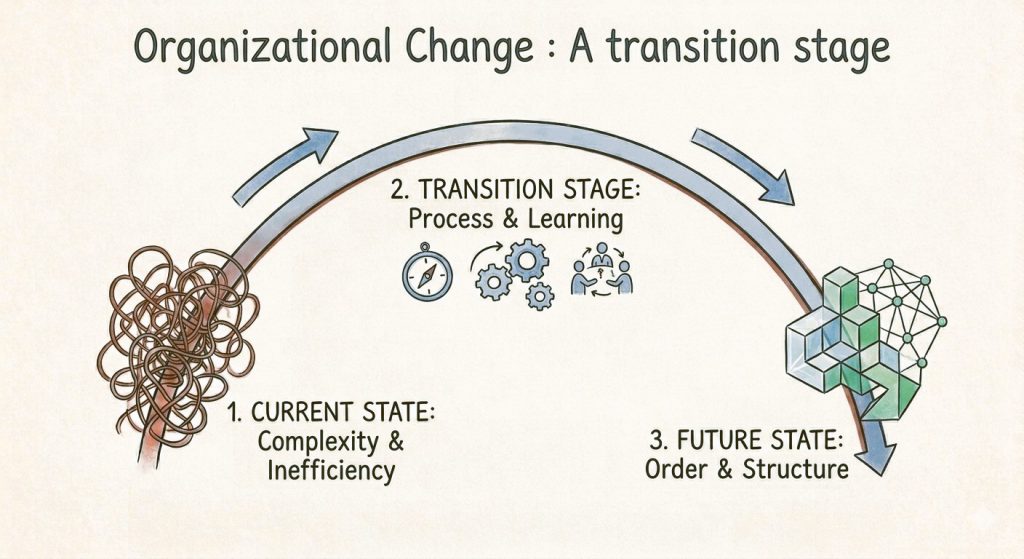
Organizational change can be planned or unplanned. Planned change is intentionally designed by management to improve performance, while unplanned change happens due to sudden external or internal situations such as crises, market shifts, or technological disruptions.
Change in an organization is not limited to physical structure; it also includes changing employee behavior, attitude, work culture, leadership style, and communication system. For example, introducing new software in a hotel, restructuring departments, or changing customer service policies are all forms of organizational change.
Nature of Organizational Change
The nature of organizational change explains the basic characteristics or features of how change occurs in an organization. It shows how change behaves inside organizations and how it affects people, systems, and processes. Organizational change is not a simple or one-time activity; it is a complex and continuous process influenced by internal and external factors.
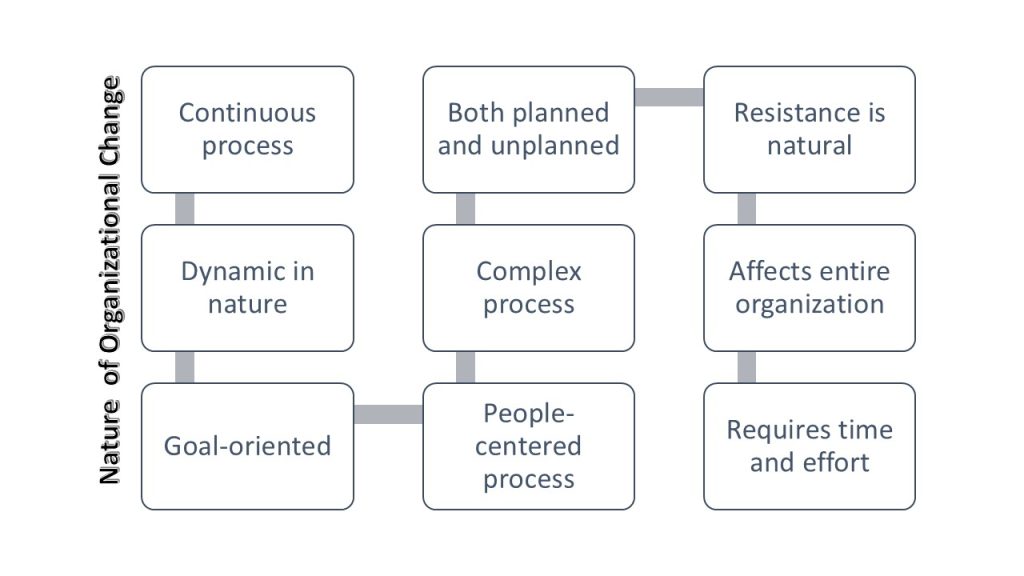
- Continuous Process : Organizational change is not a one-time activity. It happens continuously over time because the business environment keeps changing.
- Organizations must constantly update systems, policies, and technology.
- Change is ongoing for survival and growth.
- Dynamic in Nature : Change is always dynamic, meaning it is never fixed or stable.
- It changes according to market conditions, technology, and customer needs.
- Organizations must adjust quickly to remain competitive.
- Goal-Oriented : Organizational change is always done with a specific objective or goal. Without goals, change has no direction.
- People-Centered Process : Change mainly affects employees and their behavior. For example: Staff training is required when new software is introduced.
- Employees must learn new skills and adapt to new systems.
- Success of change depends on employee acceptance. : Change mainly affects employees and their behavior.
- Complex Process : Organizational change is not simple; it is complex and multi-layered.
- It involves structure, technology, culture, and people together.
- Many departments and levels are involved.
- Both Planned and Unplanned : Change can occur in two ways:
- Planned change: Designed and implemented by management (e.g., new policy)
- Unplanned change: Happens suddenly due to external factors (e.g., crisis, pandemic like COVID 19)
- Resistance is natural : Employees often resist change because there might be fear of job loss, fear of new skills and comfort with old methods. So resistance is a natural part of change.
- Affects Entire Organization : Change does not affect only one department; it affects the whole organization.
- Requires Time and Effort : Change cannot happen instantly as it needs planning, training, and implementation time. Also, employees need time to adjust change.
Forces of Organizational Change
Forces of organizational change are the factors that create pressure for change in an organization. These forces push organizations to modify their structure, technology, people, or processes in order to survive, grow, and remain competitive.
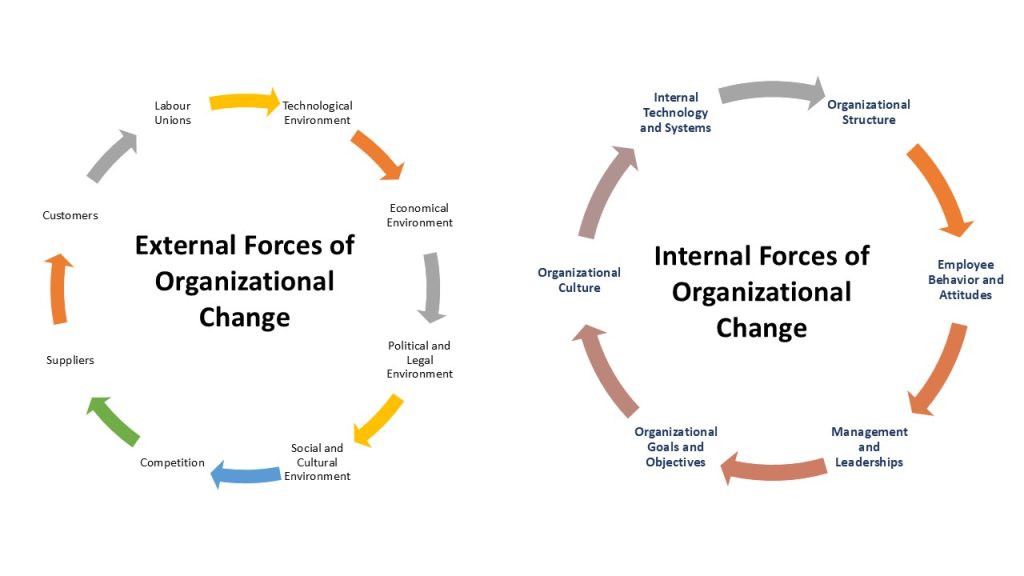
These forces are mainly divided into two categories: Internal forces and External forces.
A. External Forces of Organizational Change
External forces are the factors that come from outside the organization. The organization has little control over external forces (variables), so it must adapt. They might affect both directly and indirectly. External factors provides both opportunities and threats.
External forces for changes arise from general environment and task environment. Forces in general environment are political, economical, socio-technological and legal. These forces affect the organizations indirectly.
Next, task related environmental forces that bring the change consist of customers, competitors, suppliers and labour unions. They affect the organization directly.
- Technological Environment : Technology is one of the fastest-changing external forces. New innovations like automation, artificial intelligence, online systems, and digital tools have changed how organizations work. Businesses that fail to adopt new technology become slow and less competitive.
- Introduces new working methods
- Increases efficiency and speed
- Requires employee training and adaptation
- Makes traditional systems outdated
- Economic Environment : Economic conditions of a country or global market directly affect organizational performance. Factors like inflation, recession, interest rates, and consumer income influence demand for goods and services.
During good economic conditions, organizations expand and invest more. But during economic downturns, they focus on cost-cutting and survival strategies.- Affects customer purchasing power
- Influences profit and investment decisions
- May lead to expansion or downsizing
- Forces pricing and cost adjustments
- Political and Legal Environment : Government policies, laws, and political stability strongly affect how organizations operate. Organizations must follow rules related to taxation, labor, environment, and business operations. For example, strict environmental laws may force industries to adopt eco-friendly production methods. Similarly, labor laws may require better employee benefits and working conditions.
- Ensures compliance with laws and regulations
- Affects business stability and planning
- May increase operational costs
- Requires policy and structural adjustments
- Social and Cultural Environment : Social values, beliefs, lifestyle, and cultural trends keep changing over time. Organizations must understand these changes to meet customer expectations. For example, increasing health awareness has led restaurants and hotels to offer healthy food options. Similarly, demand for sustainable and eco-friendly services is growing.
- Changes customer preferences
- Influences product and service design
- Encourages ethical and sustainable practices
- Requires cultural sensitivity in business
- Competition : Competition forces organizations to continuously improve their performance. In a competitive market, businesses must innovate, improve quality, and offer better services to survive. For example, in the hospitality industry, if one hotel introduces digital services, others are also forced to follow to stay competitive.
- Encourages innovation and improvement
- Improves product and service quality
- Affects pricing strategies
- Forces continuous adaptation
- Globalization : Globalization connects businesses worldwide and increases competition beyond national borders. Organizations now face international standards and global competitors. This forces companies to improve quality, adopt global practices, and expand their market reach.
- Increases global competition
- Encourages international standards
- Expands business opportunities
- Requires cross-cultural understanding
B. Internal Forces of Organizational Change
Internal forces of organizational change are the factors that come from within the organization itself. These forces arise from employees, management, structure, culture, and internal processes. Unlike external forces, internal forces are more controllable by the organization, but they still create the need for change when performance, efficiency, or employee satisfaction is affected.
- Organizational Structure : Organizational structure refers to how roles, responsibilities, and authority are arranged inside the organization. When the structure becomes outdated or too complex, it creates confusion and delays in decision-making, which leads to the need for change.
- Employee Behavior and Attitudes : Employees are one of the most important internal forces of change. Their attitudes, motivation levels, skills, and satisfaction directly affect organizational performance. If employees feel dissatisfied or unmotivated, the organization may need to introduce changes like training, rewards, or better working conditions.
- Management and Leadership : Changes in management style or leadership can also lead to organizational change. Different leaders bring different visions, strategies, and working methods. Sometimes, poor leadership may require restructuring or new management approaches.
- Organizational Goals and Objectives : When an organization changes its goals or long-term objectives, it must also change its structure, strategies, and operations. As markets evolve, organizations may shift their focus to growth, expansion, quality improvement, or cost reduction.
- Organizational Culture : Organizational culture refers to shared values, beliefs, and behaviors within the organization. If the culture becomes weak or negative, it can reduce productivity and employee satisfaction, leading to the need for cultural change.
Resistance to Change
Resistance to change refers to the unwillingness or opposition of employees or organizations to accept changes in the workplace. It occurs when people feel uncomfortable, uncertain, or threatened by new ideas, technologies, policies, or working methods. Resistance is a natural human reaction because people generally prefer stability and familiar routines over sudden changes.
The resistance may be overt as well as covert (exposed and hidden). It may further be individual or organizational. Overt resistance may be expressed through strikes, reduced productivity, shoddy work (न्यून काम), and even sabotage (तोडफोड). Covert resistance mat be expressed by increased tardiness (ढिलो आउने) and absenteeism, request for transfers, resignations, loss of motivation, lower morale and higher accident or error rates.
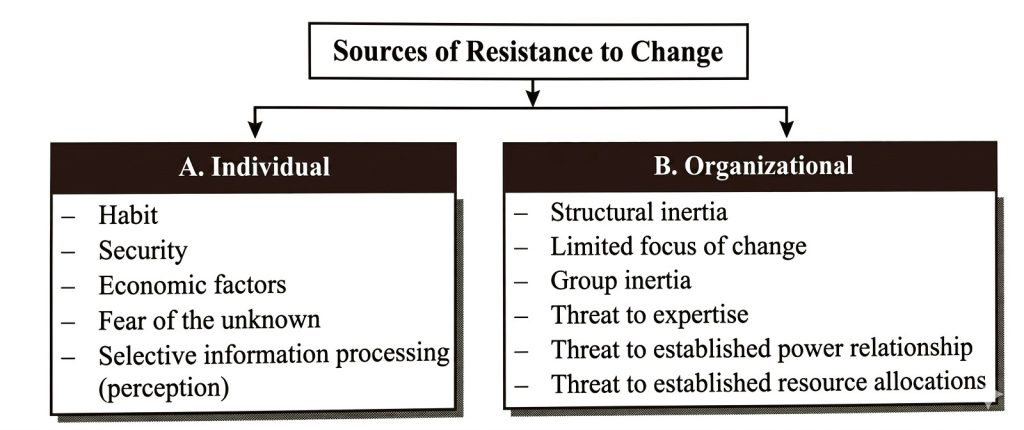
A. Individual Sources of Resistance
It is general tendency (nature) of people to resist change. Individual resistance arises from habits, personal feelings, attitudes, perceptions, and fears of employees. Different individuals react differently to change depending on their mindset and situation.
- Habit : People naturally prefer familiar routines and working methods. Habits make employees comfortable in their current environment, so they may resist changes that require learning new skills or changing old practices. For example, employees who are used to manual systems may resist computerized systems because they are comfortable with traditional methods.
- Security : Employees may feel that change threatens their job security, position, salary, or future stability. Whenever employees feel unsafe about their future in the organization, resistance increases. For example, automation and new technology may create fear of job loss among workers.
- Economic Factors : Employees may resist change if they believe it could negatively affect their income, incentives, promotions, or other financial benefits. For example, workers may oppose new production systems if they think it will reduce overtime opportunities or bonuses.
- Fear of the Unknown : Change bring unknown fear which causes anxiety. People often fear situations they do not fully understand. When organizations introduce major changes without proper explanation, employees become anxious about what may happen in the future. For example, employees may worry about whether they can adapt to new technology or new responsibilities.
- Selective Information Processing (Perception) : People resist change because of perceptual error. Individuals often interpret information according to their own beliefs and perceptions. Employees may only focus on the negative aspects of change while ignoring the benefits. For example, an employee may believe that a new system only increases workload, even though it improves efficiency overall.
B. Organizational Sources of Resistance
Another category of resistance to change is organizational resistance to change. Organizational resistance arises from the structure, culture, systems, and policies of the organization itself. Sometimes organizations become too rigid and difficult to change quickly. Some organizations are so designed that they resist innovations.
- Structural Inertia : Organizations develop stable structures, rules, policies, and procedures over time. These systems are designed to maintain stability, so they naturally resist sudden changes. For example, large organizations with many rules and formal procedures often adapt slowly to change.
- Limited Focus of Change : Organizations are made up of interconnected departments and systems. Changing one part without adjusting others may create imbalance, causing resistance. For example, introducing new technology in one department without training related departments may create coordination problems.
- Group Inertia : Sometimes work groups or teams resist change together because of shared norms, values, or peer pressure. Even if individuals support change, group influence may discourage them from accepting it. For example, labor unions may collectively oppose management decisions regarding organizational restructuring.
- Threat to Expertise : Employees or managers who are experts in current systems may resist change because new methods can reduce the importance of their skills and knowledge. For example, senior employees skilled in traditional systems may feel threatened by advanced digital technology.
- Threat to Established Power Relationships : Change may disturb existing authority and power relationships within the organization. Managers or departments with strong influence may resist changes that reduce their control. For example, decentralization may reduce the decision-making power of top management.
- Threat to Established Resource Allocations : Departments or individuals who control organizational resources may resist changes that reduce their budget, staff, or other resources. For example, a department may oppose restructuring if it fears losing funding or employees.
Overcoming or Managing Resistance to Change
Not all change programs are guaranteed to succeed. To ensure the effectiveness of change programs, managers must successfully deal with and overcome resistance to change. Organizations can reduce resistance through proper planning and employee involvement.
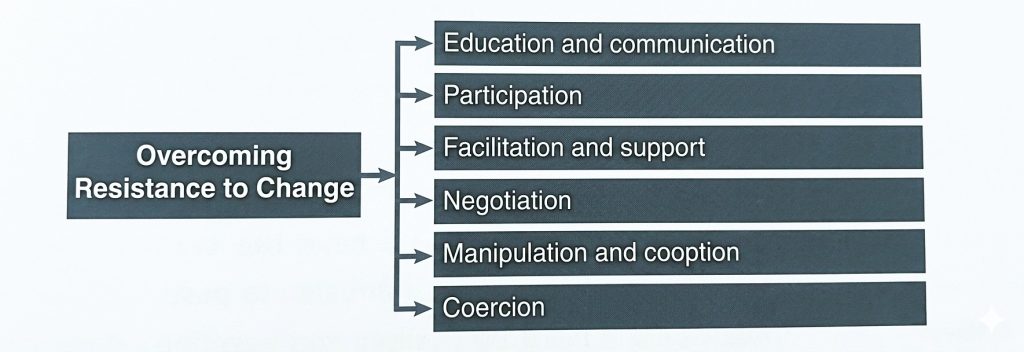
Organizations use different methods to reduce or overcome resistance to change so that change programs can be implemented smoothly.
Methods to Overcome Resistance:
- Education and Communication : This involves explaining the need for change to employees. Managers communicate clearly about why change is necessary and how it will benefit the organization and employees. Proper communication reduces fear, rumors, and misunderstandings.
- Participation and Involvement : Employees are involved in the decision-making process of change. When people participate in planning and implementation, they feel ownership of the change and are more likely to support it.
- Facilitation and Support : This method provides employees with training, counseling, and emotional support to help them adjust to change. It reduces anxiety and helps them cope with new situations.
- Negotiation : Managers offer incentives or rewards to employees in exchange for their acceptance of change. It is useful when a specific group is strongly resisting change.
- Manipulation and Co-option :
- Manipulation means selectively providing information to influence employees’ opinions about change. Managers may highlight only the positive side of the change and hide or downplay the negative aspects to gain acceptance.
- Co-option means involving a resistant person in the decision-making process by giving them a role, so they feel responsible for the change and are less likely to oppose it.
For example: If senior employees are resisting a new working system, management includes one of them in the change committee. Because they are part of the decision-making team, they are more likely to support and promote the change among others.
- Coercion : This is the use of authority, rules, or pressure to enforce change. Employees are forced to accept change through threats or disciplinary action. It is a last resort method because it may create dissatisfaction.
Approaches to Managing Organizational Change
Organizations use different approaches to plan, implement, and control change effectively. The main approaches are:
- Lewin’s Three-Step Model
- Kotter’s Eight-Step Model
- Action Research Approach
- Organizational Development (OD) Approach
- Contingency Approach
A. Lewin’s Three-Step Model
Lewin’s Three-Step Model is one of the most classic and widely used frameworks for managing organizational change. It explains how organizations can move from a current state to a desired future state in a simple three-stage process: Unfreezing, Changing, and Refreezing.
In the year 1951, Kurt Lewin, a pioneering social psychologist, has developed a new way of looking at change. His model is also called force field analysis.
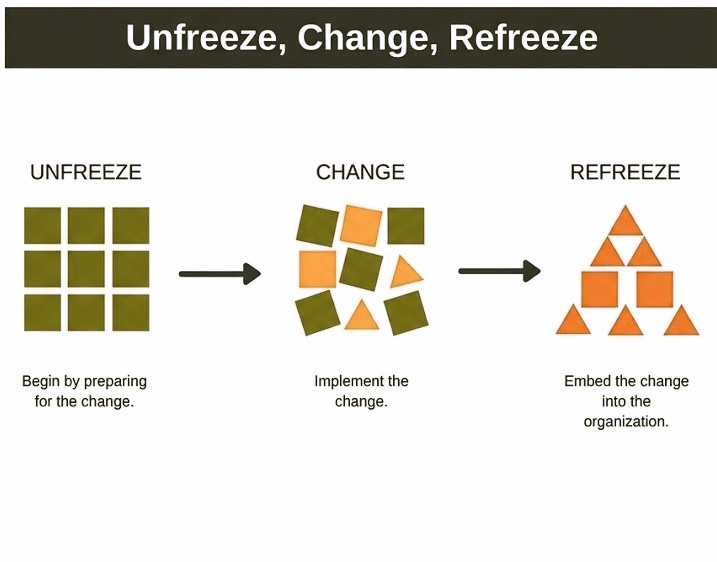
It is a more constructive and scientific approach for analyzing a change situation. It has proved to be highly useful tool to the action-oriented managers.
Explanation of Three Stages in Lewin’s Change Model:
- Unfreezing (Preparing for Change) :
Unfreezing is the first and most important stage. It involves preparing the organization and employees to accept that change is necessary.
At this stage, the existing mindset, habits, routines, and behaviors are “unfrozen” because people are naturally comfortable with the current situation and may resist change. It’s main purpose is to make employees realize that continuing with the current situation is not beneficial and change is necessary.
Key Activities in Unfreezing Stage:- Creating awareness about the need for change
- Breaking old habits and attitudes
- Communicating problems in the current system
- Reducing resistance through motivation and communication
- Creating a sense of urgency
- Changing (Movement Stage) :
This is the stage where actual change takes place. New processes, systems, behaviors, or structures are introduced. Employees begin to learn and adapt to the new way of working. It’s purpose is to move the organization from the old way of working to the new desired state.
Key Activities in Changing / Movement Stage:- Implementing new systems or technologies
- Providing training and development
- Changing organizational structure or roles
- Encouraging new behaviors and practices
- Supporting employees during transition
- Refreezing (Stabilizing the Change) :
Refreezing is the final stage where the new change is made permanent and becomes part of the organizational culture. Without refreezing, employees may go back to old habits. It’s purpose is to ensure that the change is fully accepted and maintained over time.
Key Activities in Refreezing Stage:- Reinforcing new behaviors through rewards and recognition
- Updating policies and procedures
- Monitoring performance
- Providing continuous support
- Strengthening new norms and culture
| Lewin’s model explains change as a simple and logical process: Unfreeze the old system → Implement change → Refreeze the new system. |
According to Lewin, there are two types of regular forces that affect change.
- a. Driving Forces : Forces that favor or support change.
- b. Restraining Forces : Forces that oppose or block change.
Explanation:
- Driving Forces
Driving forces are factors that encourage, support, or push an organization toward change. These forces create pressure for improvement and motivate people to adopt new ways of working.
Example:- Technological advancements
- Increased competition
- Customer demands
- Government regulations
- New market opportunities
- Desire for higher productivity
- Innovative leadership
- Restraining Forces
Restraining forces are factors that oppose, resist, or hinder change. These forces maintain the current situation and make change difficult.
Example:- Fear of the unknown
- Lack of skills and knowledge
- Habit and comfort with existing methods
- Job insecurity
- Organizational culture
- Lack of resources
- Poor communication
| Status Quo : It refers to the existing or current state of an organization. It is a condition where driving forces and restraining forces are balanced, resulting in no change. When driving forces become stronger or restraining forces are reduced, the organization moves away from the status quo and change occurs. |
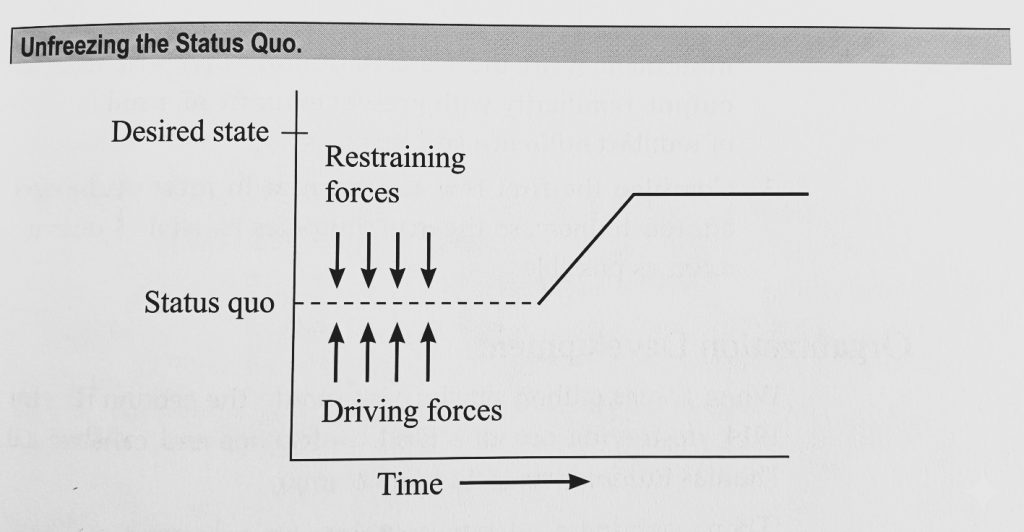
In this above figure, the status quo can be considered to be an equilibrium state.
B. Kotter’s Eight-Step Model
Kotter’s Eight-Step Model of Change was developed by John P. Kotter. It is one of the most widely used approaches to managing organizational change. The model provides a systematic process for implementing change successfully and ensuring that the change becomes a permanent part of the organization.
According to Kotter, many change initiatives fail because organizations do not follow a structured process. His model consists of eight sequential steps that help organizations overcome resistance and achieve lasting change.
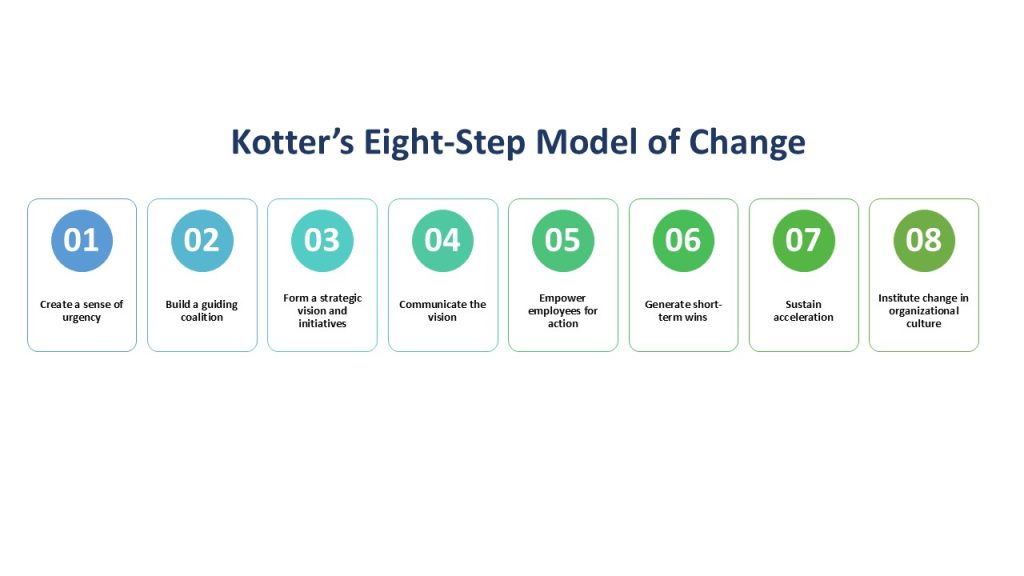
- Create a Sense of Urgency : The first step is to make employees understand why change is necessary and important. Management creates awareness about potential threats, challenges, or opportunities facing the organization.
Purpose:- Motivate people to support change.
- Reduce complacency.
- Encourage immediate action.
- Build a Guiding Coalition : A strong team of influential people is formed to lead and support the change effort. This group should have enough authority, expertise, and credibility to drive the change process.
Purpose:- Provide leadership and direction.
- Gain support from different parts of the organization.
- Form a Strategic Vision and Initiatives : A clear vision is developed to describe the desired future state. The vision helps employees understand the purpose and direction of change.
Purpose:- Provide a clear roadmap for change.
- Align employees toward common goals.
- Communicate the Vision : The vision and objectives of change should be communicated regularly and effectively throughout the organization.
Purpose:- Build understanding and commitment.
- Reduce uncertainty and resistance.
- Empower Employees for Broad-Based Action : Organizations should remove obstacles that prevent employees from supporting the change. Employees should be provided with the resources, authority, and training needed to implement change.
- Encourage participation.
- Enable employees to contribute to change.
- Generate Short-Term Wins : Small, visible successes should be achieved and celebrated early in the change process.
Purpose:- Build momentum.
- Increase employee confidence and motivation.
- Sustain Acceleration (Build on the Change) : After achieving initial successes, organizations should continue improving and introducing additional changes rather than declaring victory too early.
Purpose:- Maintain momentum.
- Prevent employees from returning to old habits.
- Institute Change (Anchor Change in the Culture) : The final step is to make the change a permanent part of organizational culture. New behaviors, values, and practices must be integrated into everyday operations.
Purpose:- Ensure long-term sustainability of change.
- Prevent regression to previous practices.
C. Action Research Approach
The Action Research Approach is a systematic method of studying organizational problems and implementing solutions through a continuous cycle of planning, action, and evaluation. It is widely used in organizational development and change management.
It is called “action research” because it combines taking action to solve a problem with research-based analysis to understand the problem better.
| Definition : Action research is a problem-solving approach in which data is collected, analyzed, and used to implement change, followed by evaluation to improve organizational effectiveness. |
Steps in Action Research Approach:
- Problem Identification : The process begins by identifying a problem in the organization that needs improvement. Example: Low employee performance or poor customer satisfaction in a hotel.
- Data Collection : Relevant information is collected to understand the problem clearly. This may include surveys, interviews, observation, or reports. Example: Collecting guest feedback and employee performance records.
- Diagnosis (Analysis) : The collected data is analyzed to find the root cause of the problem. Example: Analysis shows that slow service is due to lack of staff training.
- Action Planning : Based on the diagnosis, a plan is developed to solve the problem. Example: Planning training programs for staff to improve service speed.
- Action Implementation : The planned solution is implemented in the organization. Example: Conducting training sessions for hotel employees.
- Evaluation : The results of the action are measured to check whether the problem has improved or not. Example: Checking if guest satisfaction scores have increased after training.
- Feedback : Feedback is collected and used to make further improvements if necessary. The cycle may repeat if the problem is not fully solved.
D. Contingency Approach
The Contingency Approach is a modern approach to managing organizational change which states that there is no single best way to manage change. The best method depends on the situation, environment, people involved, and organizational conditions.
The main idea is: “Best way of managing change depends on the situation.” Different organizations face different problems, so they require different solutions.
| Definition : The contingency approach suggests that effective change management practices vary according to different situations, and managers must select the most suitable strategy based on internal and external factors. |
Factors Affecting Contingency Approach
- Organizational Size : Large organizations need more structured and formal change processes, while small organizations can adapt quickly.
- Environmental Conditions : Rapidly changing environments (like technology or competition) require faster and more flexible change strategies.
- Nature of Change : Simple changes need simple methods, while complex changes require detailed planning and involvement.
- Employee Behavior : If employees are highly resistant, managers may need supportive or participative methods.
- Technology : Advanced technology may require training and strong support systems.
Concept of Organizational Development (OD)
Organizational development (OD) is a practical and systematic approach to launching and diffusing / spreading change in organizations. It is an attempt to improve the overall organizational efficiency. It is basically a long-range program attempting to change behavioral attitudes and performance of total organizations.
The word Organizational Development (OD) was coined by Richard Beckhard in the mid 1950s, as a response to the need for integrating organizational needs with individual needs.
| Definition: Organizational Development is a planned effort to improve an organization’s overall performance and health by changing its culture, structure, and people through continuous learning and participation. Simple Definition : OD is a planned, long-term effort to improve an organization’s effectiveness and employee performance through changes in behavior, culture, and processes. |
OD is not a one-time change; it is a continuous process that helps organizations:
- Improve performance
- Increase employee satisfaction
- Strengthen teamwork
- Adapt to environmental changes
It focuses on both human aspects (people) and organizational systems (structure and processes).
Here below are the definitions from various experts:
- Stephen P. Robbins – Organizational Development (OD) is a collection of planned change interventions, built on humanistic – democratic values, which seek to improve organizational effectiveness and employee well-being.
- Bennis – Organizational Development (OD) represents to change, a complex educational strategy purporting to change the beliefs, attitudes, values and organizational structures with a view to effectively adapts to new technologies, markets and challenges and the unsteady rate of change itself.
- Griffin and Moorhead – Organizational Development (OD) is the process of planned change and improvement of the organization through application of the behavioral science.
Features of Organizational Development (OD)
The major features of organizational development (OD) are:
- Planned Process : OD is a carefully planned and systematic effort, not a sudden or random change.
- Long-Term Approach : It focuses on continuous improvement and long-term organizational growth.
- People-Oriented : OD mainly focuses on improving employee behavior, attitudes, and satisfaction.
- Participation and Involvement : Employees and managers actively participate in the change process.
- Based on Behavioral Science : It uses concepts from psychology, sociology, and management to improve organizations.
- Continuous Process : OD is not a one-time activity; it is an ongoing process of learning and improvement.
- Focus on Overall Improvement : It aims to improve both organizational effectiveness and employee well-being.
- Change in Culture and Structure : OD brings changes in organizational culture, structure, and working methods.
- Dynamic Process: OD is dynamic because it continuously adapts to changes in the internal and external environment of the organization.
- Research Based : Most of the OD interventions are research based. OD consultants go through surveys, collect data, evaluate and then take decisions.
Values of Organizational Development (OD)
The values of Organizational Development are the basic beliefs and principles that guide OD practices. They focus on improving both organizational effectiveness and human well-being.
- Respect for People : OD believes that employees should be treated with dignity and respect. People are considered the most important asset of the organization.
- Trust and Openness : OD promotes open communication, honesty, and trust between management and employees.
- Participation : Employees are encouraged to take part in decision-making and change processes.
- Cooperation and Collaboration : OD values teamwork and cooperation rather than competition among employees.
- Continuous Learning and Development : OD supports ongoing learning to improve skills, knowledge, and performance.
- Improvement in Effectiveness : The ultimate goal of OD is to improve organizational performance and efficiency along with employee satisfaction.
Prerequisites to Organizational Development (OD)
Prerequisites are the basic conditions that must be present for OD to be successful.
- Support from Top Management : Top-level management must fully support and commit to the OD program.
- Open Communication System : There must be clear and transparent communication within the organization.
- Employee Participation : Employees should be willing to participate in change activities.
- Trust and Cooperation : A healthy level of trust must exist between management and employees.
- Skilled Change Agents : Trained OD consultants or managers are needed to guide the change process.
- Readiness for Change : The organization and employees must be ready and willing to accept change.
- Supportive Organizational Culture : The culture should support learning, innovation, and flexibility.
Values of OD define what OD believes in, while prerequisites define what conditions are needed for OD to succeed. Both are essential for effective organizational development and successful change implementation.