
Past Board Questions
- Elaborate the term ‘Organizational Stress”. (1 Mark – 2024)
- Organizational stress generally reduces the productivity, so the management should be sincere to identify them and adopt approaches to manage them. In this line, describe the possible organizational stressors and appropriate approaches to manage them. (10 Marks – 2024)
Concept of Conflict
Conflict is a common phenomenon in organizations. It occurs when two or more individuals, groups, or departments have differences in opinions, interests, goals, values, or needs and oppose each other. Conflict is a genetic term starting from misunderstanding to irritation, structure break-down and non-cooperation.
Definition : Conflict is a dynamic process of disagreement, opposition, or interaction between individuals, groups, or organizations arising from perceived differences in goals, interests, values, beliefs, needs, expectations, or access to resources, where one party believes that another party is negatively affecting or may negatively affect its interests.
Simple Definition : Conflict is a disagreement or clash between individuals or groups arising from differences in goals, interests, values, opinions, or perceptions.
Different scholars have defined conflict in different ways:
- Robbins – Conflict is a process that begins when one party perceives that another party has negatively affected, or is about to negatively affects, something that the first party cares about.
- Thomas – Conflict is a process in which an effort is purpose fully made by one person or unit to block another that results in frustrating the attainment of others goals or the furthering of his or her interest.
- Newstrom and Davis – Conflict is any situation in which two or more parties feel themselves in opposition.
Conflict is basic or unavoidable fact of working life.
Nature of Conflict
Some of the major features (nature) of conflict are given:
- Conflict is a Natural Process : Conflict is a normal and unavoidable part of organizational and social life because people have different goals, values, perceptions, and interests.
- There remain mutually exclusive goals : Conflict occurs when two or more parties pursue mutually exclusive goals, values or events. It is based on the assumption that there are two or more parties whose interest or goals appear to be incompatible.
- Involves Two or More Parties : Conflict cannot exist with only one person. It requires at least two individuals, groups, departments, or organizations having opposing views or interests.
- Arises from Differences : Conflict occurs due to differences in opinions, goals, values, beliefs, needs, expectations, or interests among people.
- Perception-Based : Conflict exists when one party perceives that another party is interfering with its interests. The perception of disagreement is often more important than the actual disagreement.
- Dynamic Process : Conflict is not static; it changes over time. It may increase, decrease, be resolved, or reappear depending on the situation.
- Can Be Constructive or Destructive : Conflict may have positive effects such as creativity and innovation (functional conflict) or negative effects such as stress and reduced cooperation (dysfunctional conflict).
- Exists at Different Levels : Conflict can occur at various levels, such as:
- Intrapersonal conflict (within an individual)
- Interpersonal conflict (between individuals)
- Intragroup conflict (within a group)
- Intergroup conflict (between groups)
- Involves Emotions : Conflict often generates emotions such as anger, frustration, anxiety, hostility, or resentment among the parties involved.
- Goal-Oriented : Conflict usually arises when people believe that their goals, interests, or desired outcomes are being threatened or blocked.
- Requires Management : Conflict does not disappear automatically. It needs proper management and resolution to minimize negative effects and maximize positive outcomes.
- Conflict vs Competition : Conflict is different from competition. In conflict one side sees an opportunity to interfere with the other’s opportunity to acquire resources or perform activties. In competition both sides try to win, but neither side actively interferes with the other.
Levels of Conflict
The levels of conflict refer to the different stages or areas where conflict can occur within an organization. Conflict may arise within an individual, between individuals, within groups, or between groups.
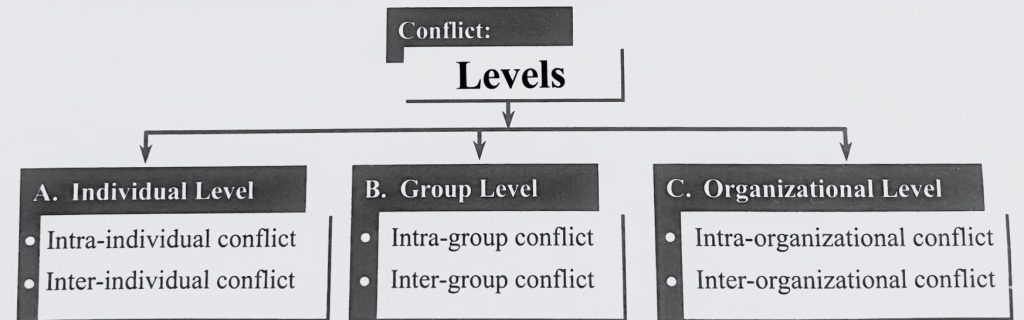
- Intra-individual Conflict (Within a Person) :
It is also called Intrapersonal Conflict. It occurs within a person when they face difficulty in making decisions or choosing between alternatives. It arises due to conflicting goals, values, roles, or expectations.
It is basically an internal struggle.
Example:
a. A hotel employee gets a job offer from another better-paying hotel, but at the same time feels loyal to the current workplace. He gets confused about whether to stay or leave.
Funny example for you:
– एक जना विद्यार्थी exam को लागि पढ्न बसेको हुन्छ। तर उसको दिमाग भन्छ, “अब तुरुन्त पढ्न सुरु गर!” अनि मनले भन्छ, “पहिले 10 मिनेट मात्र TikTok हेर, त्यसपछि पढ्छु।” 😄
– आफ्नो present girlfriend सँग खुशी भएको बेला अचानक ex girlfriend को message आउँदा, केटाले reply गर्ने कि present relationship लाई महत्व दिने भन्ने दोधारमा परेर आफ्नो भित्रै intrapersonal conflict feel गर्छ। - Inter-individual Conflict (Between Individuals) :
It is also called Interpersonal Conflict. This conflict happens between two individuals due to differences in opinion, personality, or working style.
Example:
a. Two front office staff argue because one prefers strict rule-following while the other prefers flexible handling of guests.
b. The quality control supervisor’s job is to find errors in other’s work. But the worker is unhappy with the supervisor leading conflict between supervisor and worker.
Funny example for you:
– One says, “Let’s watch horror movie.” Other replies, “I already have horror in my life—exams!
– One roommate keeps the fan on full speed in winter, while the other is wrapped in a blanket like a mummy and says, “Are you trying to turn this room into Antarctica?”
Sources / Reasons of inter-personal conflict are:- Personality differences : Some people have difficulty in getting along with each other.
- Perceptions/; Because of differences in perception conflict arises quickly and easily.
- Clashes of values and interests
- Power and status differences
- Scarce resources
- Intra-group Conflict (Within a Group) :
This occurs among members of the same team or department. It usually happens due to differences in ideas, responsibilities, or workload.
For example: In the housekeeping department, staff members disagree about who should handle VIP room cleaning duties.
Funny example for you:
– Group wants to choose a restaurant. One says momo, another says pizza, another says burger… Finally they end up eating nothing because decision still “in process”
– Group meeting planned for 5 PM in Chiya Pasal. At 5 PM, one says “I’m coming”, second says “on the way”, third is still sleeping 😴 - Inter-group Conflict (Between Groups/Departments)
This happens when two different departments or teams clash due to different goals or priorities.
For example:
Front office wants rooms ready quickly for guests, but housekeeping needs more time for proper cleaning. This creates tension (conflict) between the two departments.
Funny example for you:
– Group A: “Let’s go café.”
Group B: “No, park is better.”
End result: both groups go home and just scroll TikTok
– Front office says, “Rooms should be ready fast for guests!” Housekeeping replies, “Fast? We are cleaning, not magic show!
Sources / Reasons of inter group conflict are:- Differences in goals : Differences in goals refer to a situation where different groups or departments within an organization have separate and sometimes conflicting objectives. When each group focuses only on its own goals rather than the overall organizational goal, it can create tension and conflict between them.
- Task interdependence : Interdependence occurs when different individuals or departments depend on each other to complete their tasks. When one unit delays or performs poorly, it affects others and leads to conflict, such as kitchen delays affecting F&B operations in a hotel.
- Resource Allocation : Resource allocation is another cause of conflict because organizational resources like money, staff, and equipment are limited. When departments compete for these limited resources, disagreement and conflict arise.
- Competitive rewards system : Competitive reward system also creates conflict when rewards such as bonuses or promotions are based on competition rather than teamwork. In such cases, individuals or departments try to outperform others, reducing cooperation and increasing conflict.
- Intra-organizational Conflict :
Intraorganizational conflict means conflict that happens within the same organization.
It is actually an umbrella category, and it includes:- Interpersonal conflict
- Intragroup conflict
- Intergroup conflict
- Inter-organizational Conflict (Between Organizations) :
This conflict occurs between two or more organizations, usually due to competition or business interests. In this type of conflict, the whole organization fights with another organization. Example: Two hotels in the same area compete aggressively by offering discounts and promotions to attract the same guests.
Sources of Conflict
Sources of conflict refer to the factors or conditions that create disagreement, opposition, or misunderstanding between individuals, groups, or departments in an organization. Conflict usually arises when people have different needs, limited resources, or unclear systems of working.
However, there are no universally accepted and fixed set of sources (causes) of conflict. Here below are the general causes or sources of conflict:
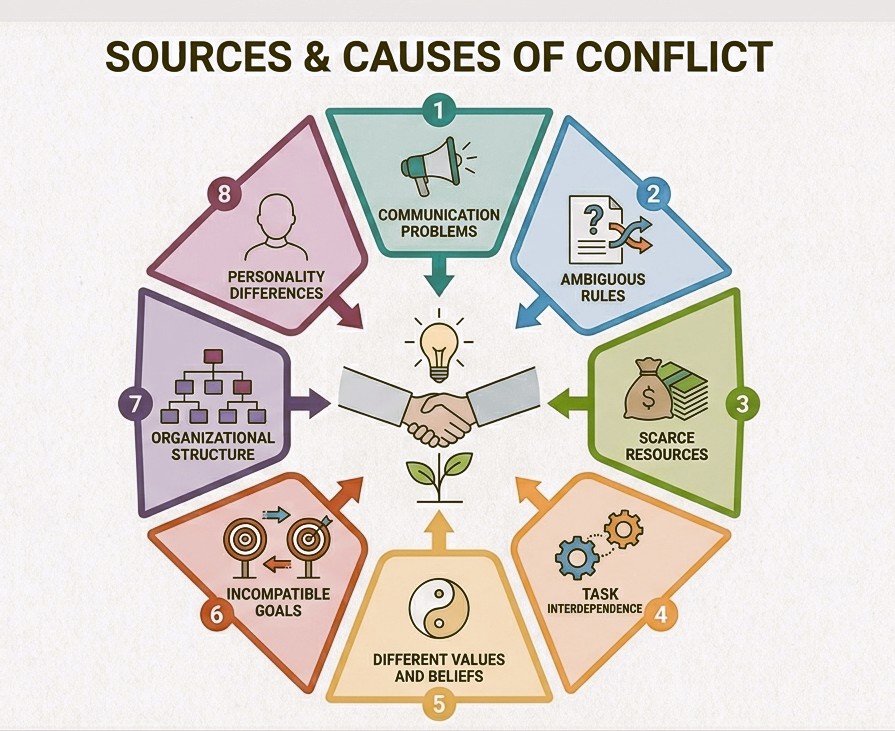
- Communication Problems : Poor or unclear communication is one of the major sources of conflict. When information is not properly shared, misunderstood, or distorted, it creates confusion among employees. Example: A manager gives instructions about a task, but different employees interpret it differently, leading to mistakes and disagreement.
- Ambiguous Rules : When rules, policies, or job responsibilities are not clearly defined, employees become confused about their duties and authority. This often leads to conflict. Example: Two supervisors give instructions to the same employee because roles are not clearly defined, causing confusion and conflict.
- Scarce Resources : When resources such as budget, manpower, time, or equipment are limited, different individuals or departments compete to get more share, leading to conflict. Example: Both housekeeping and front office departments request additional staff, but the hotel can only approve one.
- Task Interdependence : Task interdependence occurs when the work of one department depends on another. Delay or poor performance in one unit affects others, creating tension and conflict. Example: If kitchen does not prepare food on time, the F&B cannot deliver to guests timely.
- Different Values and Beliefs : People in an organization come from different backgrounds and may have different values, beliefs, or attitudes. These differences can lead to misunderstanding and conflict. Example: One employee believes in strict discipline, while another prefers a relaxed working style, leading to disagreement.
- Incompatible Goals : When different departments or individuals have conflicting goals, it creates competition and conflict between them. Example : Housekeeping focuses on quality and cleanliness, while front office focuses on fast room turnover, creating conflict between them.
- Organizational Structure : A complex or unclear organizational structure can also create conflict due to confusion in authority and reporting relationships. Example: An employee receiving instructions from two different managers.
- Personality Differences : Differences in personality, attitude, or working style can also lead to interpersonal conflict. Example: One employee is very strict and formal, while another is flexible and casual, causing friction between them.
Approaches to Conflict Management
Approaches to conflict management refer to the different ways or styles used by managers to handle conflict situations in an organization. These approaches focus on how a manager behaves or responds when conflict occurs.
- Avoiding :
Avoiding means ignoring or withdrawing from the conflict situation. The manager does not take any action to solve the conflict. This approach is used when the conflict is minor or not important.
Example: A manager ignores a small argument between employees because it does not affect work performance. - Accommodating :
Accommodating means one party gives priority to the other party’s needs and accepts their demands to maintain harmony. It is used when maintaining relationship is more important than winning the conflict.
Example: A supervisor allows an employee to change duty schedule to avoid disagreement. - Competing :
Competing means one party tries to win the conflict by using authority or power, without considering the other party’s views. It is an assertive and win–lose approach.
Example: A manager enforces a rule even if employees disagree. - Compromising :
Compromising means both parties give up something and meet at a middle point. It is a quick solution where both sides accept partial satisfaction.
Example: Two departments agree to share limited resources equally. - Collaborating :
Collaborating means both parties work together to find a solution that fully satisfies everyone. It is the best approach but takes more time and effort.
Example: Front office and housekeeping work together to improve room service without affecting quality or speed.
Concept of Organizational Stress
Stress is a natural part of organizational life, but too much stress can reduce performance, job satisfaction, and employee well-being.
| Definition: Organizational stress is a psychological and physical state of tension experienced by employees when the demands and pressures of their job exceed their ability, resources, or capacity to cope effectively within the workplace environment. Simple Definition: Organizational stress is the feeling of pressure, anxiety, or strain faced by employees due to workload, work environment, or job conditions in an organization. |
Organizational stress happens when employees feel overloaded, pressured, or unable to meet job expectations effectively. It may come from workload, deadlines, role confusion, poor communication, or workplace environment.
Causes of Organizational Stress (Work Stressors)
Stressors are the factors that create stress in employees. Organizational stress is mainly caused by various work-related factors known as work stressors. These factors create pressure on employees and affect their performance and well-being.
The stressor (or inputs of stress) comes from both inside our body & mine and outside of us. They fall into four categories. They are:
a. Individual Causes
b. Group Causes
c. Organizational Causes
d. Extra-Organizational (Environmental) Causes
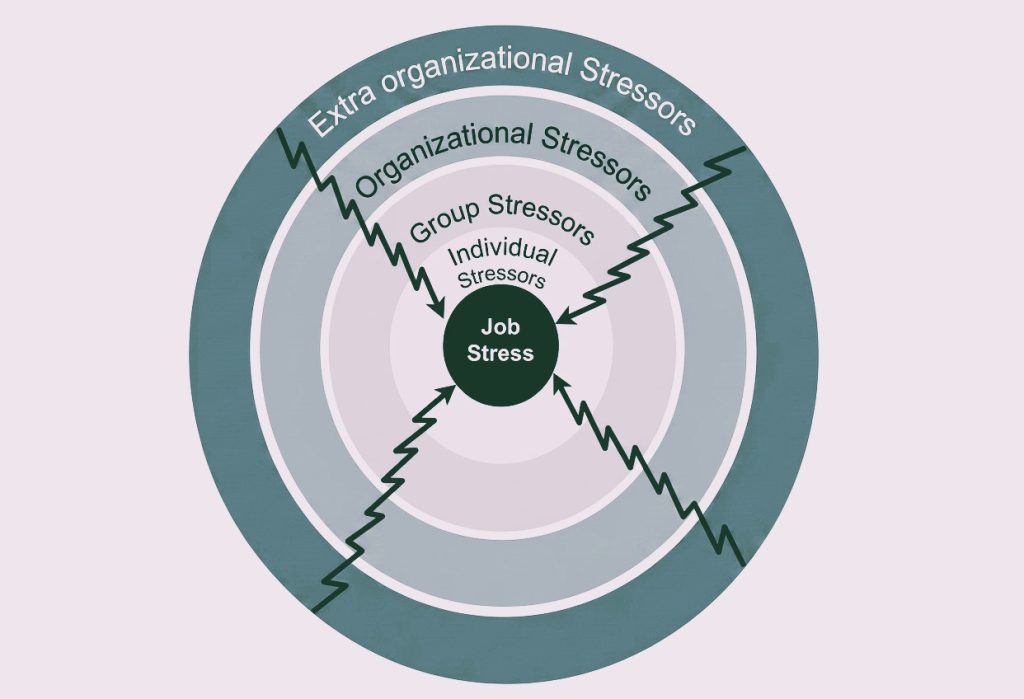
- Individual Causes / Individual Level Stressors
Individual level stressors are the stress factors that arise within a person or directly affect an individual employee, influencing how they think, feel, and perform at work. These stressors depend on personal characteristics, job roles, and changes in personal or professional life.- Role Conflict : Role conflict occurs when an employee faces conflicting expectations from different people or roles. It becomes difficult for the individual to satisfy all demands at the same time.
Example: A supervisor asks an employee to finish work quickly, while another insists on maintaining high quality. - Role Ambiguity : Role ambiguity happens when an employee is not clear about job responsibilities, duties, or expectations. This creates confusion and stress because the employee does not know exactly what is expected.
Example: A new hotel employee is unsure whether they should handle guest complaints or billing tasks. - Personality Traits (Type A and Type B) : Personality plays an important role in how stress is experienced.
- Type A Personality
a. Highly competitive, ambitious, and achievement-oriented
b. Always in hurry and time-conscious
c. Easily gets frustrated and stressed
d. More prone to job stress
For example: An employee who wants everything done quickly and becomes irritated during delays. - Type B Personality
a. Calm, relaxed, and patient
b. Less time pressure and less aggressive
c. Handles pressure more easily
c. Less likely to experience stress
For example: An employee who remains calm even during busy hotel operations.
- Type A Personality
- Life and Career Changes :
Major changes in personal life or career can create stress because individuals need to adjust to new situations.
For example:
a. Marriage or divorce
b. Promotion or demotion
c. Job transfer or new responsibilities
d. Financial problems or relocation
An employee promoted to a managerial position may feel stressed due to increased responsibility and expectations. - Personal and Behavioral Factors :
Stress can also come from personal habits, skills, and individual behavior
For example: Lack of confidence or skills, Poor time management, Health problems, Negative thinking - Perception and Attitude :
How a person interprets situations also affects stress levels. The same situation may be stressful for one person but not for another.
For example: One employee sees workload as a challenge, while another sees it as pressure.
- Role Conflict : Role conflict occurs when an employee faces conflicting expectations from different people or roles. It becomes difficult for the individual to satisfy all demands at the same time.
- Group Causes / Group Level Stressors
Group level stressors are the factors within a team or group that create stress for individuals working in that group. These stressors arise from interaction, behavior, and relationships among group members, supervisors, and teams within the organization.
People are usually members of various formal and informal groups. Groups have high level of influence on individual member’s behavior and performance.- Poor Group Cohesion :
When group members do not work together properly or lack unity, it creates stress and reduces performance. Example: In a hotel team, staff members do not support each other during busy check-in hours, causing tension and stress. - Interpersonal Conflict :
Stress arises when there are disagreements or clashes between group members due to differences in personality, opinions, or working style. Example: Two employees argue frequently about task responsibilities in the same department. - Poor Communication :
When communication within the group is unclear or incomplete, misunderstandings occur, leading to stress. Example: A team member does not receive updated instructions and makes mistakes in guest service. - Lack of Social Support :
If employees do not receive help, guidance, or emotional support from colleagues or supervisors, stress increases. Example: A new employee struggles with tasks but senior staff do not assist or guide them. - Group Pressure and Norms :
Sometimes groups create pressure to follow certain behaviors or performance standards, which can cause stress. Example: A team expects all members to work overtime, creating pressure on individuals. - Leadership Style :
An autocratic or unclear leadership style can increase stress among group members. Example: A strict supervisor constantly criticizes employees without guidance or support.
- Poor Group Cohesion :
- Organizational Causes / Organizational Level Stressors
Organizational level stressors are the stress factors that arise from the structure, policies, and working environment of an organization. These stressors affect employees as a result of how the organization is designed and managed.- Workload and Job Design :
Excessive workload or poorly designed jobs can create pressure and stress for employees. Example: A hotel employee handling too many guests during peak season with limited staff. - Role Conflict and Role Ambiguity :
Stress occurs when employees receive conflicting instructions (role conflict) or are unclear about their duties (role ambiguity). Example: One manager asks for fast service, while another demands perfect quality. - Organizational Structure :
A rigid or unclear structure can create confusion about authority and responsibility, leading to stress. Example: An employee does not know whether to report issues to the supervisor or department head. - Leadership Style :
Autocratic, unfair, or poor leadership increases stress among employees. Example: A manager who constantly criticizes employees without providing support creates tension in the workplace. - Organizational Politics :
Favouritism, power struggles, and internal politics can create a stressful work environment. Example: Promotions given based on personal connections rather than performance. - Lack of Resources : When employees do not have enough tools, staff, or facilities to complete tasks, stress increases. Example: Insufficient housekeeping staff during busy hotel seasons.
- Poor Working Conditions : Uncomfortable or unsafe working environments increase physical and mental stress. Example: Noisy, crowded, or poorly maintained work areas in a hotel kitchen.
- Workload and Job Design :
- Extra-Organizational (Environmental) Level Stressors
Extra-organizational or environmental stressors are the stress factors that originate outside the organization but still affect employees and their work performance. These stressors are not directly controlled by the organization, but they influence employee behavior, thinking, and well-being.- Economic Factors :
Changes in the economy such as inflation, recession, or financial instability can create stress for employees. Example: Rising prices and low salary increases make employees worried about meeting daily expenses. - Political and Legal Factors :
Political instability, government policies, and legal changes can create uncertainty and stress. Example: Frequent changes in labor laws or unstable political conditions affect job security and planning. - Technological Changes :
Rapid changes in technology require employees to continuously learn new skills, which can create pressure. Example: A hotel introducing a new digital booking system may stress employees who are not familiar with computers. - Family and Social Life :
Problems in family or social relationships can affect an employee’s mental state and performance at work. Example: An employee facing family conflict may feel distracted and stressed during duty hours. - Cultural and Social Expectations :
Society’s expectations, traditions, and cultural pressure can also contribute to stress. Example: Pressure to balance work life and family responsibilities in certain cultural settings. - Personal Financial Problems :
Individual financial issues outside the workplace can lead to anxiety and reduced concentration at work. Example: An employee with loan or debt worries may feel mentally disturbed at work.
- Economic Factors :
Organizational Stress Management Strategies / Approaches
Stress emerges from so many factors and conditions. Therefore, to eliminate it entirely from our lives is impossible. Organizational stress management strategies refer to the methods used by organizations to reduce stress and improve employee well-being and performance. These strategies help employees cope with work pressure and maintain a healthy work environment.
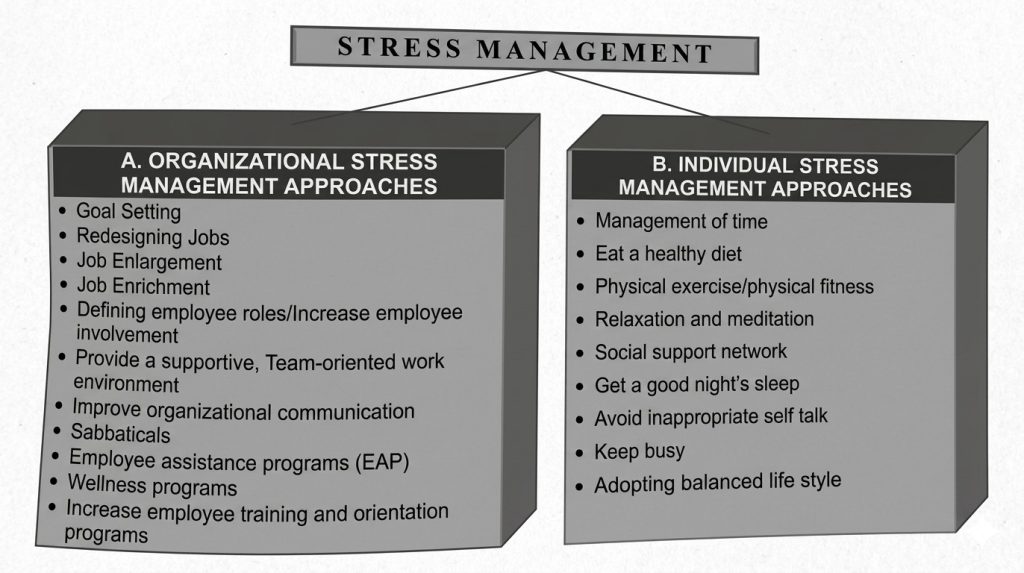
A. Organizational Stress Management Approaches
The major organizational approaches used to manage and reduce employee stress are as follows:
- Goal Setting : Goal setting means setting clear, realistic, and achievable targets for employees. When goals are unclear or too difficult, employees feel confused and stressed. Clear goals help employees understand what exactly they need to do. Example: In a hotel, setting a clear target like “clean 10 rooms per shift” reduces confusion and stress for housekeeping staff.
- Redesigning Jobs :
Job redesign means changing the structure of a job to make it less stressful and more efficient. It helps to reduce overload, confusion, and monotony.
Example: If one hotel employee is handling too many tasks (billing + complaints + check-in), the job can be redesigned into separate roles. - Job Enlargement :
Job enlargement means increasing the number of tasks in a job at the same level. It reduces boredom and makes work more interesting, which indirectly reduces stress.
Example: A receptionist is given additional tasks like handling phone calls and basic guest inquiries instead of only check-ins. - Job Enrichment :
Job enrichment means adding more responsibility, authority, and decision-making power to a job. It increases motivation and reduces stress caused by lack of control.
Example: A front desk employee is allowed to make small decisions like offering room upgrades without waiting for manager approval. - Defining Employee Roles & Increasing Employee Involvement :
Clear role definition means employees know exactly what their duties and responsibilities are. Employee involvement means including employees in decision-making processes. Both reduce confusion and improve commitment.
Example: A hotel clearly defines who handles guest complaints and also asks staff for suggestions during meetings. - Supportive and Team-Oriented Work Environment :
A supportive environment means employees help each other and managers provide guidance instead of pressure. Teamwork reduces stress and improves coordination.
Example: During peak check-in time, front office and bell desk staff help each other instead of blaming. - Improving Organizational Communication :
Clear communication reduces misunderstandings, confusion, and errors. Poor communication is a major cause of stress, so improving it helps employees feel more secure.
Example: Management clearly informs staff about duty schedules and policy changes in advance. - Sabbaticals :
Sabbaticals are long-term paid or unpaid leaves given to employees to rest and recover from work pressure. This helps employees refresh mentally and physically.
Example: A hotel manager taking a 2-month break after long years of continuous service. - Employee Assistance Programs (EAP) :
EAP provides professional counseling and support services to employees facing stress, personal problems, or emotional issues.
Example: A hotel provides counseling sessions for employees dealing with anxiety or family issues. - Wellness Programs :
Wellness programs focus on physical and mental health improvement of employees. These may include fitness activities, health checkups, yoga, and stress management training.
Example: A hotel organizes weekly yoga sessions for staff. - Training and Orientation Programs :
Training helps employees learn job skills and understand their responsibilities clearly, reducing stress caused by confusion or lack of knowledge. Orientation helps new employees adjust to the workplace easily.
Example: A new housekeeping staff member is trained on cleaning procedures before starting work.
B. Individual Stress Management Approaches
Individual stress management approaches are the techniques used by employees themselves to reduce, control, and cope with stress. These approaches help individuals maintain their physical health, mental well-being, and work performance even under pressure.
| As, “Individual Stress Management Approaches” is not in our syllabus content, it is not important but still if you want to have additional knowledge here is the explanation for you |
The major individual approaches used by employees to cope with and reduce stress are as follows:
- Time Management : Planning and organizing work properly to avoid pressure and deadlines.
- Healthy Diet : Eating nutritious food to maintain physical and mental health.
- Physical Exercise : Regular exercise helps reduce stress and keeps the body fit.
- Relaxation and Meditation : Practicing yoga, meditation, or deep breathing to calm the mind.
- Social Support Network : Getting emotional support from family, friends, and colleagues.
- Good Night’s Sleep : Taking adequate rest and sleep to refresh the body and mind.
- Avoid Inappropriate Self-Talk : Avoiding negative thoughts and maintaining a positive attitude.
- Keep Busy : Engaging in productive activities to avoid overthinking and stress.
- Adopting a Balanced Lifestyle : Maintaining a balance between work, family, rest, and recreation.