
Important Past Board Questions
- Write down the abbreviation of HRP and QWL. (1 Mark-2024)
→
HRP – Human Resource Planning
QWL – Quality of Work Life - Describe the different functions of HRM. (5 Marks-2024)
Concept of Human Resource Management (HRM)
Human Resource Management (HRM) is one of the most important functions of any organization. It focuses on managing people effectively so that organizational goals can be achieved efficiently. Employees are considered the most valuable asset of an organization because they contribute their knowledge, skills, creativity, and efforts toward organizational success.
In the hospitality industry, where service quality largely depends on employees, Human Resource Management plays an even more significant role. Hotel industry is highly labour-oriented industry. Hotels, restaurants, resorts, airlines, and other hospitality organizations rely heavily on their workforce to deliver excellent guest experiences. The success of a hospitality organization largely depends on the skills, attitudes, behavior, and performance of its workforce.
| Simple Definition: Human Resource Management (HRM) is the process of recruiting, developing, motivating, and managing employees to help achieve organizational goals effectively and efficiently. Definition: Human Resource Management (HRM) is a strategic and systematic approach to acquiring, developing, utilizing, maintaining, and retaining an organization’s human resources in order to achieve individual, organizational, and societal objectives effectively. |
Every business organization requires various resources to operate effectively and achieve its objectives. These resources include:
- Financial Resources (money and capital)
- Physical Resources (buildings, machinery, equipment, furniture, etc.)
- Material Resources (raw materials, supplies, and inventories)
- Technological Resources (technology, software, information systems)
- Information Resources (data and knowledge)
- Human Resources (employees and workforce)
Among all these resources, human resources are considered the most valuable and dynamic resource because all other resources are managed, controlled, and utilized by people. Without human resources, other resources cannot be used effectively.
Definitions of Human Resource Management according to popular scholars:
- Edwin B. Flippo – Human Resource Management is the planning, organizing, directing and controlling of the procurement, development, compensation, integration, maintenance and separation of human resources to the end that individual, organizational and societal objectives are accomplished.
- Gary Dessler – Human Resource Management refers to the policies and practices involved in carrying out the people or human resource aspects of a management position.
Characteristics of Human Resource Management (HRM)
Human Resource Management is different from other management functions because it deals directly with people. It focuses on utilizing employees’ knowledge, skills, and abilities to achieve organizational goals while also satisfying their personal and professional needs. The following are the major characteristics of HRM.
- People-Oriented Function :
HRM is primarily concerned with managing people rather than machines, money, or materials. It focuses on employees’ needs, behavior, performance, and development.
Example: In a hotel, HR managers ensure that front office staff, housekeeping employees, and F&B personnel are properly managed and supported. - Pervasive Function :
HRM exists at all levels of management, including top-level, middle-level, and lower-level management. Every manager performs some HR-related activities such as supervising, motivating, and evaluating employees.
Example: A housekeeping supervisor manages room attendants, while a hotel general manager manages department heads.
| Pervasive को मतलव → सबैतिर फैलिएको |
- Continuous Process :
Human Resource Management is an ongoing process. It begins with employee recruitment and continues through training, performance evaluation, promotion, compensation, and retirement or separation.
Example: Hotels continuously recruit, train, and develop employees to maintain service quality. - Goal-Oriented Function :
HRM aims to achieve organizational goals by ensuring that employees perform effectively and efficiently. It aligns employee efforts with organizational objectives.
Example: Hotel employees work together to improve guest satisfaction, occupancy rates, and profitability. - Development-Oriented :
HRM emphasizes the growth and development of employees through training, education, coaching, and career advancement opportunities.
Example: Hotels provide training programs on guest handling, communication skills, and service standards. - Strategic Function :
HRM is closely linked with the overall strategy of the organization. Human resource policies are designed to support long-term organizational goals.
Example: A luxury hotel may recruit highly skilled employees to maintain premium service standards and brand reputation. - Individual and Organizational Integration :
HRM seeks to balance the interests of employees and the organization. It tries to ensure that organizational goals and employee goals support each other.
Example: Providing promotion opportunities helps employees achieve career growth while helping the hotel retain talented staff. - Action-Oriented Function :
HRM focuses on taking practical actions rather than merely developing policies. It emphasizes solving employee-related issues and improving performance.
Example: If employee turnover increases, HR managers implement retention strategies rather than simply discussing the problem.
| Employee turnover को मतलव → organizationमा new employee आउने र जाने / काम छोडेर जाने process हो। |
- Comprehensive Function :
HRM covers a wide range of activities such as manpower planning, recruitment, selection, training, compensation, performance appraisal, employee welfare, and labor relations.
Example: The HR department in a hotel handles everything from hiring new staff to managing employee benefits.
| Comprehensive को मतलव → detailed For example: BhmAims को note Comprehensive हुन्छ को मतलव → complete and detailed हुन्छ |
- Dynamic Function :
HRM adapts to changes in the internal and external environment, such as technological advancements, labor market conditions, customer expectations, and legal requirements.
Example: Hotels now train employees to use digital reservation systems and online guest service platforms.
| Time, Situation र Environment अनुसार change भइरहने कुरालाई dynamic function भनिन्छ |
- Team-Based Approach :
HRM encourages teamwork, cooperation, and coordination among employees to achieve organizational objectives.
Example: Front office, housekeeping, and F&B departments must work together to provide seamless guest service. - Humanistic Approach :
HRM treats employees as valuable assets rather than merely factors of production. It emphasizes dignity, respect, motivation, and employee well-being.
Example: Hotels provide safe working conditions, employee recognition programs, and welfare facilities to improve employee satisfaction. - HRM Functions are not Confined to Business Establishments Only
HRM is often associated with business organizations like hotels, banks, factories, and companies. However, HRM functions are not limited only to profit-making organizations. They are equally important and applicable in non-business (non-profit or service) organizations such as education, health care, government institutions, recreation centers, NGOs, and other social organizations.
Objectives of Human Resource Management (HRM)
The main objectives of HRM can be explained as follows:
- To Achieve Organizational Goals
One of the primary objectives of HRM is to help the organization achieve its overall goals such as profit, growth, service quality, and market reputation by effectively utilizing human resources. - To Ensure Optimum Utilization of Human Resources
HRM aims to make the best use of employees’ skills, knowledge, and abilities so that no talent is wasted and productivity is maximized. - To Recruit and Retain the Right People
HRM focuses on attracting qualified, skilled, and suitable candidates for the right job and retaining them for a long time through motivation and good working conditions. - To Develop Employee Skills and Competencies
Another important objective is to improve employee performance through training, development programs, and continuous learning opportunities. - To Ensure Employee Satisfaction and Motivation
HRM works to keep employees satisfied and motivated through fair compensation, recognition, promotion, and a positive work environment. - To Maintain Healthy Employee Relations
HRM aims to create a good working relationship between management and employees to avoid conflicts and promote cooperation. - To Improve Productivity and Efficiency
HRM focuses on increasing overall productivity by improving employee performance, reducing absenteeism, and ensuring proper resource utilization. - To Ensure Fair Compensation and Welfare
HRM ensures that employees are paid fairly and provided with welfare facilities such as safety, health benefits, and job security. - To Promote Organizational Stability
By reducing employee turnover and maintaining a stable workforce, HRM contributes to long-term organizational success. - To Adapt to Environmental Changes
HRM helps organizations adjust to changes in technology, customer expectations, labor laws, and market conditions. Example: Hotels adopting digital booking systems require HRM to train employees accordingly
Functions (Components) of Human Resource Management (HRM)
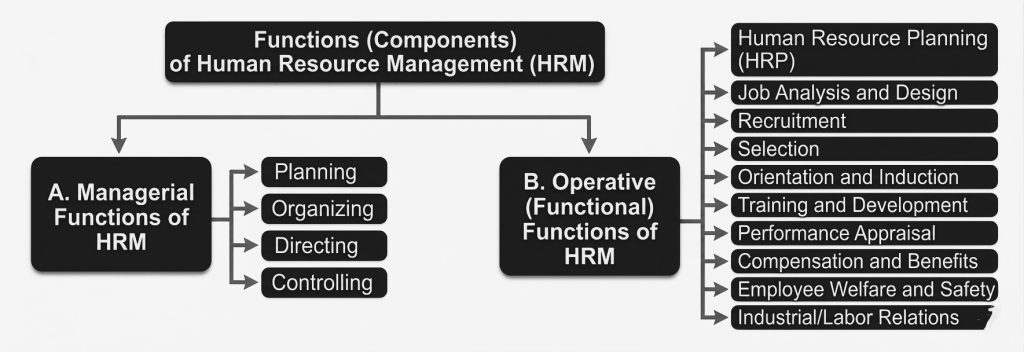
The functions of HRM are generally divided into two major categories:
- Managerial Functions
- Operative (Functional) Functions
A. Managerial Functions of HRM
Managerial functions of HRM refer to the basic management activities that are applied to human resources in an organization. These functions are similar to general management functions but are specifically focused on managing employees effectively. They help in planning, organizing, guiding, and controlling human resources so that organizational goals can be achieved smoothly.
- Planning :
Planning is the first and most important managerial function of HRM. It involves determining in advance the future human resource needs of the organization and preparing strategies to meet those needs.
It includes deciding how many employees are required, what skills are needed, and when they are needed.
For example : A hotel forecasts that during the peak season, it will need extra housekeeping and front office staff and plans recruitment accordingly. - Organizing :
Organizing means arranging human resources in a systematic way so that work can be performed efficiently. It involves assigning jobs, defining roles, and creating a structure of authority and responsibility.
It helps to ensure that the right person is placed in the right job. - Directing :
Directing involves guiding, leading, motivating, and supervising employees to ensure that they perform their tasks effectively. It is concerned with giving instructions and influencing employee behavior toward achieving goals.
This function also includes communication, leadership, and motivation. In simple way: Directing means guiding employees to do their work properly. - Controlling :
Controlling is the process of monitoring employee performance and comparing it with planned standards. If there is any deviation, corrective actions are taken to improve performance.
It ensures that organizational goals are achieved efficiently.
Managerial functions of HRM provide the foundation for effective human resource management. They ensure that employees are properly planned, organized, guided, and controlled to achieve organizational success.
B. Operative (Functional) Functions of HRM
Operative or functional functions of HRM are the core activities directly related to managing employees in an organization. These functions focus on acquiring employees, developing their skills, motivating them, maintaining good relationships, and managing their exit from the organization.
- Human Resource Planning (HRP) :
Human Resource Planning is the process of forecasting the future demand and supply of human resources in the organization. It ensures that the right number of employees with the right skills are available at the right time. - Recruitment
Recruitment is the process of attracting suitable candidates for job vacancies in the organization. It creates a pool of qualified applicants.
In simple way, It means finding people for the job. - Selection
Selection is the process of choosing the most suitable candidate from the available applicants. It involves interviews, tests, and evaluations.
In simple terms: It means choosing the best candidate. - Training and Development
Training and development focus on improving employee skills, knowledge, and performance so they can perform their jobs effectively and grow in their careers. In simple terms: It means improving employee skills. - Performance Appraisal
Performance appraisal is the process of evaluating employee performance based on set standards and providing feedback for improvement. In simple terms: It means checking how well employees are performing. - Employee and Labor Relations
Employee relations involve maintaining a healthy and positive relationship between employees and management to ensure smooth operations. In simple terms: It means keeping good relationships at work. - Employee Welfare and Safety
This function focuses on providing safe working conditions, health facilities, and welfare services to employees. In simple terms: It means taking care of employee well-being. - Promotion, Transfer, and Separation
This function deals with employee movement within or outside the organization.- Promotion: Moving to a higher position
- Transfer: Moving to another department or location
- Separation: Leaving the organization (resignation, retirement, termination)
Human Resource Outcomes
Human Resource Outcomes refer to the direct results and effects of Human Resource Management (HRM) practices on employees and the organization. These outcomes show how HR activities such as recruitment, selection, training, compensation, and employee relations influence employee behavior, attitudes, performance, and overall organizational success.
| Definition: Human Resource Outcomes are the tangible and intangible results obtained from effective HRM practices. |
These outcomes reflect how employees think, feel, behave, and perform at work, and how these factors contribute to organizational effectiveness.
They can be seen both at:
- Employee level (attitudes, behavior, well-being)
- Organizational level (productivity, quality, change readiness, etc.)
Major Human Resource Outcomes
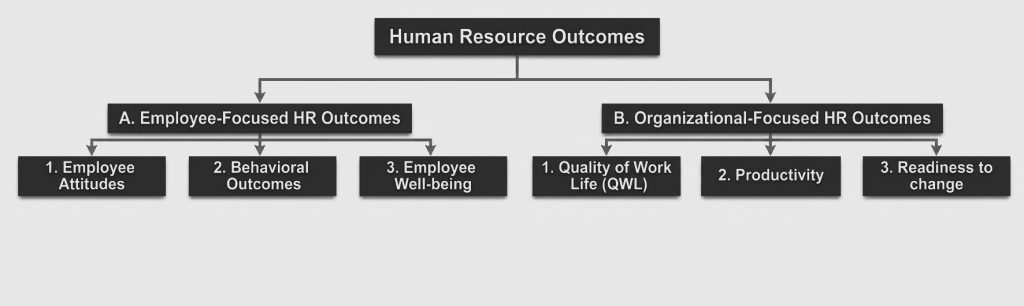
Human Resource Outcomes can be broadly grouped into:
- Employee-focused model
- Organizational performance outcomes (HR system model)
A. Employee-Focused HR Outcomes
Employee-focused Human Resource Outcomes refer to the results of HRM practices that directly affect employees at the individual level. These outcomes show how employees think, feel, behave, and experience their work environment after HR policies such as recruitment, training, motivation, compensation, and welfare are implemented.
It includes:
- Employee Attitudes :
Employee attitudes refer to the mental state, feelings, and perceptions of employees toward their job, work environment, and organization. It reflects how employees “feel” about their workplace.
These attitudes are shaped by HR practices such as leadership style, compensation, recognition, promotion opportunities, and working conditions.
Employee attitudes mainly include:
a. Job Satisfaction – how happy employees are with their job
b. Work Motivation – willingness to perform tasks effectively
c. Organizational Commitment – loyalty and emotional attachment to the organization
d. Trust in Management – confidence in leadership and decisions
Positive employee attitudes lead to better teamwork and cooperation, lower absenteeism and turnover, higher service quality and strong organizational culture while negative attitudes, on the other hand, lead to poor performance, conflicts, and dissatisfaction in the organization.
- Behavioral Outcomes
Behavioral outcomes refer to the actual actions and performance of employees at the workplace, which are influenced by their attitudes and motivation levels. In simple way, it is what employees do in real work situations.
Behavioral outcomes include:
a. Productivity – efficiency in completing tasks
b. Attendance and Punctuality – regular presence at work
c. Employee Turnover – rate at which employees leave the organization
d. Extra-Role Behavior (Organizational Citizenship Behavior) – voluntary efforts beyond job description
e. Teamwork and Cooperation – helping colleagues and departments
Strong behavioral outcomes result in smooth operations, better service delivery, reduced operational problems and strong coordination between departments, while poor behavioral outcomes lead to delays, conflicts, and service failure.
- Employee Well-being :
Employee well-being refers to the overall physical, mental, and social health of employees in the workplace. It focuses on how comfortable, safe, and stress-free employees feel while performing their job. It is one of the most human-centered outcomes of HRM.
Employee well-being includes:
a. Physical Well-being – safety, health, and working conditions
b. Psychological Well- being – stress levels, mental peace, job pressure
c. Social Well-being – relationships with colleagues and supervisors
d. Work-Life Balance – balance between personal life and job responsibilities
Good employee well-being leads to higher productivity, better job satisfaction, lower stress and burnout, reduced absenteeism and long-term employee retention while, Poor well-being leads to stress, health issues, and high turnover.
B. Organizational-Focused Human Resource Outcomes
Organizational-focused Human Resource Outcomes refer to the results of HRM practices that reflect the overall performance and effectiveness of the organization. Unlike employee-focused outcomes (which deal with feelings and behavior), these outcomes show how HRM contributes to organizational success, efficiency, adaptability, and work environment quality.
- Quality of Work Life (QWL) :
Quality of Work Life (QWL) refers to the overall quality of an employee’s experience at work, including working conditions, job satisfaction, work-life balance, and organizational support.
It focuses on making the workplace comfortable, fair, and supportive so that employees can perform their best.
QWL includes:- Safe and healthy working environment
- Fair wages and benefits
- Job security
- Work-life balance
- Employee participation in decision-making
- Good relationship with management
- Opportunities for growth and development
Good QWL leads to:
- Higher employee satisfaction
- Lower turnover rate
- Better motivation and loyalty
- Improved productivity
- Positive organizational culture
Poor QWL results in stress, dissatisfaction, and employee exit.
- Productivity
Productivity refers to the efficiency with which employees use resources such as time, skills, and effort to produce desired outputs (services or results). In HRM, productivity measures how effectively employees contribute to organizational performance.
Factors Affecting Productivity
Productivity depends on:- Employee skills and training
- Motivation and job satisfaction
- Working conditions
- Technology and tools
- Leadership and supervision
- Compensation and rewards
High productivity leads to increased profitability, better service quality, efficient use of resources and competitive advantage in the market for the organization where, on the other hand, Low productivity leads to delays, poor service, and loss of customers.
- Readiness to change:
Readiness to change refers to the degree to which employees are willing, prepared, and able to accept and adapt to changes in the organization.
Low readiness leads to resistance, conflicts, and failure of change programs, where, on the other hand, High readiness to change helps organizations to:- Implement new technologies easily
- Adapt to market trends
- Improve efficiency and innovation
- Reduce resistance from employees
Contemporary challenges (Issues) of Human Resource Management for Hospitality Industry
Human Resource Management in the hospitality industry faces many modern challenges due to changing workforce expectations, globalization, technological advancement, and the service-intensive nature of the industry. Since hospitality depends heavily on human interaction and service quality, managing employees effectively has become more complex than ever.
The major contemporary challenges / issues of human resource management (HRM) for hospitality industry are:
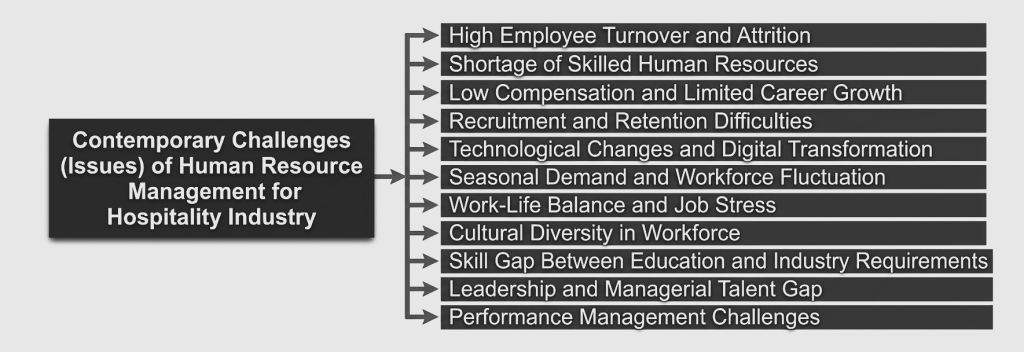
- High Employee Turnover and Attrition
The hospitality industry experiences very high employee turnover, where employees frequently leave jobs.
Causes:- Long and irregular working hours
- Weekend and holiday duties
- Physically and emotionally demanding work
- Limited job security in some cases
The impact of this issue is quite serious for organizations. Frequent employee exits increase recruitment and training costs and reduce organizational efficiency. It also leads to a loss of experienced staff, which affects service consistency and ultimately reduces guest satisfaction.
- Shortage of Skilled Human Resources
The hospitality industry often struggles with a shortage of skilled and trained employees. One of the main causes is the gap between academic education and practical industry requirements. Many graduates enter the workforce with theoretical knowledge but lack essential practical skills such as communication, problem-solving, and guest handling. Additionally, the industry is sometimes perceived as offering limited career prospects, which discourages talented individuals from joining.
As a result, organizations find it difficult to maintain service quality standards. Existing employees are often overburdened, and additional training is required for new recruits, which slows down operational efficiency. - Low Compensation and Limited Career Growth
Low salary structures and slow career progression are another key challenge in the hospitality industry. In many cases, entry-level employees are not compensated in proportion to the workload and working hours they handle. At the same time, career advancement opportunities may take time, which reduces employee motivation and engagement.
This leads to dissatisfaction among employees, increasing the likelihood of job switching. As a result, organizations face high turnover rates and struggle to attract and retain competent staff. - Recruitment and Retention Difficulties
Recruitment and retention of qualified employees is a continuous challenge in hospitality HRM. This is mainly because many potential candidates perceive hospitality jobs as stressful, demanding, and less rewarding compared to other sectors. Moreover, employees often leave organizations in search of better pay, improved working conditions, or faster career growth.
This creates instability in the workforce and forces organizations to repeatedly invest time and resources in hiring and training new employees, which affects long-term operational stability. - Technological Changes and Digital Transformation
The rapid introduction of technology in hospitality, such as AI-based services, online booking systems, and property management software, has significantly changed the nature of work. While these technologies improve efficiency, they also require employees to continuously upgrade their skills. However, not all employees are comfortable with these changes, and some may resist adapting to new systems due to lack of training or confidence.
This creates pressure on HR departments to provide continuous learning and development programs to ensure employees remain technologically competent and adaptable. - Seasonal Demand and Workforce Fluctuation
The hospitality industry experiences seasonal fluctuations in demand, especially in tourist destinations where peak and off-seasons vary significantly. During peak seasons, organizations require additional staff to manage increased guest flow, while in off-seasons, the demand for manpower decreases.
This irregular pattern creates challenges in maintaining a stable workforce throughout the year. It also results in temporary employment, job insecurity, and imbalance in employee workload, which affects motivation and retention. - Work-Life Balance and Job Stress
Employees in the hospitality industry often face poor work-life balance due to shift duties, long working hours, and continuous guest pressure. The nature of service jobs requires employees to be available during weekends, holidays, and peak business hours, which increases physical and mental stress.
Over time, this leads to burnout, reduced job satisfaction, and health issues. Consequently, organizations experience higher absenteeism and employee turnover, affecting overall service performance. - Cultural Diversity in Workforce
Hospitality organizations employ people from diverse cultural, linguistic, and social backgrounds. While this diversity adds value to the workplace, it also creates challenges in communication, coordination, and teamwork. Differences in working styles and cultural expectations may sometimes lead to misunderstandings among employees.
Therefore, HR managers need to promote inclusive policies and provide proper orientation and training to ensure smooth cooperation among staff. - Skill Gap Between Education and Industry Requirements
There is often a noticeable gap between what is taught in educational institutions and what is required in the hospitality industry. Most academic programs focus heavily on theory, while the industry demands practical skills such as guest handling, crisis management, and real-time decision-making.
As a result, fresh graduates require additional training before becoming fully productive, which increases the burden on HR departments and slows down initial performance. - Leadership and Managerial Talent Gap
While operational staff shortages are common, many organizations also face a lack of strong mid-level and senior managers. Developing leadership talent internally takes time, and external hiring can be costly.
This creates gaps in decision-making, supervision quality, and long-term strategic planning within hospitality organizations. - Performance Management Challenges
Measuring employee performance in hospitality is not always straightforward because service quality is often subjective and influenced by guest behavior. HR managers sometimes struggle to design fair and consistent appraisal systems.
If performance evaluation is perceived as unfair, it can lead to dissatisfaction, conflict, and reduced motivation among employees.